

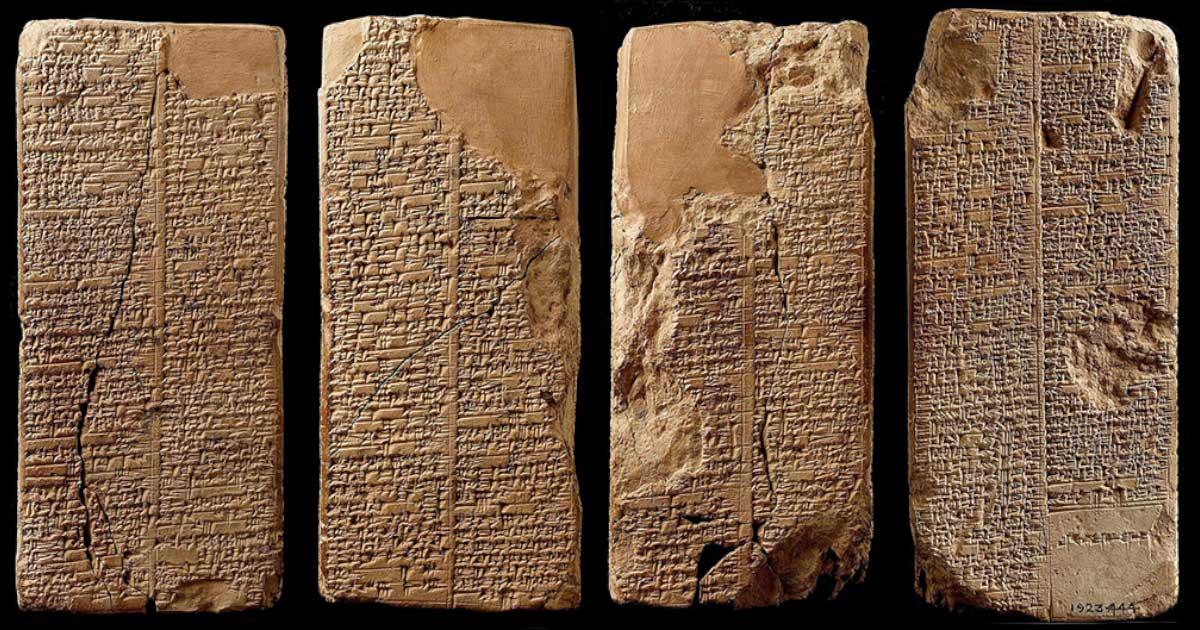

Out of the many incredible artifacts that have been recovered from sites in Iraq where flourishing Sumerian cities once stood, few have been more intriguing than the Sumerian King List. An ancient manuscript originally recorded in the Sumerian language, the Sumerian King List is a register of the kings of Sumer (ancient southern Iraq) from Sumerian and neighboring dynasties.
The list includes their names, supposed reign lengths, and the locations of “official” kingship. What makes the Sumerian King List so unique is the fact that it blends apparently mythical pre-dynastic rulers with historical rulers who are known to have existed in real life.
- Translating Archaic Sumerian Cuneiform: Pinpointing Eden, or Kharsag, Garden of the Gods
- The Kesh Temple Hymn: 4,600-Year-Old Sumerian Hymn Praises Enlil, Ruler of Gods
The first fragment of this rare and unique text, a 4,000-year-old cuneiform tablet, was found in the early 1900s by German-American scholar Hermann Hilprecht at the site of ancient Nippur and his results were published in 1906. Since Hilprecht’s discovery, at least 18 other exemplars of the king’s list have been found, most of them dating from the second half of the Isin Dynasty (c. 2017 to 1794 BC).
No two of these documents are identical. However, there is enough common material in all versions of the Sumerian King List to make it clear that they are derived from a single, “ideal” account of Sumerian history.
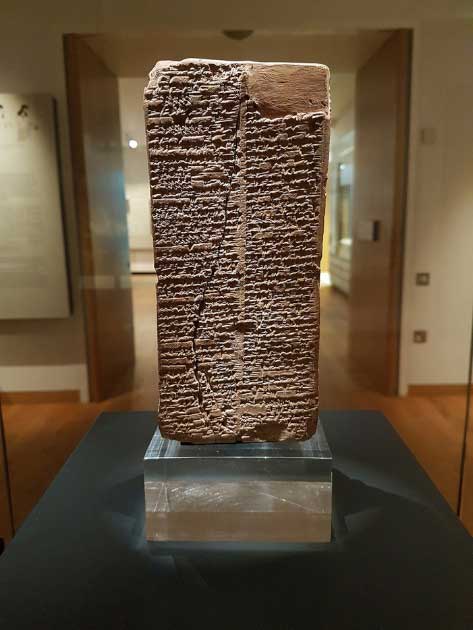
The Weld-Blundell Prism. (Ashmolean Museum / CC BY-SA 4.0)
The Weld-Blundell Prism
Among all the examples of the Sumerian King List, the Weld-Blundell prism in the Ashmolean Museum cuneiform collection in Oxford represents the most extensive version, as well as the most complete copy of the Sumerian King List. The 8-inch-high (20.32 cm) prism contains four sides with two columns on each side.
It is believed that the Weld-Blundell prism originally had a wooden spindle going through its center so that it could be rotated and read on all four sides. It lists rulers from the antediluvian (“before the flood”) dynasties to the fourteenth ruler of the Isin Dynasty (ca. 1763 to 1753 BC).
The list is of immense value because it reflects very old traditions while at the same time providing an important chronological framework relating to the different periods of kingship in Sumeria. It even demonstrates remarkable parallels to accounts in Genesis.
The Ancient Civilization of Sumer
Sumer (sometimes called Sumeria), is the site of the earliest known civilization, located in the southernmost part of Mesopotamia between the Tigris and the Euphrates rivers, in the area that later became Babylonia and is now southern Iraq from around Baghdad to the Persian Gulf.
By the 3rd millennium BC, Sumer was the site of at least twelve separate city states, including Kish, Erech, Ur, Sippar, Akshak, Larak, Nippur, Adab, Umma, Lagash, Bad-tibira and Larsa. Each of these states comprised a walled city and its surrounding villages and land. Each city state worshiped its own deity, whose temple was the central structure of the city.
Political power originally belonged to the citizens, but, as rivalry between the various city states increased, each adopted the institution of kingship. The Sumerian King List records that eight kings reigned before a Great Flood. Afterwards, the list claims that various city-states and their dynasties of kings temporarily gained power over the others.
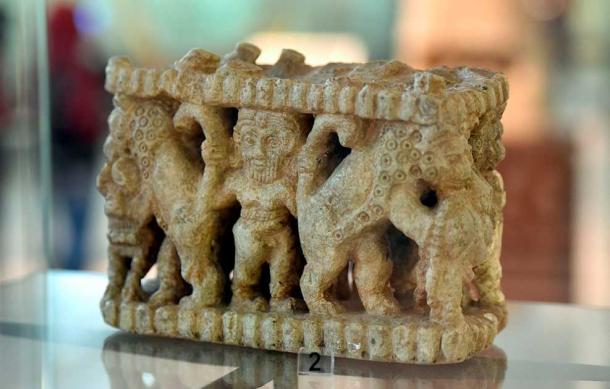
Sculptured vase depicting Gilgamesh wrestling two bulls from the Shara temple at Tell Agrab, Diyala Region, Iraq. Gilgamesh was included in the Sumerian King List. (Osama Shukir Muhammed Amin / CC BY-SA 4.0)
Sumer’s Mythical Past: Mythical Figures in the Sumerian King List
The Sumerian King List begins with the very origin of kingship, which is seen as a divine institution: “the kingship had descended from heaven.” The rulers in the earliest dynasties are represented as reigning fantastically long periods:
After the kingship descended from heaven, the kingship was in Eridug. In Eridug, Alulim became king; he ruled for 28800 years. Alaljar ruled for 36000 years. 2 kings; they ruled for 64800 years.
Some of the rulers mentioned in the early list, such as Etana, Lugal-banda and Gilgamesh, are mythical or legendary figures whose heroic feats are subjects of a series of Sumerian and Babylonian narrative compositions.
The early list names eight kings with a total of 241,200 years from the time when kingship “descended from heaven” to the time when “the Flood” swept over the land and once more “the kingship was lowered from heaven” after the Flood.
Interpretation of the Long Tenures of Early Kings
The amazingly long tenure of the early kings has provoked many attempts at interpretation. At one extreme is the complete dismissal of the astronomically large figures as “completely artificial” and the view that they are unworthy of serious consideration. At the other extreme, is the belief that the numbers have a basis in reality and that the early kings were indeed gods who were capable of living much longer than humans.
In between the two extremes is the hypothesis that the figures represent relative power, triumph or importance. For example, in ancient Egypt, the phrase “he died aged 110” referred to someone who lived life to the full and who offered an important contribution to society.
In the same way, the extremely reigns of the early kings may represent how incredibly important they were perceived as being in the eyes of the people. This doesn’t explain, however, why the periods of tenure later switched to realistic time periods.
Related to this perspective is the belief that although the early kings are historically unattested, this does not preclude their possible correspondence with historical rulers who were later mythicized. Some scholars, such as Harrison, have even sought to explain the figures through mathematical investigation and interpretation.
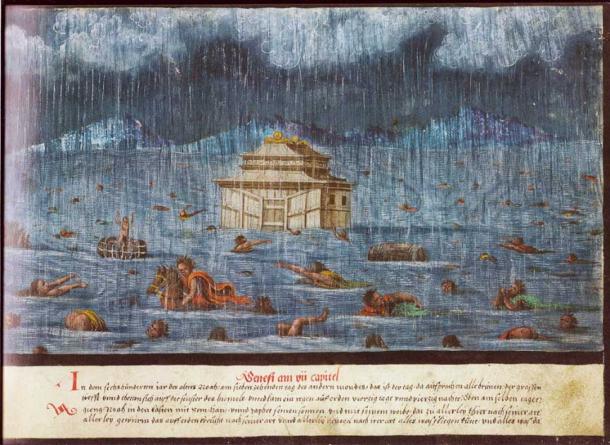
Painting of the Great Flood as told in Genesis. Augsburger Wunderzeichenbuch, Folio 1 (Genesis 7, 11-14). (Public domain)
The Sumerian King List and its Relation to Genesis
Some scholars (e.g. Bryant G. Wood, 2003) have drawn attention to the fact that there are remarkable similarities between the Sumerian King List and accounts in Genesis. For example, Genesis tells the story of ‘the great flood’ and Noah’s efforts to save all the species of animals on Earth from destruction. Likewise, in the Sumerian King List there is discussion of a great deluge, where the text states that “the flood swept over the earth.”
The Sumerian King List provides a list of eight kings (some versions have 10) who reigned for long periods of time before the flood, ranging from 18,600 to 43,200 years. This is similar to Genesis 5, where the generations from Creation to the Flood are recorded. Interestingly, between Adam and Noah there are eight generations, just as there are eight kings between the beginning of kingship and the flood in the Sumerian King List.
- Ancient Babylonian Reborn After Having Been Silenced for 2000 Years
- The Code of Ur-Nammu: When Ancient Sumerians Laid Down the Law, Everyone Obeyed
After the flood, the King List records kings who ruled for much shorter periods of time. Thus, the Sumerian King List not only documents a great flood early in man’s history, but it also reflects the same pattern of decreasing longevity as found in the Bible - men had extremely long life spans before the flood and much shorter life spans following the flood.
The Sumerian King List truly is a perplexing mystery. Why would the Sumerians combine mythical rulers with actual historical rulers in one document? Why are there so many similarities with Genesis? Why were ancient kings described as ruling for thousands of years? These are just some of the questions that still remain unanswered after more than a century of research.
Top image: Weld-Blundell Prism, a clay cuneiform inscribed with the Sumerian Kings List. Source: Public domain
By Joanna Gillan
References
Geerts, L. C. No date. “The Sumerian King List” in Biblioteca Pleyades. Available at: https://www.bibliotecapleyades.net/sitchin/king_list.htm
Harrison, R. K. 1993. “Reinvestigating the Antediluvian Sumerian King List” in JETS 36/I. Available at: https://www.etsjets.org/files/JETS-PDFs/36/36-1/JETS_36-1_003-008_Harrison.pdf
Jacobsen, T. 1939. The Sumerian King List. The Oriental Institute of the University of Chicago. The University of Chicago Press. Available at: http://oi.uchicago.edu/pdf/as11.pdf
No name. No date. “The Sumerian King List (SKL)” in A Library of Knowledge of the Cuneiform Digital Library Initiative. Available at: https://cdli.ox.ac.uk/wiki/doku.php?id=the_sumerian_king_list_skl
No name. No date. “The Sumerian king list: translation” in The Electronic Text Corpus of Sumerian Literature. Available at: https://etcsl.orinst.ox.ac.uk/section2/tr211.htm
Wood, B. G. 2003. “Great Discoveries in Biblical Archaeology: The Sumerian King List” in Bible and Space Journal. Available at: https://www.galaxie.com/article/bspade16-4-04



















Comments
Modern Western Thought Processes
Permalink
20th and 21st century so called specialists in history and archeology are incredibility stupid and short sighted. We DO NOT KNOW how long humans REALLY existed in the past. All of their preconceived notions are based on Darwin whose theories are assumed to be correct for because some scientist says so. Or biased histories written by the greeks when these civilizations were already ancient even to them. Egypt and Sumeria are far older then the conventional wisdom allows for and so modern man can't even allow for a past that doesn't fit into their modern paradigms. Maybe early kings did rule for ten of thousand of years, How do we know they didnt? WE DON'T.
Long lived people
Permalink
In reply to lost in translation by Peter Harrap
The simplest explanation is numbers inflation, and kings conflation. Inflation: size of armies, pls divide by 10, 100 even 1000. Same with years. Then you have conflation: whole dynasties going by the name of the founder, such as Beit-David, all the kings of Judah subsequent to David.
Then you have another problem: when did the whole experiment with civilization actually start? And why/how?
Myth may have some answers, and I like David Rohl's imaginative attempt to tell that story.
Will we ever know? I doubt it.
Be well.
lost in translation
Permalink
The Rosetta stone was used to translate heirogyphs as a part of it is in greek and we can read it. Unfortunately the people who decided that what Champollion did was OK made an enormous assumption: they assumed that the heiroglphic content was the same as the written demotic Egyptian, and the Greek. These last were everyday languages and the heiroglyphs were the secret sacred language of the priests.
Hmmm, you have a priestly caste separate from and ruling over the locals, maintaining their power and prestige by ensuring they, and they only understand their language, and can read their writings.
There are still codes everywhere reported on this site, entire books nobody understands. I do not think we can read heiroglyphs accurately, and there are discrepancies and anachronisms in the Egyptian Kings Lists we have never figured out.
I believe frankly that the same thing has happened here and that mis-translation and/or a confusion in the definition of units has everybody falling over themselves about the impossibly long reigns of any number of pre-Flood monarchs.
The argument that they were Gods is unreliable as Gods do not have an age or a birthday! They are immortal and eternal. They do not die. Like the Angels.
Humans worshipped as Gods are nevertheless mortal and die, and they have birthdays, but they do not live for 28,000 and 36,000, and 18,000 years etc.
To suggest it is unwise, as nobody on earth has even been credited in modern times with a life longer than 147 years, and that was a man in Georgia who had no birth record at all.
Are the units wrong, and are they days, or hours, or do the numbers refer to something else entirely, or has somebody who imagines they can read the language made a few easy to do, simple, human mistakes.?
The most plausible
Permalink
The most plausible explanation would seem to be some sort of change in the units used to measure time. If they were counting days, the longest reign would have been about a century. If we use the 3,600 year increment the longest reign during the purported antediluvian era would be a little over a decade. Some of the earliest calendar systems used 360 days per year - one digit off from this unit. I can't believe that this is coincidental; Nibiru is really not necessary for explaining this.