
Fact Check verdict:
Gunung Padang is a megalithic site of five stone terraces on a hilltop in Cianjur, West Java, described by Dutch scholars more than a century ago: Established
Charcoal found beneath terrace retaining walls dates to around 117 BC and 50 BC: Established
The 2023 pyramid paper was retracted on March 18, 2024: Established
Gunung Padang is a pyramid built 20,000 to 27,000 years ago: Unverified
Large chambers lie inside the hill: Unverified
An advanced Ice Age civilization, later wiped out, built the site: Unverified
The verdict
Indonesian geologists sent a quiet hilltop in West Java around the world in October 2023, with a paper arguing that Gunung Padang is a pyramid whose oldest layers were shaped 20,000 to 27,000 years ago. Could a pyramid that old really stand in Java? Verdict: Unverified.
According to the retraction notice issued by the journal Archaeological Prospection on March 18, 2024, the paper dated soil that could not be tied to anything human-made, and its pyramid reading is "incorrect". The stone terraces on the summit are real, and the excavated evidence puts them at roughly 2,000 years old.
- Established: Gunung Padang is a megalithic site of five stone terraces on a hilltop in Cianjur, West Java, described by Dutch scholars more than a century ago. Reason: Archaeology magazine and the 2023 paper itself both describe the terraces, and both cite early Dutch accounts.
- Established: Charcoal found beneath terrace retaining walls dates to around 117 BC and 50 BC. Reason: Lutfi Yondri's excavations recovered it, as reported by Archaeology magazine, which points to construction about 2,000 years ago.
- Established: The 2023 pyramid paper was retracted on March 18, 2024. Reason: the notice says its radiocarbon dates came from soil with no link to artifacts or features that could be reliably read as human-made.
- Unverified: Gunung Padang is a pyramid built 20,000 to 27,000 years ago. Reason: the only dates for that age come from organic soil, the journal called the pyramid interpretation incorrect, and no artifact of that age has been published.
- Unverified: Large chambers lie inside the hill. Reason: the paper inferred cavities from geophysical readings and water loss during drilling, and no chamber has been excavated or entered.
- Unverified: An advanced Ice Age civilization, later wiped out, built the site. Reason: no archaeological evidence from Java supports it, and the people of the region at that time were hunter-gatherers who left no large stone structures.
What the evidence says
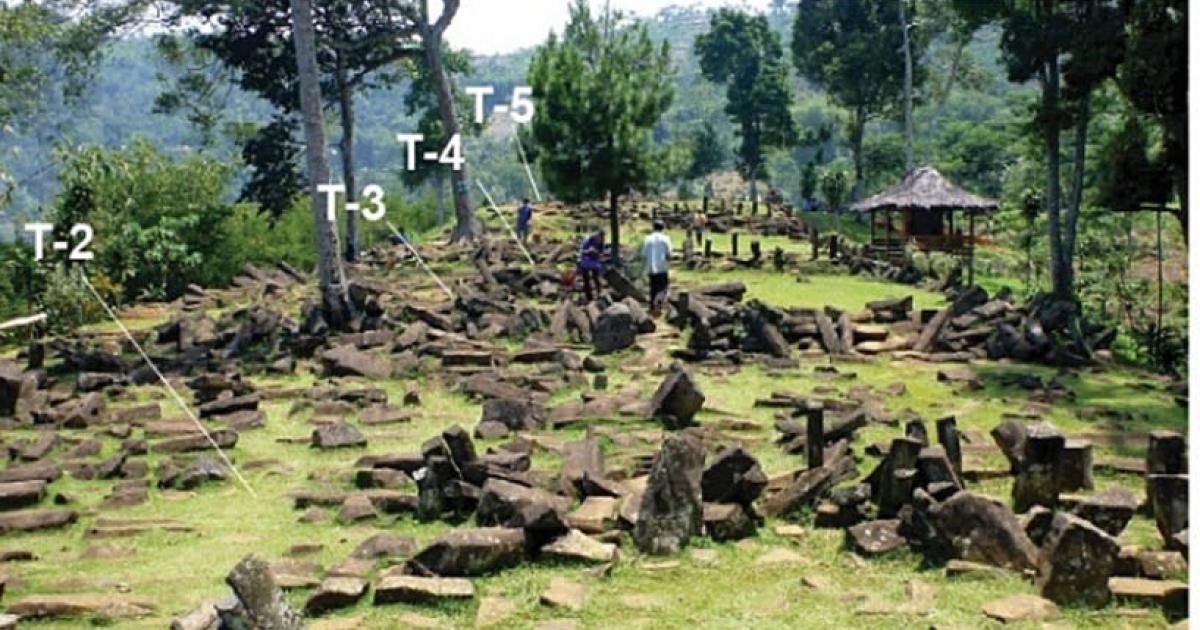
Gunung Padang sits on an extinct volcano in the highlands of western Java, where five artificial terraces with stone retaining walls are reached by a staircase of 370 stone steps, according to Archaeology magazine. The terraces are covered with structures made from prismatic andesite blocks, a natural rock form that geologists call columnar joints.
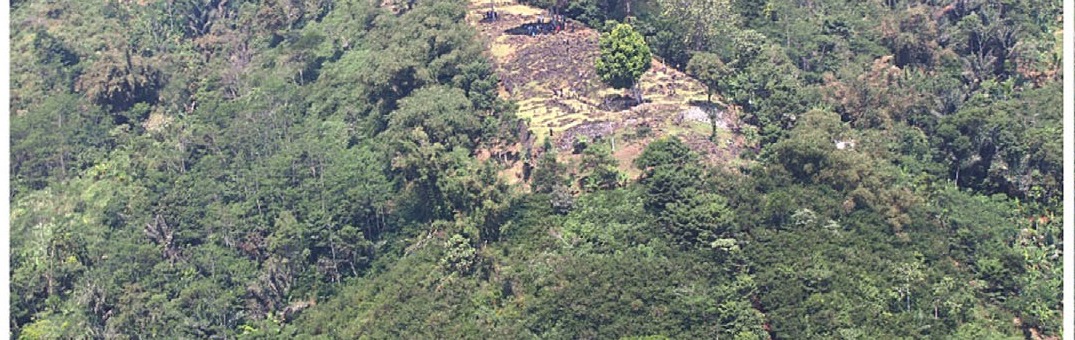
Aerial view of Gunung Padang taken from a helicopter, with the stone terraces cleared on the forested hilltop. (Natawidjaja et al. 2023, Archaeological Prospection, Figure 1a, paper since retracted/CC BY 4.0)
The site was recorded in 1914 by the Dutch archaeologist N.J. Krom, then largely ignored until three farmers from the village of Karyamukti brought it to the attention of local authorities in 1979. Excavations by Indonesia's National Archaeology Research Institute in the 1980s exposed the basic layout, and some researchers suggested a date as early as 2500 BC.
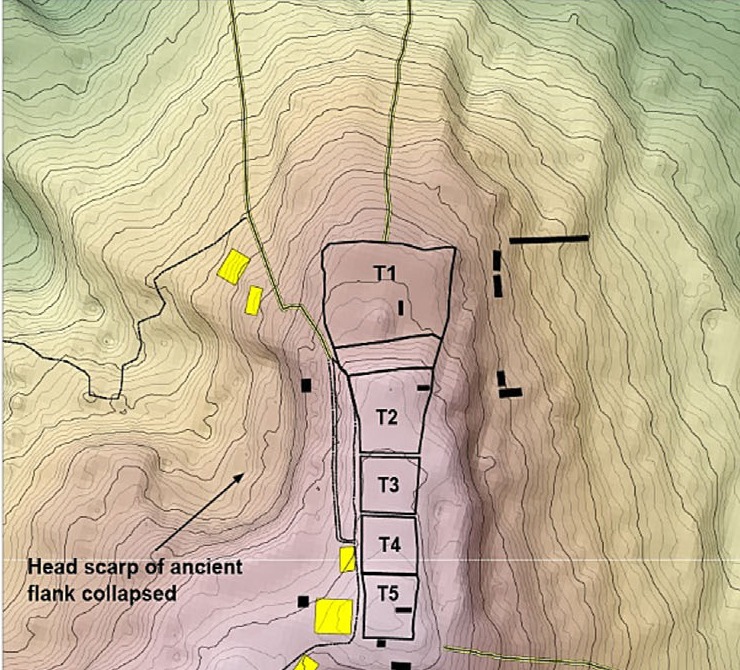
Topography and site map of Gunung Padang from a geodetic survey, showing the five terraces, T1 to T5. (Natawidjaja et al. 2023, Archaeological Prospection, Figure 1b, paper since retracted/CC BY 4.0)
Lutfi Yondri, an archaeologist who has dug at the site for three decades, recovered charcoal under a retaining wall on Terrace 1 that has been radiocarbon dated to around 117 BC. Other charcoal from beneath Terraces 2 and 4 clustered around 50 BC. He told Archaeology magazine that the dates suggest "the terraces at Gunung Padang were not built by one generation".
The findings that went viral came from a different kind of work, published in Archaeological Prospection on October 20, 2023 by Danny Hilman Natawidjaja and 11 coauthors. Between 2011 and 2014 the team used ground-penetrating radar, electrical resistivity, seismic tomography, trenching and core drilling to map what lies under the terraces and slopes.
The abstract states that "Radiocarbon dating of organic soils from the structures uncovered multiple construction stages dating back thousands of years BCE, with the initial phase dating to the Palaeolithic era". The paper reports 12 organic soil samples in total, six taken from boreholes and six from trenches, and every dated sample is listed as organic soil.
Its oldest result, sample GP2-750, came out at 22,750 radiocarbon years before present, calibrated to roughly 25,300 to 24,500 BCE, or about 27,000 years ago. From these soils the team placed its deep Unit 3 between 25,000 and 14,000 BCE, and concluded that the hill is "a pyramid-like construction".
That chain of reasoning is where critics pressed. Bill Farley, an archaeologist at Southern Connecticut State University, told Nature that the soil samples, though accurately dated, carry no hallmarks of human activity such as charcoal or bone fragments. Flint Dibble of Cardiff University argued that tumbling rock can line itself up: "Material rolling down a hill is going to, on average, orient itself".
The journal's editors, Eileen Ernenwein and Gregory Tsokas, and the publisher Wiley agreed after an investigation that the paper contained a major error. In the words of the notice, "the radiocarbon dating was applied to soil samples that were not associated with any artifacts or features that could be reliably interpreted as anthropogenic", so the pyramid reading could not stand.
The chambers claim rests on the same survey. The paper matched a zone of high electrical resistance with a zone of slow seismic waves and pointed to water loss during drilling as signs of open spaces underground. Those readings are indicative rather than conclusive, and none of the sources read for this check reports a chamber being opened.
The site reached a mass audience before the paper did. Netflix's 2022 series Ancient Apocalypse opened with an episode on Gunung Padang. Its host, the British writer Graham Hancock, promotes the idea "that an advanced global civilization was wiped out 12,000 years ago at the end of the last ice age," as Nature put it.
The paper's acknowledgements make the link explicit, thanking "Mr Graham Hancock for kindly proofreading the manuscript and his team for shedding light on Gunung Padang in Netflix's Ancient Apocalypse". Times Higher Education reported that this thank-you raised further questions about the study.
The alternative view
All 12 authors disagree with the retraction, the notice itself records. In a response posted on Graham Hancock's website on March 21, 2024, they argued that the sampled rock layers "have been unequivocally established as man-made constructions or archaeological features, rather than natural geological formations". They added that small portable artifacts accompany those layers.
They also challenged critics to "provide an alternative geological explanation for their shapes, composition and arrangement". Speaking to Nature before the retraction, Natawidjaja said "The neatly arranged, shaped and massive nature of these rocks, some weighing up to 300 kilograms, dismisses the likelihood of transportation over significant distances".
Those are fair questions about how the buried columns came to lie as they do. Yet the paper itself calls the megalithic stones "naturally formed basaltic-andesite columnar-joint rocks".
The wider record weighs against an Ice Age builder. Archaeology magazine reports that "Most Indonesian archaeologists are highly skeptical of this claim," because people on the archipelago at that time were hunter-gatherers. Yondri told Nature that people in the region lived in caves between 12,000 and 6,000 years ago, with no sign of sophisticated stonemasonry.
Where this leaves it
Gunung Padang is a genuine megalithic monument, a set of terraces where, scholars believe, ancestors of the local Sundanese people held rituals, with charcoal dates that point to the last centuries BC. What fails is the leap from old soil deep inside a volcanic hill to a pyramid shaped by human hands 27,000 years ago, a leap the journal itself rejected.
The verdict is Unverified rather than Fringe, because the deep layers were measured by trained geologists and their arrangement is still argued over by named specialists. Until someone dates human work in those layers, the 27,000-year pyramid remains less a discovery than a hypothesis resting on soil samples.
How we checked this
Read in full for this check: the 2023 Natawidjaja paper, through Wiley's full text and the open access copy on Wikimedia Commons, the March 2024 retraction notice, Archaeology magazine's 2024 feature, Nature's November 2023 report as reprinted by Scientific American, the Times Higher Education report and the authors' response. Netflix's episode listing was used for series context only, and the episode was not watched.
Yondri's own excavation reports were not read directly, and his dates are cited as reported by Archaeology magazine. The New York Times report on the retraction was paywalled and is not cited. No interviews were conducted, and earlier Ancient Origins coverage was not used as a source. Every quote was checked against a saved copy on October 24, 2026.
How we label claims: see How we check evidence.
More in this series: Göbekli Tepe, the Sphinx and Atlantis: what the evidence says.
Looking south across Gunung Padang's terraces T2 to T5, with the scattered columnar andesite blocks, labeled by the authors of the 2023 study. Natawidjaja et al. (2023), Archaeological Prospection, Figure 2g (paper since retracted), via Wikimedia Commons. CC BY 4.0
By Aris Manus
Sources
- Natawidjaja, Danny Hilman, et al. (2023). Geo-archaeological prospecting of Gunung Padang buried prehistoric pyramid in West Java, Indonesia. Archaeological Prospection (retracted). Read in full.
- Archaeological Prospection (2024). Retraction: Geo-Archaeological prospecting of Gunung Padang buried prehistoric pyramid in West Java, Indonesia. Volume 31, Issue 2. Read in full.
- Powell, Eric A. (2024). Java's Megalithic Mountain. Archaeology, July/August 2024. Read in full.
- Lewis, Dyani (2023). Experts Doubt Claims that World's Oldest Pyramid Was Discovered in Indonesia. Scientific American, reprinted from Nature, November 28, 2023. Read in full.
- Grove, Jack (2024). Paper claiming world's oldest pyramid retracted over error. Times Higher Education. Read in full.
- Natawidjaja, Danny Hilman, et al. (2024). Authors' response to the retraction, posted March 21, 2024. grahamhancock.com. Read in full.
- Netflix (2022). Ancient Apocalypse, Season 1, episode listing. Read in full (listing only).