
Medusa was one of the most familiar faces in ancient Anatolia, carved on tombs and temples, set on military gear and stamped on coins. In Tokat, a Turkish city in the ancient region of Pontus, the earliest traces of her come from the coins of a king who spent much of his reign at war with Rome, Mithradates VI Eupator of Pontus.
That is the finding of a paper by Şengül Dilek Ful of the Department of Art History at Tokat Gaziosmanpaşa University, published on October 9, 2026, in the Journal of Literature and Humanities. On October 20, Arkeonews reported that the king "was challenging the growing power of Rome," a week after Greek Reporter described the Medusa coins as a tool of psychological warfare.
According to Ful, the coins were circulated before battles and served as "strategic instruments of psychological warfare, intended to intimidate the enemy and symbolize impending victory." But did a king really fight the Roman Republic with the face of a monster?
Perseus, Nike and a Head on a Shield
Ful studied Medusa coins struck at Kabeira, Komana and Taulara, three mints of ancient Pontus that now lie within Tokat. Taulara was a fortress where Mithradates VI kept his treasures, and the paper dates the coins to the periods 120 to 63 BC and 85 to 65 BC.
Two designs recur on these coins, according to the paper. On the first, the helmeted head of Athena fills one side, while the other shows the hero Perseus holding "a harpe in his extended right hand and the severed head of Medusa in his left," with her body at his feet.
On the second design, the head of Medusa sits at the center of a shield or aegis, while the reverse shows Nike, the goddess of victory, walking with a palm branch over her shoulder. The same pair appears on bronze coins of Amisos, one of the Greek cities of the kingdom.
A specimen in the Bibliothèque nationale de France weighs 7.4 grams (0.26 oz) and measures 22 millimeters (0.87 in) across. However, the designs were not unique to the three towns. Ful notes that the scenes appear on coins "minted by all Greek city-states and fortresses loyal to Mithradates VI."
A Gorgon to Frighten the Romans?
Ful sets the coins against the politics of the age. In her account, Mithradates "positioned himself as the figure who would liberate the peoples of Anatolia and its environs from Roman oppression," and so the king emerged "as a 'savior'" in a revolt against Roman rule.
She writes that the king chose the motifs on purpose, and that by "circulating these coins prior to military engagements" he hoped to bind the Greek and native peoples of Anatolia to his cause. For both points the paper cites an earlier study by Keleş, published in 2008.
In this reading, the image of Perseus beheading Medusa showed a hero achieving the impossible, while Nike stood for the victory to come. However, the paper offers no ancient text in which the king or his officials explain the choice, and the claim about battle timing rests on the earlier literature.
A Hero for Greeks and Persians
Other historians have read the same coins as a statement about the king himself. Andrea F. Gatzke, writing in The Ancient History Bulletin in 2019, argued that Perseus was "a fresh face and a perfect heroic model for Mithridates," because he was "the ancestor of both the Persians and Alexander of Macedon, and therefore of Mithridates himself."
The belief that Perseus fathered the Persians can already be found in the work of the Greek historian Herodotus. He reported a message said to have been sent by Xerxes to the Greek city of Argos before the Persian invasion of Greece:
"Perses our forefather had, as we believe, Perseus son of Danae for his father, and Andromeda daughter of Cepheus for his mother"
Gatzke concluded that the hero "was not intended to be an exclusively Persian or Greek symbol," and she notes that earlier scholars such as Price saw the coins as a stress on the king's Persian roots alone. Even so, she reads the Medusa types struck in wartime as "surely meant to reference Mithridates' own (hopeful) defeat of Rome."
When Were the Medusa Coins Struck?
The timing matters, because a coin minted years before the war could hardly have been aimed at Roman soldiers. Gatzke places the start of the war with Rome around 89 or 88 BC and dates most of the types added during the war to 85 to 65 BC.
The scholarly dates for the Amisos bronzes are far from settled. In a study for the Black Sea Studies series, Sergej Saprykin noted that they belong to 111 to 90 BC under the scheme of F. Imhoof-Blumer, or to 95 to 85 BC under a newer, preliminary chronology proposed by F. de Callataÿ.
Saprykin also found that the Gorgon and Nike types were among the most popular bronzes in the markets of Pontus, and that they turned up in the coin finds of Kolchis on the eastern shore of the Black Sea. Saprykin treats these bronzes as evidence for trade across the Black Sea, and his paper does not discuss the Gorgon as a way to frighten an enemy. If the Gorgon was aimed at Roman eyes, she also spent much of her working life changing hands in the markets of the king's own lands.
Medusa the Protector in Roman Tokat
The Gorgon outlived the king by several centuries in the region around Tokat. Ful lists a Medusa relief on an orthostat block from Niksar, a frieze block in the Sebastopolis Lapidarium, a funerary stela, a sarcophagus fragment with two Medusa heads, six terracotta plaques and four small bronze appliques, dating from the 2nd to the 5th centuries AD.
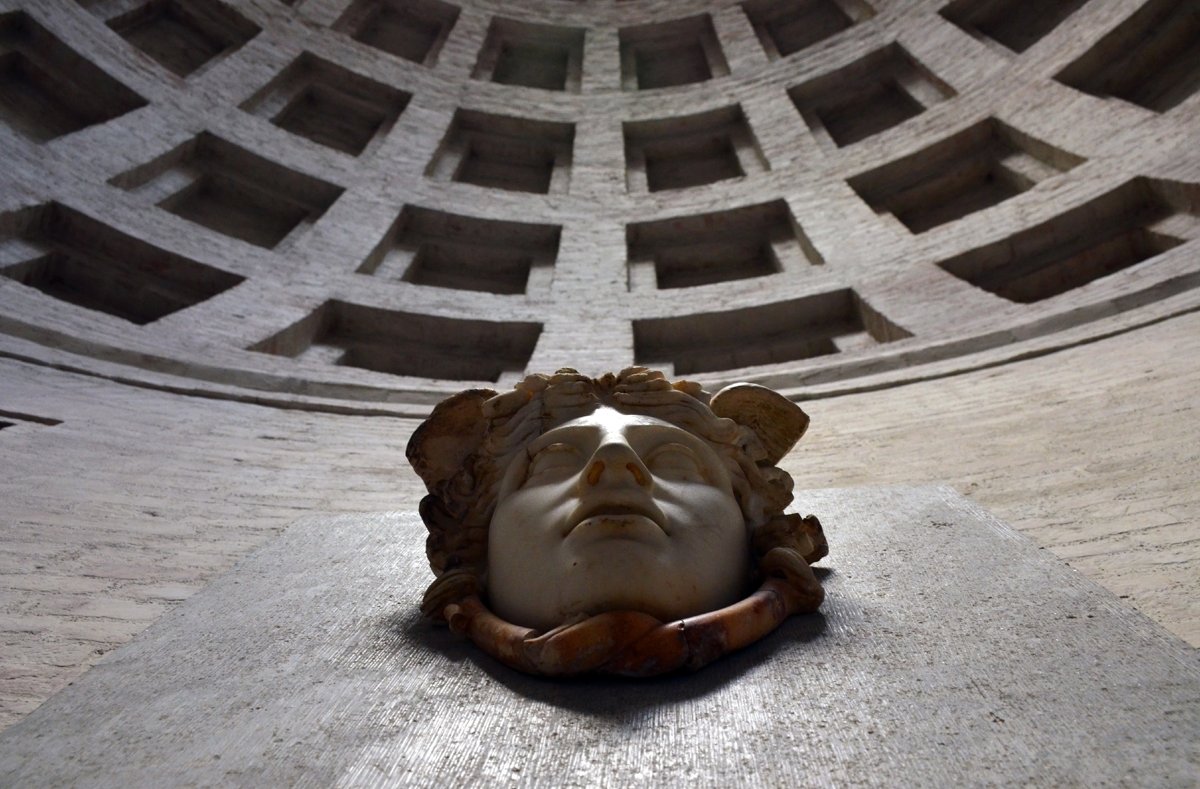
The so-called Medusa Rondanini, a Roman marble head of the Gorgon in the Glyptothek, Munich. Photo: Vassil, via Wikimedia Commons, CC0
On the tombs and buildings of the Roman period, her main role was protection. Ful notes that her name comes from a Greek verb meaning to protect or to rule, and that in Pseudo-Lucian's Philopatris she is described as a monster used to frighten enemies. In her words, the head "serves as a psychological shield, conveying the message that the structure is inviolable and under protection."
The coins and the Tokat carvings themselves are Established. The idea that Mithradates issued Medusa coins as psychological warfare before his battles with Rome is Unverified, and so is the claim that Perseus was meant to advertise the king's Persian ancestry. The dating of the coins is Disputed. Whether or not the king meant his Gorgon for Roman eyes, the later carvings from Tokat are kept today in the Tokat Museum and the Sebastopolis Lapidarium, and the Niksar block is on display.
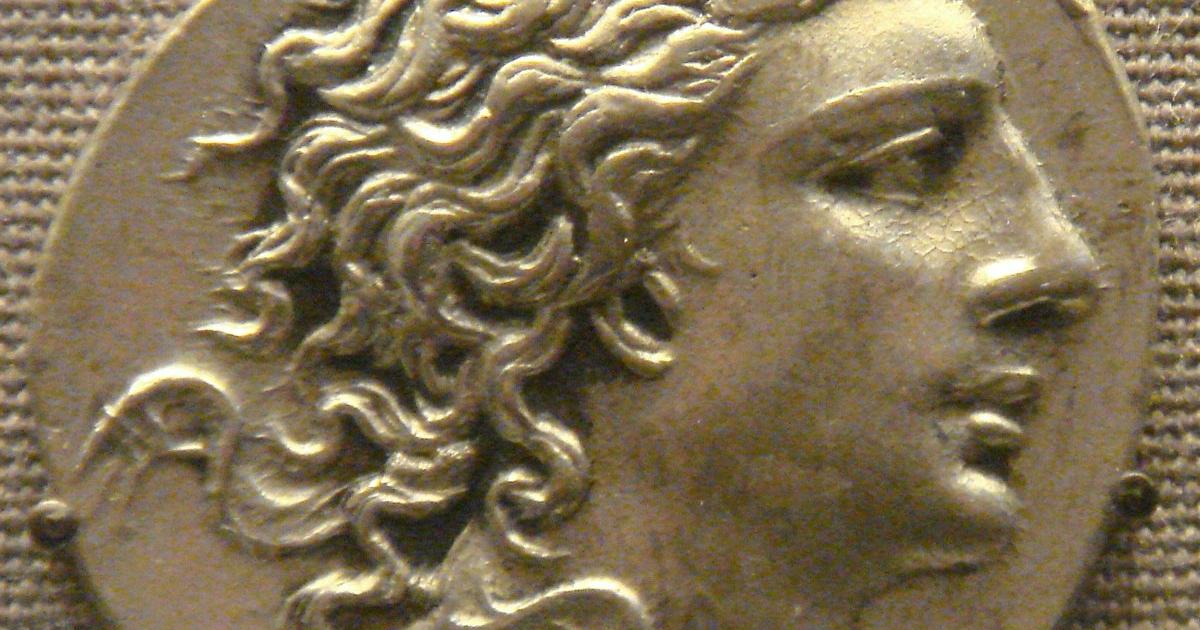
A coin with the portrait of Mithradates VI Eupator of Pontus, photographed at the British Museum. Photo: PHGCOM, via Wikimedia Commons, public domain
By Aris Manus
Sources
- Şengül Dilek Ful, "The Place and Significance of Medusa in Tokat in the Light of Numismatic and Archaeological Finds," Journal of Literature and Humanities 78, October 9, 2026
- Arkeonews, "How a Greek Myth Became a Political Weapon Against Rome in Ancient Anatolia," October 20, 2026
- Greek Reporter, "Ancient Coins Reveal How Medusa Became a Weapon of Psychological Warfare," October 13, 2026
- Andrea F. Gatzke, "Mithridates VI Eupator and Persian Kingship," The Ancient History Bulletin 33, 2019
- Sergej Ju. Saprykin, "The Unification of Pontos: The Bronze Coins of Mithridates VI Eupator as Evidence for Commerce in the Euxine," Black Sea Studies 6
- Herodotus, Histories 7.150, translated by A. D. Godley, Perseus Digital Library
- Bibliothèque nationale de France, "Monnaie : Bronze, Amisos, Pont," catalogue record