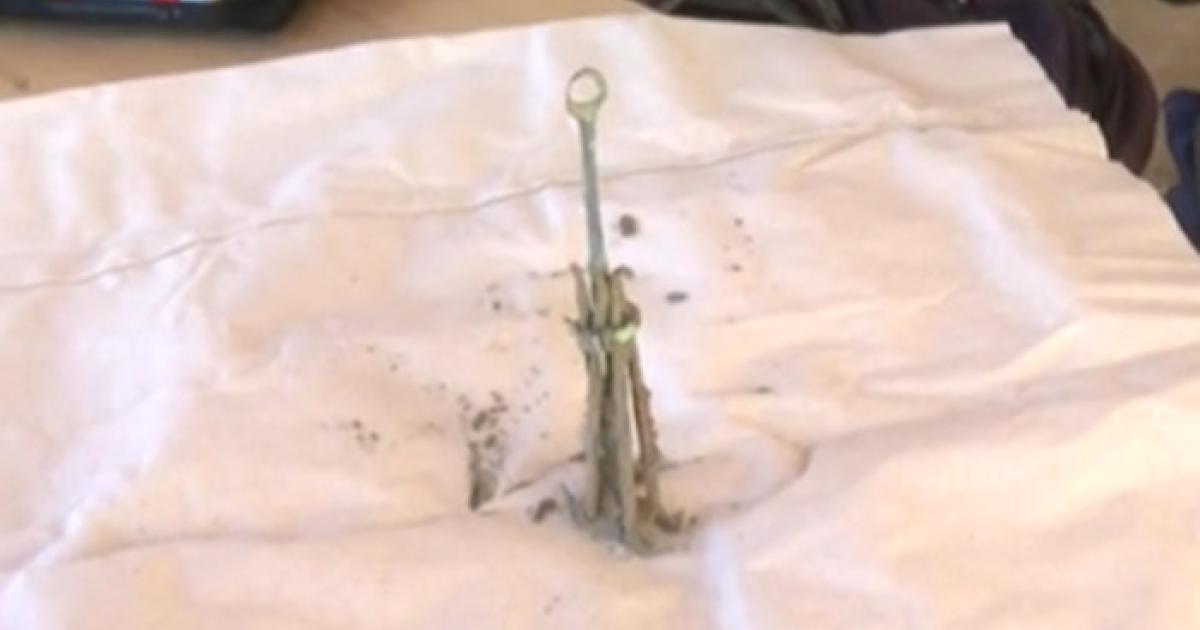

A small bronze object found inside a Thracian temple in southern Bulgaria has left archaeologists with an unusually practical problem: what was it made to do? As Arkeonews reports, the object is a ring fitted with four carefully shaped hooks, each ending in a pronounced barb. It may have supported lamps, yet its form also recalls large fishing tackle—an awkward combination that has made the find one of the site’s most intriguing discoveries.
A Mechanism in the temple Entrance
The object was recovered from the pronaos, or entrance chamber, of a temple near the village of Vasil Levski, in Karlovo Municipality. Excavation director Associate Professor Kostadin Kisyov told Bulgarian media that his team had not previously encountered a mechanism of this kind. In a report by Cross based on a bTV interview, Kisyov described it as a possible “mechanism for hanging lamps,” but noted that the chains needed to suspend lamps have not been found.
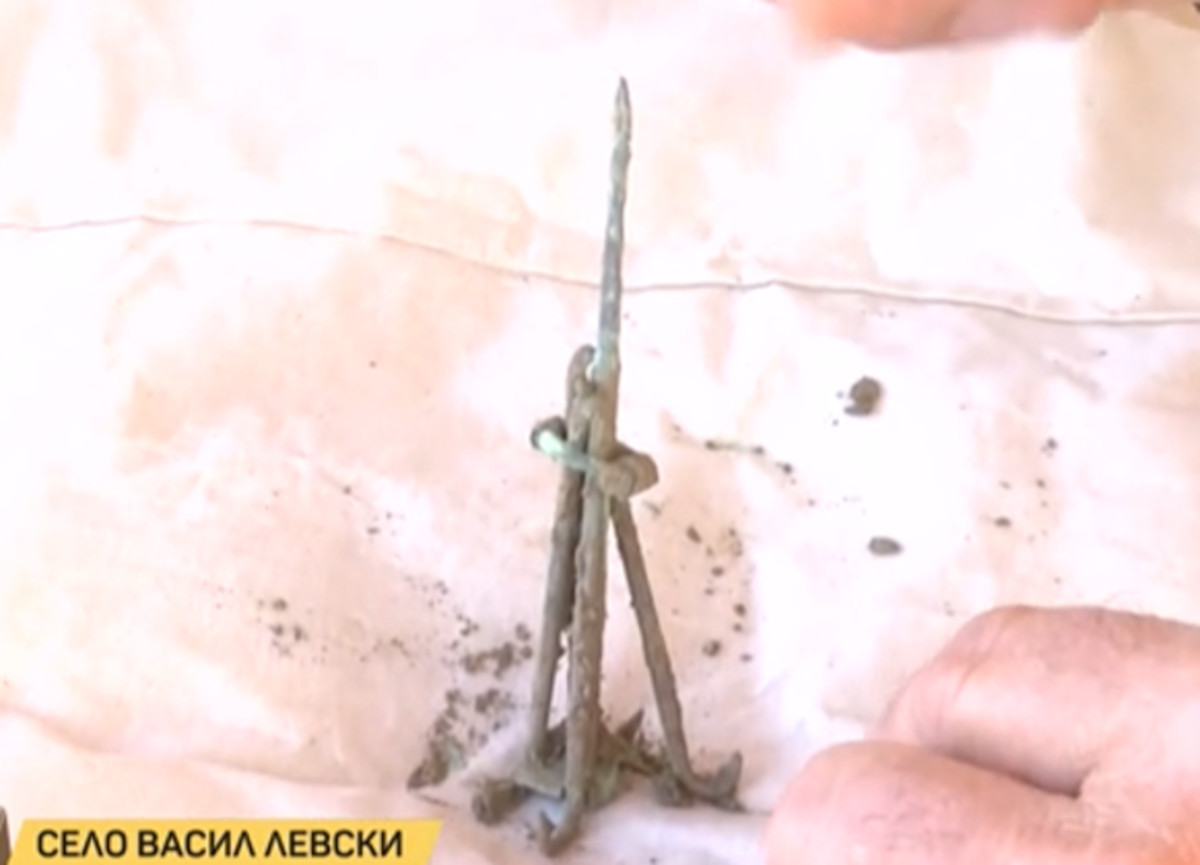
Close up of the instrument or mechanism. (bTV screenshot)
The alternative is fishing equipment. The backward-facing barbs look convincingly like those on fishhooks, but the object appears too large for ordinary use in the nearby Stryama River. Kisyov suggested that, if it was a fishing device, it may have been intended for larger waterways such as the Maritsa or Danube, or even for sea fishing. Neither interpretation is secure, and its position inside a temple does not by itself prove that the mechanism was ritual equipment.
The Possible “Golden City” of the Odrysians
The settlement is dated mainly to the sixth and fifth centuries BC, when the Odrysian Kingdom was becoming the dominant Thracian power in the region. Reporting by Bulgarian National Radio Plovdiv describes a settlement of roughly 40 decares, with a smaller fortified area, monumental stone buildings and a temple measuring about eight meters square. Kisyov has proposed that it could have been an early Odrysian capital associated with King Teres I, but the ancient name and political role remain unconfirmed.
The site’s modern nickname, the “Golden City,” comes from its distinctive roof tiles. According to the Bulgarian report, the tiles used several protective layers, including red and black coatings and a shimmering mineral finish. Imported transport amphorae from Chios, Samos and Thasos point to connections with the Aegean world, while the masonry shows that local elites adopted or employed construction techniques associated with Greek settlements. These details fit the wider picture of Thracian society described in The Mysterious Thracians: Unveiling Their Unique Culture, a culture shaped by local traditions and sustained contact with neighboring powers.
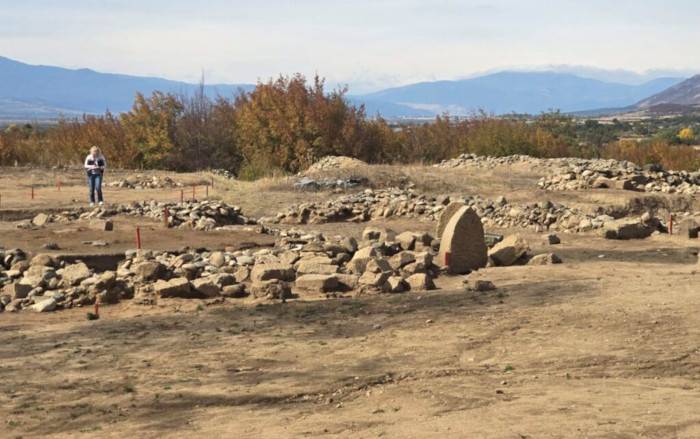
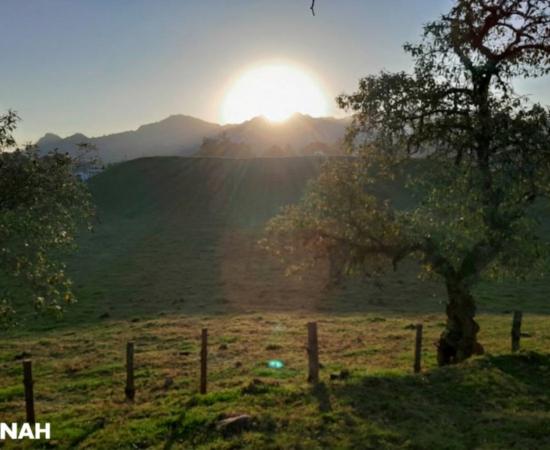
Ancient Thracian settlement near Vasil Levski, Bulgaria, where archaeologists discovered an unusual bronze mechanism inside a temple. (Karlovo Municipality)
Why the Bronze Find is so Difficult to Classify
The mechanism illustrates a recurring difficulty in archaeology: an object’s location can suggest a function, but it cannot settle the question. A temple may contain fittings, tools, offerings or objects brought in through trade, and the four hooks could have belonged to an installation that has not survived. The absence of chains weakens the lamp-holder theory, while the size and inland location complicate the fishing theory.
That uncertainty is especially important for Thrace, where the ancient people left few written records of their own. Archaeologists must reconstruct religious life and technology from buildings, imported goods and objects whose uses are not always obvious, as seen in Thracian Warrior Tomb Yields Stunning Artifacts and A marble slab inscription invoking a goddess sheds light on Thracian history. For now, the bronze ring is best treated as an unresolved piece of evidence rather than proof of a previously unknown ritual.
What Further Excavation May Reveal
A second temple with a similar plan is still being investigated, and more work may show whether the buildings formed a single sacred precinct or served different purposes. Continued excavation could also reveal a chain, a mounting point, associated lamps or traces of use that would favor one interpretation. Until then, the four-hooked object remains a rare example of how a single piece of Thracian bronze can challenge assumptions about what belonged inside an ancient temple.
Top image: The mechanism or instrument found in Thracian Temple in Bulgaria. Source: bTV screenshot
By Gary Manners
References
Arkeonews. 2026. Mysterious Bronze Mechanism Discovered in 2,500-Year-Old Thracian Temple in Bulgaria. Available at: https://arkeonews.net/mysterious-bronze-mechanism-discovered-in-2500-year-old-thracian-temple-in-bulgaria/
Collin Rugg News. 2026. The more archaeologists examine this temple find, the less it looks like ritual gear: inside the Thracian bronze puzzle. Available at: https://www.collinruggnews.com/the-more-archaeologists-examine-this-temple-find-the-less-it-looks-like-ritual-gear-inside-the-thracian-bronze-puzzle/?shem=aimgspe
Cross.bg. 2026. Загадъчен бронзов механизъм откриха при разкопки археолози. Available at: https://www.cross.bg/kisyov-kyki-mehanizum-1807908.html
Petrichanska, A. 2022. Проучват храма в Златния град на одрисите в подножието на Стара планина. Available at: https://old-news.bnr.bg/plovdiv/post/101677280/prouchvat-hrama-v-zlatnia-grad-na-odrisite-v-podnojieto-na-stara-planina