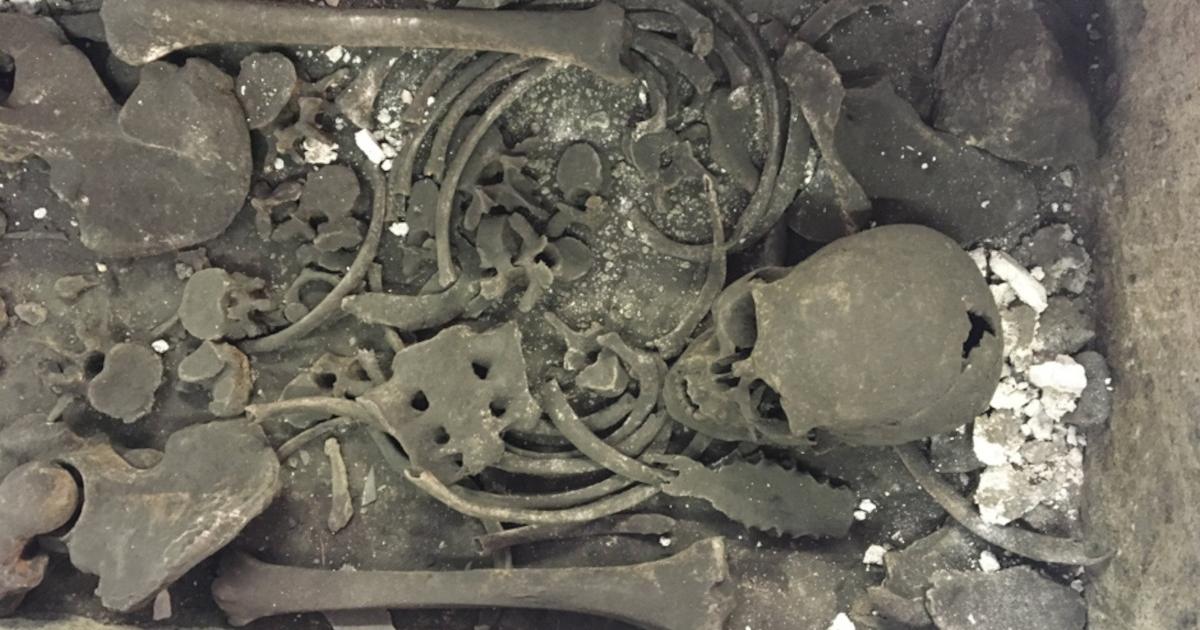

A new study in the Journal of the British Archaeological Association argues that a skeleton found inside a Roman sarcophagus at Westminster Abbey may belong to Ælfwig, an abbot who died around 1020. The identification is not certain, but the evidence brings a 150-year-old mystery closer to an answer. It also shows how a Roman coffin was given a second life in late Saxon England.
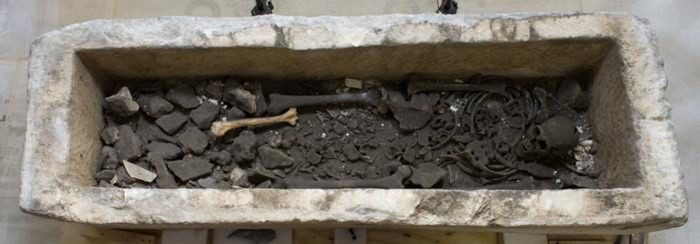
Interior of the sarcophagus. Image shows as it was found upon opening in 2016. (© Pre-Construct Archaeology Ltd.)
A Roman Coffin with a Medieval Clue
The stone coffin was excavated beside Westminster Abbey in 1869, but its story began much earlier. Its inscription commemorates Valerius Amandinus, a wealthy man placed in the sarcophagus during the third or fourth century, according to the Roman Inscriptions of Britain. The lid, however, points to a later burial.
A large Latin cross was carved across that lid centuries later, probably in the 10th or 11th century. It signals Christian reuse of an older Roman container for a high-status burial. When the sarcophagus was opened in a conservation studio in 2016, researchers found that the skeleton had survived after all.
- “Completely Unique” 2,000-Year-Old Roman Mausoleum Unearthed Near London Bridge
- “Flat-Packed” Roman Funerary Bed Found in London
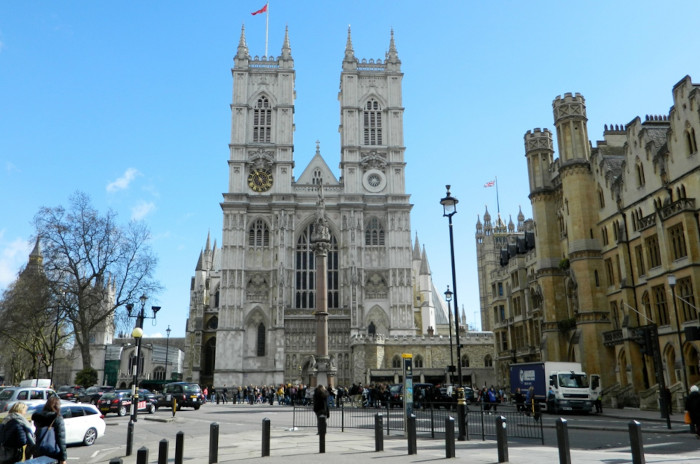
Westminster Abbey façade, London. (Paasikivi / CC BY-SA 4.0)
New Analysis Narrows the Field
Human-bone specialist James Young Langthorne assessed the occupant as a man aged 35 to 49 and about 1.75 meters tall. That is older than the 19th-century description of a “robust young man” no more than 30. Radiocarbon dating placed the bones between AD 987 and 1052, matching the cross and confirming late Saxon reuse, records a press release.
The burial itself adds another layer. A pale rectangular outline suggests that the body was first placed in a timber coffin and covered with lime, while the wood later decayed. Study author Warwick Rodwell said in the press release:
“We have two viable contenders for the occupant of the sarcophagus,” - namely Ælfwig and his successor Wulfnoth.
- Roman Sarcophagus Containing Two Skeletons Unearthed in Bath
- Two Roman Coffins with Celtic Motifs, One Containing an Adult and Infant, Found in England
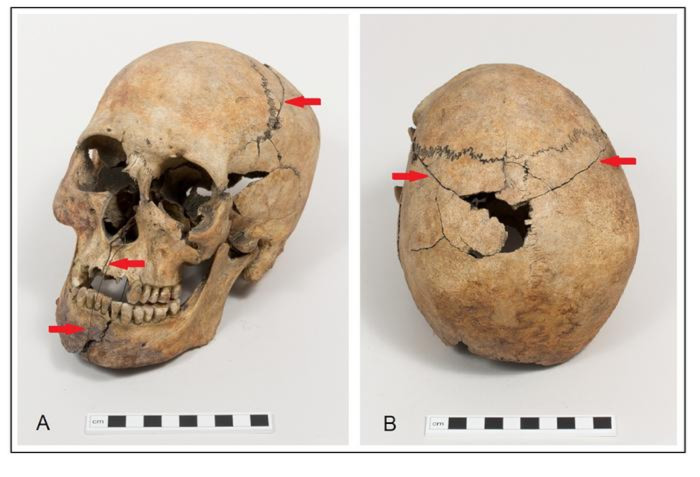
Skeleton: the skull, as repaired in 1869. (© Pre-Construct Archaeology Ltd)
Why an Abbot Fits the Evidence
Ælfwig is considered the stronger candidate because he was already a Westminster monk before becoming abbot, and records place his death around 1020. Wulfnoth, his successor who died in 1049, remains possible. As Rodwell told The Guardian, “Nobody of lower rank would have been buried in anything like that.”
The sarcophagus may first have been installed in the eastern arm of the Anglo-Saxon church, with its recut lid serving as a cross-slab in the floor. During Henry III’s rebuilding in the 1240s, it was apparently moved to the new sacristy courtyard around 1258. The Roman sarcophagus survived, while its medieval occupant faded from memory.
A Roman Sarcophagus with a Second Life
The Westminster discovery belongs to a wider pattern in which burials reveal changing identities and beliefs across Britain. Ancient Origins has reported on a Roman cemetery in Somerset containing more than 50 burials and Roman burial sites in Cambridgeshire with an unusual number of decapitations. A sealed Roman sarcophagus from Aquincum shows how much can survive when a coffin remains undisturbed.
The study does not prove the skeleton is Ælfwig, and no name has been recovered from the bones. It does provide a coherent chain of evidence: a late Roman coffin, a late Saxon cross, a man who died at the right time, and burial treatment suited to an important churchman. The Roman sarcophagus is now displayed in Westminster Abbey’s Queen’s Diamond Jubilee Galleries.
Top image: Interior of the sarcophagus holding the skeletal remains prior to in situ cleaning. Source: Pre-Construct Archaeology Ltd.
By Gary Manners
References
Clark, G., and Egan, R. 2026. Mystery skeleton found in Roman sarcophagus at Westminster Abbey may finally have an identity. Available at: https://phys.org/news/2026-10-mystery-skeleton-roman-sarcophagus-westminster.html
Guardian, The. 2026. Mystery of Roman sarcophagus unearthed at Westminster Abbey solved at last, expert says. Available at: https://www.theguardian.com/uk-news/2026/oct/21/mystery-roman-sarcophagus-westminster-abbey-solved-at-last-expert-says
Rodwell, W. 2026. Westminster Abbey’s Roman Sarcophagus and its Afterlife. Journal of the British Archaeological Association. Available at: https://doi.org/10.1080/00681288.2026.2675788
Roman Inscriptions of Britain. 2024. RIB 16. Funerary inscription for Valerius Amandinus. Available at: https://romaninscriptionsofbritain.org/inscriptions/16
Taylor & Francis Group. 2026. Mystery skeleton found in Roman sarcophagus at Westminster Abbey may finally have an identity. Available at: https://www.eurekalert.org/news-releases/1147649
Westminster Abbey. n.d. The Queen’s Diamond Jubilee Galleries. Available at: https://www.westminster-abbey.org/visit-us/the-queens-diamond-jubilee-galleries