
Last updated: 19 October 2026
Author: Ancient Origins editorial. The desk summarises the published specialist literature. We are not an excavating archaeology team, and nothing here is new fieldwork.
How to read the labels: Established, Disputed, Fringe and Unverified are defined on our page How we check evidence.
The short answer
- Göbekli Tepe's age: Established. Hunter-gatherers built it in the Pre-Pottery Neolithic, roughly 9600 to 8200 BCE.
- Göbekli Tepe as a temple-only sanctuary: Disputed. Ritual use is accepted, but the excavators themselves now report houses and water collection on the site.
- A comet impact caused the Younger Dryas cooling: Disputed, and the largest recent review says the idea should be rejected.
- The "Vulture Stone" (Pillar 43) records that comet: Fringe. The excavation team rejects it, and the proposed date is older than the site's radiocarbon dates.
- The Great Sphinx belongs to Khafre's Old Kingdom building programme: Established. A smaller debate over whether Khufu began it is still open.
- Robert Schoch's rain-erosion dating, which makes the Sphinx thousands of years older: Fringe.
- Atlantis was a real sunken continent: Fringe. Classicists read Plato's story as a philosophical fiction.
- The Richat Structure in Mauritania is Atlantis: Fringe. It is a natural eroded dome tied to igneous activity about 100 million years ago.
1. Göbekli Tepe: how old is it, and what was it for?
Verdict: Age Established (about 9600 to 8200 BCE). Temple-only interpretation Disputed.
The claim. Göbekli Tepe in south-eastern Turkey is often called "the world's first temple": a mountaintop sanctuary of carved T-shaped pillars, built by hunter-gatherers before farming.
Evidence for the date. UNESCO's World Heritage listing describes monumental round-oval and rectangular structures "erected by hunter-gatherers in the Pre-Pottery Neolithic age between 9,600 and 8,200 BCE". The excavation team at the German Archaeological Institute (DAI) gives a sequence running from the Pre-Pottery Neolithic A (about 9600 to 8700 BC) into the Early Pre-Pottery Neolithic B (about 8700 to 8200 BC) and the late ninth millennium BC. Lee Clare's 2020 DAI research summary gives about 9500 to 8000 cal BC.
Evidence for ritual use. The pillars carry reliefs of wild animals, and some are carved as stylised human figures with arms, belts and loincloths. A 2012 paper in Antiquity by the excavators reported very large quantities of animal bone in the fill of the enclosures and argued for large-scale feasting with "a strong cultic significance". UNESCO says the monuments were "probably used in connection with rituals, most likely of a funerary nature".
Limits of the temple story. In 2011 the archaeologist E. B. Banning argued in Current Anthropology that the "temples" might be houses rich in symbolism, and that a site with this much debris and food-processing equipment was unlikely to have had no residents. Since then the excavation team has revised its own view. Clare's 2020 summary reports domestic buildings with hearths, bead production and a sub-floor burial, plus a large rock-cut pit and channels that may have collected rainwater. It says this "exposed the weaknesses of the temple-narrative" and that the backfilling of the big enclosures, once read as deliberate and ritual, now looks like slope slides from higher parts of the mound. The same summary says the team has dropped Klaus Schmidt's earlier three-layer chronology.
Where this leaves it. The date range is secure. The special buildings clearly had a ritual role, but "temple with no settlement" is no longer the excavators' own view.
2. The Younger Dryas impact and the "Vulture Stone"
Verdict: Younger Dryas impact Disputed, with the weight of recent specialist review against it. Pillar 43 as a comet "date stamp" Fringe.
The claim. In 2007, Richard Firestone and colleagues proposed in PNAS that an extraterrestrial impact or airburst about 12,900 years ago helped trigger the Younger Dryas cold period and contributed to megafaunal extinctions and the end of Clovis culture in North America. In 2017, Martin Sweatman and Dimitrios Tsikritsis, of the University of Edinburgh's School of Engineering, argued in Mediterranean Archaeology and Archaeometry that carvings on Göbekli Tepe's Pillar 43 match star patterns and record "a date stamp for 10950 BC ± 250 yrs", close to the proposed impact.
Evidence for the impact. Firestone and colleagues reported a thin layer at Clovis-age sites with magnetic grains, microspherules, charcoal, soot, nanodiamonds and other markers they read as signs of an impact. Later papers added support: Petaev and colleagues (PNAS, 2013) found a large platinum spike in a Greenland ice core at the Younger Dryas boundary, and Moore and colleagues (Scientific Reports, 2020) reported high-temperature meltglass at Abu Hureyra in Syria.
Evidence against the impact. A 2011 review in Earth-Science Reviews by Pinter and colleagues found that the proposed impact markers had either been rejected or had met contrary evidence. For example, carbon spherules turned out to be indistinguishable from fungal sclerotia and arthropod droppings. A 2023 review in the same journal by Holliday and 12 co-authors concluded that "the YDIH should be rejected". It notes that no crater dates to the onset of the Younger Dryas, that most proposed markers also form through ordinary processes, and that very few sites are dated precisely to 12,900 years ago. Even the 2013 platinum paper said its likely source was "unlikely to result in an airburst or trigger wide wildfires". In November 2025 Scientific Reports published a correction to the supporting information of the Abu Hureyra paper.
Evidence against the Vulture Stone reading. The excavators replied in the same journal in 2017 ("More than a vulture"). Their main points were these:
- The proposed date is 700 to 1,000 years older than the oldest radiocarbon date for Enclosure D, where Pillar 43 stands. The earliest dates from the site fall at the end of the Younger Dryas, not its start.
- Many pillars were moved and reused, and the enclosures may have been roofed, which would make them poor observatories.
- There is no reason to think Neolithic hunters saw the same constellations as later Babylonian and Greek astronomers.
- The study chose a few pillars out of more than 60, and left out details such as the reliefs on Pillar 43's narrow sides.
Sweatman and Tsikritsis answered that their statistical case had not been tested, and Sweatman has since published further work along the same lines (Time and Mind, 2024).
Where this leaves it. The impact hypothesis is still debated in print, but the broadest recent review rejects it. The Pillar 43 reading rests on that hypothesis and on star matching that the site's archaeologists reject. Its proposed date also conflicts with the site's radiocarbon record.
3. Was the Great Sphinx carved thousands of years before the pharaohs?
Verdict: Old Kingdom, Khafre's building programme Established (a Khufu start still debated). Schoch's much older date Fringe.
The claim. Geologist Robert Schoch argues that deep, rounded weathering on the Sphinx and the walls of its enclosure could only have been made by rain and runoff, at a time much wetter than Old Kingdom Egypt. On his own site he says the core of the body dates to "at least 5000 BCE", and that his latest work points to about 10,000 BCE. He also reports seismic tests showing deep weathering below the enclosure floor, and he argues that the head was later recarved, which is why it looks small.
Evidence for an older Sphinx. Schoch first published the argument in KMT in 1992. In 2001 the geologist Colin Reader argued in Archaeometry that the uneven pattern of erosion fits rainfall runoff, and that the Sphinx "may pre-date the reign of Khufu". Reader's date is far more modest than Schoch's. He ties the runoff to conditions he says lasted at Giza until the late Fifth Dynasty. His paper was published together with critical comments from other specialists.
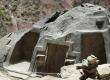
Evidence for Khafre. Mark Lehner of Ancient Egypt Research Associates (AERA) mapped the Sphinx and its temples stone by stone between 1979 and 1983, working with geologist Thomas Aigner. They found that many core blocks of the Sphinx Temple contain the same rock layers that run through the Sphinx's body, so they were cut from the ditch around the statue as it was carved. The Sphinx Temple was built after Khafre's Valley Temple. The south side of the Sphinx quarry is the north side of the foundation of Khafre's causeway, so the lower Sphinx was cut after the causeway. Lehner concludes that "Khafre created most of the Sphinx", while noting that Khufu might have started it. Lehner and Zahi Hawass set out the case for Khafre in Archaeology magazine in 1994.
Limits of the water-erosion argument. AERA argues that the Sphinx's soft layers erode fast enough to explain their condition without an earlier date. It notes that large pieces fell from the statue in 1981 and 1988. AERA also says the tomb Schoch's supporters compare it with, the tomb of Debehen, lies about 418 metres away and about 27 metres higher, in different rock layers. When asked where the earlier civilisation that carved it could be, Schoch himself points to Göbekli Tepe in Turkey, not to finds at Giza.
Where this leaves it. Specialists still debate which Fourth Dynasty king started the Sphinx. A date thousands of years before the Old Kingdom is not supported by the archaeology of the Sphinx and its temples.
4. Was Atlantis a real lost continent?
Verdict: Atlantis as a historical sunken continent Fringe. Atlantis as Plato's literary and philosophical creation Established among the classicists we consulted.
The claim. Atlantis was a real island empire beyond the Strait of Gibraltar that was destroyed around the end of the last Ice Age, and its memory survived in Egyptian records that reached Plato.
What Plato actually says. In the Timaeus (24e to 25d), Critias tells how an Egyptian priest at Sais told Solon of an island "larger than Libya and Asia put together" lying "in front of the straits which are by you called the Pillars of Heracles". It attacked Europe and Asia, was defeated by ancient Athens, and "in a single day and night of misfortune" sank into the sea. In the Critias (108e), the war is set nine thousand years before Solon's time. Critias calls it "a tale which, though strange, is certainly true".
Evidence against a real Atlantis. The text itself frames the story as Socrates' ideal city made real. Critias says the city "which you yesterday described to us in fiction, we will now transfer to the world of reality", and Socrates welcomes it as "a fact and not a fiction". The classicist Christopher Gill, whose edition of the Atlantis texts was published by Liverpool University Press in 2017, reads it as "a tale of two cities". Ancient Athens stands for the ideal state of the Republic and Atlantis for its opposite. He says the story "looks suspiciously unlike a true story, and more like a philosophical fable", and that people have searched for Atlantis "even though it absolutely isn't there". Benjamin Jowett reached the same view in the introduction to his 19th-century translation, judging the story "far more likely to have been invented by Plato than to have been brought by Solon from Egypt".
Where this leaves it. The only ancient source is Plato, and his own framing points to invention. No source we found offers primary evidence of a real Atlantis.
5. Is the Richat Structure ("Eye of the Sahara") Atlantis?
Verdict: Richat as Atlantis Fringe. Richat as a natural eroded dome Established.
The claim. Popular videos argue that the Richat Structure's concentric rings match Plato's description of rings of land and water, and that the site was flooded and destroyed at the end of the last Ice Age. Ancient Origins summarised the best-known version, a video on the Bright Insight YouTube channel, in a 2022 article. We have not reviewed that video directly.
What the geology shows. NASA's Earth Observatory describes Richat as about 40 kilometres across. It was once thought to be an impact crater, but it is "an uplifted geologic dome", and differing erosion of its rock layers left the circular ridges. A 1969 paper in the GSA Bulletin was titled "Richat and Semsiyat Domes (Mauritania): Not Astroblemes". In 2005, Matton, Jébrak and Lee showed in Geology that the rings are eroded cuestas in Late Proterozoic to Ordovician rocks. They read the structure as the surface expression of a Cretaceous alkaline igneous complex, with magmatic activity dated to about 98 to 99 million years ago.
Evidence against the Atlantis match. Plato puts Atlantis in the Atlantic, "in front of" the Pillars of Heracles, and says it sank beneath the sea. Richat is an inland landform. In the Critias, the rings around the palace island add up to 27 stadia across: a 5-stadia island, then rings of 1, 2, 2, 3 and 3 stadia on each side. Plato also describes a 50-stadia canal to the sea and a plain of 3,000 by 2,000 stadia. Richat's 40 km rings were formed by erosion of rock, not built. No archaeological evidence of a city on the structure has been published in the sources we checked.
Where this leaves it. Richat is a remarkable natural formation. Linking it to Atlantis means accepting Atlantis as real, which is itself Fringe, and then ignoring both Plato's location and the geology.
What we left out, and why
- Hawass and Lehner (1994). We confirmed the bibliographic record of their Archaeology article. Our summary of the Khafre case comes from AERA pages written by Lehner, which we read in full.
- Specific claims in the Bright Insight video, such as an Atlantis diameter of 127 stadia, appear here only as summarised in Ancient Origins' 2022 article. We treat them as Unverified until checked against the video.
- Reader (2001) critiques. The comments by Shortland and Doherty and by Wilkinson were published with Reader's paper. We confirmed they exist but did not read their full text, so we do not summarise their arguments.
Sources
All links were opened or checked by the desk on 19 October 2026.
Göbekli Tepe
- UNESCO World Heritage Centre. "Göbekli Tepe" (property 1572, inscribed 2018). https://whc.unesco.org/en/list/1572/
- Dietrich, O., Heun, M., Notroff, J., Schmidt, K. and Zarnkow, M. (2012). "The role of cult and feasting in the emergence of Neolithic communities. New evidence from Göbekli Tepe, south-eastern Turkey." Antiquity 86 (333): 674 to 695. https://doi.org/10.1017/S0003598X00047840
- Banning, E. B. (2011). "So Fair a House: Göbekli Tepe and the Identification of Temples in the Pre-Pottery Neolithic of the Near East." Current Anthropology 52 (5). https://doi.org/10.1086/661207
- Clare, L. (2020). "Göbekli Tepe, Turkey. A brief summary of research at a new World Heritage Site (2015 to 2019)." e-Forschungsberichte des DAI 2020 (2): 81 to 88. https://doi.org/10.34780/efb.v0i2.1012 (read via https://www.academia.edu/44286875/)
Younger Dryas impact and Pillar 43
- Firestone, R. B. et al. (2007). "Evidence for an extraterrestrial impact 12,900 years ago that contributed to the megafaunal extinctions and the Younger Dryas cooling." PNAS 104 (41): 16016 to 16021. https://doi.org/10.1073/pnas.0706977104
- Pinter, N. et al. (2011). "The Younger Dryas impact hypothesis: A requiem." Earth-Science Reviews 106: 247 to 264. https://doi.org/10.1016/j.earscirev.2011.02.005
- Petaev, M. I., Huang, S., Jacobsen, S. B. and Zindler, A. (2013). "Large Pt anomaly in the Greenland ice core points to a cataclysm at the onset of Younger Dryas." PNAS 110 (32). https://doi.org/10.1073/pnas.1303924110
- Moore, A. M. T. et al. (2020). "Evidence of Cosmic Impact at Abu Hureyra, Syria at the Younger Dryas Onset (~12.8 ka): High-temperature melting at >2200 °C." Scientific Reports. https://doi.org/10.1038/s41598-020-60867-w. Correction (2025): https://doi.org/10.1038/s41598-025-28180-6
- Holliday, V. T. et al. (2023). "Comprehensive refutation of the Younger Dryas Impact Hypothesis (YDIH)." Earth-Science Reviews 247: 104502. https://doi.org/10.1016/j.earscirev.2023.104502
- Sweatman, M. B. and Tsikritsis, D. (2017). "Decoding Göbekli Tepe with archaeoastronomy: What does the fox say?" Mediterranean Archaeology and Archaeometry 17 (1): 233 to 250. https://doi.org/10.5281/zenodo.400780
- Notroff, J., Dietrich, O., Dietrich, L., Lelek Tvetmarken, C., Kinzel, M., Schlindwein, J., Sönmez, D. and Clare, L. (2017). "More than a vulture: A response to Sweatman and Tsikritsis." Mediterranean Archaeology and Archaeometry 17 (2): 57 to 74 (Matters Arising, including the authors' reply). https://doi.org/10.5281/zenodo.599855 (read via https://jensnotroff.com/wp-content/uploads/2017/06/ii-17_37_maa-172_response-to-sweatman.pdf)
- Notroff, J. (2017). "Archaeoastronomy, meteor showers, mass extinction: What does the fox say?" Tepe Telegrams (DAI excavation blog). https://www.dainst.blog/the-tepe-telegrams/2017/04/21/archaeoastronomy-meteor-showers-mass-extinction-what-does-the-fox-say-and-what-the-crane-the-aurochs/
- Sweatman, M. B. (2024). "Representations of calendars and time at Göbekli Tepe and Karahan Tepe support an astronomical interpretation of their symbolism." Time and Mind 17 (3 to 4): 191 to 247. https://doi.org/10.1080/1751696X.2024.2373876 (bibliographic record checked; full text not reviewed)
Great Sphinx
- Schoch, R. M. "The Great Sphinx." Research highlights page. https://www.robertschoch.com/sphinx.html
- Schoch, R. (1992). "Re-dating the Sphinx." KMT 3 (2): 53 to 67. (Cited as listed in AERA's reference list; not read directly.)
- Reader, C. D. (2001). "A Geomorphological Study of the Giza Necropolis, with Implications for the Development of the Site." Archaeometry 43 (1): 149 to 165. https://doi.org/10.1111/1475-4754.00009
- Lehner, M. "Who Built the Sphinx? The Sphinx Temple Has the Answer." AERA. https://aeraweb.org/projects/who-built-the-sphinx/
- AERA. "Khafre's Monuments as a Unit." https://aeraweb.org/khafres-monuments/
- AERA. "Geology of the Sphinx." https://aeraweb.org/geology-of-the-sphinx/
- Hawass, Z. and Lehner, M. (1994). "The Sphinx: Who built it, and why?" Archaeology 47 (5): 30 to 41. https://www.jstor.org/stable/41766473 (bibliographic record checked)
Atlantis
- Plato. Timaeus. Trans. B. Jowett. Project Gutenberg eBook 1572. https://www.gutenberg.org/ebooks/1572
- Plato. Critias. Trans. B. Jowett. Project Gutenberg eBook 1571. https://www.gutenberg.org/ebooks/1571
- Liverpool University Press (2018). "The 'truth' behind Atlantis: Christopher Gill on Plato's Atlantis Story." Interview. https://liverpooluniversitypress.blog/2018/08/29/the-truth-behind-atlantis-christopher-gill-on-platos-atlantis-story/
- Gill, C. (1977). "The Genre of the Atlantis Story." Classical Philology 72 (4): 287 to 304. https://doi.org/10.1086/366370 (bibliographic record checked)
Richat Structure
- NASA Earth Observatory (2022). "The Eye of the Sahara." https://science.nasa.gov/earth/earth-observatory/the-eye-of-sahara-150060/
- Matton, G., Jébrak, M. and Lee, J. K. W. (2005). "Resolving the Richat enigma: Doming and hydrothermal karstification above an alkaline complex." Geology 33 (8): 665 to 668. https://doi.org/10.1130/G21542.1 (full text read via https://archipel.uqam.ca/272/1/Matton%5Fetal05.pdf)
- Dietz, R. S., Fudali, R. and Cassidy, W. (1969). "Richat and Semsiyat Domes (Mauritania): Not Astroblemes." GSA Bulletin 80: 1367. (Bibliographic record checked.)
- Johnston, M. (2022). "What Do Astronauts, Atlantis, and Africa Share? The Richat Structure!" Ancient Origins. /unexplained-phenomena/richat-structure-0016927
Last updated: 19 October 2026. If you spot an error, see How we check evidence for how we handle corrections.