Before dawn on October 22, hundreds of visitors gathered at Abu Simbel in southern Egypt, with some sleeping outside the temple to secure a view of a fleeting solar spectacle. The Abu Simbel alignment sent sunlight deep into the Great Temple of Ramses II. For roughly 20 minutes, the beam reached statues in the inner sanctuary, turning an ancient act of planning into a modern pilgrimage.
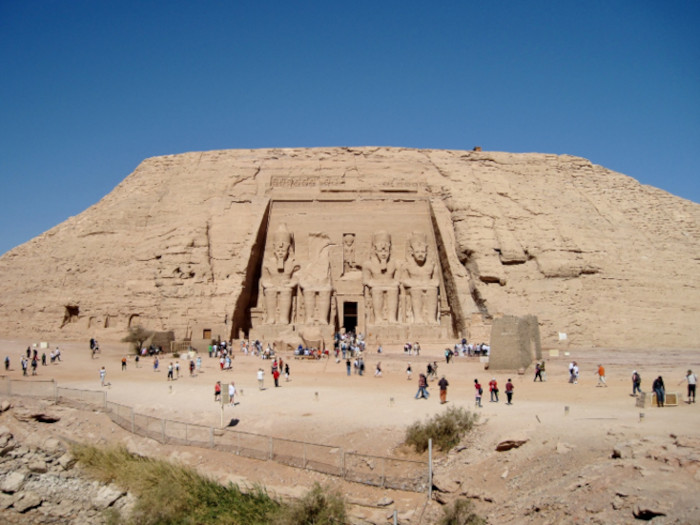
The Great Temple of Ramses II at Abu Simbel. (Olaf Tausch / CC BY 3.0)
A brief light show draws a long queue
The phenomenon occurs twice a year, on October 22 and February 22, as reported by the Associated Press. Those dates are widely believed to relate to Ramses II’s accession and birthday, although the evidence for that interpretation is not conclusive, as an Ancient Origins account of Abu Simbel notes. According to Daily Sabah, the beam travels about 60 meters through the temple before illuminating Ramses II, Amun-Ra and Ra-Horakhty.
The wait was part of the experience. Visitors formed a slow-moving line with phones and selfie sticks, while performers in bright clothing danced outside to tabla percussion and the sound of mizmars, a traditional Egyptian trumpet.
“Today is a very special day, as you can see. It’s a celebration and a historic holiday,” local guide Hisham Khela told the Associated Press.
- Abu Simbel: The Great Temple of Ramesses II was Almost Lost
- The Life and Death of Ramesses II, Ramesses the Great
A solar idea written into stone
Inside the sanctuary are four divine figures: Ramses II, Amun, Ra-Horakhty and Ptah. The sunlight reaches three of them, while Ptah remains in darkness, a detail sometimes linked to his association with the underworld.
The alignment is not an isolated curiosity in Egyptian history. Other Ancient Origins features examine the sun temple at Heliopolis and the oldest recorded solar eclipse connected with Egyptian pharaohs. Together, they suggest why a few minutes of carefully timed sunlight can still feel meaningful, even when the original ritual purpose is debated.
- The Winter Solstice at Seven Amazing Megalithic Sites
- Oldest Recorded Solar Eclipse Helps Date the Egyptian Pharaohs
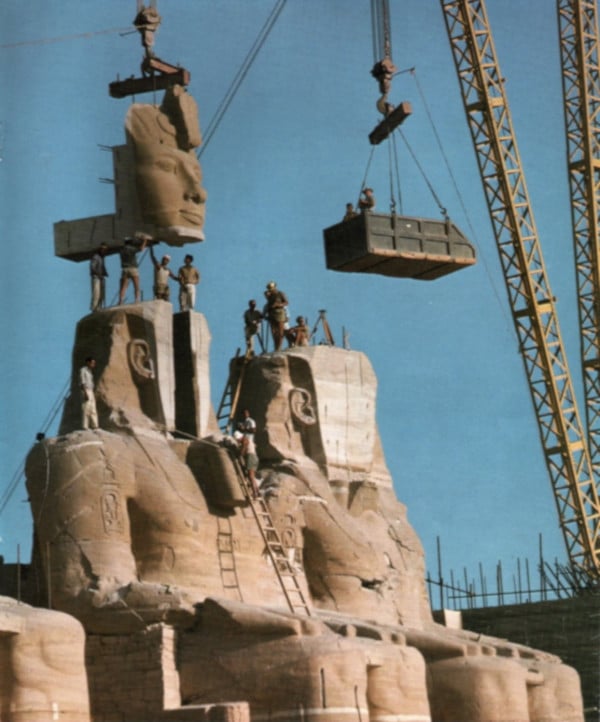
Workers lift sections of the Abu Simbel colossi during the temple’s relocation. (Per-Olow Anderson (1921-1989)/Public domain)
The temple that was moved but not misaligned
Abu Simbel’s survival is almost as remarkable as its solar design. When Egypt built the Aswan High Dam, the resulting reservoir threatened to submerge the Nubian monuments, so UNESCO coordinated an international rescue campaign from 1960 to 1980; its official account says 22 monuments and complexes were saved. The Abu Simbel temples were dismantled, moved to higher ground and reassembled, with the relocation completed in 1968 according to Ancient Origins.
Engineers preserved the temple’s relationship with the sun, allowing the Abu Simbel alignment to survive the move.
“I came here for the huge temple statues and how well preserved they are,” first-time visitor Janice Souudi told the Associated Press, adding that the colors and hieroglyphics were “beautiful, stunning, worth it!”
Her reaction captures the attraction of the event: it is not only a calculation in stone, but also a brief encounter between architecture, landscape and living spectators.
The next opportunity will come on February 22, when the rising sun is expected to repeat its journey into the sanctuary. Until then, the October gathering has once again shown how the Abu Simbel alignment can bring together Egyptology enthusiasts, local performers and travelers who are willing to trade a night’s sleep for twenty minutes of ancient light.
Top image: Sunlit statues in the inner sanctuary of the Great Temple at Abu Simbel. Source: Diego Delso / CC BY-SA 4.0
By Gary Manners
References
Ancient Origins. 2019. Abu Simbel: The Great Temple of Ramesses II was Almost Lost. Available at: /ancient-places-africa/abu-simbel-enormous-temple-great-ramesses-ii-was-buried-3000-years-008528
Associated Press. 2026. Twice a year, a golden sunbeam illuminates a 3,000-year-old Egyptian temple. Available at: https://apnews.com/article/abu-simbel-ramesses-ii-solar-phenomenon-19782216d28022400f5181de989c5140
Daily Sabah. 2026. Twice a year, sun lights up Ramses II’s 3,000-year-old temple. Available at: https://www.dailysabah.com/life/history/twice-a-year-sun-lights-up-ramses-iis-3000-year-old-temple/amp
Fahmy, H. and Salah, M. 2026. Tourists sleep outside temple in Egypt to catch a glimpse of pharaoh phenomenon. Available at: https://www.independent.co.uk/news/science/archaeology/egypt-great-temple-ramses-b3071995.html
Newman, H. 2025. The Winter Solstice at Seven Amazing Megalithic Sites. Available at: /news-history-archaeology/winter-solstice-sites-0020038
UNESCO. 2022. Working Together: Abu Simbel. Available at: https://whc.unesco.org/en/story-abu-simbel/