
Mammoth Bones Resurface After 99 Years
For the first time in almost a century, archaeologists at Breitenbach in eastern Germany have opened dense piles of mammoth bone lying alongside flint tools, tusk fragments and worked ivory.
The camp belongs to the Aurignacian, the culture of an early phase of modern human settlement in Europe, and is usually dated to about 32,000 to 34,000 years ago.
According to the official release from Saxony-Anhalt's State Office for Heritage Management and Archaeology, issued on October 20, 2026, this year's dig produced the first large bone concentrations at the site since 1927.
Cut marks on some bones now suggest that the meat was eaten. The new bone deposits themselves are Established.
Writing for Archaeology News Online Magazine, Dario Radley reported that the site "covers about 10,000 square meters and ranks as the largest open-air Aurignacian site in western Eurasia."
Because most sites of this age are caves, Marcel Weiß of the state office was quoted by HeritageDaily saying that "an open-air site of this size is something very special, especially when the finds are as well preserved as in Breitenbach."
The site has a long research history, beginning when a schoolboy picked up a mammoth tooth at a sawmill near the village in 1924. Three years later, in 1927, the Swedish archaeologist Nils Niklasson opened nearly 400 square meters there.
Modern digs by the state office and MONREPOS, part of the Leibniz Centre for Archaeology, began in 2009 and have added more than 150 square meters.
From Fossil Ivory to Fresh Kills?
The excitement comes from what the bones might mean. Breitenbach was already known for an ivory workshop, with drilled beads, projectile points and fragments of carved figures.
Earlier research, though, suggested the ivory was far older than the camp, which pointed to people were collecting tusks from long dead animals instead of killing mammoths. Did the residents actually bring down live giants?
Olaf Jöris, project manager at MONREPOS, summed up the old view in HeritageDaily's English version: "Previous investigations had suggested that the ivory used in Breitenbach is likely significantly older than the settlement by early modern humans."
In the German release he goes further, suggesting the residents may have killed mammoths on site. His own wording there includes "vielleicht," which means perhaps.
That hedge matters, because cut marks show that people took meat from a carcass, but on their own they do not show how the animal died.
HeritageDaily itself noted that "Further analysis of the newly recovered bones and ivory will be needed to establish exactly how the animals died and how extensively they were exploited by Breitenbach’s inhabitants." Mammoth hunting at Breitenbach is therefore Unverified.
A Date That Does Not Add Up
Even the age of the camp is open to argument, since the state office places the settlement at about 32,000 to 34,000 years old, while the MONREPOS project page gives around 34,000 years. A 2012 announcement about the ivory workshop described the site as at least 35,000 years old.
The sharpest challenge appeared in June 2026 in the journal Boreas. A team led by Tilman Böckenförde of Göttingen University compared Breitenbach with three similar Aurignacian sites in western Germany.
They concluded that "the published dates for Breitenbach do not agree with the general archaeological evidence." In their view the camp is probably 1,000 to 6,000 years older than its radiocarbon results suggest, so its age is Disputed.
The dating dispute feeds straight into the hunting debate, because if the camp is older, the gap between the ivory and the settlement could shrink and freshly hunted tusks would be easier to imagine. That is an inference from the published dates, not a tested result, so it is Unverified.
Hunting Versus Scavenging Across Europe
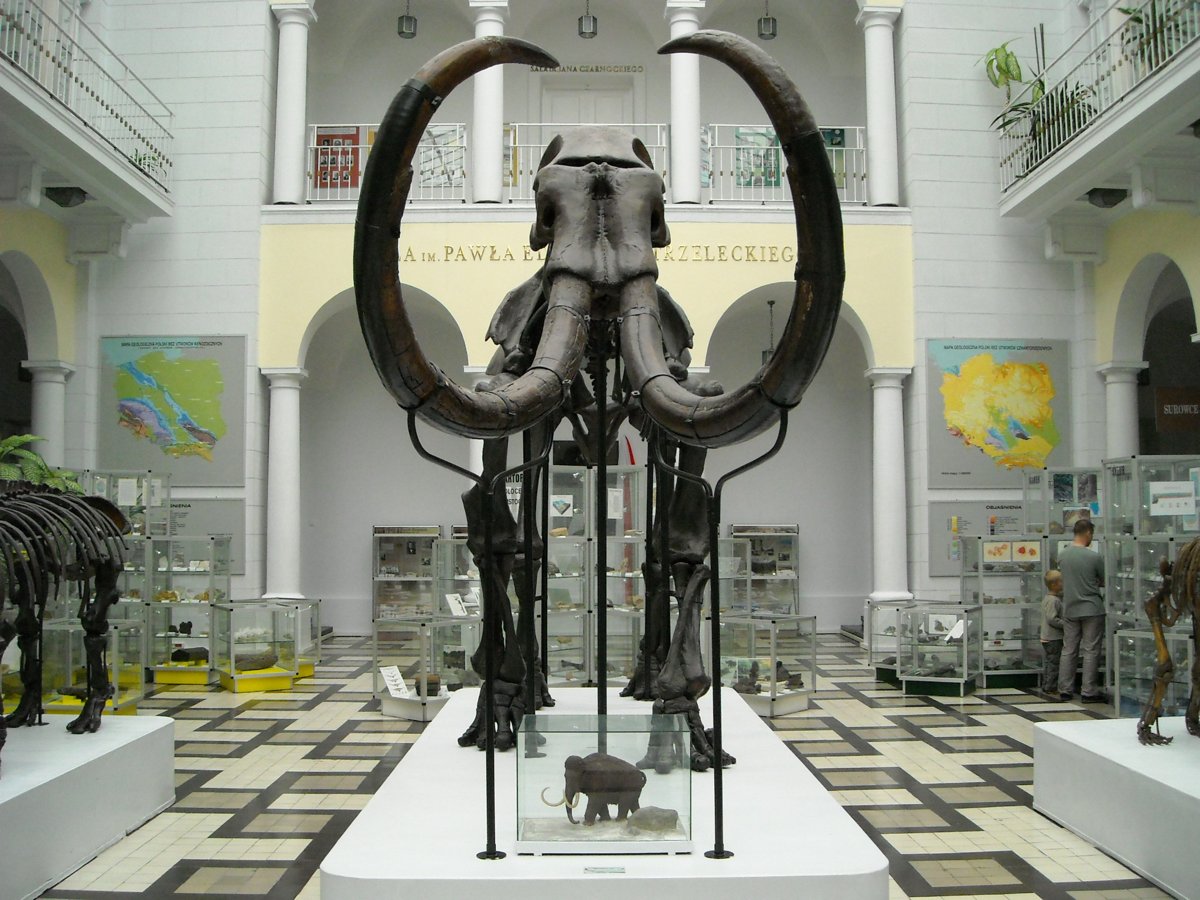
A woolly mammoth skeleton on display in the Geological Museum of the Polish Geological Institute in Warsaw, shown for comparison. It is not from Breitenbach. (Wikipek/CC BY 3.0)
Breitenbach is far from the only place where this argument plays out. The clearest evidence of mammoth hunting in Central Europe comes from Kraków Spadzista in Poland, where a team led by Piotr Wojtal reported in 2019 that "A fragment of a flint shouldered point is embedded in a mammoth rib".
A weapon stuck in bone is direct proof, so hunting at that site is Established.
That proof belongs to the Gravettian, a later culture, and Kraków Spadzista dates to roughly 28,600 to 27,000 years ago.
A 2019 study led by Jarosław Wilczyński compared it with Milovice I in Moravia, in today's Czech Republic, dated to about 30,100 to 29,200 years ago. The authors concluded that "The hunter-gatherers at both sites had a mammoth-hunting focus".
Their mortality profiles differed, with mid-life adults dominating at Milovice and juveniles at Kraków, which the authors linked to different weapons and strategies.
So the best case for mammoth hunting in Central Europe comes thousands of years after Breitenbach. Could the Aurignacian residents of Breitenbach have been doing the same thing much earlier?
The Ukrainian evidence is messier, and at Mezhyrich, known for circular structures built from mammoth bones, a 2025 study questioned how the bone was obtained.
Wei Chu of Leiden University, Pavlo Shydlovskyi of Taras Shevchenko National University of Kyiv and Andreas Maier of the University of Cologne argued that earlier dates relied on "mammoth remains that have likely been primarily obtained through scavenging." They dated the structure they studied to about 18,000 years ago.
The parallel with Breitenbach is direct, since the Mezhyrich team wrote that "Reliable mammoth bone ages range by millennia and may thus indicate a sustained use of scavenged mammoth remains following the LGM," meaning the Last Glacial Maximum.
They allowed that the youngest bones were "possibly indicative of active hunting." Its open peer review was mixed, and one reviewer asked for the evidence behind the scavenging claim, so this reading is Unverified too.
Bone as Fuel and Building Material
Eastern European sites also show what else a mammoth could provide. A 2020 study in Antiquity led by Alexander Pryor on Kostenki 11 in Russia noted that "Circular features made from mammoth bone are known from across Upper Palaeolithic Eastern Europe, and are widely identified as dwellings."
That feature yielded charcoal and burnt bone, though the Mezhyrich paper notes suggestions that the Kostenki 11 rings were too large to roof.
Bone also served as fuel, and here the Boreas team wrote about Breitenbach itself.
They reported "bone coal and burnt bones" there, a sign that, alongside firewood, "faunal remains have been employed as a means of supplementing limited supplies of available wood." They linked the practice to the Aurignacian in general. Bone as fuel at Breitenbach is therefore Established, while bone as a building material there remains Unverified.
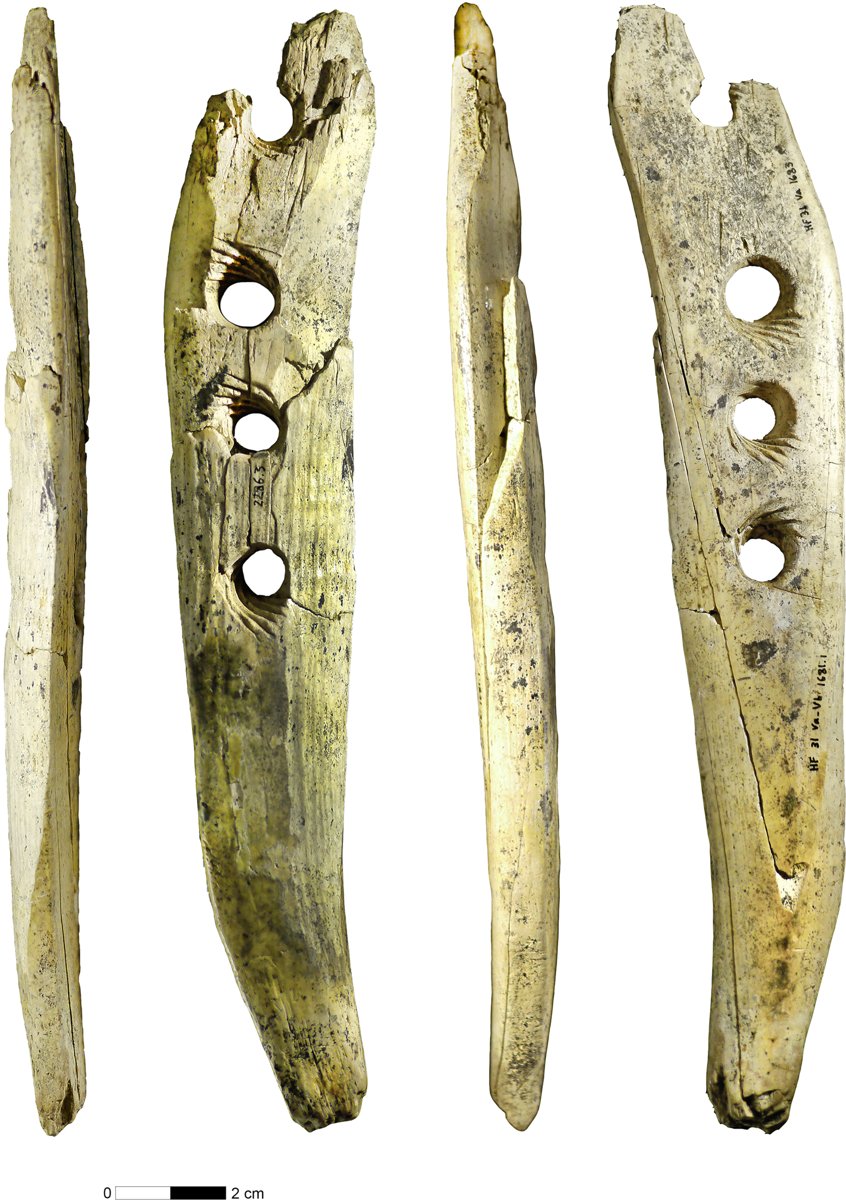
A perforated baton made from mammoth ivory, more than 35,000 years old, from Hohle Fels cave, another Aurignacian site in southwest Germany. It is not a Breitenbach find. (H. Jensen, University of Tübingen/CC BY 4.0)
One route to an answer comes from Hohle Fels, another Aurignacian site in Germany. In 2026 a University of Tübingen team reported in Scientific Reports that it had recovered ancient DNA from mammoth ivory there.
The results support "the interpretation that humans repeatedly accessed ivory from different mammoth herds over time, potentially through direct hunting or collection from a wide geographic range." Similar work could test the Breitenbach tusks.
On the evidence so far, the new bone piles are indicative rather than conclusive. They show that people gathered mammoth remains at one of the largest open-air Aurignacian camps known, and they reopen a question that seemed settled.
Until the cut marks, the dates and the ivory are fully published, the mammoth hunters of Breitenbach remain less a proven fact than a promising lead.
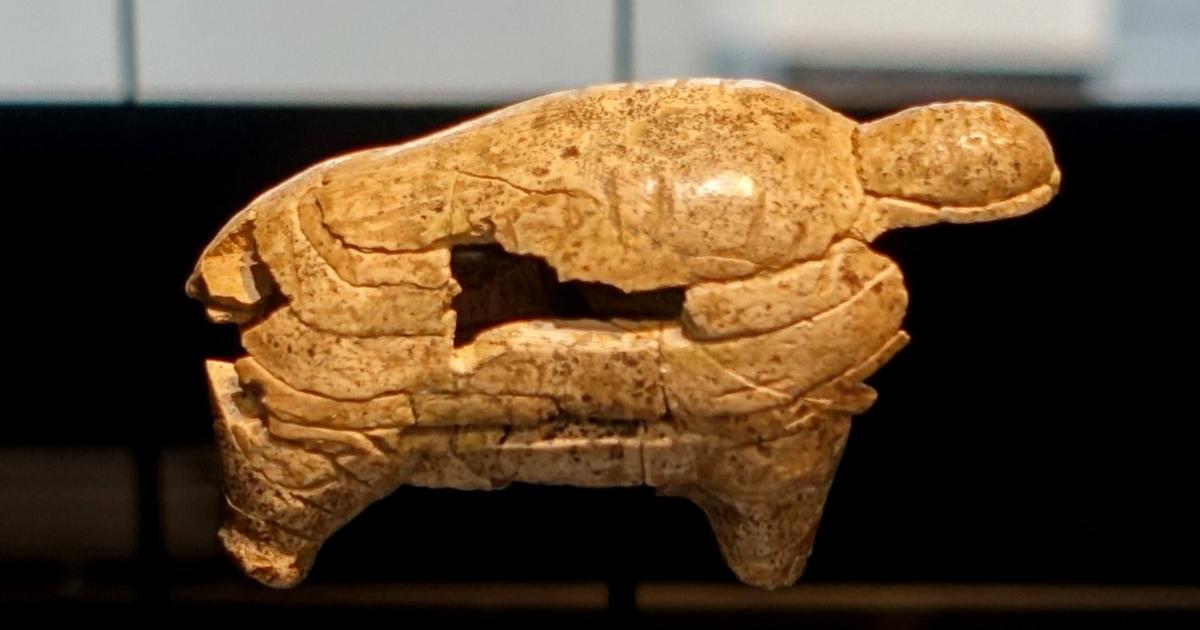
An ivory mammoth from Geißenklösterle cave, another Aurignacian site in southwest Germany. It is not a Breitenbach find. Landesmuseum Württemberg, Stuttgart. Photo: Daderot, via Wikimedia Commons, public domain
By Aris Manus
References
- State Office for Heritage Management and Archaeology Saxony-Anhalt (LDA), press release on the 2026 Breitenbach excavation, October 20, 2026 (German)
- Dario Radley, "Mammoth bones at a 32,000-year-old camp in Germany suggest Stone Age hunters took down live giants," Archaeology News Online Magazine, October 22, 2026
- Mark Milligan, "30,000-year-old site reveals new evidence of mammoth hunting in Ice Age Europe," HeritageDaily, October 20, 2026
- Tilman Böckenförde and colleagues, "The Early Upper Palaeolithic open-air site of Friedrichsdorf-Seulberg, Germany, in the context of the northern central European Aurignacian," Boreas (2026)
- Wei Chu, Pavlo Shydlovskyi and Andreas Maier, "A revised radiocarbon chronology for the mammoth bone structures and associated features at Mezhyrich, Ukraine," Open Research Europe (2025)
- Jarosław Wilczyński and colleagues, "Mammoth hunting strategies during the Late Gravettian in Central Europe as determined from case studies of Milovice I (Czech Republic) and Kraków Spadzista (Poland)," Quaternary Science Reviews (2019)
- Piotr Wojtal and colleagues, Quaternary Science Reviews 213 (2019), on Kraków Spadzista
- Alexander J. E. Pryor and colleagues, "The chronology and function of a new circular mammoth-bone structure at Kostenki 11," Antiquity (2020)
- Moreland and colleagues, "Ancient DNA from the Upper Paleolithic mammoth ivory of Hohle Fels, Germany," Scientific Reports (2026)
- LEIZA, "The Aurignacian Open-air Site Breitenbach (Saxony-Anhalt, Germany)," project page
- LEIZA news, new discoveries at the Breitenbach site (German, 2026)
- idw science news, press release on the Breitenbach ivory workshop, September 13, 2012 (German)
- Wikimedia Commons, Geißenklösterle ivory mammoth, photo by Daderot
- Wikimedia Commons, Mammuthus primigenius 1, photo by Wikipek
- Wikimedia Commons, perforated mammoth ivory baton from Hohle Fels, photo by H. Jensen