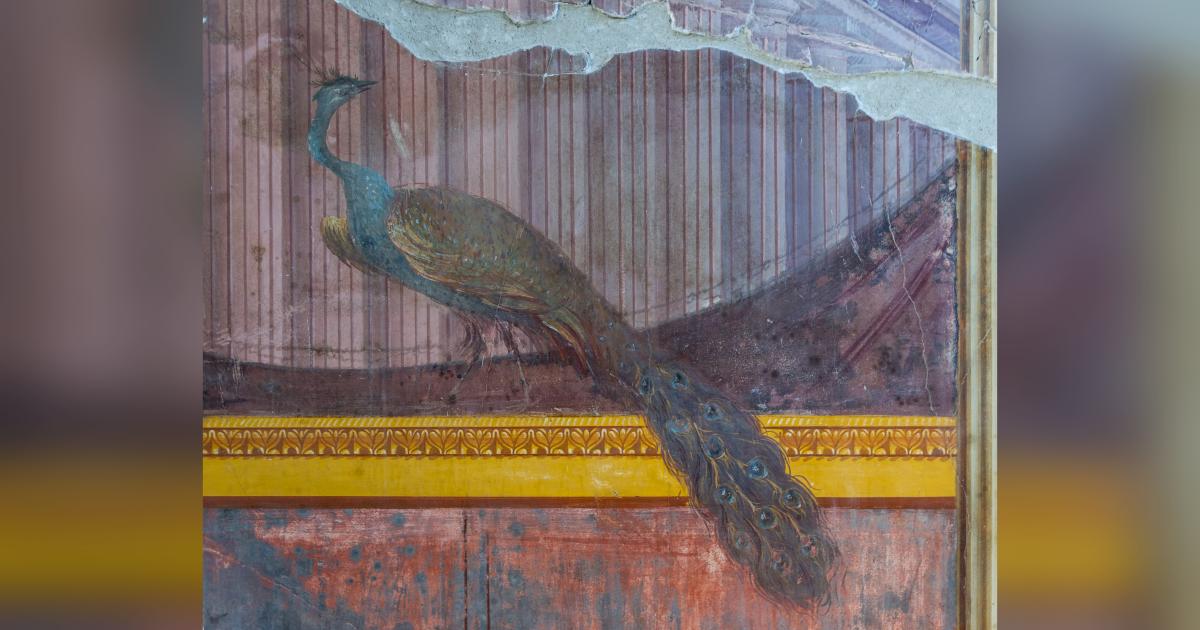

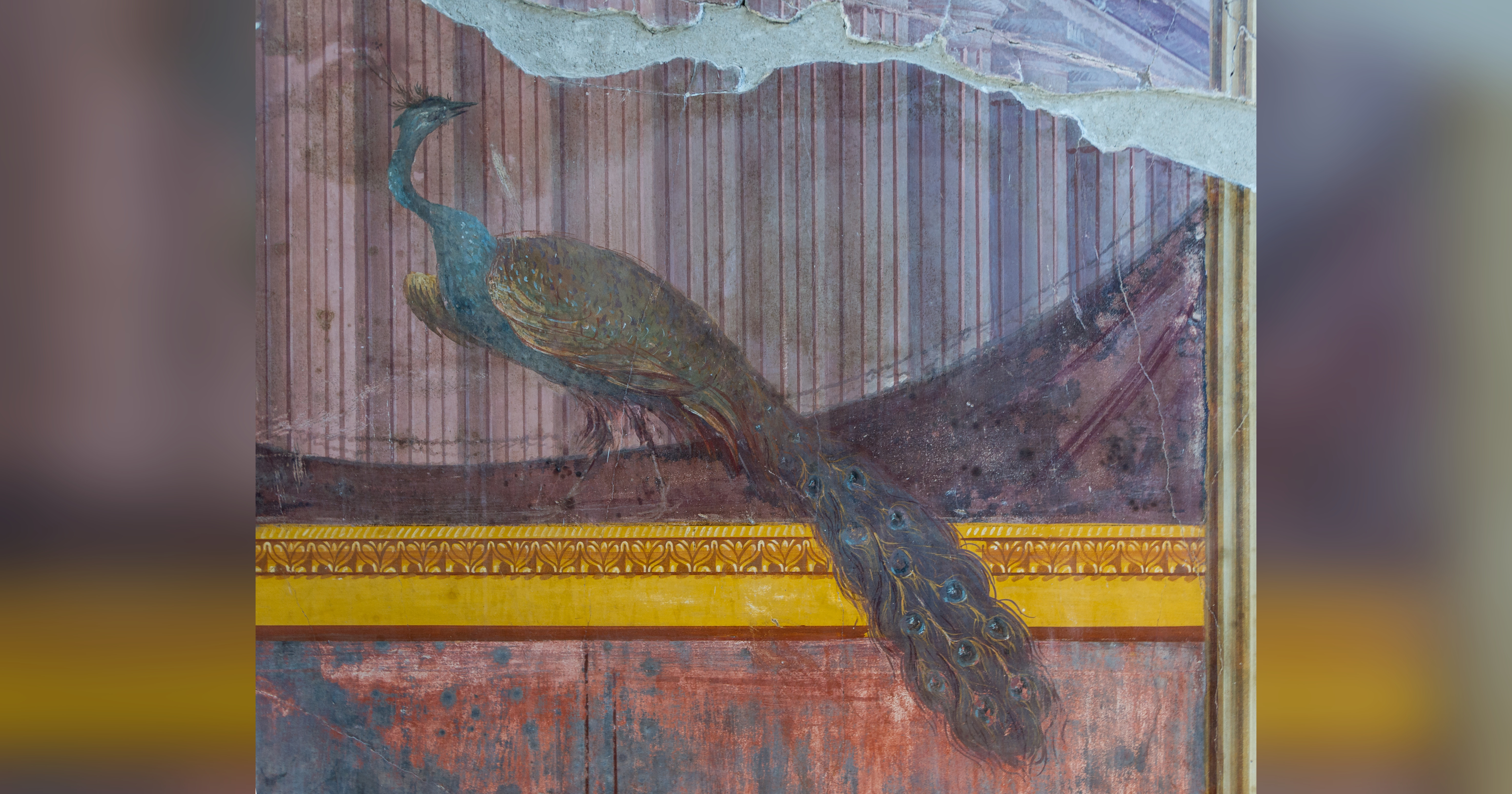
A painted peacock on a wall of Villa A at Oplontis, near Pompeii, Italy, still in place where it was painted. It is shown as a comparable Roman wall painting and is not from the Mérida house. (Image: Jebulon, CC0, via Wikimedia Commons, photo shown unaltered at native size on a wider canvas, with a blurred fill made from the photo added at both sides)
Trainee archaeologists in Mérida, the Roman city of Augusta Emerita in western Spain, have uncovered painted walls in the courtyard of a large townhouse at the Huerta de Otero site. The paintings show peacocks and other birds, a hunting scene and mythological figures. The city council says they are the best wall paintings found in Mérida in more than three decades.
The house is already well known to archaeologists and visitors. In 2023, the same excavation exposed a floor mosaic with the head of Medusa at its center, surrounded by four peacocks that stand for the seasons. The new paintings come from the peristyle, the porticoed garden courtyard at the heart of a wealthy Roman home, close to the room where that mosaic was found.
A Strip of Earth Left Since 1976
Huerta de Otero lies on the western side of Mérida, between the Roman embankment that held back the Guadiana River and the southern wall of the Alcazaba fortress. The plot was first excavated in 1976, before the state acquired it, and then sat largely untouched for decades. Digging resumed in 2019 through the Barraeca vocational schools run by the city council, which train students in archaeological fieldwork under the supervision of the Consorcio de la Ciudad Monumental, the body that manages Mérida's Roman monuments.
This year's students in the Barraeca V program targeted a tongue of earth left in place by the 1976 dig. According to the council's November 17 release, it had blocked a clear view of how the Medusa room connected to the part of the peristyle that was already exposed. Removing it paid off. In the words of José Vargas, the school's archaeology instructor, "the excavation has given us the surprise that wall paintings have appeared that decorate the walls, both outside and inside, of the peristyle" (translated by Ancient Origins).
"They are very well preserved, with motifs that combine nature, rich birdlife and mythological themes," Vargas added in the same release (translated by Ancient Origins).
Birds, a Hunt and a Satyr
Local reporting fills in the detail that the official release leaves out. Speaking to Cadena SER in early November, Vargas described panels on the inner face of the courtyard separated by low walls, with cranes, peacocks and other birds. He also described a satyr, the minor mythological figure who attended Bacchus at his wine banquets. As digging continued, a hunting scene appeared, which he said clearly shows a feline running after a pair of deer.
The newspaper Hoy reported a slightly different version of the hunt, describing a lion chasing a deer. It also listed swans among the birds and said the satyr appears beside a woman. El Periódico Extremadura mentioned peacocks, a swan, trees and a mythological scene linked to a Bacchic banquet. Until the panels are published in full, the safest description is a big cat pursuing deer.
Hoy also reported a date for the paintings of between the middle of the 1st century and the middle of the 2nd century AD. The council release itself gives no date, so that range should be treated as provisional.
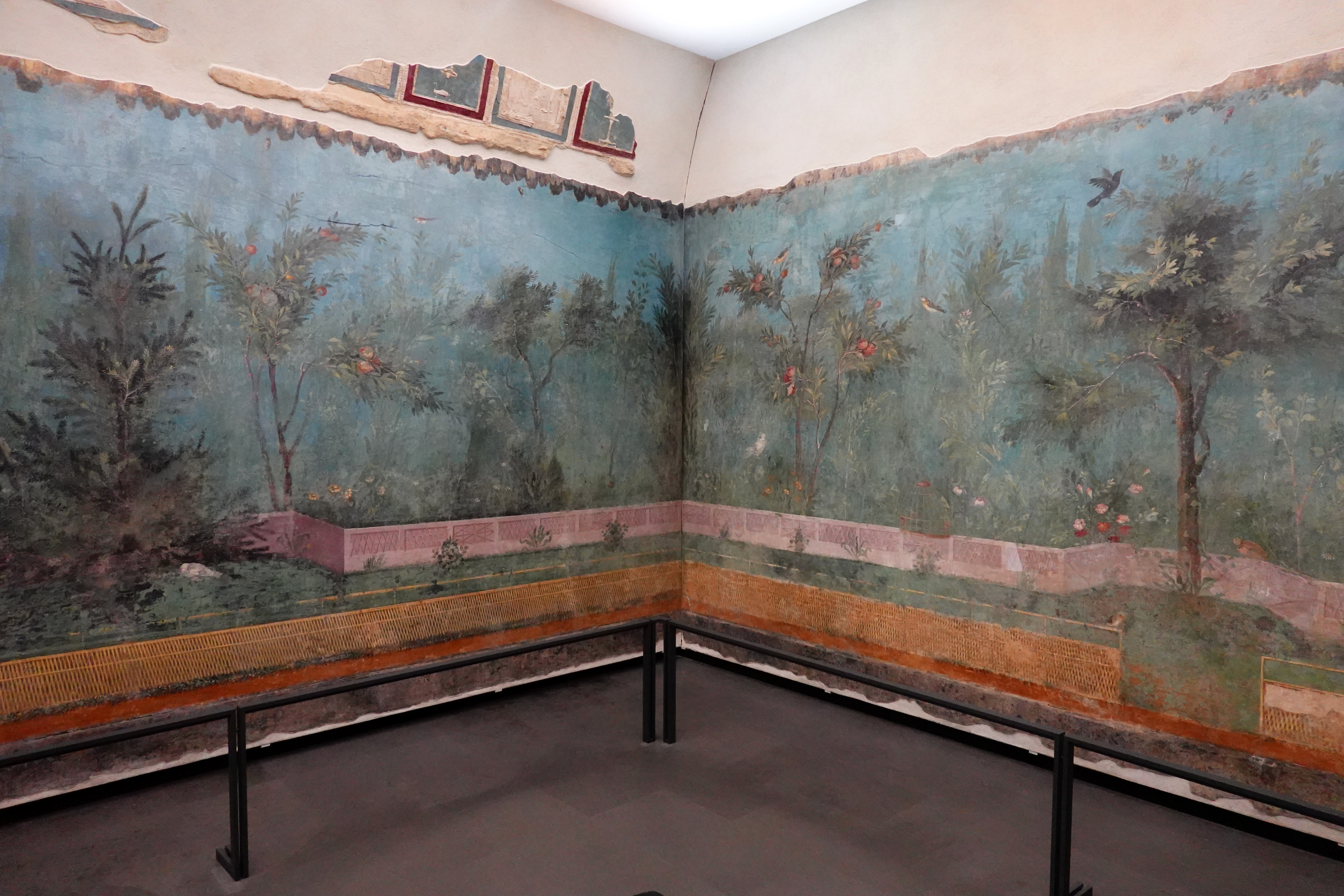
The painted garden room from the Villa of Livia at Prima Porta, 30 to 20 BC, now in the Palazzo Massimo alle Terme, Rome. It is shown as a comparable Roman garden painting with birds and is not from the Mérida house. (Image: Richard Mortel, CC BY 2.0, via Wikimedia Commons, shown at native size)
Why Would a Roman Paint Peacocks?
Painted gardens, birds and hunting scenes were common choices for the walls around Roman garden courtyards, where they seemed to extend the real planting. Ancient Origins has covered similar work, including a hunting fresco in Pompeii restored with lasers and newly uncovered frescoes with birds and a peacock at the Villa Poppaea at Oplontis.
For the city council, the birds were also a statement about status. Pilar Amor, the council delegate for employment training, called them "paintings of peacocks in the peristyle, which are images very representative of the power that the people who lived in this domus must have accumulated" (translated by Ancient Origins).
The council's own page for a public tour of the site goes further. "The rich decoration and the quality of preservation mean that these are the best wall paintings found in Mérida in more than thirty years," it states (translated by Ancient Origins). Vargas told Cadena SER that the only local paintings in comparable condition were those found on Calle Parejo in 1996 and 1997.
The House of the Medusa
The new finds add to a remarkable floor. According to the council's 2023 release, the main room of the house was paved with a polychrome mosaic of about 30 square meters (323 square feet). A Medusa head sits in an octagonal medallion, with four peacocks representing the seasons placed in hexagons at the corners, framed by flowers, birds, fish and masks.
"The appearance of the image of Medusa is typical of mosaic floors of the 2nd century AD, as a prophylactic sign or a sign of protection for the inhabitants of the domus," Vargas said at the time (translated by Ancient Origins). Félix Palma, director of the Consorcio, added that the site "is exceptional in character because of the level of preservation of the remains and, above all, because of the ornamental scheme that decorates the house" (translated by Ancient Origins). Ancient Origins reported on that discovery in its article on the Medusa mosaic from Huerta de Otero.
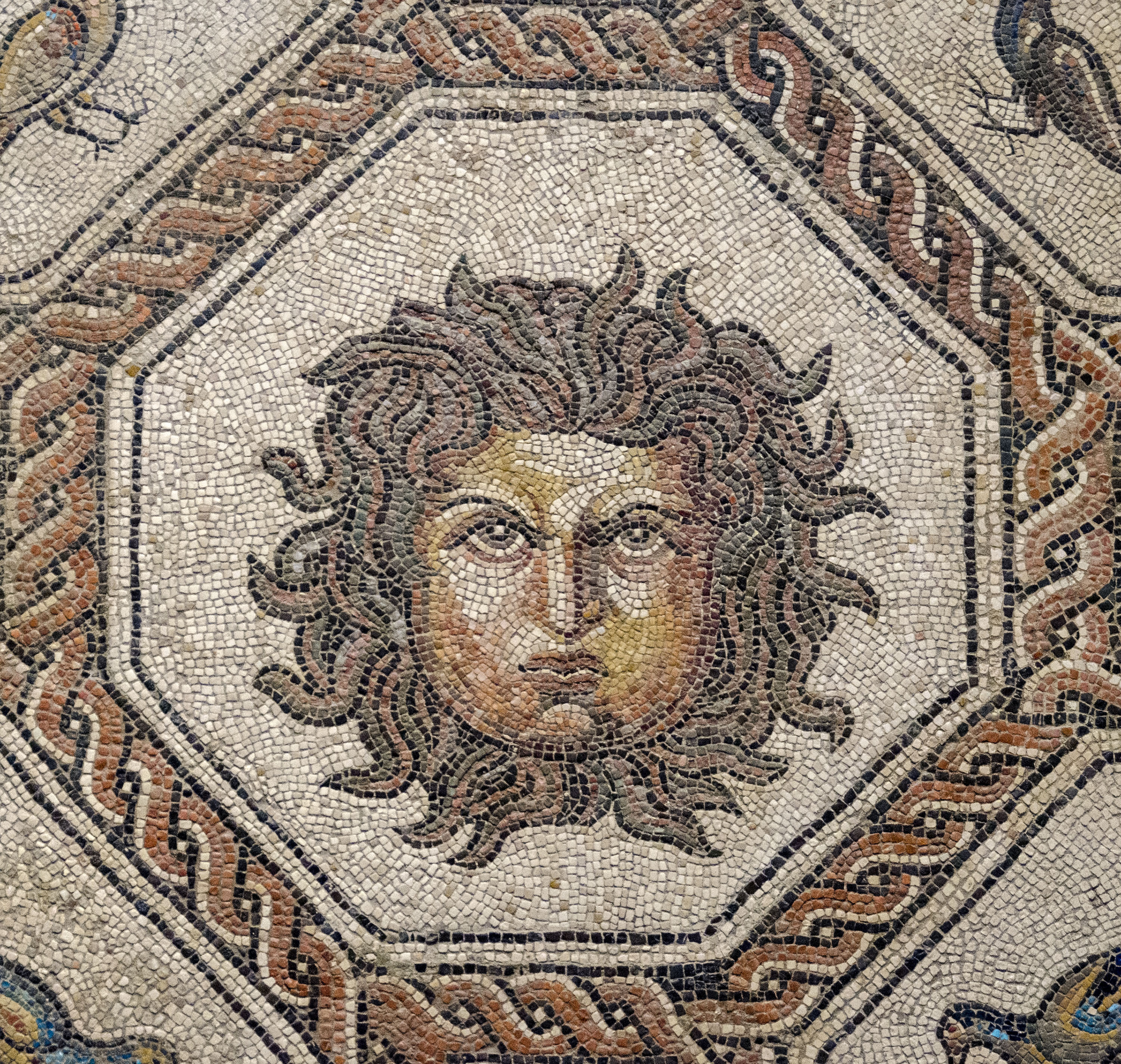
Part of the Medusa and Seasons mosaic from Palencia, Spain, dated to the 4th century AD, in the National Archaeological Museum, Madrid. It is shown as a comparable Spanish Medusa mosaic and is not from the Mérida house. (Image: Ángel M. Felicísimo, CC BY 2.0, via Wikimedia Commons, shown at native size)
A Mansion Barely Begun
The house was large even by the standards of Augusta Emerita, which Greek Reporter notes was founded under Augustus as a colony for veteran soldiers and later the capital of the province of Lusitania. According to the Consorcio, as quoted by El Periódico Extremadura, it had several courtyards at different levels linked by a marble staircase, private baths and rooms with geometric and figurative mosaics.
The 2023 release adds that excavations between 2019 and 2023 exposed about 40 meters (131 feet) of the city's founding wall, 2.7 meters (9 feet) thick and surviving up to 5 meters (16 feet) high. A 6-meter-wide (20-foot) street ran along its inner face, and private baths built in the 4th century AD later covered part of it.
Most of the Huerta de Otero site still lies underground. Vargas said in the council release that "the Huerta Otero plot covers more than 5,000 square meters and we will have excavated fifteen percent" (translated by Ancient Origins). Hoy reported him as saying that much remains to be dug under eight meters of earth. He also told the paper that the students had found a mosaic path running through the peristyle, and a geometric mosaic in excellent condition that has yet to be formally presented.
However, the next phase depends on the training program. The council says the Barraeca V course ends in December, and a new school starts in January with a training period before digging resumes. The council also scheduled a guided tour, titled "Paseo por la Domus en la Huerta de Otero," for Sunday, November 22, limited to 20 adults chosen by lottery.
Vargas told Cadena SER that once fully excavated, Huerta de Otero could rank alongside the House of the Mithraeum and the House of the Amphitheater, two of Mérida's best known Roman homes. With only about 15 percent of the plot explored, that comparison remains a forecast. However, the painted courtyard already shows how lavishly one family of Augusta Emerita decorated its home.
By Aris Manus
Sources
Ayuntamiento de Mérida. 2026. "El yacimiento de Huerta de Otero, en el que trabaja la escuela Barraeca V, suma nuevos hallazgos arqueológicos con unas pinturas murales." November 17, 2026. In Spanish. Available at: https://merida.es/el-yacimiento-de-huerta-de-otero-en-el-que-trabaja-la…
Ayuntamiento de Mérida. 2026. Visita Guiada "Paseo por la Domus en la Huerta de Otero". In Spanish. Available at: https://merida.es/agenda/visita-guiada-huerta-otero/
Ayuntamiento de Mérida. 2023. "Las excavaciones en la Huerta de Otero sacan a la luz el gran mosaico de Medusa en la estancia principal de una espléndida domus romana." July 26, 2023. In Spanish. Available at: https://merida.es/las-excavaciones-en-la-huerta-de-otero-sacan-a-la-luz…
Hidalgo Sancho, C. 2026. "La Huerta de Otero revela unas de las mejores pinturas romanas halladas en Mérida en 30 años." El Periódico Extremadura, November 17, 2026. In Spanish. Available at: https://www.elperiodicoextremadura.com/merida/2026/11/17/huerta-otero-r…
Vinagre, C. J. 2026. "Un yacimiento en Mérida saca a la luz nuevos mosaicos romanos y pinturas murales de gran valor." Hoy, November 17, 2026. In Spanish. Available at: https://www.hoy.es/merida/yacimiento-merida-saca-luz-nuevos-mosaicos-ro…
Greek Reporter. 2026. "Archaeologists Discover Remarkably Preserved Roman Wall Paintings in Spain." November 18, 2026. Available at: https://greekreporter.com/2026/11/18/archaeologists-roman-wall-painting…
Escobar, M. M. 2026. "Nuevas pinturas murales amplían los hallazgos en Huerta de Otero." Cadena SER, November 5, 2026. In Spanish. Available at: https://cadenaser.com/extremadura/2026/11/05/nuevas-pinturas-murales-am…