
Fact Check verdict: Established. Newgrange dates to about 3200 BC, before Egypt's first pyramid and Stonehenge's first earthwork, and its roof-box admits the midwinter sunrise by design in the view of the surveys read.
Newgrange is a passage tomb on the north bank of the River Boyne, about 50 kilometers north of Dublin. Its builders lived in Neolithic Ireland, and the claim that their monument outdates the pyramids is repeated in guidebooks and across the web. So how well does it hold up?
Where the claim comes from
The claim appears in this form on newgrange.com, a website devoted to the monument, which describes it this way: "Built around 5,200 years ago, in approximately 3200 BC, it is older than both Stonehenge and the Great Pyramids of Giza."
The second half of the claim concerns light. The same site says that from 19 to 23 December, at dawn, "a narrow beam of light penetrates the roof-box and reaches the floor of the chamber," an opening above the entrance to the passage.
How old is Newgrange?
The Office of Public Works, which manages the site, says the passage tombs of Knowth, Newgrange and Dowth "were built circa 3200BC." UNESCO lists the group as Brú na Bóinne, inscribed as a World Heritage Site in 1993, and calls it Europe's largest concentration of prehistoric megalithic art.
A 2024 research report commissioned by Ireland's National Monuments Service and led by the surveyor Frank Prendergast gives the same date. It says the three great mounds "were constructed around 3200 BC during the Middle Neolithic," a period it dates to between 3600 and 2900 BC in Ireland.
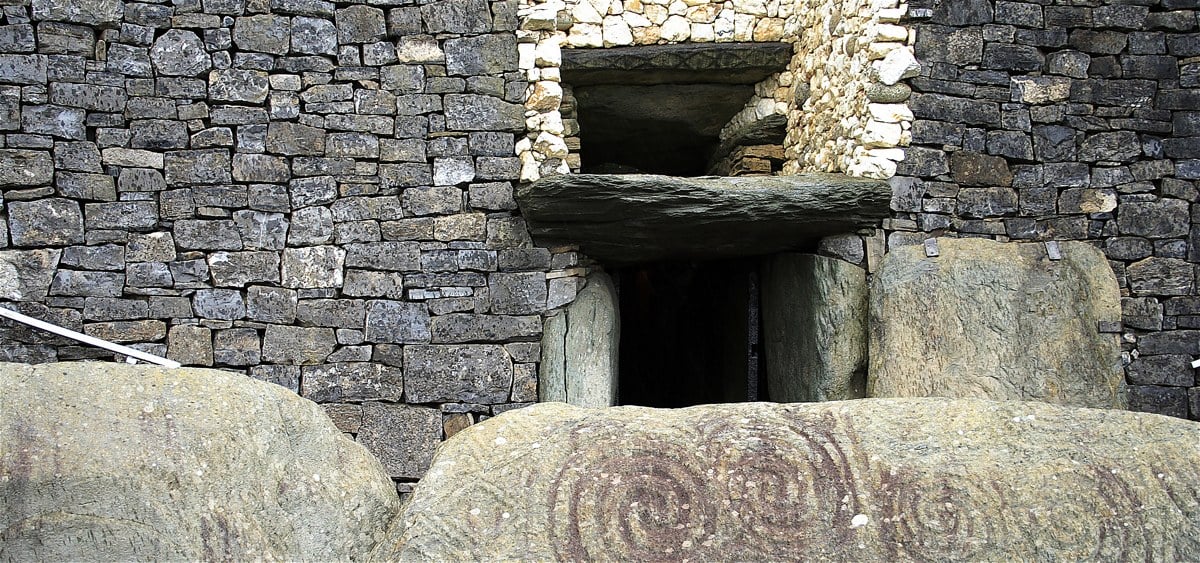
The entrance to Newgrange, with the roof-box opening above the doorway and the carved entrance stone in front. Photo by Allen Karsina, 2006, via Wikimedia Commons, public domain, resized.
Older than the pyramids and Stonehenge?
Egypt's first pyramid is the Step Pyramid of Djoser at Saqqara. Egypt's Ministry of Tourism and Antiquities says it was built in the early Third Dynasty, in the reign of King Netjerykhet, known as Djoser, in about 2667 to 2648 BC. UNESCO calls it "the oldest pyramid to be constructed."
On those figures, Newgrange came about five centuries before the first pyramid in Egypt. Every later pyramid, including the Great Pyramid of Khufu at Giza that most people picture, came after Djoser's, so the gap with Giza is wider still.
Stonehenge makes for a closer comparison, and English Heritage says its earliest known major phase was a circular ditch and bank "built about 3000 BC," and that the stones were set up "In about 2500 BC." Newgrange is older than both, though the gap with the first earthwork is only about two centuries.
Was it built for the solstice?
The light inside the tomb was recorded in modern times by Michael O'Kelly, who excavated and restored the monument. The 2024 report says he visited on the winter solstice of 1967 and documented the effect on 21 December 1969, when he timed a beam of sunlight that lit the chamber for 17 minutes.
Whether that beam was intended has been tested. The surveyor Jon Patrick measured the alignment in the 1970s, and the astronomer Douglas Heggie doubted his case. Tom Ray then resurveyed the tomb in the late 1980s, and his 1989 paper in Nature argued that the width and height of the gap in the floor of the roof-box "may have been deliberate, tracing the path of the Sun at the solstice."
The 2024 report summarizes Ray's finding that the roof-box "was very probably designed in width, height and with astronomical alignment intent." Ray also showed that, because of a slow change in the tilt of the Earth, sunlight in about 3200 BC would have reached deeper into the chamber than it does today.
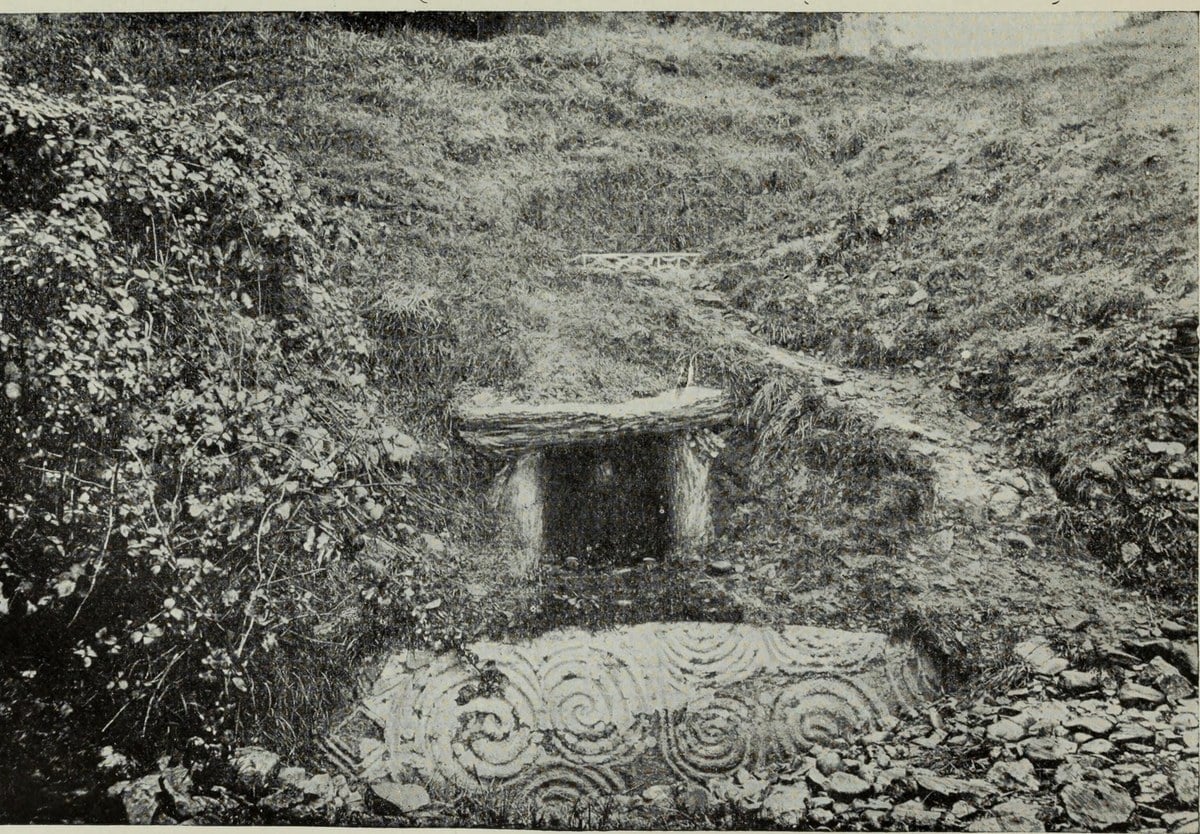
The entrance to Newgrange and its carved entrance stone, in a photograph by Robert Welch of Belfast published in 1910, decades before the excavation and restoration of the 1960s. From T. W. Rolleston's Myths and Legends of the Celtic Race, via Wikimedia Commons_(14596737390).jpg), public domain, resized.
The challenge to the roof-box
The account has a critic, and in 2016 The Irish Times reported a paper in the journal Emania by the archaeologist Michael Gibbons, a former co-director of the national sites and monuments record office, and his nephew Myles Gibbons.
Gibbons said the roof-box had "not a shred of authenticity" and was "fabricated" during the restoration of the 1960s. The paper also argued that later Iron Age activity at Newgrange had been played down, a point the archaeologist Robert Hensey partly accepted.
Hensey rejected the main charge, however. In a statement reported by TheJournal.ie, the Office of Public Works cited him saying "There is no question that the roof-box is a modern construct or invention," and that the excavation archive allows a comparison of the roof-box before and after restoration. The office called the suggestion "entirely untrue" and released photographs from 1935 and 1954 that, it said, show the roof-box in the same position before the excavation.
Where this leaves it
Newgrange was built around 3200 BC, about five centuries before Egypt's first pyramid and a little before Stonehenge's first earthwork. Its roof-box admits the midwinter sunrise, and the surveys read for this check judge that effect to be very probably intended by the builders.
The case for design rests on measurement and probability, since the builders left no written record of their aims. The one serious challenge, that the roof-box was invented during restoration, is contradicted, according to the Office of Public Works, by photographs taken decades before the excavation began.
Earlier Ancient Origins coverage reported the roof-box challenge as it broke, and an earlier fact check looked at where Stonehenge's stones came from. Background on the monument is in the Newgrange atlas entry.
How we checked this
Read for this check were the Office of Public Works and World Heritage Ireland pages, the 2024 National Monuments Service report, the abstract of Ray's paper in Nature, UNESCO's listings for Brú na Bóinne and Memphis, Egypt's Ministry of Tourism and Antiquities, English Heritage, The Irish Times and TheJournal.ie.
Patrick's and Heggie's work, and O'Kelly's 1982 book, are cited as reported in the 2024 report. The Gibbons paper in Emania was not read, so its case is given as reported by The Irish Times. Earlier Ancient Origins coverage was not a source, and the labels are explained on the evidence standards page.
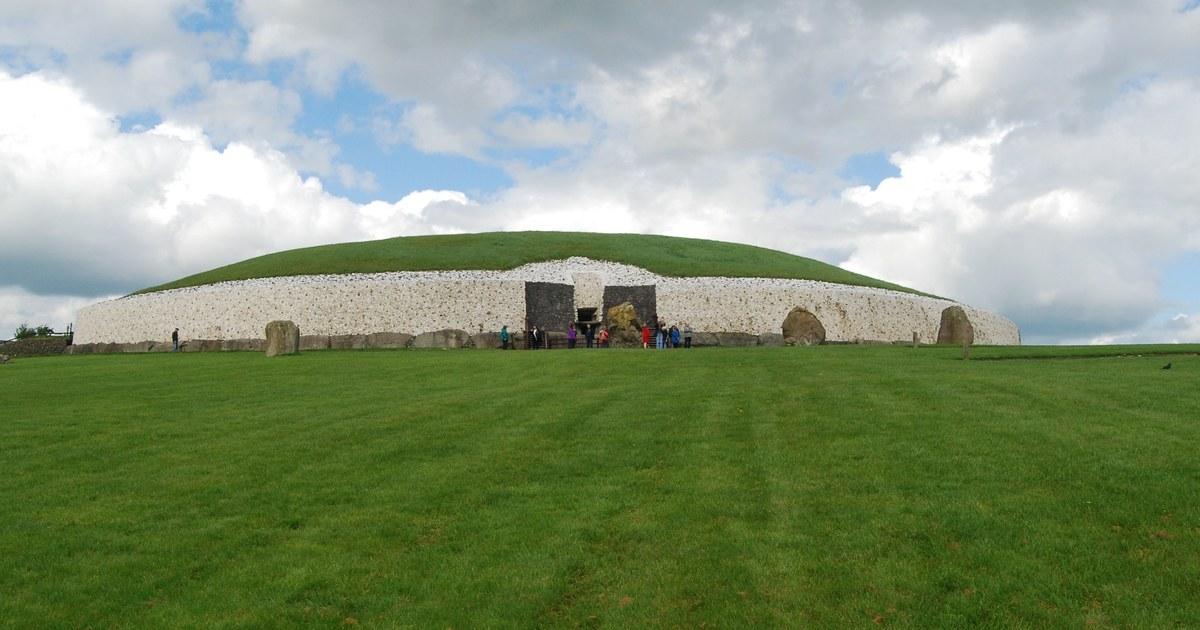
The restored passage tomb of Newgrange in the Boyne Valley, Ireland. Photo by jemartin03 via Wikimedia Commons, CC BY 2.0 (https://creativecommons.org/licenses/by/2.0/), cropped and resized
By Aris Manus
Claim by claim
- Established: Newgrange is older than the Egyptian pyramids and Stonehenge, and it was built to catch the winter solstice sunrise. Reason: its date of about 3200 BC precedes both, and the surveys read judge the solstice alignment very probably intended.
- Established: Newgrange was built around 3200 BC. Reason: the Office of Public Works and the National Monuments Service report.
- Established: Egypt's first pyramid, the Step Pyramid of Djoser, dates to about 2667 to 2648 BC. Reason: Egypt's Ministry of Tourism and Antiquities and UNESCO.
- Established: Stonehenge began as an earthwork about 3000 BC, and its stones went up about 2500 BC. Reason: English Heritage.
- Established: Sunlight enters the chamber through the roof-box around the winter solstice. Reason: O'Kelly's 1969 record and the 2024 report.
- Unverified: The roof-box was fabricated during the restoration of the 1960s. Reason: the Office of Public Works says photographs from 1935 and 1954 show it in place before the excavation, and Robert Hensey cites the excavation archive.
Sources
Prendergast, Frank, et al. (2024). Winter Solstice Phenomenon at Newgrange: Research Report 2024. Commissioned by the National Monuments Service, World Heritage Ireland.
Ray, T. P. (1989). The winter solstice phenomenon at Newgrange, Ireland: accident or design? Nature 337, pp. 343 to 345. Abstract.
Office of Public Works, Heritage Ireland. Brú na Bóinne Visitor Centre, Newgrange and Knowth.
World Heritage Ireland. Winter Solstice.
UNESCO World Heritage Centre. Brú na Bóinne, Archaeological Ensemble of the Bend of the Boyne. World Heritage List, property 659.
UNESCO World Heritage Centre. Memphis and its Necropolis, the Pyramid Fields from Giza to Dahshur. World Heritage List, property 86.
Ministry of Tourism and Antiquities, Egypt. The Step Pyramid Complex of Djoser.
English Heritage. History of Stonehenge.
The Irish Times (2016). Newgrange "sun trap" may be only 50 years old, says archaeologist.
TheJournal.ie (2016). Newgrange's winter solstice is only 50 years old? No way, says OPW.
Newgrange.com. Newgrange, World Heritage Site. Cited for the claim only.