

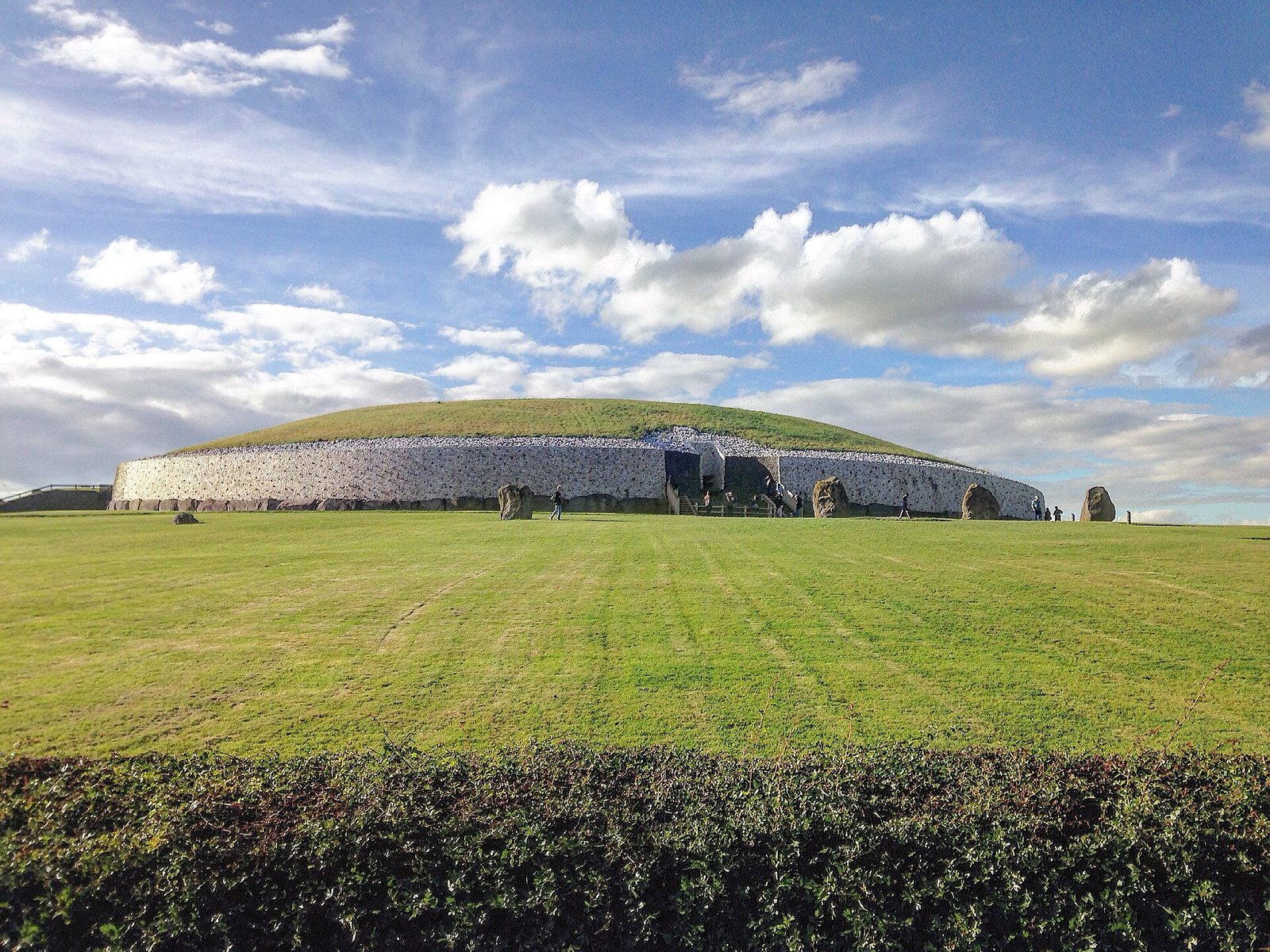
Photo: Tjp finn, CC BY-SA 4.0 via Wikimedia Commons Source
Newgrange is a great passage tomb in the Boyne Valley of County Meath, Ireland. It was built around 3200 BC, which makes it older than Stonehenge and the Giza pyramids. At the winter solstice the rising sun shines through a roof box and lights its inner chamber, and it is part of the Brú na Bóinne World Heritage Site.
A great passage tomb in the Boyne Valley whose roof box lets the midwinter sunrise light the inner chamber. It is protected as a national monument of Ireland. It is part of Brú na Bóinne.
- Country
- Ireland
- Region
- Europe
- Period
- about 3200 BC
- Kind of site
- Irish passage tomb, tomb
- Heritage status
- World Heritage Site; National monument of Ireland
- Part of
- Brú na Bóinne
- Located in
- County Meath, Ireland
- Also known as
- Newgrange Passage Tomb
- Coordinates
- 53.6947° N, 6.4756° WWikipedia and Wikidata agree within 0.0 km
- UNESCO
- World Heritage site 659
- Reference
- Wikidata Q339503
- Encyclopedia
- Wikipedia article
About this place
Newgrange is a prehistoric monument in County Meath in Ireland, placed on a rise overlooking the River Boyne, eight kilometers west of the town of Drogheda. It is an exceptionally grand passage tomb built during the Neolithic Period, around 3100 BC, making it older than Stonehenge and the Egyptian pyramids. Newgrange is the main monument in the Brú na Bóinne complex, a World Heritage Site that also includes the passage tombs of Knowth and Dowth, as well as other henges, burial mounds and standing stones. Newgrange consists of a large circular mound with an inner stone passageway and cruciform chamber. Burnt and unburnt human bones and possible grave goods or votive offerings were found in this chamber. The monument has a striking façade made mostly of white quartz cobblestones and ringed by engraved kerbstones.
Adapted from the Wikipedia article Newgrange (this version), lightly edited for style, under the CC BY-SA 4.0 license.
Nearby places
Open in the Atlas →- Knowth 1.3 km (0.8 mi)
- Brú na Bóinne 1.7 km (1.1 mi)
- Dowth 2.0 km (1.2 mi)
- Townleyhall passage grave 3.3 km (2.1 mi)
- Hill of Slane 5.1 km (3.2 mi)
- Mellifont Abbey 5.3 km (3.3 mi)














Recent comments