
Fact Check verdict:
Many bluestones came from the Preseli Hills in Wales, and the Altar Stone from north-east Scotland: Established
Whether people or glacier ice moved the bluestones about 230 km, and whether Waun Mawn was an earlier circle: Disputed
How the Altar Stone traveled about 700 to 750 km: Unverified
The story of Merlin and the giants is medieval folklore, first written down about 1136: Established
Giants, wizards or alien help moved the stones: Fringe
The verdict
At the center of Stonehenge lies a six-tonne sandstone slab whose grains point to north-east Scotland. Verdict: the claim splits into nine parts. Established: many bluestones match Preseli outcrops in Wales, the Altar Stone matches Scotland's Orcadian Basin, and the Merlin story is medieval folklore. Disputed: that people hauled the bluestones from Wales, that ice carried them instead, that Waun Mawn was an earlier circle moved to Stonehenge, and that most sarsens came from West Woods. Unverified: the route the Altar Stone took. Fringe: giants, wizards or alien help.
- Established: Many bluestones match outcrops in the Preseli Hills of west Wales, including Carn Goedog and Craig Rhos-y-felin. Reason: rock types and chemistry tie stones to named outcrops, and even Brian John, who argues for ice, writes of "their multiple sources in West Wales".
- Disputed: People quarried the bluestones and moved them about 230 km to Salisbury Plain. Reason: most archaeologists accept it, as even Brian John notes, and it rests on quarry features dated to about 3000 BC, yet its own supporters admit "There is scant evidence for either hypothesis".
- Disputed: Glacier ice carried the bluestones most of the way to Salisbury Plain. Reason: earth scientists have argued it in peer-reviewed journals since 1971, and the sand-grain test that counts hardest against it is one study from 2026.
- Disputed: Waun Mawn was an earlier stone circle, partly dismantled and rebuilt at Stonehenge. Reason: excavators and critics read the same stoneholes as one great ring or as smaller settings.
- Established: The Altar Stone's mineral grains match the Old Red Sandstone of the Orcadian Basin in north-east Scotland, not Wales and not Mainland Orkney. Reason: dated zircon, apatite and rutile grains give the match, and separate mineral work rules out Mainland Orkney.
- Unverified: How the Altar Stone traveled about 700 to 750 km, by sea, overland or partly by ice. Reason: no physical trace of the journey has been reported, so every proposed route is an inference.
- Disputed: Most of the big sarsens came from West Woods, Wiltshire, about 25 km north. Reason: one geochemical study points there, and a reanalysis says several sources remain possible.
- Established: The Merlin story is medieval folklore, first written down by Geoffrey of Monmouth about 1136. Reason: the text survives and dates from about 4,000 years after building began.
- Fringe: Giants, wizards or alien help moved the stones. Reason: no evidence supports it, and the Waun Mawn excavators call the legend "clearly fantasy".
What the evidence says
Mike Parker Pearson and colleagues write that "the bluestones of Stonehenge came from the Preseli Hills of west Wales, 230km away". In 2019 they reported that Carn Goedog and Craig Rhos-y-felin "have now been excavated to reveal evidence of megalith quarrying around 3000 BC". Their 2015 paper, reported here at the time, set out two possible routes, overland at "around 220 miles" or by sea, noting that "the shorter sea route is about 180 miles long".
Anthony Clarke and colleagues dated grains inside the Altar Stone and found "a remarkable similarity to the Old Red Sandstone of the Orcadian Basin in northeast Scotland". That places the source "at least 750 km from its current location", a result covered here in 2024. Richard Bevins and colleagues then tested Orkney and concluded that "the Altar Stone was not sourced from Mainland Orkney". Parker Pearson's team see in such distant stones "a monument of island-wide unification".
The big sarsens are local. David Nash and colleagues found that "50 of the 52 sarsens at the monument share a consistent chemistry" and named West Woods, Wiltshire, as "the most probable source area for the majority of sarsens at the monument".
As for Merlin, English Heritage notes that "The oldest surviving story of the building of Stonehenge was written about 1136 by Geoffrey of Monmouth". In Geoffrey's telling, "The giants of old brought them from the farthest coasts of Africa, and placed them in Ireland". The episode ends with "a manifest proof of the prevalence of art above strength".
The alternative view
Some earth scientists hold that ice brought the bluestones east. Geoffrey Kellaway argued in Nature in 1971 that "Spreading ice sheets rather than human activity could have brought the rocks to Salisbury Plain." Brian John notes that "For a century most archaeologists have accepted that the stones were transported by humans, but a number of earth scientists have taken the view that they were entrained and transported to Salisbury Plain by glacier ice", and that "There is remarkably little evidence in support of either theory". His 2024 study of the Newall boulder, dug up at Stonehenge in 1924, argues that its shape is glacial and that "The elaborate archaeological narrative of bluestone quarrying and human transport to Stonehenge must now be re-examined".
The replies have been firm. Parker Pearson's 2015 paper noted "there is no evidence for glacial deposition within southern central England". By 2019 the team wrote that their work "conclusively invalidates the misconception that Pliocene or Pleistocene glaciers may have transported the bluestones to Salisbury Plain". In 2025 Bevins and colleagues reported "no evidence to support an interpretation that it is a glacial erratic", tracing the Newall boulder to Craig Rhos-y-Felin. In 2026 Clarke and Chris Kirkland dated more than seven hundred mineral grains from streams around the monument and concluded that "Salisbury Plain remained unglaciated during the Pleistocene, making direct glacial transport of Stonehenge's megaliths unlikely" (our report on the grains). We keep it at Disputed because specialists still argue it in journals, and the strongest test against it is one recent study.
Waun Mawn is contested too. Parker Pearson's team reported that "the diameter of this former stone circle was 110m", dated to about 3000 BC and aligned on midsummer sunrise like Stonehenge's ditch. Timothy Darvill replied that "Waun Mawn is argued to represent a series of smaller stone settings", and that a Welsh source-circle "cannot be excluded but, the author argues, the claim is unsupported by the current evidence". The excavators replied that a central hearth "reinforces the authors' original interpretation". John writes that "it has still not been demonstrated that there ever was a small stone circle here, let alone a 'giant' one".
The Altar Stone's route is open. Clarke's 2024 team favored the sea, because overland haulage from Scotland would face "topographic barriers". In 2026 Clarke, Remy Veness, Kirkland and colleagues found Caithness sandstones gave "the closest match in zircon age structure". Ice could have carried it towards Dogger Bank, which "would reduce the anthropogenic transport distance required to Stonehenge from 700 km to 400 km", although Dogger Bank flooded before the stone likely arrived. Their summary: "Even under a glacially assisted scenario, substantial anthropogenic transport would have remained necessary."
The sarsens have their own quarrel. Ronald Hancock and colleagues reassessed Stone 58 and suggested "that three to six sources cannot be ruled out". Nash and Timothy Ciborowski replied that "there are three significant methodological issues with the study". Hancock's team: "We maintain that no definitive geochemical match for stone #58 can be argued based on the available data."
Clarke and Kirkland note that "Others might mention giants, wizards, or alien assistance to explain the transport of Stonehenge's stones". The Waun Mawn excavators say Geoffrey's legend "is clearly fantasy: there never were any giants", and add that "none of Stonehenge's stones come from Ireland".
Where this leaves it
Where the stones came from is now largely measured. How they moved is still argued, by people who agree that evidence for the journey itself is thin. The sharpest open question is the Altar Stone. Did people carry it down the coast by boat, or did ice do part of the work before people finished the last stretch?
How we checked this
We read in full Parker Pearson 2015, 2019, 2021 (post-referee version) and 2022 (accepted manuscript), Darvill 2022, John's boulder paper, Clarke 2024, Clarke and Kirkland 2026, Bevins 2024, Nash 2020, both Conversation articles, English Heritage and Geoffrey's text. For the rest we read the abstract or summary only. Every quote was checked against a saved copy on 20 October 2026.
How we label claims: see How we check evidence.
More in this series: Göbekli Tepe, the Sphinx and Atlantis: what the evidence says.
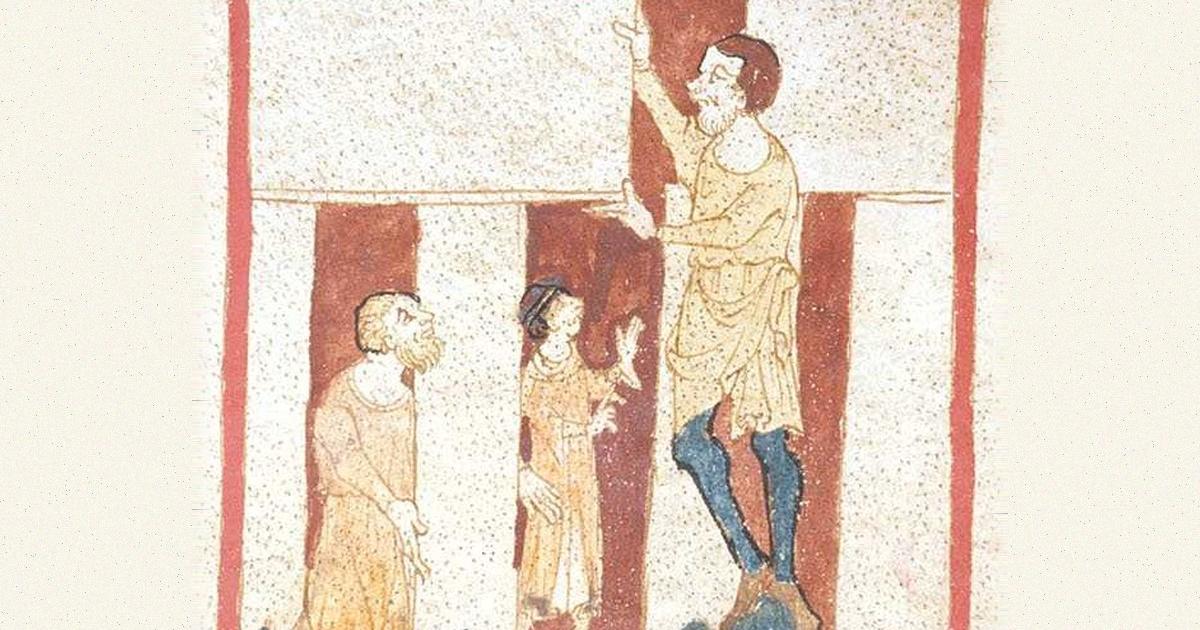
The oldest known picture of Stonehenge, from a 14th-century copy of Wace's Roman de Brut, shows a giant raising the stones with Merlin's help. The story began with Geoffrey of Monmouth about 1136. Merlin and a giant raising Stonehenge, Wace, Roman de Brut, British Library Egerton 3028, fol. 30r, about 1325 to 1350. Public domain, via Wikimedia Commons.
By Aris Manus
Sources
- Parker Pearson, M. et al. (2015). Craig Rhos-y-felin: a Welsh bluestone megalith quarry for Stonehenge. Antiquity 89: 1331 to 1352. Read in full.
- Parker Pearson, M. et al. (2019). Megalith quarries for Stonehenge's bluestones. Antiquity 93: 45 to 62. Read in full.
- Parker Pearson, M. et al. (2021). The original Stonehenge? A dismantled stone circle in the Preseli Hills of west Wales. Antiquity 95: 85 to 103. Read in full, post-referee version.
- Darvill, T. (2022). Mythical rings? Waun Mawn and Stonehenge Stage 1. Antiquity 96: 1515 to 1529. Read in full.
- Parker Pearson, M. et al. (2022). How Waun Mawn stone circle was designed and built, and when the Bluestones arrived at Stonehenge: a response to Darvill. Antiquity 96: 1530 to 1537. Read in full, accepted manuscript.
- John, B. S. (2024). The Stonehenge bluestones did not come from Waun Mawn in West Wales. The Holocene 34: 895 to 907. Abstract only.
- Kellaway, G. A. (1971). Glaciation and the Stones of Stonehenge. Nature 233: 30 to 35. Journal page summary only.
- John, B. S. (2024). A bluestone boulder at Stonehenge: implications for the glacial transport theory. E&G Quaternary Science Journal 73: 117 to 134. Read in full.
- Bevins, R. E. et al. (2025). The enigmatic 'Newall boulder' excavated at Stonehenge in 1924: New data and correcting the record. Journal of Archaeological Science: Reports. Abstract only.
- Clarke, A. J. I. and Kirkland, C. L. (2026). Detrital zircon-apatite fingerprinting challenges glacial transport of Stonehenge's megaliths. Communications Earth and Environment 7: 54. Read in full.
- Clarke, A. J. I. and Kirkland, C. L. (2026). Grains of sand prove people, not glaciers, transported Stonehenge rocks. The Conversation, 21 January 2026. Read in full.
- Clarke, A. J. I. et al. (2024). A Scottish provenance for the Altar Stone of Stonehenge. Nature 632: 570 to 575. Read in full.
- Bevins, R. E. et al. (2024). Was the Stonehenge Altar Stone from Orkney? Journal of Archaeological Science: Reports 58: 104738. Read in full.
- Parker Pearson, M. et al. (2025). Stonehenge and its Altar Stone: the significance of distant stone sources. Archaeology International 27. Abstract only.
- Clarke, A. J. I., Veness, R., Kirkland, C. L. et al. (2026). From Highlands to Henge: Refining the Provenance and Transport Pathways of Stonehenge's Altar Stone. Journal of Quaternary Science 41: 888 to 895. Abstract only.
- Veness, R. (2026). New theory on how six-tonne Stonehenge rock was transported from Scotland thousands of years ago by a glacier. The Conversation, 28 July 2026. Read in full.
- Nash, D. J. et al. (2020). Origins of the sarsen megaliths at Stonehenge. Science Advances 6: eabc0133. Read in full.
- Hancock, R. G. V. et al. (2024). Stonehenge revisited: A geochemical approach to interpreting the geographical source of sarsen stone #58. Archaeometry 67: 1 to 19. Abstract only.
- Nash, D. J. and Ciborowski, T. J. R. (2025). Comment on: 'Stonehenge revisited...'. Archaeometry 67: 1423 to 1436. Abstract only.
- Hancock, R. G. V. et al. (2025). On Sourcing Stonehenge Sarsen Stone #58: A Response to Nash and Ciborowski's Comments. Archaeometry 68: 48 to 50. Abstract only.
- English Heritage. Set in Stone? Stonehenge history and stories. Read in full.
- Geoffrey of Monmouth (c. 1136). History of the Kings of Britain, Book 8, chapters 10 to 12, trans. A. Thompson and J. A. Giles (1842). Read in full.