
Archaeologists working with the documentary series Time Team have uncovered a previously unknown Anglo-Saxon grave at Sutton Hoo in Suffolk, the burial ground made famous by its seventh-century ship burial. The Independent, reporting with the PA news agency on November 18, said the grave held an uncommon "sand body" along with a brooch, a knife, tweezers and beads. According to the National Trust, which owns the site and ran the dig with Time Team, the remains of such burials decompose to leave a "ghost-like shape" preserved within the surrounding sand.
The grave was found in Garden Field, which The Independent describes as a cemetery distinct from the ship burial grounds and royal mounds. The findings also indicate that a second burial may lie beneath the first, the report said. Arkeonews, which also covered the find, notes that further examination will be needed to establish whether the suspected feature is another grave.
Although the news broke this week, the grave was found more than a year ago. The National Trust's project page says the 2025 season ran from Monday, May 19 to Saturday, June 15, 2025, and Time Team describes its second season in Garden Field as taking place in the summer of 2025. It has been made public alongside a new four-part series about the dig, hosted by Sir Tony Robinson. Time Team says the first episode went out to Patreon supporters on November 7 and free on YouTube on November 14, with weekly episodes leading to a finale on December 5.
A Shape Held in Sand
The soil at Sutton Hoo is acidic, and CNN reported in 2025 that it rotted away the wood of the Anglo-Saxon ship and left many of the bone combs found at the site poorly preserved. Angus Wainwright, a National Trust archaeologist, explained the phenomenon in a statement carried by the PA news agency and published by The Independent. "One of the strangest features of the excavations at Sutton Hoo in the 1980s was the discovery of the ‘sand bodies’," he said. "These were burials where the bodies and bones had dissolved away in the acid soil, replaced by hard sand which held the form of the person not unlike some of the bodies at Pompei."
"It was certainly a high point of this latest dig, to find another of these bodies in the Garden Field cemetery," Wainwright added.
The chemistry behind the effect was studied during the 1980s campaign. In the full excavation report, archaeologist Martin Carver notes that a Leverhulme project set out to understand how the sand bodies had formed. It found that organic material "was transformed to humic sand within a decade" unless the acidity was reduced by a large amount of bone or by contact with metal, and that insoluble decay products could still be detected afterward. Carver's team measured the surface acidity of the site in 1983 at between pH 3.8 and 4.2.
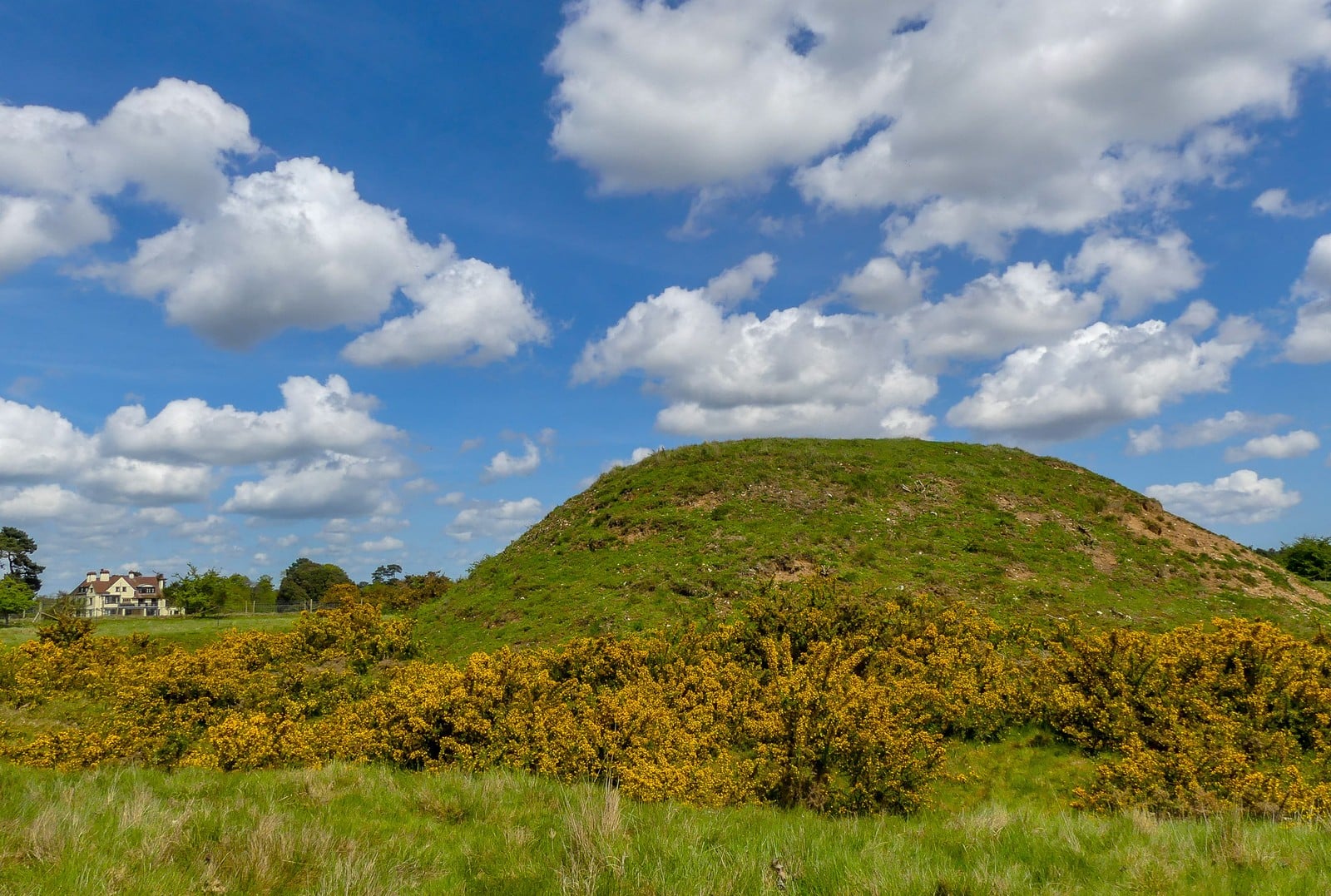
One of the burial mounds of the royal burial ground at Sutton Hoo, photographed in May 2018. The Garden Field cemetery, where the new grave was found, is not shown. (Image: Mike Prince, via Wikimedia Commons, CC BY 2.0)
The same soil explains the most famous absence at Sutton Hoo. When Basil Brown uncovered the great ship in Mound 1 in 1939, he revealed "the ghost of a ship," the National Trust says, with the outline of the planks and ribs surviving in the sand. The Independent describes it as a 27 meter oak vessel. No body was found in the burial chamber, but later chemical analysis of the sand beneath it showed high phosphate levels, which established that a body had decomposed there, according to the Trust.
The Earlier Sand Bodies Were Different
The new grave joins a small and unusual group of burials. The National Trust's history of the site says Carver's team, working over a decade from 1983, found human forms in the spaces between the mounds as areas of harder, darker sand. Those 39 individuals lay in distorted positions, some with bound legs and ankles, broken necks or severed heads, and the Trust says all of them died violently. Post holes nearby are thought to mark an early gallows.
Carver himself later called them "execution burials," according to a review of his 1998 book by the historian Bailey Young in The Medieval Review. Radiocarbon dates placed some of them in the later Anglo-Saxon period and others in the seventh century, when the mound cemetery was still in use.
However, the Garden Field grave looks different on the evidence published so far. It contained a brooch, a knife, tweezers and beads, and nothing reported so far suggests violence or a gallows. The Trust's account of the cemetery found when the visitor center was built in 2000 describes women buried with everyday items, including combs, bowls, small knives, shoulder brooches and beads, which is close to what the new grave held.
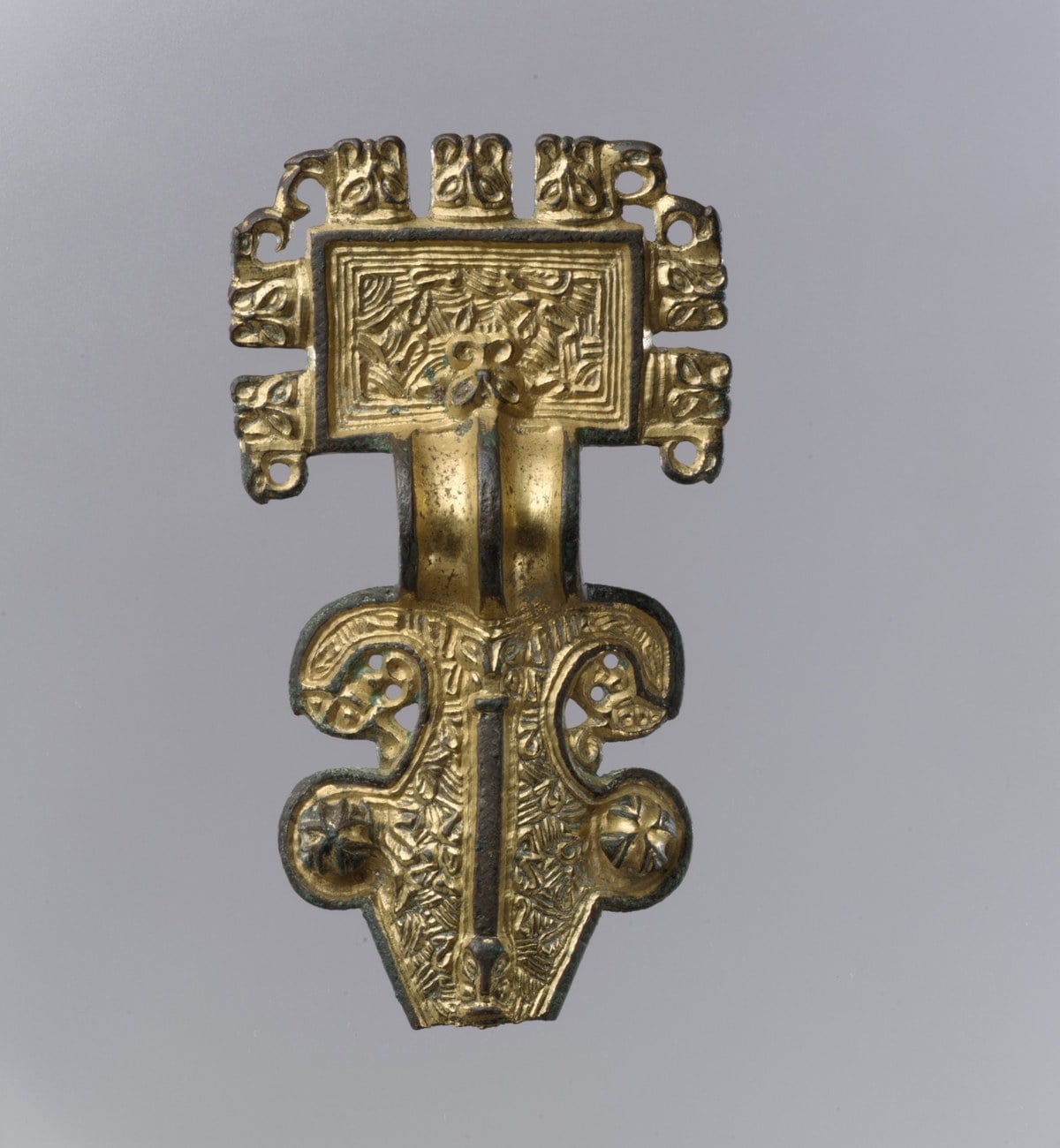
An Anglo-Saxon square-headed bow brooch of gilded copper alloy inlaid with niello, dated 500 to 600. It is shown as an example of the period and is not the brooch found in the new grave. (Image: The Metropolitan Museum of Art, 1985.209, CC0 public domain)
The People Around the Kings
Wainwright framed the dig as a shift in focus. "Until now, archaeologists have focused on the royal burial mounds," he said. He added that the mounds mattered to the Saxon kings but stood in surroundings that were also familiar to "the everyday East Anglians who lived in the villages and farms of the river valley."
"This excavation moves the focus to these people and their ancestors and descendants," he added.
The cemetery around Garden Field is older than the royal mounds, according to both the National Trust and CNN, and excavations in 2000 recorded 13 cremations and nine burials there. The Trust describes those buried as coming from low to relatively high status families and says they may have been the grandparents and great-grandparents of East Anglian kings.
Garden Field had already produced one celebrated object. In 1986, harrowing in the field brought fragments of the Bromeswell Bucket to the surface, and the Trust says letterforms in its decoration suggest it was made in the sixth century, probably in Antioch. In 2024 Time Team lifted the base of the bucket in a single block, and analysis showed that it had held cremated human and animal bone and an unburnt double-sided comb. That work was reported here in 2025.
A Boat-Shaped Mystery by the River
The new series also follows a second investigation closer to the River Deben. The East Anglian Daily Times reported on November 16 that an earlier survey picked up something unusual underground, and that a more detailed scan led the team to think it had the shape of a boat. "If there's anything like 3m between those ribs, you're talking a big vessel," the team said, according to the paper.
However, the archaeologists have stressed that no boat has been discovered. Other explanations being tested include a dock or a much later saw pit, and the paper notes that Woodbridge had a thriving shipbuilding industry between the 1400s and the 1700s. Later geophysics showed a genuine cut into the clay, deeper at one end, with a straight edge and what appeared to be tiered access. Time Team said those features could fit a dock, although a saw pit might have needed similar access.
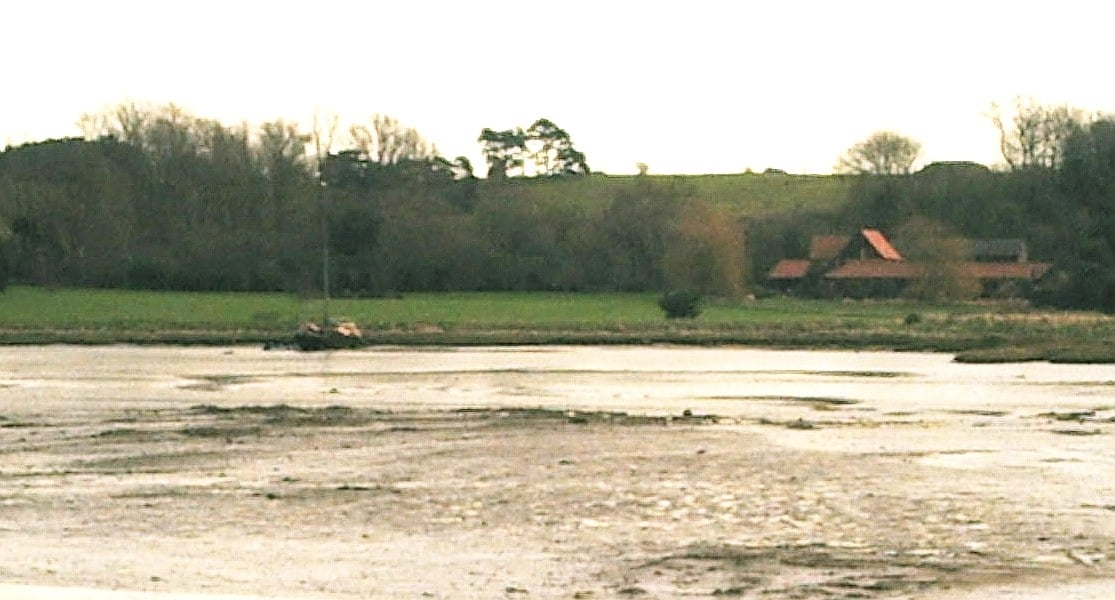
Sutton Hoo seen from the tidal River Deben, with Mound 2 on the horizon. The riverside feature under investigation is not identified in this photograph. (Image: Steven Plunkett, via Wikimedia Commons, CC BY 2.5, cropped by SilkTork)
Neither the riverside feature nor the possible second burial in Garden Field has been confirmed, and the remaining episodes may show how far the 2025 season got with each. Earlier coverage of Time Team and of Sutton Hoo is collected on those topic pages, along with a project to rebuild the Mound 1 ship.
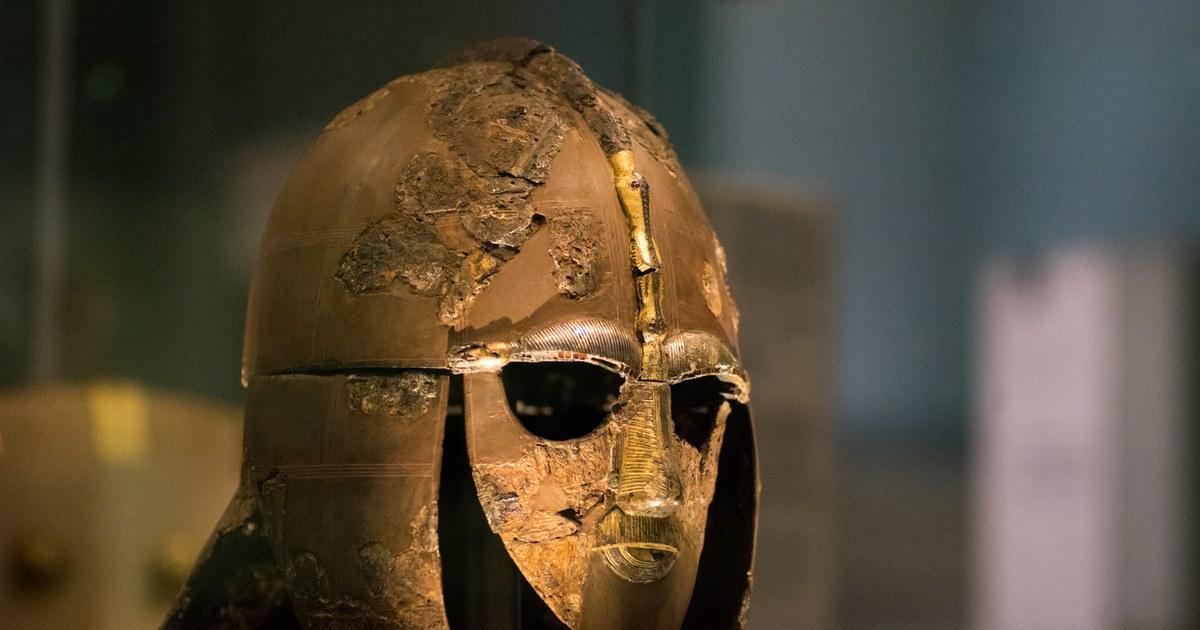
The reconstructed helmet from the Mound 1 ship burial, photographed at the British Museum. It comes from the 1939 excavation and is not from the new Garden Field grave. (Image: Paul Hudson, via Wikimedia Commons, CC BY 2.0, cropped)
By Aris Manus
Sources
Allingham, P. 2026. Report on the Anglo-Saxon grave found in Garden Field at Sutton Hoo, with PA. The Independent, November 18, 2026.
Arkeonews. 2026. "New Anglo-Saxon Grave Found at Sutton Hoo Beyond the Royal Mounds." Available at: https://arkeonews.net/new-anglo-saxon-grave-found-at-sutton-hoo-beyond-…
National Trust. "National Trust and Time Team partnership." Available at: https://www.nationaltrust.org.uk/visit/suffolk/sutton-hoo/time-team-ann…
National Trust. "Archaeology history: Sutton Hoo." Available at: https://www.nationaltrust.org.uk/visit/suffolk/sutton-hoo/history-of-ar…
East Anglian Daily Times. 2026. "Possible large buried vessel investigated near Sutton Hoo." November 16, 2026. Available at: https://www.eadt.co.uk/news/26731711.possible-large-buried-vessel-inves…
Time Team. 2026. Sutton Hoo Season 2 announcement. Available at: https://www.timeteamdigital.com/news/coming-soon-|-sutton-hoo-season-2
Strickland, A. 2025. "Archaeologists solve mystery of 6th century artifact from famed ship burial site." CNN, May 24, 2025. Available at: https://www.cnn.com/2025/05/24/science/sutton-hoo-bromeswell-bucket
Carver, M. 2005. "Environment and site formation." Chapter 10 in Sutton Hoo: A Seventh-Century Princely Burial Ground and its Context. Available at: https://martincarver.com/sites/martincarver.com/files/sutton-hoo/Carver…
Young, B. 1999. Review of M. Carver, Sutton Hoo: Burial Ground of Kings? The Medieval Review 99.02.03. Available at: https://scholarworks.iu.edu/journals/index.php/tmr/article/view/14703
The Metropolitan Museum of Art. Square-Headed Bow Brooch, 500 to 600, accession 1985.209. Available at: https://www.metmuseum.org/art/collection/search/466124