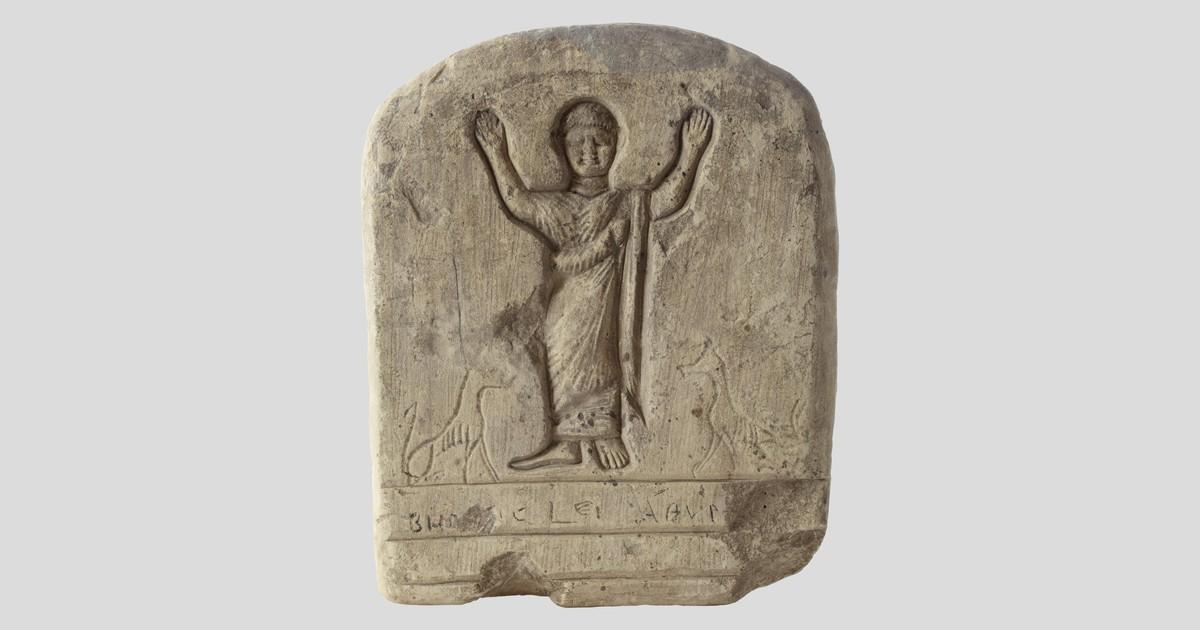

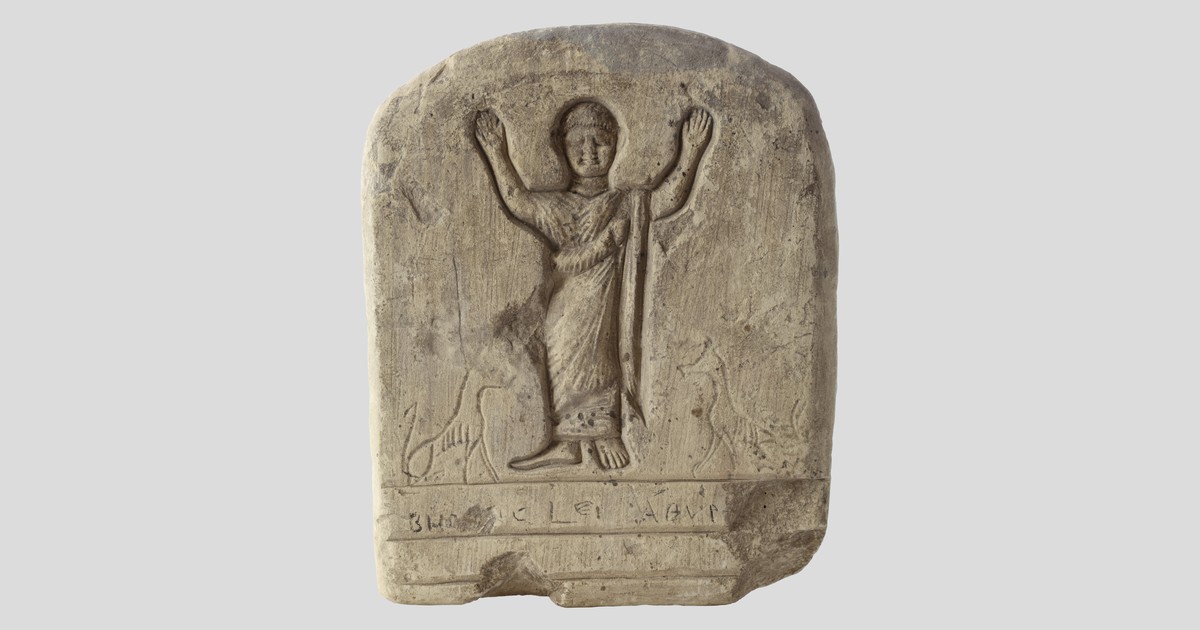
A limestone funerary stela from the Kom Abu Billou necropolis, catalogued by the Archaeological Museum in Kraków as the Stela of Bes and dated to the second half of the 2nd century AD. It belongs to the site's earlier Roman-period finds and is not from this week's discovery. (Image: Archaeological Museum in Kraków, MAK/AS/1447, via Wikimedia Commons, public domain)
An Egyptian mission from the Supreme Council of Antiquities has uncovered a large cemetery at Tell Kom Abu Billo in Menoufia Governorate, on the western edge of the Nile Delta. The Ministry of Tourism and Antiquities announced the find on Wednesday, November 18. According to the statement, as carried by Egypt's National Media Authority and SEE News, the necropolis holds numerous tombs and burials dating to the end of the Late Period, the Ptolemaic period and the beginning of the Roman period.
The ministry lists a large number of stone and pottery coffins, the remains of several wooden coffins, vaulted tombs built of mudbrick and another tomb lined inside with limestone. Minister of Tourism and Antiquities Sherif Fathy pointed, in the ministry's words, to the great variety of burial types, coffins and finds, which he said reflects the richness of the site and its historical importance.
An Open Courtyard Full of Burials
Hisham El-Leithy is secretary general of the Supreme Council of Antiquities. He described the find as "the first of its kind at the site in terms of this quantity of burials and coffins that appeared in an open burial courtyard" (translated by Ancient Origins). He added that architectural elements still extend beneath the sand and debris in several directions.
El-Leithy also said that preliminary study of the finds and grave goods suggests the cemetery was most likely used for members of the middle class. SEE News renders the same point as the cemetery having "primarily served middle-class citizens."
Mostafa Rizk, director general of Menoufia Antiquities, said the excavation exposed "a surface layer containing hundreds of stone coffins, some without lids and others completely smashed" (translated by Ancient Origins). The ministry attributes the damage to vandalism at the site in earlier periods and to quarrying in the area. Rizk said the team also found many remains of pottery coffins, some with human features of a caricatured character and others in a fully anthropoid form.
The human remains inside the coffins were in a very poor state, according to Rizk. Study of them still revealed traces of embalming materials and resins, along with layers of cartonnage and plaster painted in yellow, red, blue and gold. He said the dead had been treated according to ancient Egyptian beliefs and practices.
Dating the Cemetery
Mohamed Abdel-Badie heads the Egyptian Antiquities Sector at the council. He said preliminary study points to the early Ptolemaic period, in the 3rd and 2nd centuries BC, with some burials from the end of the Late Period. The dating rests on several lines of evidence listed in the statement, including the stratigraphic sequence, the pottery, the styles of the stone and pottery coffins, the burial customs and the architecture of the tombs.
The burials, Abdel-Badie said, reflect the continuity of funerary customs tied to ancient Egyptian religion and to deities including Renenutet, Osiris, Isis and Hathor, whose cults were linked at different times with Tarrana and Kom Abu Billo. Earlier work showed that the site's history reaches back to early periods of Egyptian history, he said, with the ruins of the ancient town and a temple of Hathor under her title "Lady of Turquoise."
Golden Tongues, Amulets and a Nursing Goddess
The small finds read like an inventory of Ptolemaic funerary belief. The ministry lists a number of golden tongues, an earring, a pendant from a gold necklace, gold sheets and scarabs. It also lists a large number of faience ushabti figurines of different shapes and sizes, some inscribed with hieroglyphs. There were also offering tables, small limestone heads, small sphinxes and pieces of stone statues of the falcon god Horus.
Among the terracottas, the team found pieces of figures in the form of Isis-Aphrodite, and the Arabic statement later mentions three terracotta figures representing her. One object stands out in the list. The ministry describes it as "part of a fired clay vessel lid shaped in the form of Isis-Aphrodite seated on a lotus flower and nursing her child Harpocrates" (translated by Ancient Origins).
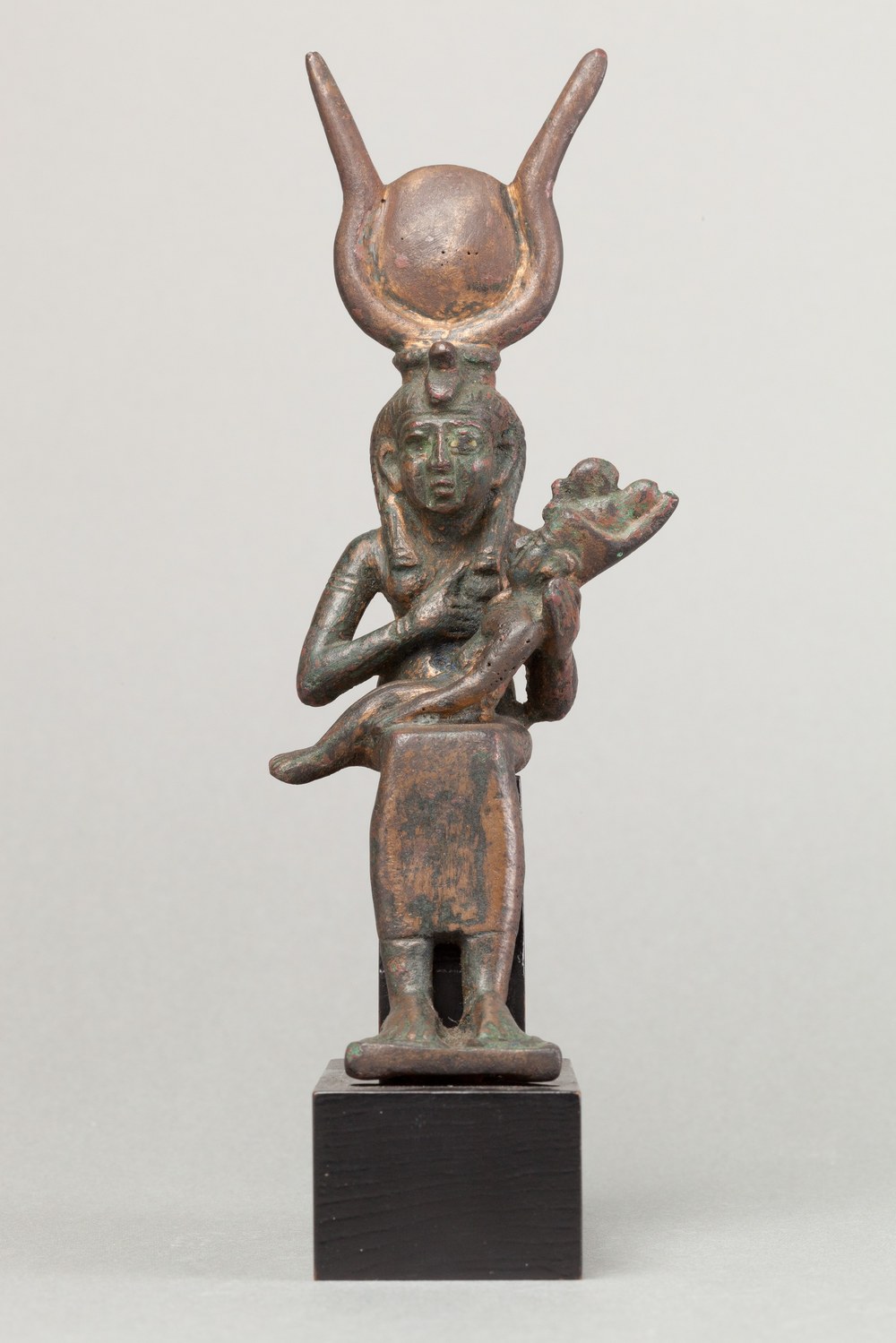
A cupreous metal statuette titled Isis and Horus by the museum, showing the goddess holding the child at her breast, Late Period to Ptolemaic period, 664 to 30 BC. It is shown for comparison and is not from Kom Abu Billo. (Image: The Metropolitan Museum of Art, Gift of Lily S. Place, 1923, 23.6.9, CC0 public domain)
Other finds include schist scarabs, a scarab of blue lapis lazuli, wedjat eyes and small amulets. The team also recovered fragments of mud elements coated in gypsum showing a royal palace facade with two pylons. Above them crouch two facing lions with falcon heads wearing the Double Crown, each resting its right paw on a djed pillar. Two falcon burials lay between the coffins.
The release does not explain the golden tongues. Similar finds elsewhere have drawn an interpretation from excavators. At Oxyrhynchus, Live Science reported in 2024, the co-directors of the Spanish and Egyptian mission said the tongues were meant to help the dead speak in the afterlife and reflected the belief that gold was "the flesh of the gods." Egyptologist Salima Ikram of the American University in Cairo told the same outlet that at Oxyrhynchus such tongues "might have been the vogue for the embalming house in the area." Earlier coverage of the golden tongue found at Taposiris Magna, of two Oxyrhynchus mummies with golden tongues and of 13 mummies with gold tongues from Oxyrhynchus traces the same custom.
A Cemetery at the Door of the Natron Valley
Abdel-Badie stressed that the importance of the find also lies in its location. The cemetery sits within the archaeological zone of the ancient town of Terenouthis, modern Tarrana. According to the statement, the town lay at the eastern entrance to the Wadi el-Natrun, a valley known historically for the extraction of the natron salt used in mummification.
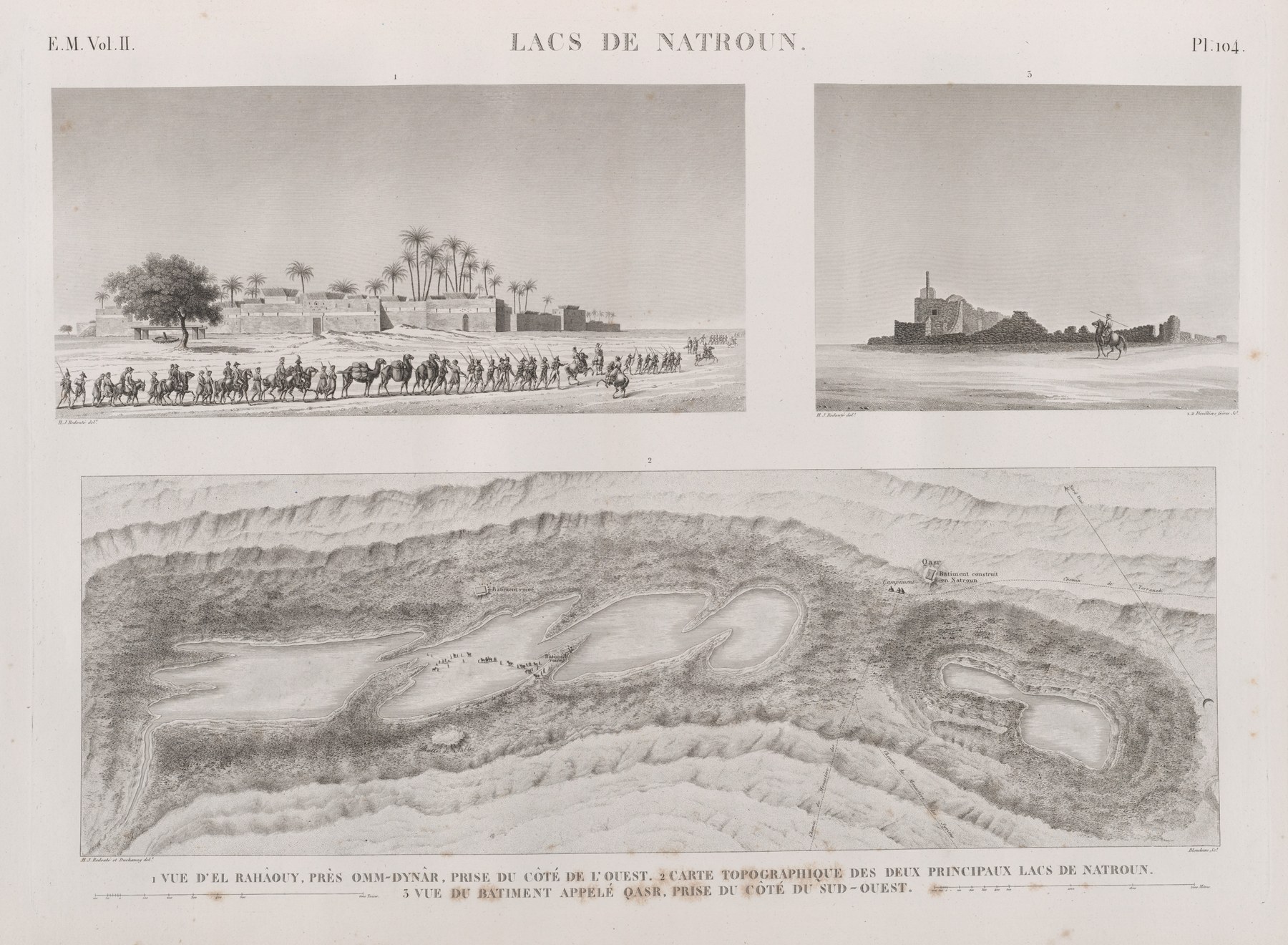
Plate 104, Lacs de Natroun, from the French Description de l'Égypte, Paris, 1809. A topographic map of the two main natron lakes of the Wadi el-Natrun lies beneath views of El-Rahaouy near Omm-Dynar and of a building called the Qasr. (Image: New York Public Library, General Research Division, via Wikimedia Commons, public domain)
That salt sits at the center of the best known ancient account of embalming. Herodotus, writing in the 5th century BC, described embalmers who "conceal the body for seventy days, embalmed in saltpetre," in A. D. Godley's 1920 translation, and noted that "no longer time is allowed for the embalming."
Kom Abu Billo is not new to archaeology. The French Institute of Oriental Archaeology in Cairo has worked at the site with the HiSoMA laboratory since 2013. It records excavations by the Egypt Exploration Fund in 1888 and a single season in 1935 by the Kelsey Museum of the University of Michigan under Enoch Ernest Peterson. Rescue excavations by the Antiquities Service between 1969 and 1975, carried out as the el-Nasseri canal was dug, exposed Pharaonic burials and a large part of a Graeco-Roman necropolis.
The French mission describes a mudbrick enclosure that most likely belonged to the temple of Hathor, the town's principal goddess. The tombs it has excavated in the necropolis since 2014 are Roman, dating to between the 1st and 4th centuries AD. Each has a niche in its facade holding a funerary stela and an offering table. Stelae like the one pictured above come from that later Roman cemetery. The burials announced this week are older, with most provisionally dated by the ministry to the 3rd and 2nd centuries BC.
Excavation, study and scientific documentation of the finds and architecture will continue, the ministry said, with the aim of revealing more about the history of the cemetery and of ancient Tarrana.
By Aris Manus
Sources
Al-Minyawi, S. and Zaki, F. 2026. "الكشف عن جبانة أثرية تعود إلى أواخر العصر المتأخر بالمنوفية" [Discovery of an archaeological cemetery dating to the end of the Late Period in Menoufia]. National Media Authority (Maspero), November 18, 2026. Text of the Ministry of Tourism and Antiquities statement, in Arabic. Available at: https://www.maspero.eg/art-and-culture/2026/11/18/1006758/
Abu Dashish, A. 2026. "Egyptian Mission Uncovers Tell Kom Abu Billo Necropolis in Menoufia." SEE News, November 18, 2026. Available at: https://see.news/egyptian-mission-uncovers-tell-kom-abu-billo-necropoli…
Asaad, M. 2026. "كشف أثرى لجبانة تضم مئات التوابيت الحجرية والفخارية ودفنات آدمية وأوشابتي" [Archaeological discovery of a cemetery containing hundreds of stone and pottery coffins, human burials and ushabtis]. Youm7, November 18, 2026. In Arabic. Available at: https://www.youm7.com/story/2026/11/18/%D9%83%D8%B4%D9%81-%D8%A3%D8%AB%…
Jarus, O. 2024. "13 ancient Egyptian mummies found with gold tongues to help them talk in the afterlife." Live Science, December 18, 2024. Available at: https://www.livescience.com/archaeology/ancient-egyptians/13-ancient-eg…
Dhennin, S. "Kôm Abou Billou." Institut français d'archéologie orientale (IFAO). Available at: https://www.ifao.egnet.net/recherche/archeologie/mefkat-kom-abou-billou/
Herodotus. The Histories, Book 2, chapter 86. Translated by A. D. Godley. Cambridge, MA: Harvard University Press, 1920. Available at: https://www.perseus.tufts.edu/hopper/text?doc=Perseus%3Atext%3A1999.01…