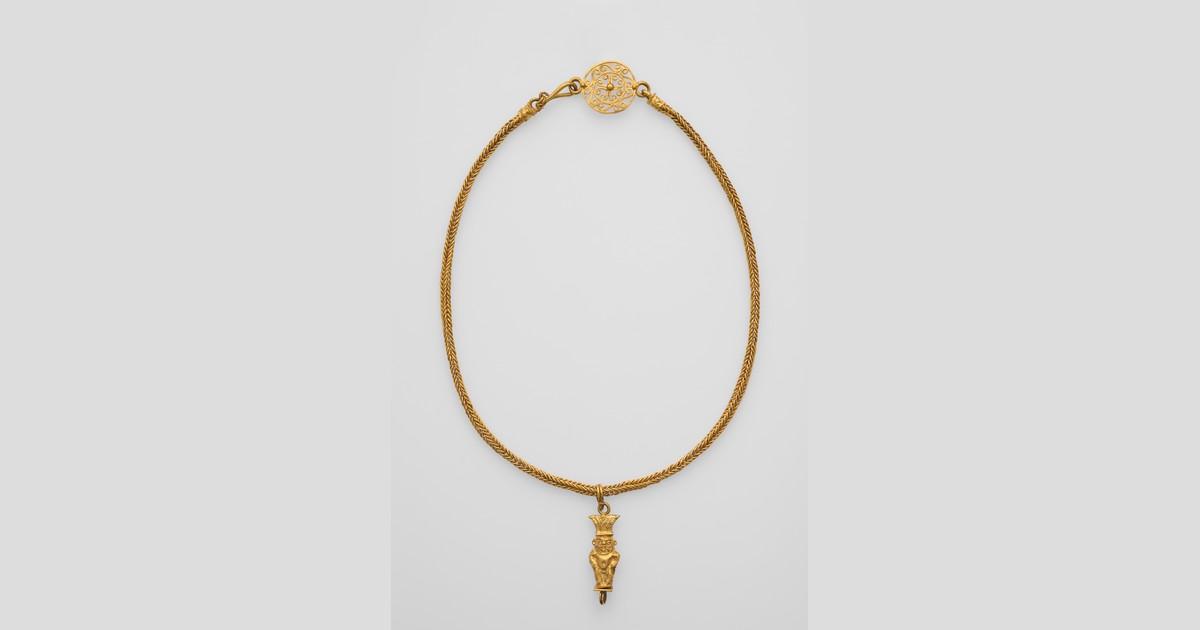

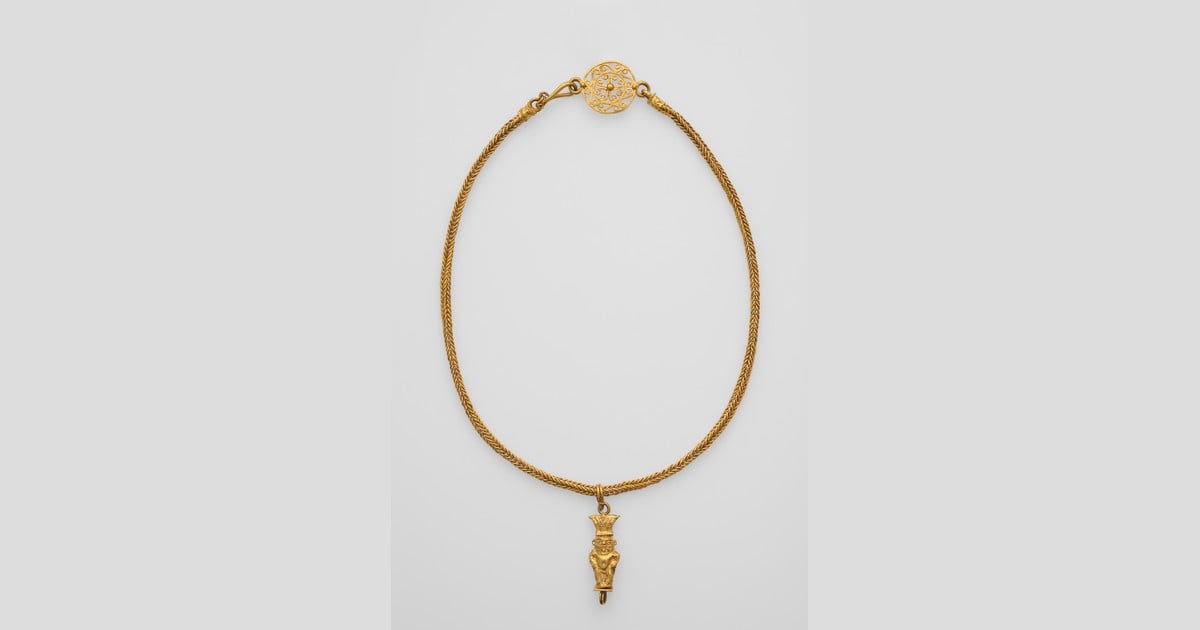
A loop-in-loop gold chain with an openwork clasp and a pendant of the god Bes, from Egypt, Roman period, 2nd century AD. It is shown as a comparable Roman chain and is not the Redesdale find. (Image: The Metropolitan Museum of Art, Gift of Mrs. Edward S. Harkness, 1940, 40.9.12, CC0 public domain)
Finding gold is something many archaeologists never experience in a whole career, according to a Newcastle University archaeologist. Elise Zallu, a first-year student at Newcastle University, found hers on the first day of her first dig. Her find, a section of Roman gold chain about 7 centimeters long, was one of several finds from a summer 2026 training excavation at a site in Redesdale, Northumberland, announced by the university on November 18.
According to the university's release, the season also produced a folded lead sheet with Latin writing, a gilded cavalry fitting, pottery scratched with a personal name and a carnelian gemstone engraved with Jupiter. The release says that "the quantity and quality of this year's finds have surprised even experienced researchers."
A Training Dig on the Frontier
The excavation brought together 52 first-year archaeology students, split into two groups that each spent two weeks on site. They worked alongside volunteers from the Redesdale Archaeology Group, and the excavations were directed by The Archaeological Practice Ltd.
The work forms part of a long-running research project into the structures, industries and activities that supported life on Rome's northern frontier. According to the release, Newcastle University staff, students and partners have investigated the site since the early 1990s, with major campaigns from 1992 to 1998 and in 2010.
The current project, which began in 2021, has so far explored the buried remains of two large enclosures, or annexes, with their defenses, internal buildings and roads, along with evidence for industry. The release links such areas with the workshops, supply depots, traders and families that would have supported Roman frontier communities.
A Chain That Could Still Be Worn
The chain is fragile, but its condition is good enough that, if complete, it could still be worn today, according to the release. It was made with the Roman loop-in-loop technique, in which, instead of simple round links, each ring was pinched into a figure-eight shape, folded and then interwoven with the next to make a flexible chain.
The release adds that chains of this type were usually made from very pure gold and are often associated with elite jewelry, decorative military amulets or fittings belonging to high-ranking officers and their families. It does not say who owned the Redesdale chain.
"Finding the gold chain was really surreal, especially given it was the first day of my first dig," Zallu said in the release. "I didn't expect to find anything like that my whole career, so it was definitely a surprise."
Eric Tourigny, a senior lecturer in historical archaeology at Newcastle University's School of History, Classics and Archaeology, put the find in perspective. "Finding a gold artefact is something many archaeologists can go an entire career without experiencing," he said. "For a first-year student to discover a beautifully preserved Roman gold chain on their first day in the trench is truly remarkable."
A Folded Sheet of Lead
Also on the first day, student Shannon Wood found a folded piece of lead bearing traces of a Latin inscription, and the small sheet carries partly obscured cursive letters scratched into its surface.
The archaeologists' leading explanation is a commercial seal, connected with trade, taxation, ownership or the movement of goods through the Roman military supply network. The release offers a second possibility, that the sheet was a personal message or a curse tablet. People across the Roman world scratched prayers, grievances, requests and sometimes curses onto thin lead sheets before folding them and leaving them in sacred places. The release says further study of the inscription is expected to reveal more about its purpose.
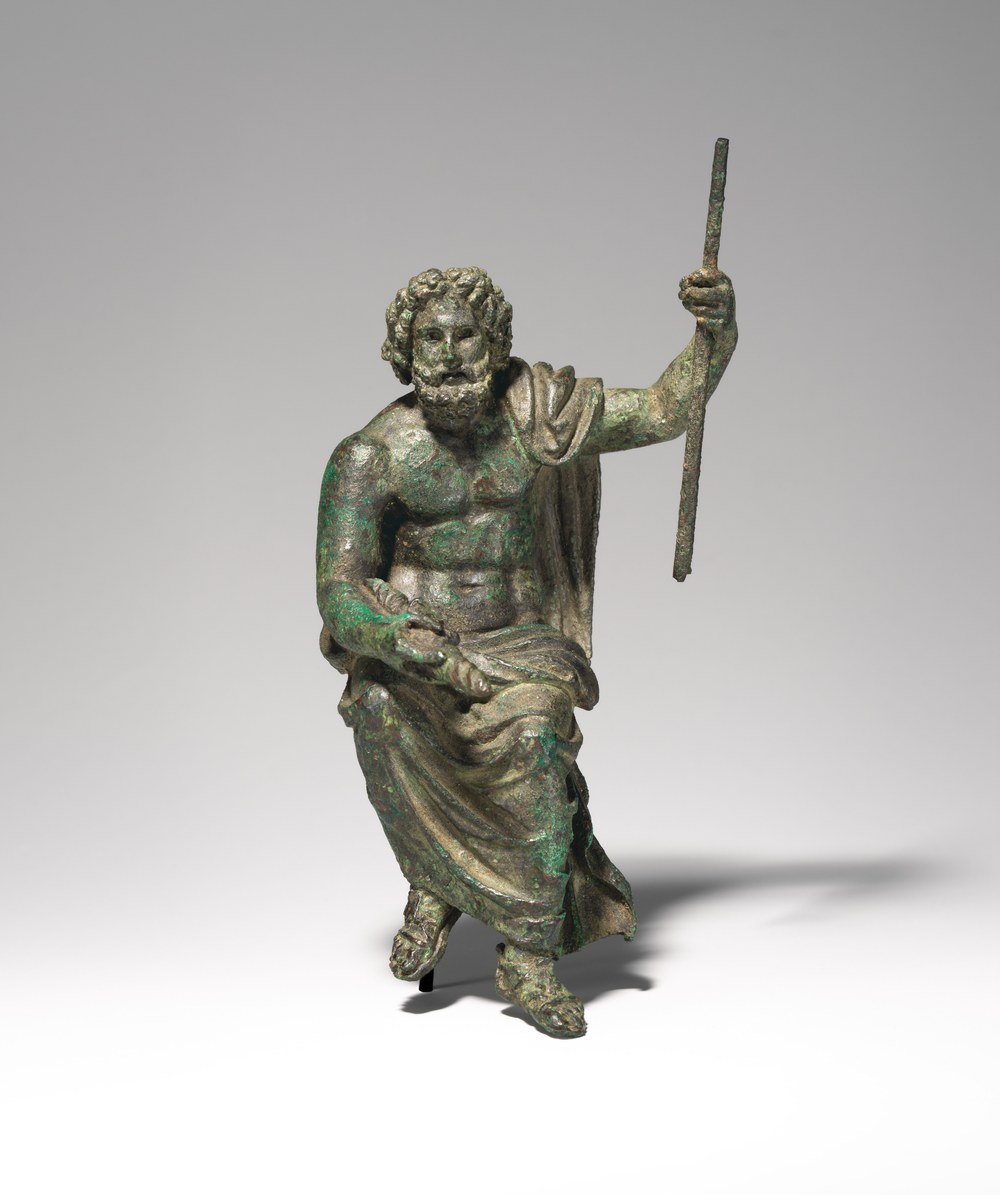
A bronze statuette of Jupiter Capitolinus holding a scepter, Roman Imperial period, 1st to 2nd century AD. It is shown for comparison and is not from Redesdale. (Image: The Metropolitan Museum of Art, Gift of Henry G. Marquand, 1897, 97.22.8, CC0 public domain)
A Gilded Fitting for a Horseman
On the second day, student Megan Potter uncovered a decorated Roman military fitting with traces of gilding. It has been identified as a peltate cavalry dangler, a decorative bronze mount that would have hung from a military belt, a horse harness or possibly the lower fitting of a sword scabbard.
The pelta design is a crescent shape based on the small shields carried by warriors in Classical art. On the Redesdale piece, the curved ends turn inward toward a central axis, and the front carries molded concentric ridges. The fitting is heavily corroded, but much of the gilding survives, which shows that it once had a bright gold appearance.
Objects of this quality were costly and highly visible, according to the release, and signaled status within the Roman military. The archaeologists suggest that the fitting may have belonged to a cavalry officer or another high-ranking person.
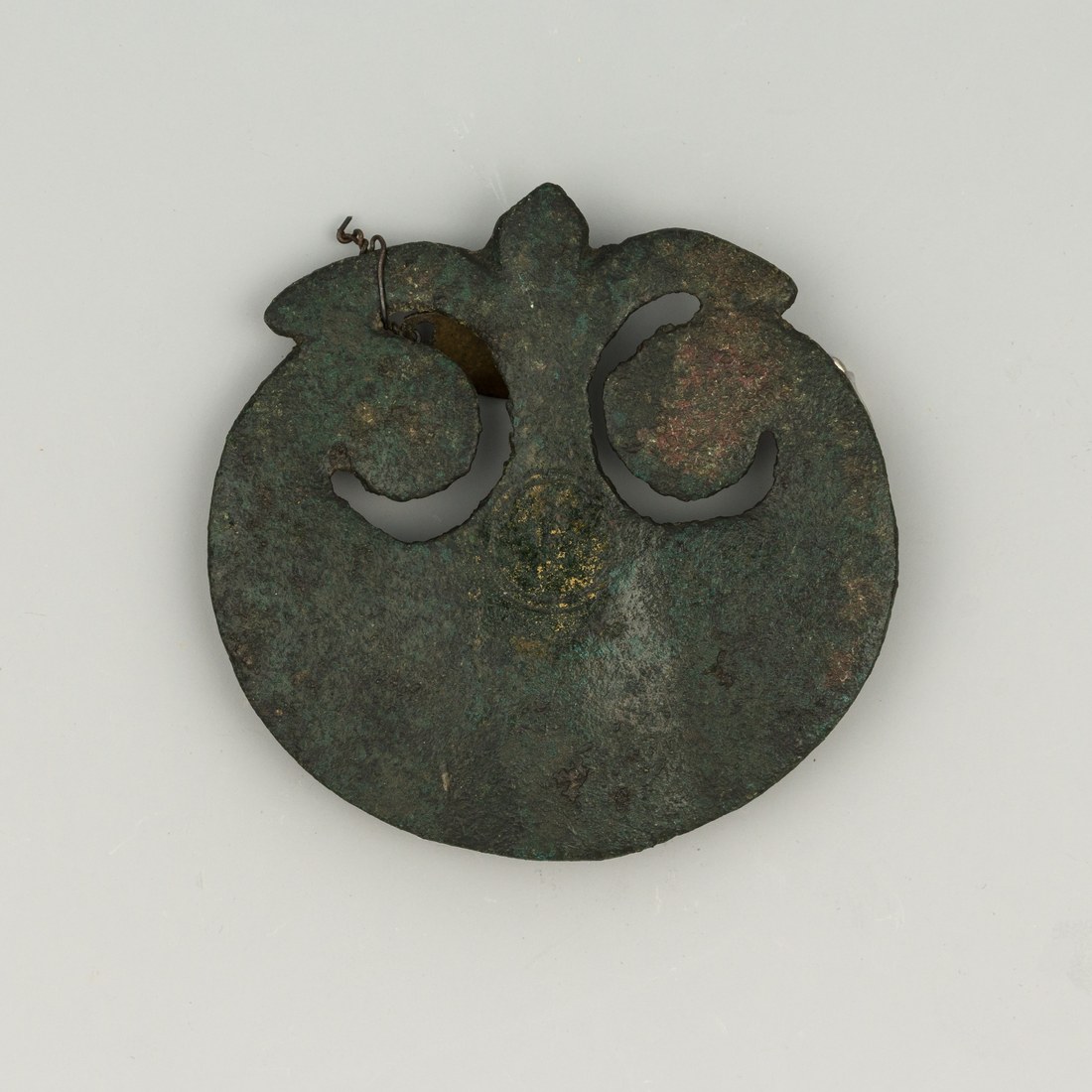
A Roman horse harness ornament, probably from Germany, 2nd to 3rd century AD, in copper alloy, possibly with gold, decorated with a cutout pelta motif. It is shown as a comparable and is not from Redesdale. (Image: The Metropolitan Museum of Art, Gift of Stephen V. Grancsay, 1942, 42.50.229, CC0 public domain)
A Man Called Martinus
The students also recovered coins, spearheads, dress accessories, pottery and other everyday objects, and many pieces of pottery carry Roman graffiti.
One well-preserved example is a bowl of Samian ware, the glossy red tableware also known as terra sigillata. It is scratched with either "MARTIN[I]" or "MARTIN[US]," which the release says likely refers to a man named Martinus. Several other sherds found this season appear to carry the same name. The release interprets them as ownership marks or personal identification added by someone who lived or worked at the site nearly 2,000 years ago.
Jupiter on a Carnelian
In the closing week of the season, students Maisy Watmough and Zoe Yuill found a carved carnelian intaglio. Intaglios were engraved gems set in rings and used as personal seals, and when pressed into warm wax, they could authenticate documents and identify their owners.
The Redesdale gem is cut from polished orange carnelian and shows Jupiter, king of the Roman gods, holding a scepter and a small figure of Victory, with an eagle at his feet. The release notes that the god's image was popular among soldiers, administrators and wealthy civilians throughout Roman Britain.
This is the fourth intaglio from the site, according to the release, after two found in the 2025 season and another found in the 19th century.
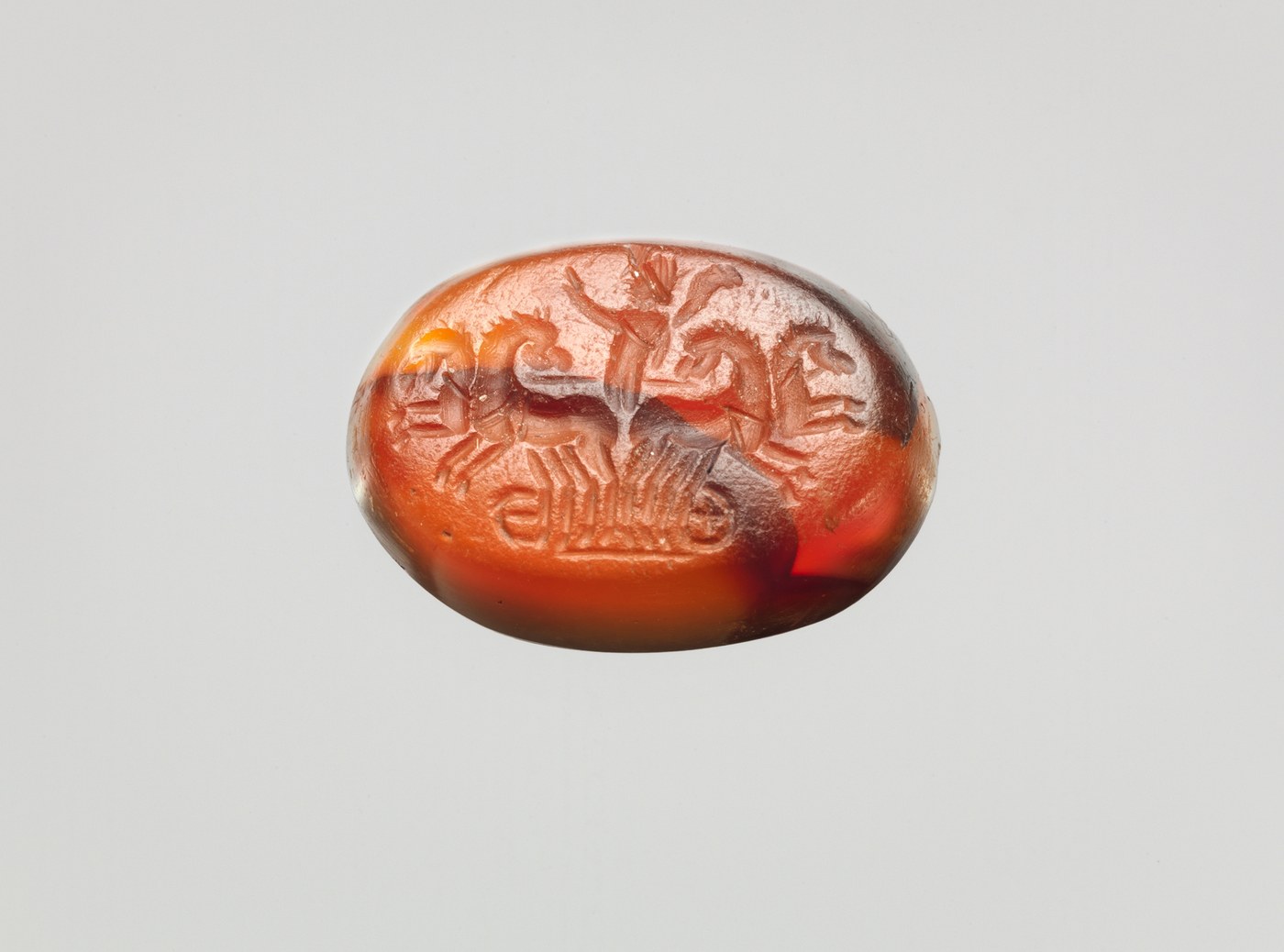
A Roman carnelian intaglio engraved with Sol driving a four-horse chariot, 2nd century BC to 2nd century AD. It is shown as a comparable carnelian seal stone and is not the Redesdale Jupiter gem. (Image: The Metropolitan Museum of Art, Bequest of W. Gedney Beatty, 1941, 41.160.688, CC0 public domain)
"It was so exciting to find the intaglio," Watmough said in the release. Yuill, who is studying for a BA in archaeology, added: "I loved my time at the field school, especially as everyone there was so friendly and helpful."
Stories From the Edge of the Empire
For the site director, the finds matter most for what they reveal about the people who lived there. Richard Carlton, site director and visiting fellow in archaeology at Newcastle University, said: "These finds are exciting not only because of their quality, but because of the stories they tell."
"A gold chain, a signet gemstone, inscribed pottery and a decorated brooch illuminate the lives of the people who made this site work almost two millennia ago," he said. "Combined with the buildings and industrial features the team is excavating, they also help us understand how the frontier operated, and how Roman and Native communities interacted."
The Independent, reporting on the release, described the finds as a treasure trove from the northernmost edge of the Roman Empire. Further study of the inscription on the lead sheet is expected, and the release presents the project as helping archaeologists reconstruct how soldiers, civilians and traders lived side by side on the frontier. For more on Roman engraved gems in the region, see the earlier report on 30 Roman intaglios from a Hadrian's Wall bathhouse site, along with further stories from Northumberland and Hadrian's Wall.
By Aris Manus
Sources
Newcastle University Press Office. 2026. "Archaeology students find Roman treasures on first excavation." November 18, 2026. Available at: https://www.ncl.ac.uk/press/articles/latest/2026/11/archaeologystudents…
Sankaran, V. 2026. "First-year archaeology students find Roman treasure trove during first excavation." The Independent, November 19, 2026. Available at: https://www.independent.co.uk/news/science/archaeology/roman-treasure-s…
Newcastle University. "Dr Eric Tourigny." Staff profile, School of History, Classics and Archaeology. Available at: https://www.ncl.ac.uk/hca/people/profile/erictourigny.html