
Fact Check verdict: Unverified. No dated find or published study supports an Ice Age origin, the city was cut with metal tools, and the firmest evidence for its use comes from the Byzantine period.
Derinkuyu lies beneath the town of the same name in Nevşehir Province, in the Cappadocia region of central Turkey, where rooms, corridors and shafts run down through floor after floor of soft rock.
A popular claim holds that it was dug before the end of the last Ice Age, as a refuge from a cosmic catastrophe or a killing winter, so what do the people who have studied Derinkuyu report about its age?
What the evidence says
The most detailed recent survey read for this check is a 2025 research article in the journal Asia Minor Studies by Elif Kahya Yıldırım. She describes Derinkuyu as carved into a volcanic rock layer known as the Kızılkaya ignimbrite, and gives its depth as 85 meters over an area of 2,500 square meters. "Today, 8 floors can be seen," she writes.
The paper counts around 200 rooms, or an estimated 400 with unexcavated parts, and citing Krassmann puts the living space at approximately 2,000 people.
Official Turkish figures are close but not identical, and the Ministry of Culture's museum page gives an approximate depth of 85 meters and a 55-meter ventilation shaft that also served as a well, with only ten percent of the city open to visitors. The district governor's office, writing in Turkish, says the eight open floors reach about 50 meters, and that clearing everything could bring the depth to 85 meters and 12 to 13 floors, translated here by Ancient Origins.
Kahya Yıldırım is direct on dating, writing that "Metal tools were used in the creation of Underground Cities." On that basis, following a 2004 doctoral thesis by Ayhan, she argues that the underground cities cannot be dated earlier than the 3rd millennium BC.
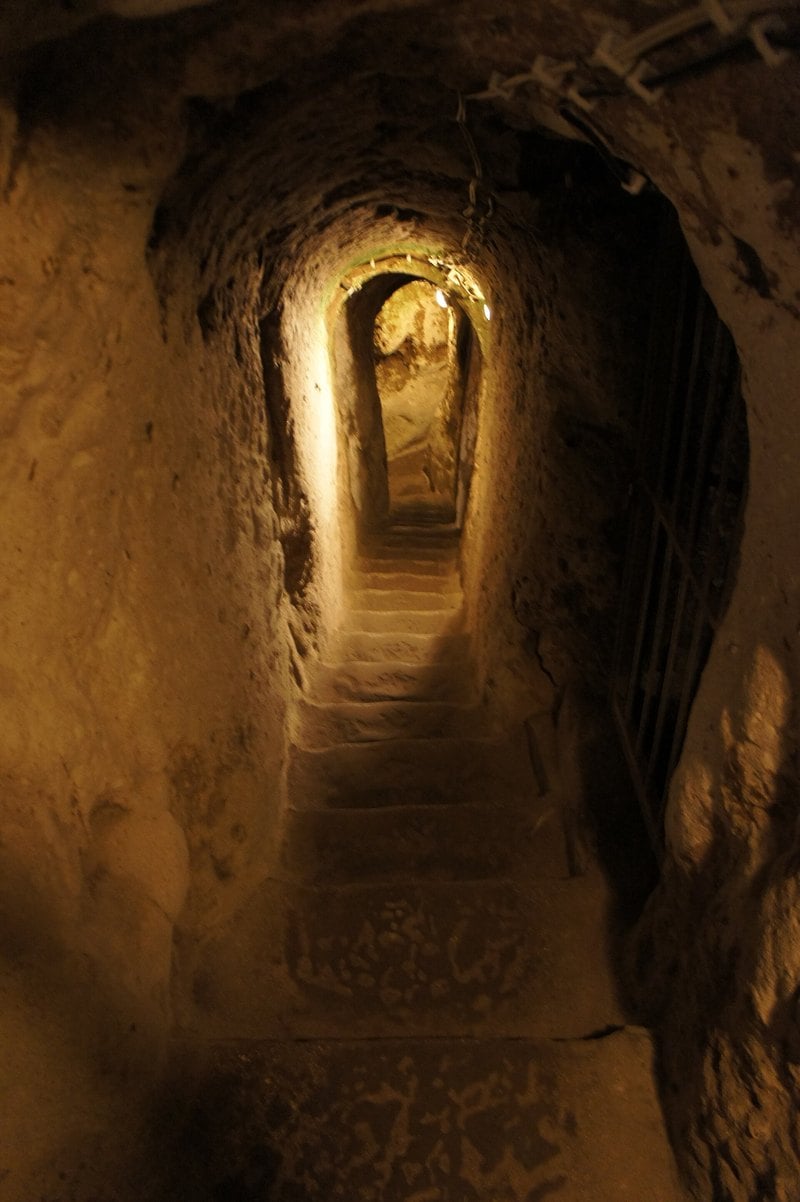
A carved stairway inside Derinkuyu Underground City. Photo by Cappo80, 2014, via Wikimedia Commons, CC BY 4.0, resized.
Older traces, and a caution
Some finds inside the city are older than its Byzantine heyday. A Hittite period hand mill was found on the lower floors, and the district governor's office reports a marble eagle statue dated to the Roman period, in a section closed to visitors. Kahya Yıldırım warns that the mill "may have been brought there at a later date," so it cannot date the rock it was found in.
She treats a Phrygian start the same way. Traces of Phrygian worship at another underground site, Mazıköy, point to links with the pre-Christian period, but she concludes that the idea "cannot go beyond a guess" without better archaeological and laboratory data.
The oldest written account she cites is the Anabasis of Xenophon, from the 4th century BC. In the Dakyns translation, Xenophon describes village houses that were underground, entered through an opening like the mouth of a well, but "broad and spacious below." The passage describes villages in Armenia, on the Greek army's march, and does not name Derinkuyu.
The Byzantine refuge
For the clearest evidence, Kahya Yıldırım turns to the Christian communities of the Byzantine era. "The most obvious cultural evidence that has survived to this day in the underground cities belongs to the Byzantine period," she writes, and she reports that several researchers, including Jerphanion, Kempe and Ousterhout, support the view that local Christian people may have dug settlements in the region between the mid-7th and early 11th centuries, when Arab raids struck the region.
UNESCO tells the same story in its listing for the Göreme National Park and the Rock Sites of Cappadocia. It traces monastic life in the region to small communities of hermits in the 4th century, who followed the teachings of Basil the Great, Bishop of Kayseri. Later, it says, "in order to resist Arab invasions, they began banding together into troglodyte villages or subterranean towns such as Kaymakli or Derinkuyu which served as places of refuge."
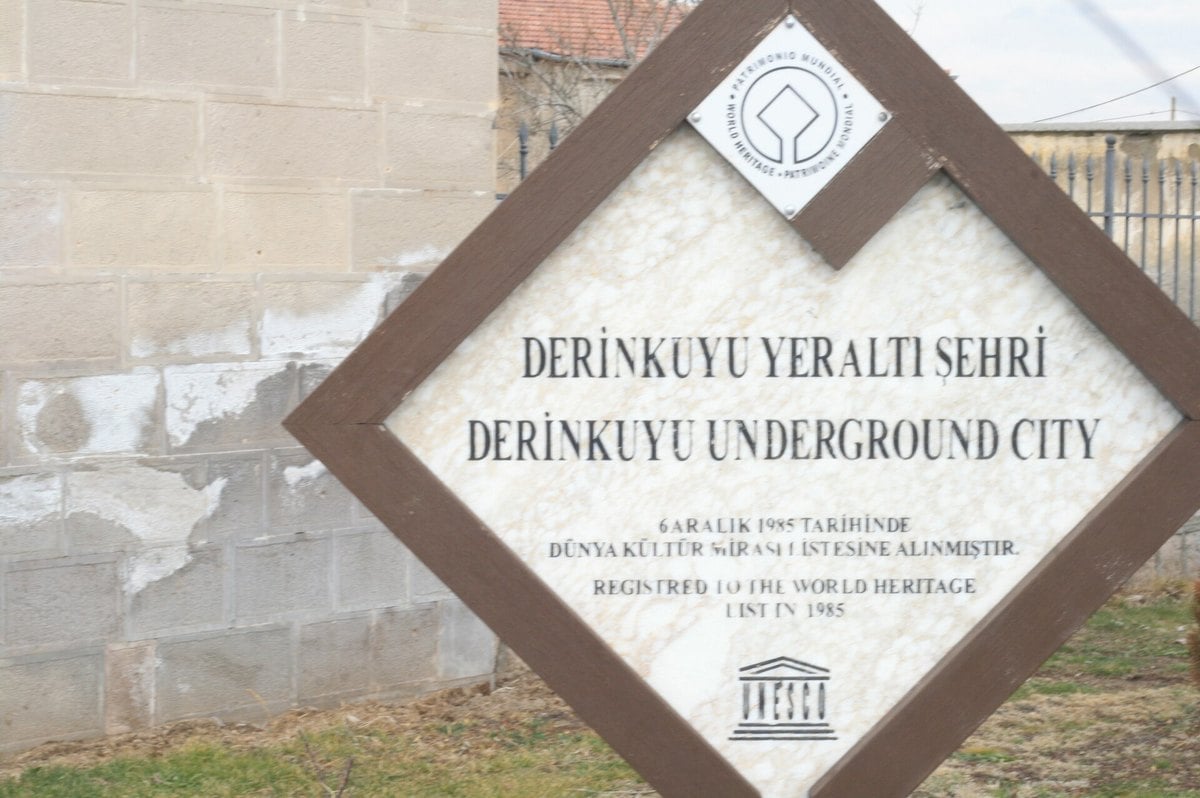
A sign for Derinkuyu Underground City carrying the UNESCO World Heritage emblem. Photo by neverbutterfly, 2012, via Wikimedia Commons, CC BY 2.0, resized.
A military manual from the 10th century gives a view from the Byzantine side. As reported by Kahya Yıldırım, Nikephoros Phokas wrote that scouts watching the roads warned people to take shelter underground with their goods. A 1988 French review describes the treatise as a manual for countering Arab raids in Cappadocia.
Inside Derinkuyu, the rooms reflect a living Christian community. The museum page lists stables, cellars, dining halls, churches and a missionary school on the second floor. The Ministry's culture portal, in Turkish, adds a confession room and a baptism pool, translated here by Ancient Origins. It also says early Christians fleeing the Roman Empire reached Cappadocia in the 2nd century and settled there.
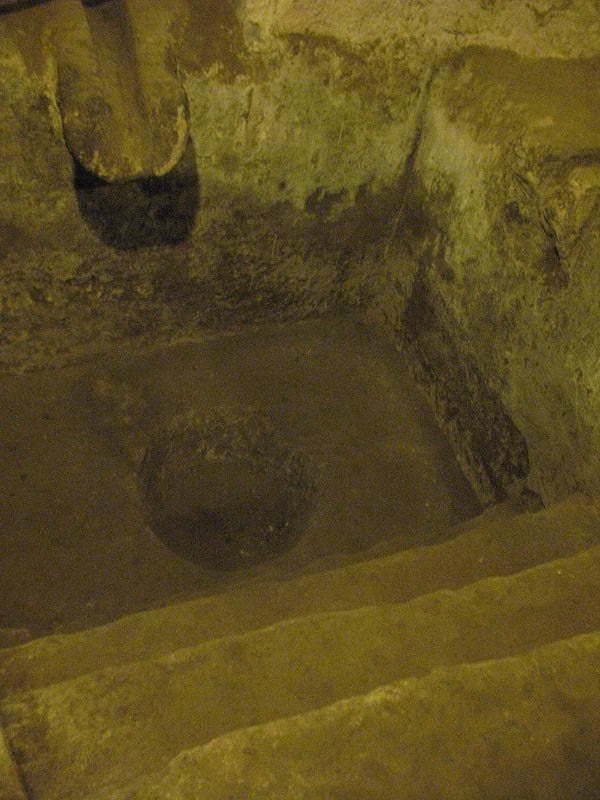
A rock-cut room at Derinkuyu that the photographer labeled a baptism chapel. Photo by Martijn Munneke, 2008, via Wikimedia Commons, CC BY 2.0, resized.
Kahya Yıldırım reports that use carried on for centuries, including shelter from Timur's raids in the 14th century, and that the settlements were abandoned with the population exchange between Turkey and Greece in 1923. The upper floors were cleaned and opened to visitors in 1965, according to her paper and the museum page.
The alternative view
The appeal of an older origin is easy to understand, since the museum page estimates that Cappadocia holds between 150 and 200 underground settlements, and the scale of the work invites big questions.
One version of the Ice Age idea, summarized by the history news site Ancient Nerds, comes from a video that links Derinkuyu to the story in the Avesta of Yima building a refuge called the Vara against a catastrophic winter. The presenter, Ancient Nerds reports, cites Persian scholarship placing underground cities before the Younger Dryas, a cold spell near the end of the last Ice Age.
People did live in central Anatolia more than 10,000 years ago. A 2024 genetics study in Science Advances describes the Neolithic site of Aşıklı Höyük, which went through early phases of sheep domestication, as occupied between about 10,300 and 9,300 years ago. None of the sources read for this check connect that site, or any other settlement of that age, with Derinkuyu.
Where this leaves it
No source opened for this check reports a dated find or study placing Derinkuyu before the 3rd millennium BC, and the clearest evidence comes from Byzantine churches, chapels and refuge use.
Earlier Ancient Origins coverage asked who built Derinkuyu and toured Derinkuyu and the rock churches of Göreme. Background is also in the Derinkuyu atlas entry and a guide to sites worth visiting in Cappadocia.
How we checked this
Read for this check were the 2025 survey, the UNESCO listing, official Turkish pages, Xenophon, a review of the Phokas treatise and the Aşıklı Höyük study. Turkish and French passages were translated by Ancient Origins and appear only as paraphrase.
Several studies, including a geomechanical survey of Derinkuyu, could not be opened because the publishers refused access. Earlier Ancient Origins coverage was not a source, and the labels are explained on the evidence standards page.
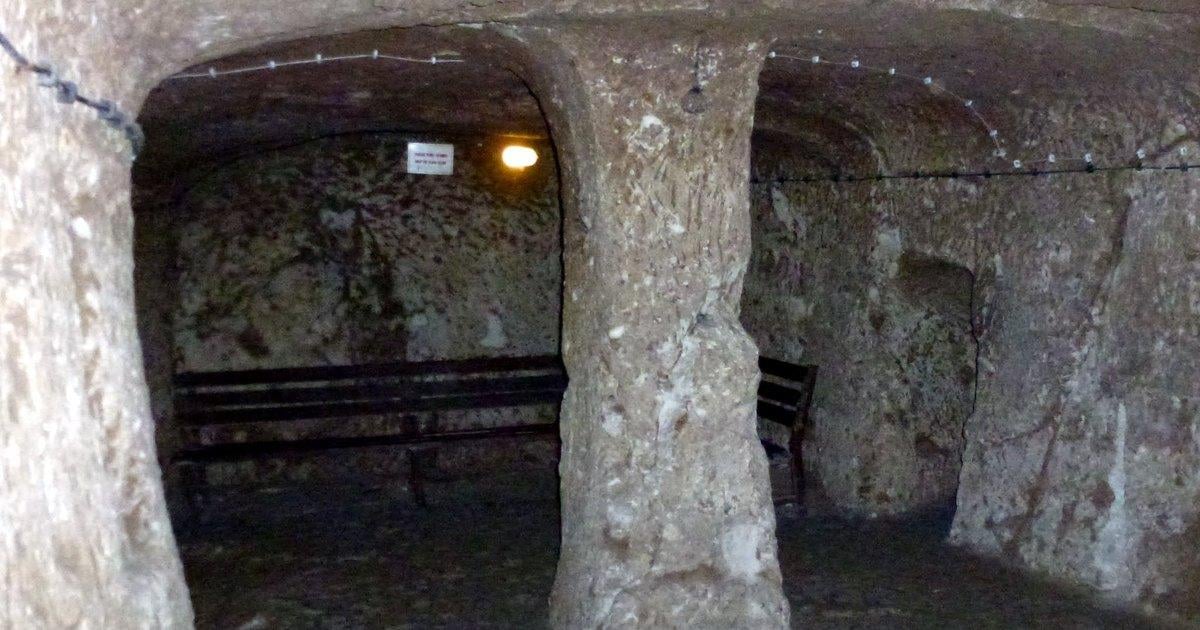
A rock-cut room with a pillar left in place inside Derinkuyu Underground City, Nevşehir Province, Turkey. Photo by Николай Максимович, 2012, via Wikimedia Commons, CC BY 3.0 (https://creativecommons.org/licenses/by/3.0/), cropped and resized
By Aris Manus
Claim by claim
- Unverified: The underground city of Derinkuyu is over 10,000 years old and was built to shelter from an Ice Age or cosmic disaster. Reason: no dated find supports it, and the published limit is the 3rd millennium BC.
- Established: Derinkuyu is a multi-level rock-cut complex in Nevşehir Province, Cappadocia, with eight floors open today. Reason: the survey and official pages agree.
- Disputed: Derinkuyu is 85 meters deep. Reason: the district office puts the open floors at about 50 meters.
- Established: Christian communities used and expanded the city as a refuge in the Byzantine period. Reason: UNESCO and the published research agree.
- Unverified: The Phrygians first cut Derinkuyu. Reason: the survey calls this a guess.
Sources
Kahya Yıldırım, Elif (2025). Evaluation of Underground Cities in Nevşehir and its Surroundings in Terms of Cultural Geography. Asia Minor Studies 13 (1), pp. 77 to 105.
UNESCO World Heritage Centre. Göreme National Park and the Rock Sites of Cappadocia. World Heritage List, property 357.
Republic of Türkiye Ministry of Culture and Tourism. Derinkuyu Underground City. muze.gov.tr.
Republic of Türkiye Ministry of Culture and Tourism. Derinkuyu Yeraltı Şehri. Kültür Portalı. In Turkish.
Derinkuyu District Governorship. Tarihi Yeraltı Şehrimiz. In Turkish.
Xenophon. Anabasis, translated by H. G. Dakyns. Project Gutenberg, Book IV.
Failler, Albert (1988). Review of Dagron and Mihăescu, Le traité sur la guérilla (De velitatione) de l'empereur Nicéphore Phocas. Revue des études byzantines 46, pp. 231 to 232. In French.
Sandoval-Castellanos, E., and colleagues (2024). Ancient mitogenomes from Pre-Pottery Neolithic Central Anatolia and the effects of a Late Neolithic bottleneck in sheep (Ovis aries). Science Advances 10 (15), eadj0954. Open access via PubMed Central.
Ancient Nerds. Video compares proposed Christian, Hittite and Persian origins for Derinkuyu. Cited for the claim only.