
Fact Check verdict: Fringe. The Trilithon sits in an early Roman podium, and capstans, rollers and ramps known from antiquity could have moved its blocks.
Few ancient building sites draw as much speculation as the Temple of Jupiter at Baalbek, in the Beqaa Valley of Lebanon. The writer Graham Hancock wrote in 2014 that "I believe these huge megaliths long predate the construction of the Temple of Jupiter and are likely to be 12,000 or more years old." Is he right that Rome could not have placed them?
According to the archaeological evidence, the great blocks belong to a temple podium built under Roman rule in the first century AD, from a quarry close to the site. Engineering studies show how such loads could be moved with known methods, though some questions about the quarry are still open.
What the evidence says
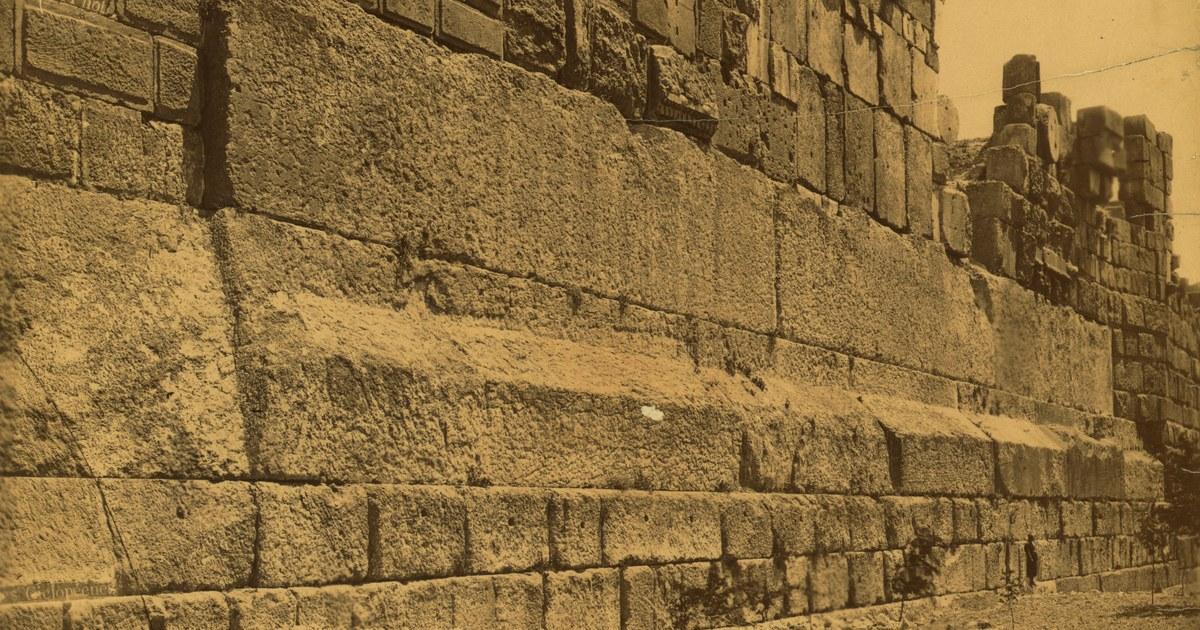
The Trilithon is a course of three limestone blocks in the western wall of the temple podium. The French architect and archaeologist Jean-Pierre Adam, in a 1977 study in the journal Syria, gave their lengths as 19.60, 19.30 and 19.10 meters, each 4.34 meters high and 3.65 meters deep.
Adam put their average weight at close to 800 metric tons, resting on a course of blocks each nearly 10 meters long and about 350 tons in weight. Translations from his French are by Ancient Origins.
The stone came from a quarry that Adam calls Cheikh Abdallah, about 800 meters from the sanctuary. Archaeology magazine in 2014 placed the quarry "about a quarter of a mile from a temple complex in the ancient city of Heliopolis."
The date comes from the building itself. Daniel Lohmann of the German Archaeological Institute, writing in 2010, places the Jupiter sanctuary and its unusual scale in "the first half of the first century AD," and he names the Trilithon as its most famous example. The temple, he adds, was "nearly finished in the year 60 AD," a date he takes from an inscription.
Adam pointed to the same evidence in 1977, a graffito on the bedding face of a capital that gives the year 60 AD. In a 2014 New Yorker report, Elif Batuman wrote that, according to the institute's Margarete van Ess, "the temple of Jupiter was definitely built by the Romans," in at least four phases beginning around 15 BC.
How the blocks were moved
In Adam's reconstruction of the move from quarry to wall, workers built a road with long timbers laid along its length, so that rollers under each block ran on a hard surface.
He notes that the quarry sits slightly higher than the temple, so the first courses could be hauled down a gentle slope. After each course was finished, the road was raised to the level of the next one, and the blocks were drawn straight onto the wall without being lifted into the air.
The pulling power came from capstans, upright winches turned by teams of workers, linked to pulley blocks. To show what such gear can do, Adam described the move of the Thunder Stone in Saint Petersburg, a granite block of about 1,250 tons. It was hauled some 6 kilometers using two capstans, each worked by 32 men, with pulleys multiplying their pull.
Adam stressed that Roman builders had these tools, drawing on the tenth book of Vitruvius and a Roman tomb relief that shows a lifting machine. He concluded that his study had brought the problem of placing the Baalbek blocks down to human dimensions.
Batuman reported that van Ess saw the blocks as split from the bedrock along natural fissures and dragged from the quarry, "probably using a capstan," with a sledge also under discussion.
The alternative view
The case for an older builder starts from real features of the site. Hancock does not deny Roman skill, and he wrote that "the Romans could move very large blocks of stone." His doubt is about height, because he argues that setting three blocks of 800 tons some 18 or 20 feet above the ground "is a problem of a completely different order."
He also asks why three even larger blocks, in the range of 1,000 to 1,650 tons, were left behind in the quarry. They include the Stone of the Pregnant Woman, or Hajjar al-Hibla, and a block found in 2014 and estimated at about 1,650 tons. Hancock suggests that they were buried under sediment and unknown to Roman builders.
There is also real evidence of building before Rome. Lohmann reports that "the foundation wall underneath the peristasis of the early imperial pseudodipteral temple could be proven to be of pre-Roman date." He describes an earlier T-shaped terrace that Roman builders took into their own plan.
That earlier wall does not carry the Trilithon, since Lohmann describes the podium with the three great blocks as a Roman front built around the older terrace. Adam also links the style of the blocks to local Phoenician building methods within a Roman program, which may help explain why they look different from the temple above them.
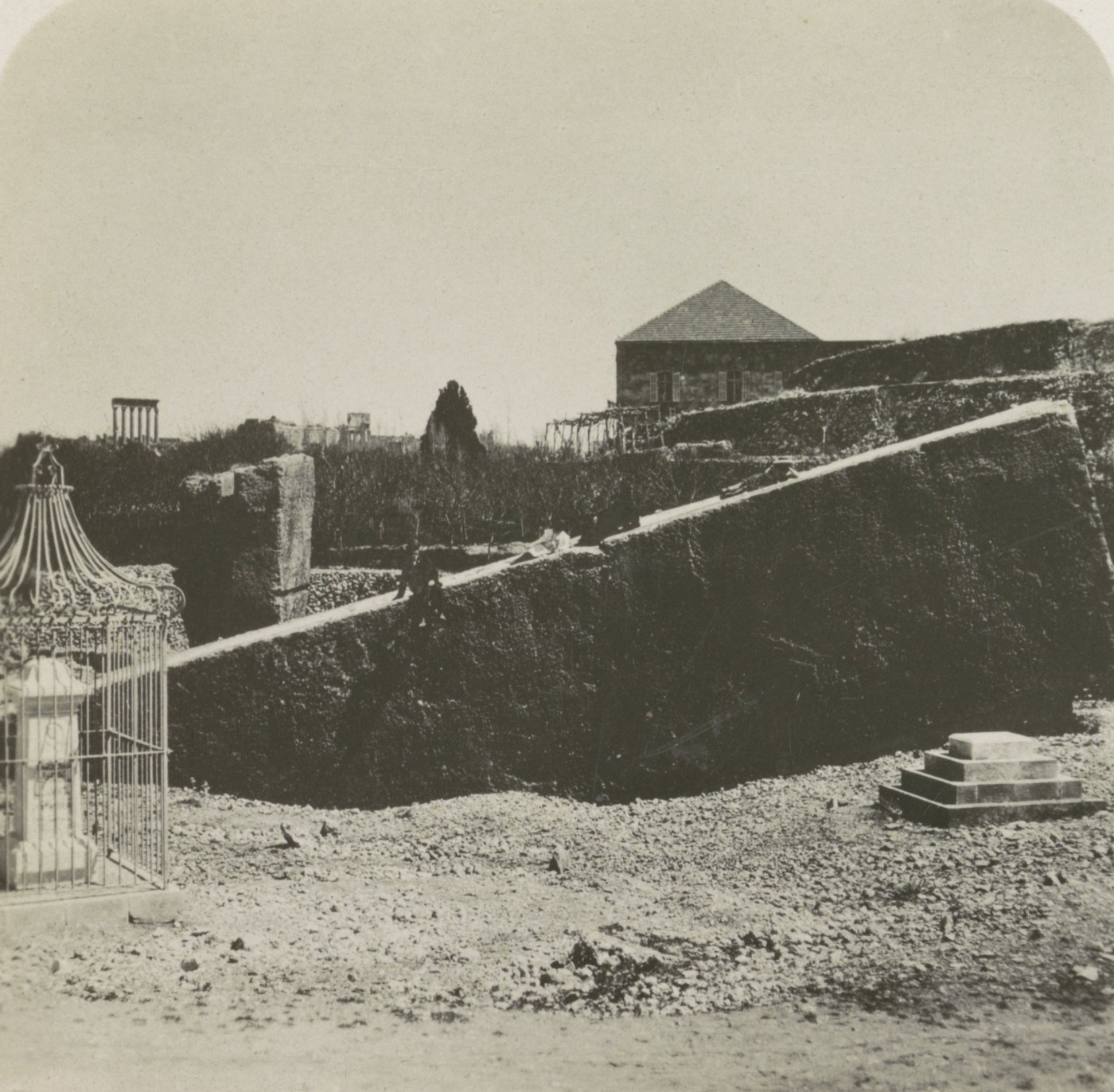
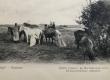
The Stone of the Pregnant Woman in the Baalbek quarry, in a stereo photograph taken between about 1884 and 1914. Image: Rijksmuseum, via Wikimedia Commons. Public domain.
The quarry blocks fit the Roman account better than Hancock suggests. The 2014 block, in a statement from the German Archaeological Institute reported by Archaeology magazine, was smooth enough to show it "was meant to be transported and used without being cut." Batuman reported that the Stone of the Pregnant Woman "turned out to have a crack that would have impeded its transport."
Where this leaves it
According to the sources consulted, the Trilithon sits in a podium that Roman builders raised in the first half of the first century AD, from a quarry less than a kilometer away. The methods needed to move it were known to Roman engineers and have been tested on similar loads in later centuries.
Why the largest quarry blocks were abandoned, and what the older terrace once supported, are still open questions. The idea that a far older civilization placed the stones remains less likely than the Roman builders of Baalbek, whose quarry still holds the Stone of the Pregnant Woman and the block found in 2014.
How we checked this
Read for this check: Adam's 1977 article in Syria in its Persée edition, Lohmann's 2010 paper in the Bollettino di Archeologia online, the German Archaeological Institute project pages on Baalbek, Batuman's 2014 New Yorker article, the 2014 Archaeology magazine report and Hancock's 2014 post on his website. The institute's 2014 statement and van Ess's comments are known here only as those reports quote them.
No interviews were conducted, earlier Ancient Origins coverage was not a source, and every quote was checked against a saved copy on November 3, 2026.
How we label claims: see How we check evidence.
The Trilithon in the western podium wall of the Temple of Jupiter at Baalbek, photographed around 1860. Photo: Tancrède R. Dumas, public domain, Library of Congress, via Wikimedia Commons. Public domain.
By Aris Manus
Claim by claim
- Fringe: No one in Roman times could have moved Baalbek's megaliths, so an older civilization placed them. Reason: the Trilithon sits in an early imperial podium, and known Roman methods could move such loads.
- Established: Each Trilithon block weighs about 800 metric tons and came from a quarry about 800 meters away. Reason: Adam gives the sizes, weights and quarry distance.
- Established: The temple and its podium were built in the early Roman imperial period. Reason: Lohmann dates the work to the first half of the first century AD, with the temple nearly finished by AD 60.
- Established: Part of an older terrace from before Roman times lies under the temple. Reason: Lohmann reports a pre-Roman foundation wall under the temple colonnade.
- Established: Capstans, pulleys, rollers and ramps can move blocks of this size. Reason: Adam sets out the method and cites the Thunder Stone, moved with two capstans.
- Unverified: Why the largest quarry blocks were left behind. Reason: a crack is reported in one stone, but no full study of all three was read.
Sources
Adam, Jean-Pierre (1977). A propos du trilithon de Baalbek. Le transport et la mise en oeuvre des mégalithes. Syria 54 (1-2): 31 to 63. doi:10.3406/syria.1977.6623.
Lohmann, Daniel (2010). Giant Strides towards Monumentality: The Architecture of the Jupiter Sanctuary in Baalbek/Heliopolis. Bollettino di Archeologia on line I, Volume speciale, Poster Session 2.
Deutsches Archäologisches Institut. Das Heiligtum des Iupiter Optimus Maximus Heliopolitanus in Baalbek/Heliopolis, project 2486, and Die neolithische bis eisenzeitliche Besiedlung in Baalbek, project 5713. dainst.org.
Batuman, Elif (2014). The Myth of the Megalith. The New Yorker, December 18, 2014.
Archaeology magazine (2014). "Biggest Boulder" Unearthed in Lebanon. December 2, 2014. archaeology.org.
Hancock, Graham (2014). Third Giant Megalith At Baalbek. grahamhancock.com.