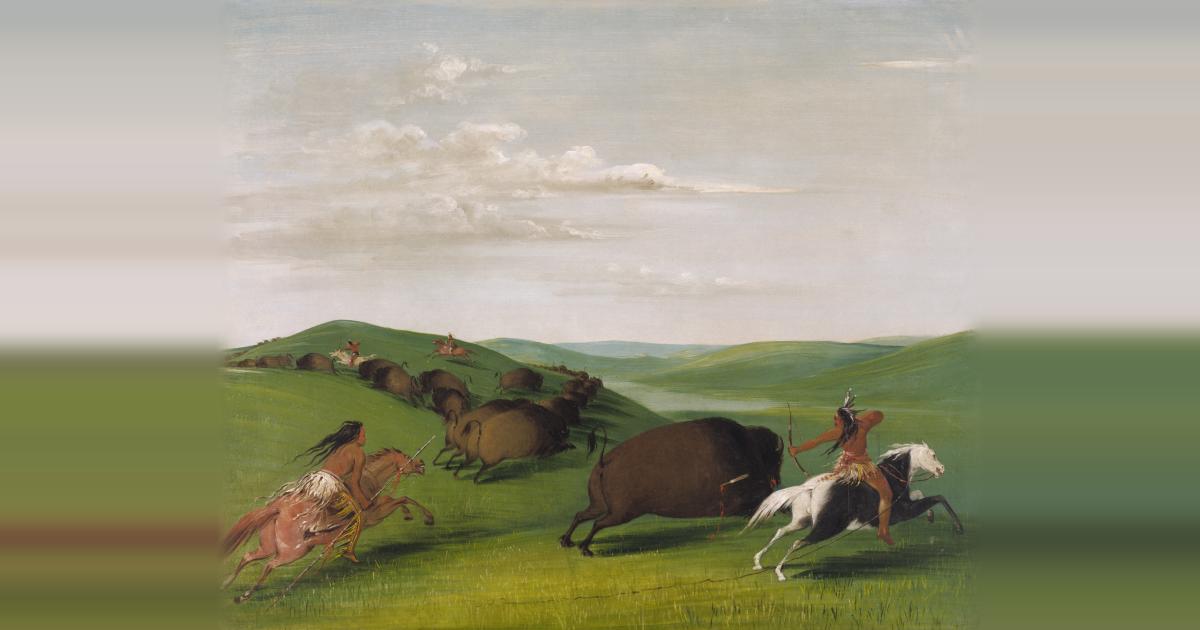

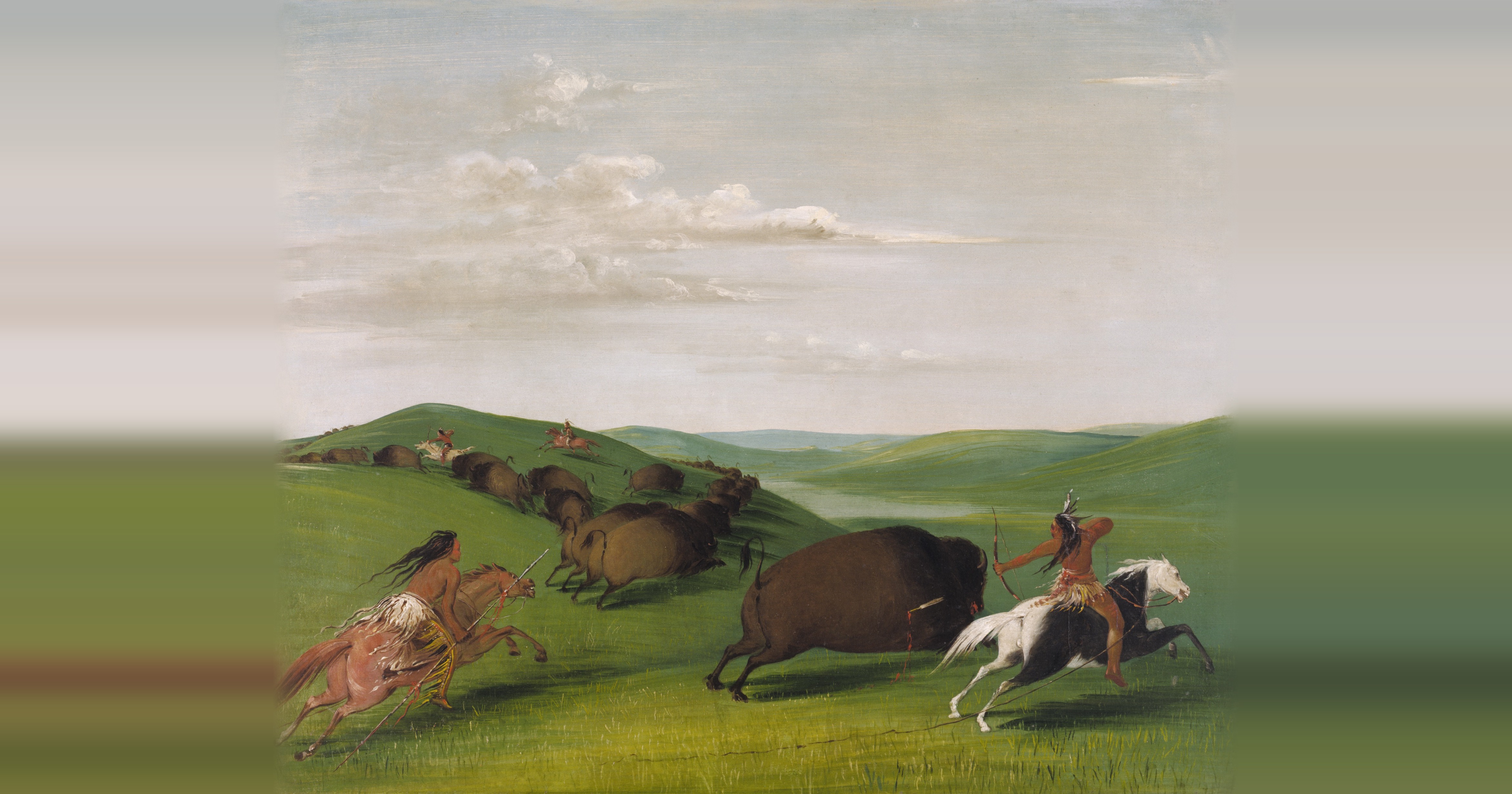
George Catlin, Buffalo Chase with Bows and Lances, 1832 to 1833, oil on canvas. Catlin painted Plains peoples in a romanticized style for audiences in the eastern United States, so the scene is an outside artist's view rather than a record. It shows a mounted chase, a different method from the cliff drives at Nighthawk, and it is not from the site. (Image: Smithsonian American Art Museum, Gift of Mrs. Joseph Harrison, Jr., 1985.66.410, CC0, painting shown at native size with the background extended at both sides)
Hunters on the Texas Panhandle stampeded bison off the same crumbling cliff at least seven times over roughly 3,000 years, a new study has found. The site, known as Nighthawk, sits in Caprock Canyons State Park in Briscoe County. It adds rare and well-dated evidence that people on the Southern Plains used a communal hunting method best known from the northern Plains.
According to the paper, published online on November 9, 2026, in the journal American Antiquity, the kills span the Late Archaic to the Protohistoric periods, from about 3,500 to 400 years ago. The team, led by geoarchaeologist August "Gus" Costa of Rice University, based that sequence on 27 direct radiocarbon dates from bison bone collagen and charcoal. "These new data challenge many long-held assumptions about the nature of bison jump hunting techniques in time and space," the authors wrote.
A Cliff Found by Chance
The site came to light in November 2021. Rick Day, a Texas Historical Commission steward, and his partner Susan Day spotted bison bones eroding from a slope beneath a cliff near Quitaque, on land owned by Texas Parks and Wildlife. According to Plains Archeological Research, which sponsored the project, the couple were scouting the park for a school science field trip at the time. The name Nighthawk comes from the nightjar birds the team saw nesting at the site.
According to NewsChannel 10, the pair had moved to higher ground after meeting a group of bison. Day told the station that they stumbled onto a large dirt cliff with a line of bison bones running through it. Test excavations by a Texas Tech University field school followed in 2023, and crews spent about two months on a larger salvage dig in the spring of 2024, funded by the Summerlee Foundation with matching money from the state parks agency.
Speed mattered because the cliff is falling apart. Plains Archeological Research estimates that around 70 percent of the site has already been destroyed by erosion, and Costa told NewsChannel 10 that the site was eroding so quickly that the team had to act as fast as possible.
How Do You Prove a Bison Jump?
In a jump, hunters guided a herd toward a precipice and stampeded the animals over the edge so the fall would kill or disable them. The paper notes that such cliffs are usually 10 to 30 meters (33 to 98 feet) high and that conservative estimates put the number of animals needed for a jump to work at around 100. Organizing a drive on that scale took many people working together, along with a large crew to butcher the carcasses before the meat spoiled.
At Nighthawk, the main bone beds lie at the base of a cliff about 20 meters (66 feet) high, on a bedrock tableland about 50 meters (164 feet) above the valley floor. Costa told NewsChannel 10 that the animals could only have reached that spot by falling from above. He added that the hunters did all this on foot with large wild animals, which meant that a great many people had to cooperate.
The archaeologists recorded the site as two areas, 41BI564 beside the modern cliff and 41BI565 about 120 meters (394 feet) to the east. Further work showed that the two belong to one site that erosion has pulled apart. The oldest kills lie in the eastern area, farthest from today's cliff edge.
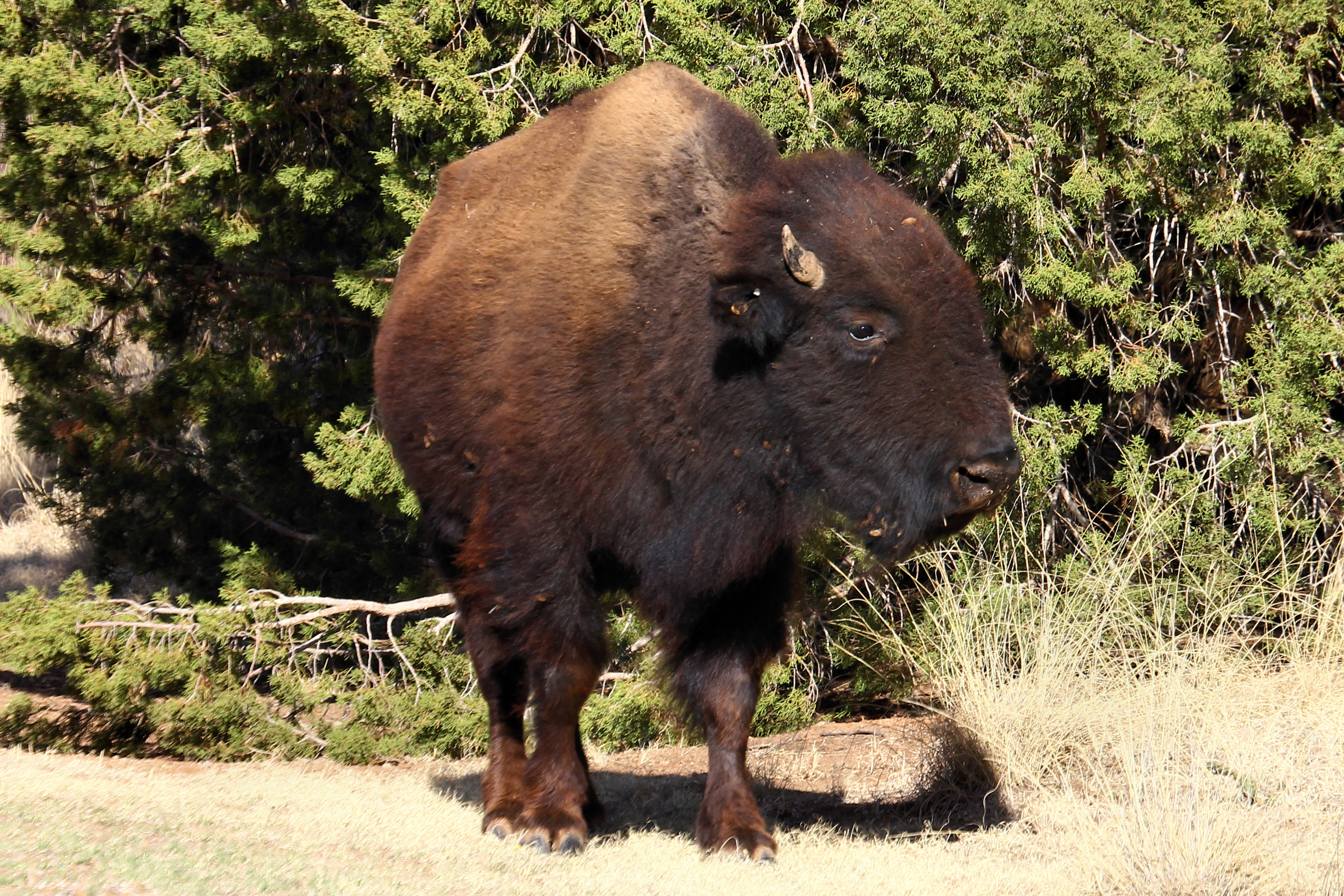
A plains bison from the Texas State Bison Herd at Caprock Canyons State Park, photographed in 2023. It is a modern animal and is not from the Nighthawk excavations. (Image: Larry D. Moore, CC BY 4.0, via Wikimedia Commons, shown at native size)
A Cliff That Moved
The edge the hunters used did not stay in one place. The study argues that after about 2,900 years ago a narrow plateau spur was cut off from the main plateau, which shifted the jump-off point more than 100 meters (330 feet) to the west. The geology here wears back quickly. Historic geological observations cited in the paper put the retreat of the eastern Caprock Escarpment at 60 to 190 meters per 1,000 years.
That erosion helps explain why so few jumps have been found in the region. Some researchers had argued that the Southern Plains simply lacked suitable cliffs. The authors disagree firmly. "We can reject this hypothesis," they wrote, adding that "There are many suitable precipices for bison jumping around the Southern High Plains, and we now know that some were used."
Seven Kills Across Three Millennia
The two oldest kills date to between 3,575 and 3,400 years ago and between 2,965 and 2,855 years ago, and both are linked to Late Archaic dart points. Later events came after the arrival of the bow, with Scallorn and Washita arrow points among the finds. The most recent kill, Kill 7, has an age range of AD 1520 to 1665, which the authors say overlaps Spanish colonial intrusion into the region.
The bones that survive are modest in number. Most kills are represented by just one or a few preserved animals, and the team counts a minimum of 27 bison across all seven events. Costa told NewsChannel 10 that there may have been nine or more hunts in total, since erosion has removed parts of the record.
The stone tools recovered with the bones point to wide connections. Most were made from local Tecovas chert and Ogallala quartzite, but a few tools were made of Alibates flint from about 130 kilometers (81 miles) away. Two dart points, two arrow points and a biface were made of Edwards chert from Central Texas, some 500 to 600 kilometers (310 to 370 miles) to the southeast.
For the authors, the later kills matter most. "It represents the first example of Late Prehistoric bison jumping in southern Plains," they wrote. They suggest that knowledge of communal bison hunting passed from Late Archaic to Late Prehistoric times, when pottery and archery reached the area, and that it survived a long gap in use at the site.
North and South
Bison jumps are far better known from the northern Plains. Head-Smashed-In Buffalo Jump in Alberta, a UNESCO World Heritage Site, preserves evidence of the practice over nearly 6,000 years, according to UNESCO. Ancient Origins has reported on a 1,600-year-old meal found still in a roasting pit at Head-Smashed-In and on stone drive lines and buffalo kill areas exposed by a controlled burn in Montana.
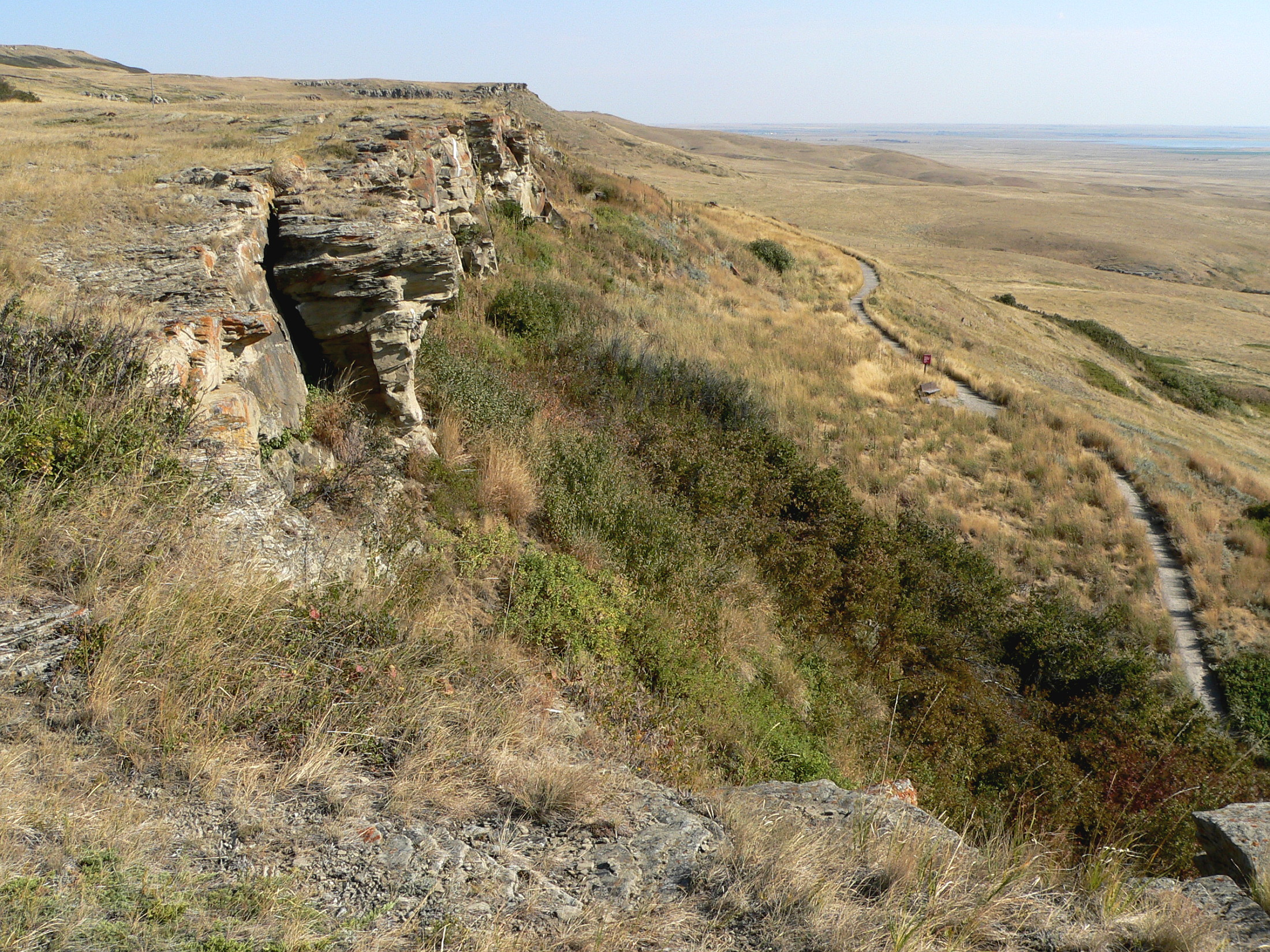
The cliffs at Head-Smashed-In Buffalo Jump in Alberta, Canada, photographed in 2006. It is shown as a comparable northern Plains jump and is not the Nighthawk site. (Image: Ken Thomas, public domain by the photographer's release, via Wikimedia Commons, shown at native size)
In Texas, Plains Archeological Research describes Nighthawk as the second bison jump ever found in the state, after Bonfire Shelter in Val Verde County, in the Lower Pecos region also known for its ancient painted murals. The new paper is more cautious about Bonfire, calling it the only well-known possible jump candidate in Texas. It notes that a Late Archaic kill of about 2,600 years ago there is rarely doubted as a jump, while a far older bone bed has long faced skepticism.
The authors also see clear differences between north and south after about 2,000 years ago. In the north, advances in fat extraction, food storage such as pemmican, and trade with Plains village farmers likely pushed bison hunting toward an industrial scale. "At present we have no evidence for equivalent industrialization in the south," they wrote. Costa told NewsChannel 10 that the Indigenous peoples of the Southern Plains had the same ability as hunters farther north, although their motives may have differed.
Bison Back in the Canyons
Nighthawk is now a protected State Antiquities Landmark, and park staff continue to monitor it for erosion and vandalism, NewsChannel 10 reports. The park is also home to the Texas State Bison Herd, descended from bison kept by Charles and Mary Ann Goodnight in the late 1800s. Researchers are now studying ancient bison DNA and teeth to learn how the animals moved across the region and whether they are related to the modern herd.
Le'Ann Pigg, the park's assistant superintendent, told the station that the find helps complete the long story of people and bison in the canyons. With most of the site already gone and the exact number of hunts still uncertain, the full history of the Nighthawk cliff remains less complete than the record of its last seven kills.
By Aris Manus
Sources
Costa, A. G., Houk, B. A., Lyle, A. S., Bement, L., Lintz, C., Lawrence, K. L., Frederick, C. D. and Culleton, B. J. 2026. "The Nighthawk Bison Jump: New Evidence for Recurrent Late Holocene Bison Jumping in the Southern Plains." American Antiquity, pp. 1 to 28. Published online November 9, 2026. Available at: https://doi.org/10.1017/aaq.2026.10229
Cavazos, C. 2026. "Archaeologists uncover rare ancient bison jump hunting site at Caprock Canyons." NewsChannel 10 (KFDA), November 21, 2026. Available at: https://www.newschannel10.com/2026/11/21/archaeologists-uncover-rare-an…
Plains Archeological Research. n.d. "Nighthawk Bison Jump." Accessed November 21, 2026. Available at: https://www.plainsarch.org/nighthawk
UNESCO World Heritage Centre. 2026. "Head-Smashed-In Buffalo Jump." Available at: https://whc.unesco.org/en/list/158