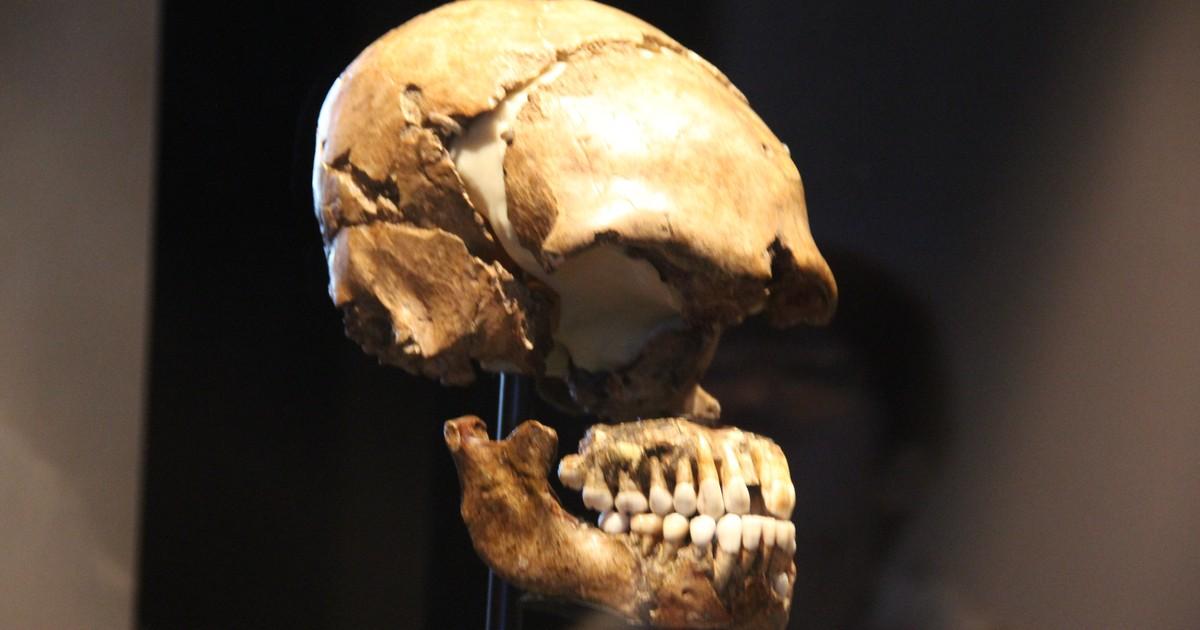

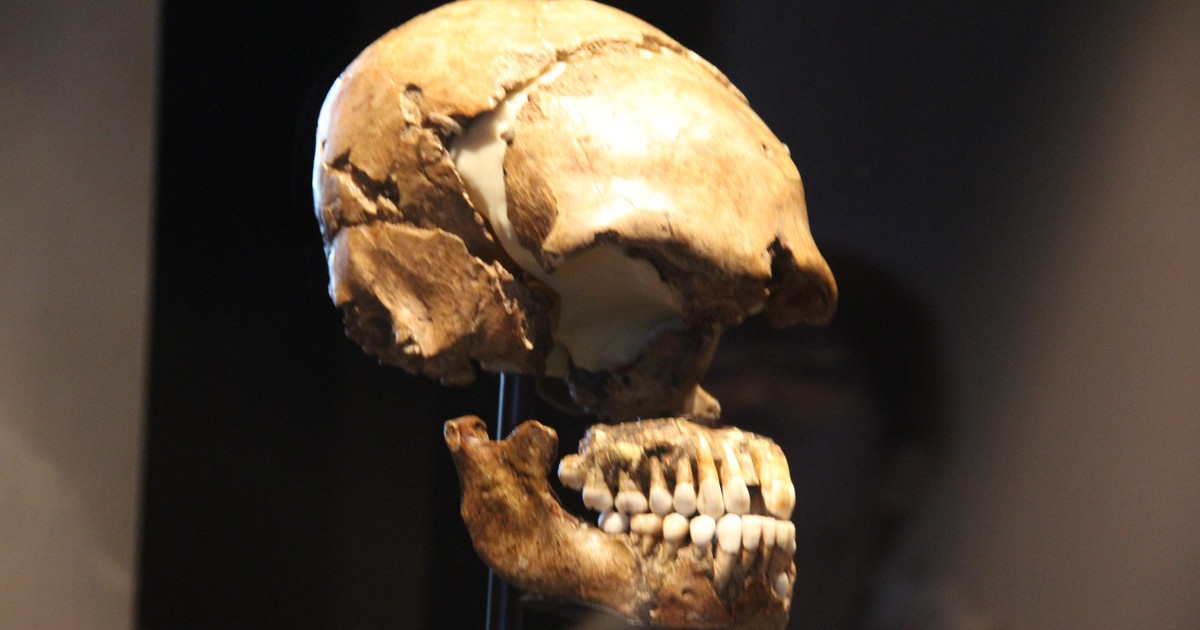
The Le Moustier 1 Neanderthal skull on display at the Neues Museum, Berlin. The photo has been cropped to a wide frame and reduced in size from the original. (Image: photograph by Gary Todd via Wikimedia Commons, CC0)
A small stretch of DNA that Neanderthals passed to the ancestors of many people alive today is associated with a slightly smaller region at the back of the brain. In a study published in PNAS on November 16, 2026, geneticists Hugo Zeberg and Svante Pääbo report that a Neanderthal-derived variant near the gene DAAM1 is associated with a smaller occipital lobe and, in people with two copies, a lower risk of schizophrenia.
According to the paper's abstract, "Carriers of the Neandertal variant have altered DAAM1 expression and occipital lobe volumes that are about 0.85 cm³ smaller per gene copy." The same abstract adds that the variant "is associated with reduced schizophrenia risk by almost 10% in homozygous carriers," meaning people who inherited the variant from both parents. The findings show an association in population data and do not show that the variant causes, prevents or treats the condition.
A Variant From an Old Encounter
Neanderthals died out about 40,000 years ago, but not before interbreeding with Homo sapiens. Most people today who are not of sub-Saharan African ancestry carry about 2% Neanderthal ancestry, according to Live Science, and earlier Ancient Origins coverage has followed how much of the Neanderthal genome survives in modern humans.
Zeberg, who holds posts at the Karolinska Institute in Sweden and the Max Planck Institute for Evolutionary Anthropology in Leipzig, worked with Pääbo, a director at the Leipzig institute and winner of the 2022 Nobel Prize in Physiology or Medicine. Their starting point was anatomy. The abstract notes that "Neandertal crania were less globular than those of modern humans, suggesting differences in the relative volumes of brain regions, including the frontal and occipital lobes."
The pair looked for gene variants tied to occipital lobe size that are also absent from people of sub-Saharan African descent, whose ancestors had little or no contact with Neanderthals, Smithsonian reports. Nature reports that the variant they found was present in all five detailed Neanderthal genomes available to scientists but absent from Denisovan genomes. Smithsonian puts the number of Denisovan genomes tested at two.
According to Nature, the variant is a deletion of four DNA letters on chromosome 14 that was first identified in 2019. It sits within a Neanderthal-derived block of DNA 59.7 kilobases long, which Nature reports is too long to have survived from an older ancestor shared by both species. In the authors' words, the variant "lies in predicted transcription-factor recognition motifs near DAAM1, a gene that is known to be involved in brain development."
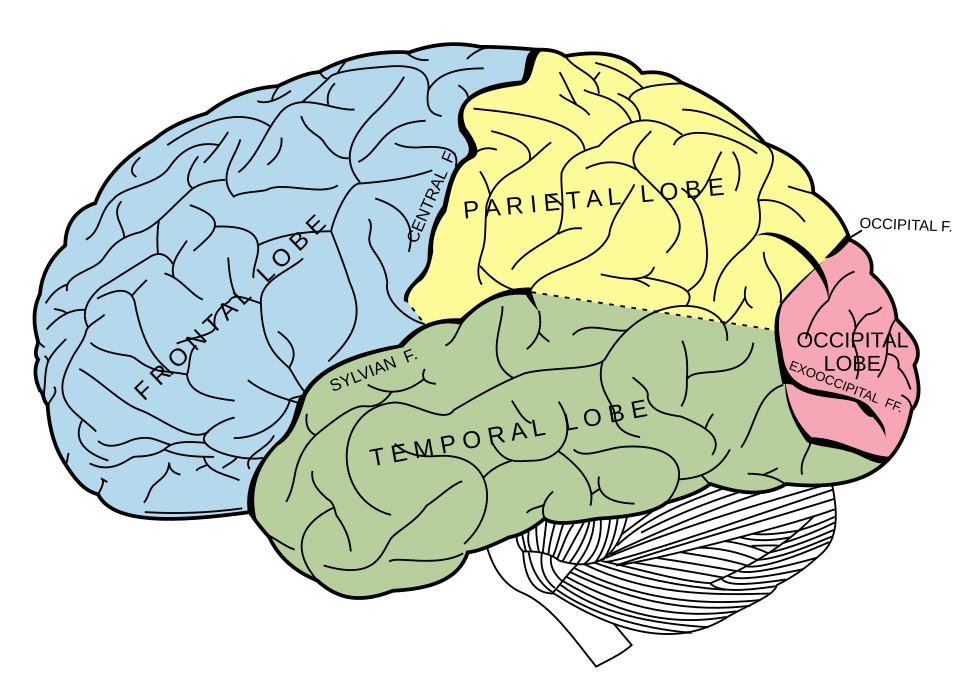
The lobes of the human brain seen from the side, with the occipital lobe shown in pink at the back. Diagram after Henry Vandyke Carter's plate in Gray's Anatomy, redrawn by Mysid. Shown at 960 pixels wide, as rendered by Wikimedia Commons from the original vector file, with its transparent background set to white. (Image: Henry Vandyke Carter and Mysid via Wikimedia Commons, public domain)
How Big Is the Effect?
The occipital lobe sits at the back of the skull and houses the visual cortex. Nature reports that the effect is centered on a part of the lobe called the cuneus, and that the change of 0.85 cubic centimeters (0.05 cubic inch) per copy is larger than that of any other known variant acting on that region.
Scientific American, reporting on UK Biobank data used in the study, gives the reduction as about 1.7 cubic centimeters in people with two copies. Smithsonian, citing Science, reports that about 20% of people of European descent carry at least one copy of the variant. Ancient Origins has not yet been able to check those population figures against the full paper.
Zeberg and Pääbo say the result is the opposite of what might be expected, Nature reports. Neanderthal brains were longer from front to back than those of modern humans and tended to have slightly larger occipital lobes, according to Nature. Yet the variant they handed on is linked to a smaller one. Princeton geneticist Joshua Akey, who was not involved in the work, told Nature that this is less strange than it sounds, Smithsonian reports, since brain size is shaped by very many genes pulling in different directions.
Tony Capra, an evolutionary geneticist at the University of California, San Francisco, who was not involved either, made a similar point to Live Science. In his view a single variant cannot capture the full range of Neanderthal genetic variation that shaped their brains.
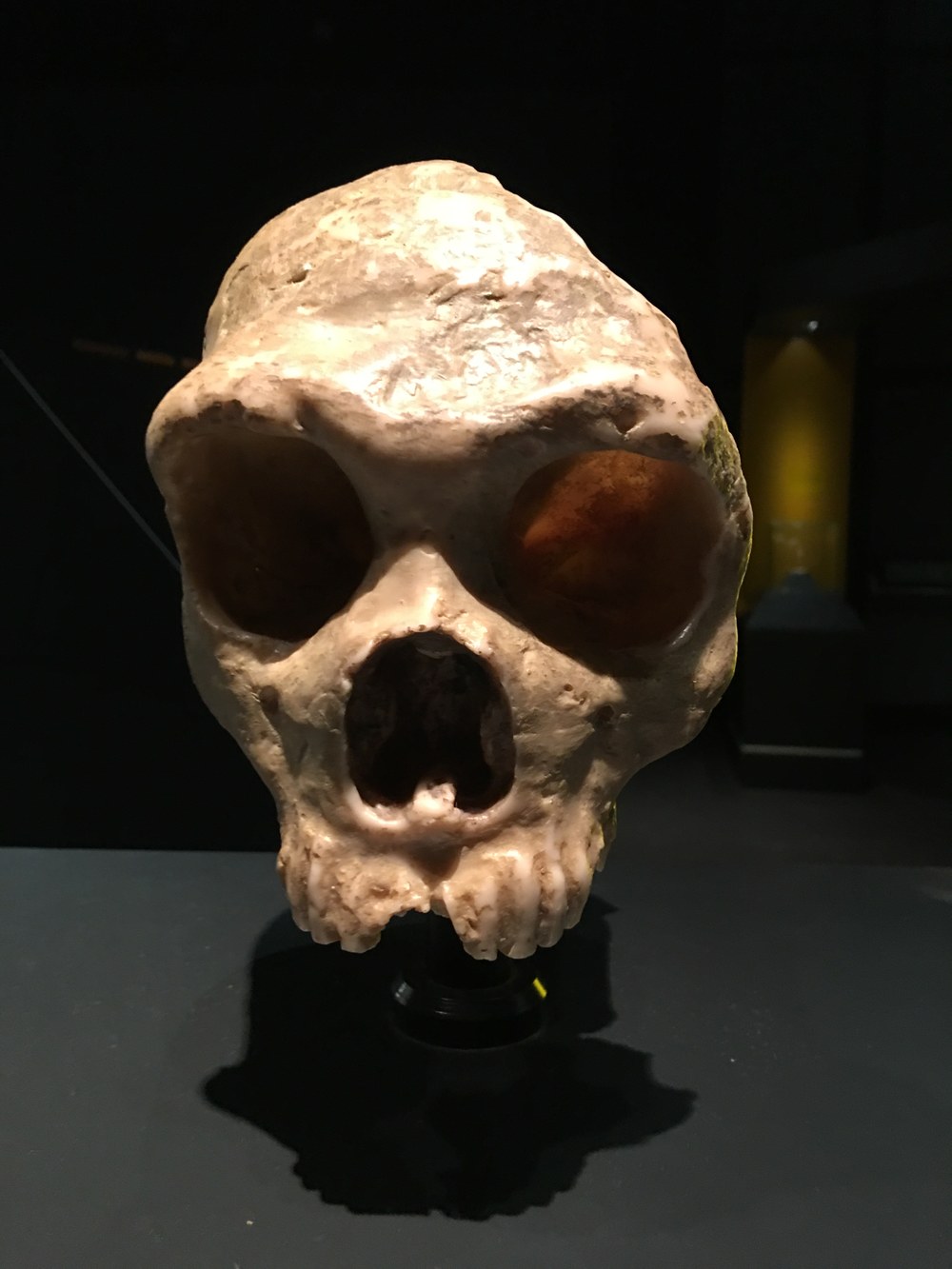
A cast of the Gibraltar 1 Neanderthal skull at the Natural History Museum, London. The photo has been rotated upright and reduced in size from the original. (Image: Velatrix via Wikimedia Commons, CC0)
What the Schizophrenia Link Does and Does Not Show
The headline number concerns people with two copies of the variant. In that group the abstract reports "reduced schizophrenia risk by almost 10%," a modest shift in odds across a large population. It does not mean that any individual carrier is protected, and it says nothing about people who already live with the condition.
The authors also tested whether Neanderthal DNA in general behaves the same way, and found that it does not. The abstract states that "Neandertal ancestry as a whole does not show such a tendency." In other words, the association is tied to this one variant and gives no reason to think that having more Neanderthal ancestry makes anyone more or less likely to develop schizophrenia.
Scientific American reports that the variant was not linked to depression, bipolar disorder or attention deficit hyperactivity disorder. Smithsonian adds autism spectrum disorder to that list. Why the variant is associated with schizophrenia at all remains unknown. Symptoms of schizophrenia can include visual hallucinations, and Zeberg told Live Science that it is tempting to connect the result to the visual cortex. However, he stressed that there is currently no evidence for such a link.
No Sign of a Hit to Intelligence
A smaller brain region might be expected to come with some cost to thinking skills, but the study found little sign of one. According to the abstract, "Any association with cognition or schooling is small or nonexistent, amounting to at most two weeks of education per allele against an average of about 15 y." The authors conclude that the variant is "linked to altered brain anatomy in present-day humans and lower schizophrenia risk while having little or no association with general cognitive ability."
According to Smithsonian, the researchers note that their findings suggest the size of a brain region should not be equated with cognitive ability. The study also follows earlier work on diseases and traits inherited from Neanderthals and on the long history of human and Neanderthal interbreeding.
What Comes Next?
How the variant changes DAAM1 activity in the developing brain is still unclear, Smithsonian reports, and studies in animals or brain organoids could help. Zeberg and Pääbo plan to keep searching the genome for other Neanderthal variants with measurable effects, Scientific American reports.
For now, the study offers a rare case in which a single inherited Neanderthal variant can be tied to a measurable change in the anatomy of living people. Its link to schizophrenia rests on population statistics, and its biological meaning remains less clear than its size.
By Aris Manus
Sources
Zeberg, H. and Pääbo, S. 2026. "A Neandertal-derived genetic variant reduces occipital brain volume in present-day humans." Proceedings of the National Academy of Sciences, 123(48), e2624837123. DOI: 10.1073/pnas.2624837123. Available at: https://doi.org/10.1073/pnas.2624837123
Marshall, M. 2026. "Genetic variant that reshaped the human brain was inherited from Neanderthals." Nature, November 16, 2026. Available at: https://www.nature.com/articles/d41586-026-03762-0
Mogensen, J. F. 2026. "Neanderthal DNA linked to lower risk of schizophrenia in modern humans." Scientific American, November 16, 2026. Available at: https://www.scientificamerican.com/article/neanderthal-dna-linked-to-lo…
Hashemi, S. 2026. "A Gene Variant Inherited From Neanderthals Might Affect Modern Humans' Brain Size and Provide Protection Against Schizophrenia." Smithsonian Magazine, November 2026. Available at: https://www.smithsonianmag.com/smart-news/a-gene-variant-inherited-from…
Choi, C. Q. 2026. "Neanderthal genes linked to lower risk of schizophrenia in modern humans." Live Science, November 18, 2026. Available at: https://www.livescience.com/archaeology/neanderthals/neanderthal-genes-…