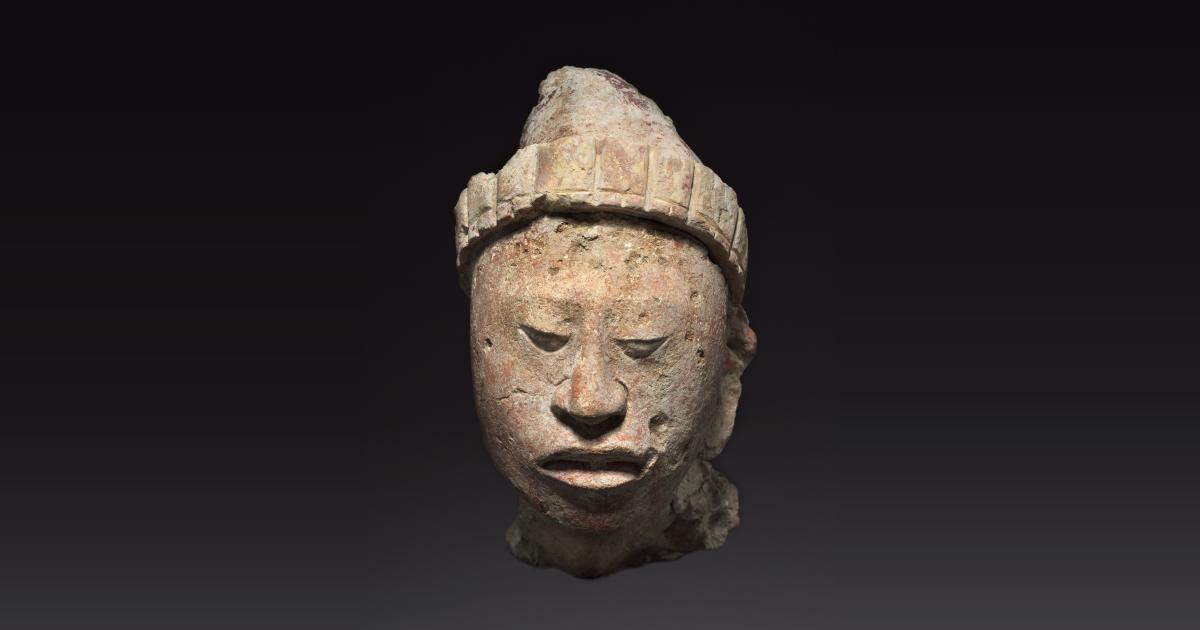

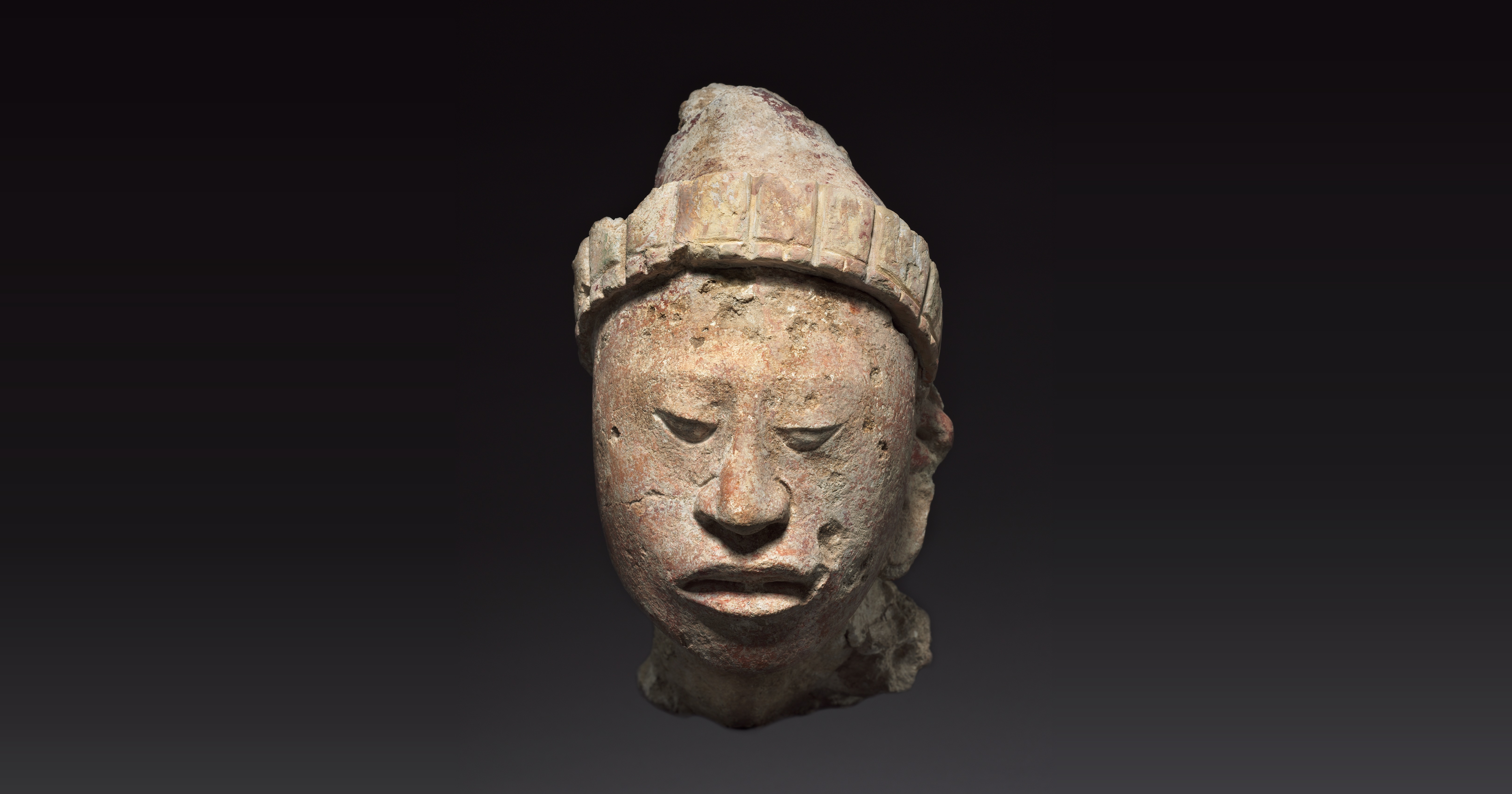
A painted Maya stucco head made to be fixed to a building facade, from Campeche, Mexico, AD 250 to 900. It is shown as a comparable example of Maya stucco work and is not from El Mirador. (Image: The Cleveland Museum of Art, Gift of Mr. and Mrs. James C. Gruener, 1990.183, CC0, background extended)
Archaeologists working deep in the forests of northern Guatemala have pulled more than 30 painted stucco heads from one modest building at El Mirador, a city better known for its colossal Preclassic pyramids. The faces, which include probable gods, rulers and ancestors, were presented at a press event in Guatemala on November 18, 2026. Researchers say no other single Maya structure has yielded so many.
According to Diario de Centro América, the Guatemalan government newspaper, the Guatemalan Tourism Institute (INGUAT) and the Mirador Basin Archaeological Project, directed by Richard Hansen, held the event under the title "Los rostros del Mirador," or The Faces of El Mirador. Reuters photographed the restored originals in the project's laboratory in Guatemala City the following day.
A Small Building Full of Faces
The heads come from a structure now called the Edificio de los Rostros, or Building of the Faces, in the Casa del Coral group east of the great La Danta complex. In their 2016 paper, Douglas Mauricio, Richard Hansen and Stanley Guenter describe it as 17 by 10 meters (56 by 33 ft) at the base and 5 meters (16 ft) high, with four trenches cut into it by looters.
The project's mapping team first found the group in 2012, when scattered stucco fragments were spotted near the building. According to Prensa Libre, Mauricio began rescue excavations there in 2013. Many of the heads lay along the south side, under blocks that had fallen from the facade and among the looters' rubble. None was found where it had originally been placed, so the way the faces were once arranged remains unknown.
Gods, Rulers and a Ferryman of the Dead
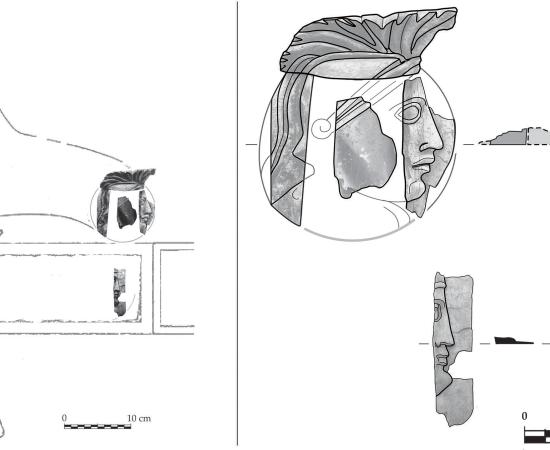
Each head was modeled in lime stucco over a stone tenon, and many keep their original paint in red, orange, black and Maya blue. The excavators have given provisional identities to many of them. One old, monkey-like face with a leaf-shaped plume painted in Maya blue "could be a representation of the God of Death," according to epigrapher Stanley Guenter, as reported in the 2016 paper (translated by Ancient Origins).
Another head, an elderly male deity wearing a jaguar headdress painted yellow and black, may be the Old Paddler God, the paper says, a deity "responsible for carrying the dead to the underworld" (translated by Ancient Origins). Other faces were tentatively read as a possible Maize God, a wind deity and a clown or jester figure. A young man, described in 2016 as the only face painted in Maya blue, might have been the owner of the building or a member of an important lineage.
The authors set out their overall reading in plain terms. "These heads are considered part of a mythological scene of complete beings composed of deities and ancestors of the ruling class of the site in the Late Classic period," they wrote in the paper's English abstract. In the Spanish text they go further and propose "an entire iconographic pantheon of deities and ancestors" (translated by Ancient Origins). Those identifications rest on iconography alone, and the researchers present them as preliminary.
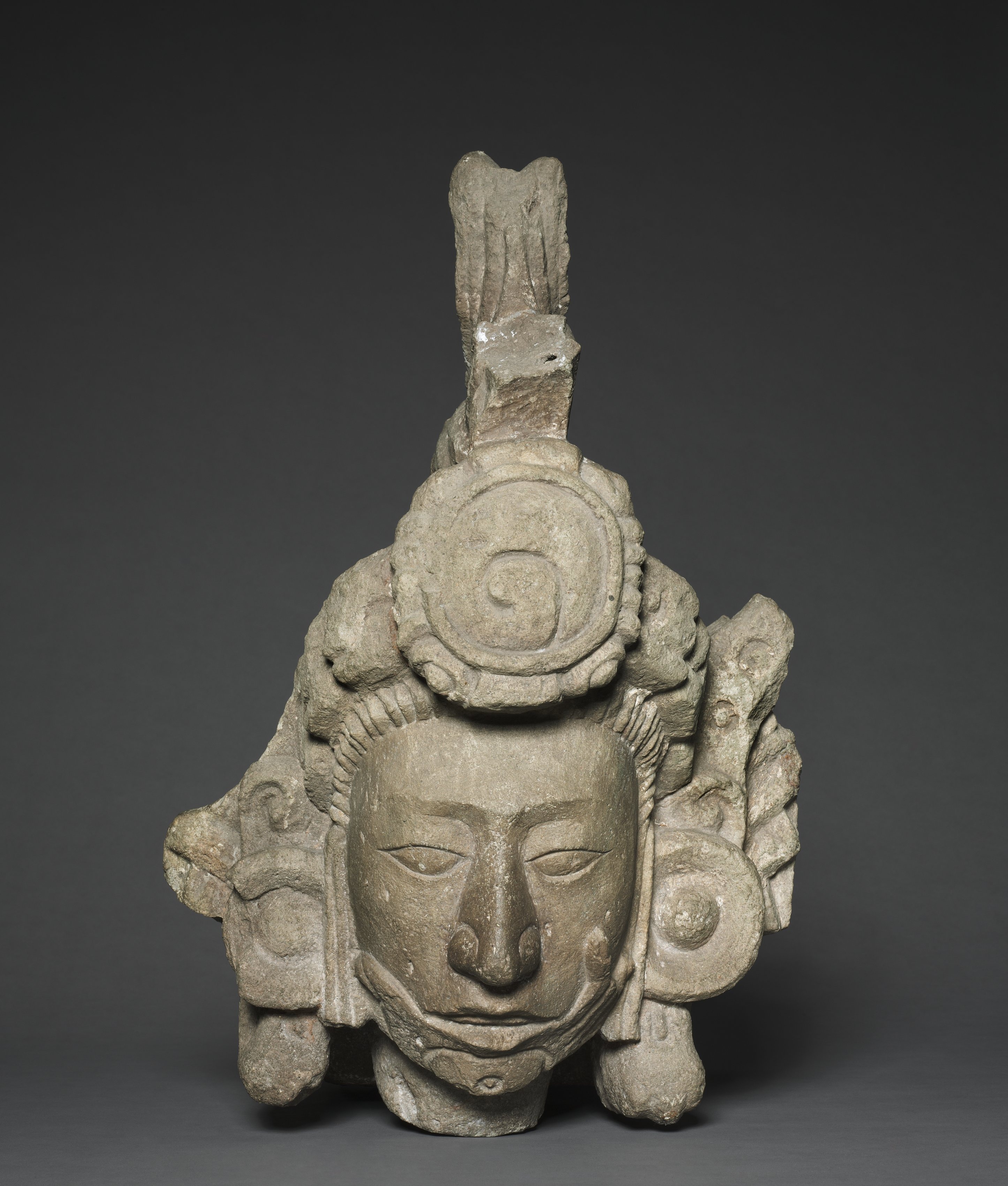
Head of a young noble from the facade of Structure 10L-22A at Copán, Honduras, AD 746. It is shown as a comparable Late Classic facade sculpture and is not from El Mirador. (Image: The Cleveland Museum of Art, Gift of the Hanna Fund, 1953.154, CC0)
What Is New in 2026?
The heads themselves are not brand new. Several went on display at Guatemala's national archaeology museum as early as May 2015, according to Prensa Libre. The excavators also described the finds at Guatemala's archaeology symposium in 2015 and again in 2021. What changed this week is the scale of the collection and the state of its restoration.
Speaking to the Guatemalan outlet TN23, Douglas Mauricio Martínez put the current total at an estimated 42 to 43 sculptures, counting complete heads and fragments together. Arkeonews counts more than 30 sculptures plus various fragments. It also reported Mauricio as saying that about three more pieces came out of the ground in the 2026 season and still need restoration. The final count is likely to shift as fragments are matched and treated.
Mauricio told Reuters that no other known structure in the Maya world has produced so many sculptures, a claim Ancient Origins has not been able to test independently. Arkeonews reports that more than 20 heads have been fully restored so far, with some already at the national museum and others still in the laboratory.
Late Visitors to an Ancient City
One of the most striking points about the faces is their date. El Mirador reached its peak in the Preclassic period, many centuries before these heads were made. Reuters dates the sculptures to the seventh and eighth centuries AD, while the 2016 paper places them in the Late Classic, between AD 650 and 850.
Mauricio told Reuters that the heads offer clues about a later phase at El Mirador, when a smaller population returned to the city and looked after the work of their predecessors. In his 2022 paper he asks "what the main reason was for building and adorning a building on the periphery of El Mirador" rather than in the old monumental center (translated by Ancient Origins).
His tentative answer looks to the building's position near the causeway between El Mirador and Nakbe. He suggests that "it may have functioned as a stopping place or pilgrimage center between both settlements" and that it later became "a center of worship for the Preclassic ancestors" (translated by Ancient Origins). The causeways themselves are the subject of earlier Ancient Origins coverage of the Maya superhighway in the Guatemalan jungle.
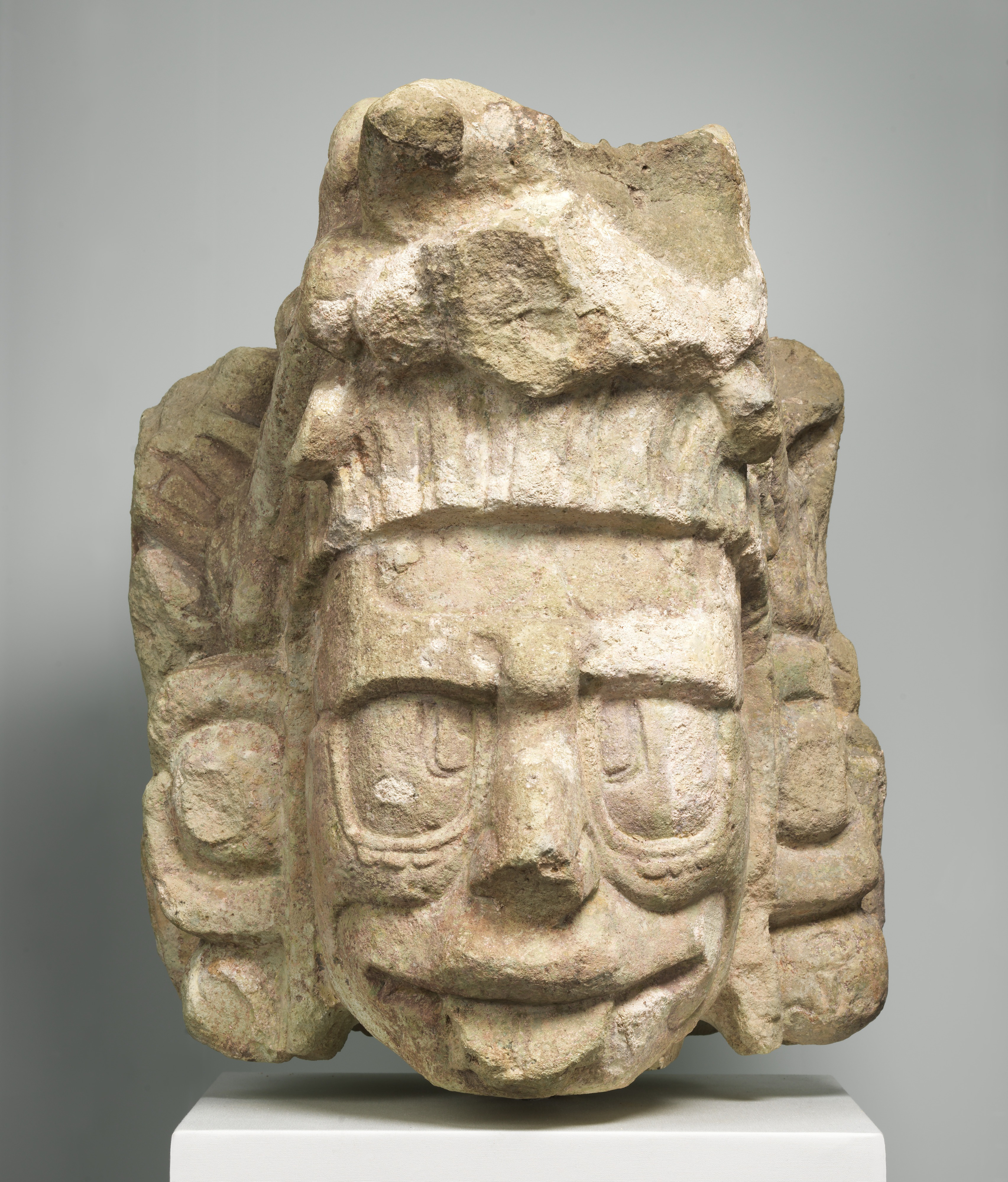
Head of a solar deity in volcanic tuff, mortar and paint, Honduras, AD 600 to 900. It is shown as a comparable Maya sculpted head and is not from El Mirador. (Image: The Metropolitan Museum of Art, Anonymous Gift, in honor of Assen Nicolov, 2022, 2022.422, CC0)
Pots, Pigments and Patient Restoration
The building also held more than 35 ceramic vessels, according to Arkeonews. They include the neckless jars known as tecomates or bucules, which the 2022 paper records in deposits beside the building. Mauricio told TN23 that the building was surely a ceremonial center, and Arkeonews reports that researchers suspect some of the vessels held fermented drinks. However, neither the pots nor the sculptures yet prove how the building was used.
Lilian Vega de Zea, the project's restoration director, told TN23 that her team keeps intervention to a minimum. Cracks are consolidated with lime, and missing parts are left unrestored. Any added color is meant to remain easy to tell apart from the original paint. She told Reuters that the use of color points to several people working on each head, from those who prepared the pigments to those who mixed the stucco. In her view, the faces also carried a message about authority to the people who saw them.
A Wider Survey
The presentation also covered the project's wider work in the basin. Diario de Centro América reports that LiDAR survey since 2015 has helped identify more than 964 archaeological sites in the region, an effort covered earlier in Ancient Origins reporting on the labor needed to build El Mirador.
For a city famous for the vast La Danta pyramid, the Building of the Faces offers a far smaller and more personal view of El Mirador. With the newest pieces still unrestored and the original layout scattered by looters, the meaning of this gallery of faces remains less settled than its craftsmanship.
By Aris Manus
Sources
Reuters. 2026. "Maya stucco heads offer glimpse of ancient artistry in Guatemala." CNA, November 19, 2026. Available at: https://www.channelnewsasia.com/business/maya-stucco-heads-offer-glimps…
Castillo, E. 2026. "INGUAT y Proyecto Cuenca El Mirador presentan hallazgos mayas del Preclásico." Diario de Centro América, November 18, 2026. In Spanish. Available at: https://dca.gob.gt/noticias-guatemala-diario-centro-america/inguat-y-pr…
TN23. 2026. "Arqueólogos presentan nuevos hallazgos de esculturas mayas en la Cuenca el Mirador en Petén." November 18, 2026. In Spanish. Available at: https://www.tn23.tv/arqueologos-presentan-nuevos-hallazgos-de-escultura…
Arkeonews. 2026. "New Maya Sculptures Discovered at Guatemala’s Ancient City of El Mirador." November 2026. Available at: https://arkeonews.net/new-maya-sculptures-discovered-at-guatemalas-anci…
Prensa Libre. 2015. "Exhiben cabezas de estuco descubiertas en el sitio Arqueológico El Mirador." May 14, 2015. In Spanish. Available at: https://www.prensalibre.com/vida/escenario/exhiben-cabezas-de-estuco-de…
Mauricio, D., Hansen, R. and Guenter, S. 2016. "Las cabezas de estuco recuperadas en el grupo Casa del Coral, El Mirador, Petén, Guatemala." In XXIX Simposio de Investigaciones Arqueológicas en Guatemala, 2015, pp. 761 to 770. Museo Nacional de Arqueología y Etnología, Guatemala. Available at: https://www.mesoweb.com/Simposio/pdf/29/Mauricio_et_al.2016.pdf
Mauricio Martínez, D. 2022. "Nuevos Estudios en el Edificio de Los Rostros, Grupo Casa del Coral, El Mirador, Petén." In 34 Simposio de Investigaciones Arqueológicas en Guatemala, 2021, pp. 541 to 552. Asociación Tikal, Guatemala. Available at: https://www.mesoweb.com/Simposio/pdf/34/Mauricio.2022.pdf