
Ochre was one of the key innovations of the African Middle Stone Age, the period associated with the emergence of Homo sapiens. Powdered ochre turns up at many southern African sites alongside organic materials, some of them protein-based, but those proteins are rarely recovered, which leaves archaeologists guessing at what the mixtures were for.
A new study, published on October 21, 2026, in the journal Proceedings of the Royal Society B, now offers a rare clue. Zahra Haghighi of the SapienCE center at the University of Bergen and her colleagues write that "Our analysis identified type I collagen confidently matching common eland (Taurotragus oryx) in two samples" of ochre-rich sediment. So what was an antelope doing in the paint pot?
A Red Surface at Klipdrift Shelter
Klipdrift Shelter lies in the De Hoop Nature Reserve, about 150 kilometers (93 miles) east of Cape Town. According to the paper, its Middle Stone Age layers date to between about 72,000 and 52,000 years ago, and excavations in 2011 to 2013 and in 2018 recovered stone tools, marine shells, hearths, engraved ostrich eggshell and 597 pieces of ochre.

A stretch of the Whale Trail on the rocky coast of the De Hoop Nature Reserve in South Africa's Western Cape. The Klipdrift sites lie in the reserve's coastal cliffs, but this view does not show them. Photo: flowcomm, via Wikimedia Commons, CC BY 2.0
The ochre comes from the so-called Howiesons Poort, a Middle Stone Age tradition dated here to about 60,000 years ago. One layer held something unusual, described in the abstract as a "laterally continuous, ochre-rich sediment surface, possibly over 1 m long, 40 cm wide, and up to 1 cm thick" (about 3.3 feet by 16 inches, and up to 0.4 inches thick).
The surface was dug out completely during the early seasons, and its exact outline was never recorded. However, small samples of it had been kept in storage at a University of the Witwatersrand laboratory in Cape Town. Those archived samples, collected during the 2011 to 2013 seasons, are what the team analyzed.
Reading Proteins Where DNA Fails
The method is known as paleoproteomics, the study of ancient proteins. As the authors point out, the oldest ancient DNA from Africa is far younger than this site, and proteins survive much longer. In their words, proteins "may therefore represent the only taxonomically informative biomolecular evidence retrievable when DNA is no longer present."
Of five samples, two yielded collagen alpha 1 and alpha 2, the chains of type I collagen. The alpha 1 sequence matched several African antelope and cattle relatives, but the alpha 2 sequence matched only the common eland, which the paper calls "a large antelope native to southern Africa." The proteins also showed near-complete deamidation, a chemical change linked to long-term alteration, which the authors say supports an ancient origin.
Could the protein have come from scraps of bone in the dirt? The team checked 15 samples under optical and electron microscopes and found probable bone in only four, each with just one or two tiny fragments. They concluded that "the low abundance and small size of these fragments indicate that they were rare" in the material they tested.
Paint, Glue or a Painted Hide?
The authors write that "these findings suggest the deliberate mixing of eland-derived proteins with ochre powder." They see two main scenarios. One theory is that eland material served as a binder in an ochre mixture. Another possibility is that "an ochre-covered eland hide was deposited at the site," and the hide rotted away while the ochre stayed in place.
Each idea has a weak point, as the supplementary material explains. No collagen type III, a protein typical of skin, was detected, which could argue against a hide. However, coarse ochre grains of 2 to 5 millimeters (up to 0.2 inches) are also present in the surface, and the authors say this "does not align with known practices of paint production," which relied on finely ground pigment.
Ochre surfaces at other Stone Age sites have proved hard to read. At Geißenklösterle Cave in southwestern Germany, an ochre layer in the Aurignacian deposits was first read as an ochre-covered animal hide, but a later study suggested iron leaching through the sediment instead, a reinterpretation the Klipdrift authors note was based only on soil samples. For their own site, they conclude that the eland collagen is "most probably due to human action."
The Eland in San Belief
The choice of animal matters for another reason, because the paper describes the animal as "deeply revered in the San mythology," the traditions of the hunter-gatherers of southern Africa. The supplementary material adds that the eland is "the most represented antelope in African rock art," and that it played a part in boys' first-kill rites, girls' puberty ceremonies, marriage and rain-making.
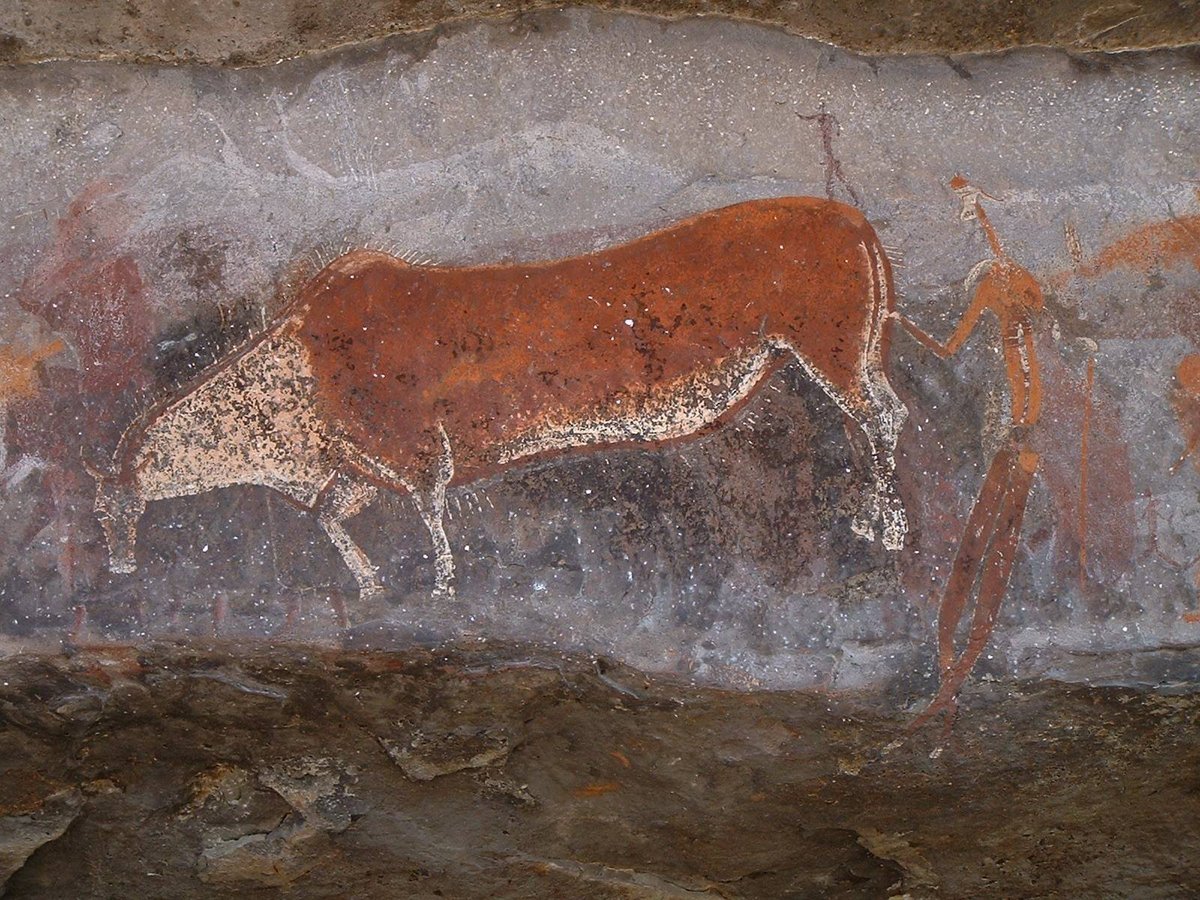
A painted eland panel at Game Pass Shelter in the KwaZulu-Natal Drakensberg. It is not from Klipdrift and was not part of the study. The human figure holding the eland's tail is thought to depict a shaman in a trance. Photo: Alandmanson, via Wikimedia Commons, CC BY 4.0
Ethnographic accounts cited by the authors describe San painters mixing a special ochre with the blood and fat of a freshly killed eland. In certain rituals, the supplementary material says, such paint was likely meant as "a medium through which spiritual power was believed to be transferred and activated." It is a remarkable parallel, and the team handles it with care.
Whether or not the people of Klipdrift shared such beliefs is a question the evidence cannot settle. The authors stress that their single case "is not sufficient to support the ritual significance of eland in the MSA," and they warn that "such cultural associations cannot be directly projected back" across 60,000 years. Further sites, they suggest, would test the idea that the eland's symbolic significance has deep roots.
A Clue That Points Two Ways
The paper also notes that common eland had already been identified among the animal bones excavated at the site, suggesting that the species "may have held significance for its inhabitants." In a release from Kyushu University on Phys.org, Takumi Tsutaya writes: "These findings provide new evidence for the complex technical and possibly symbolic behaviors of early Homo sapiens."
The identification of common eland collagen in the ochre surface is Established, since it rests on directly measured protein sequences. That people deliberately combined eland material with ochre, whether as a binder or on a painted hide, is Unverified, and any ritual meaning is Unverified as well.
Today, the red surface itself is gone, dug away more than a decade ago. Yet a few small samples of stored sediment have shown that proteins can outlast DNA in African soils, and that the question of what Stone Age people did with eland and ochre can now be put to the dirt itself.
A common eland (Taurotragus oryx) photographed in the Masai Mara, Kenya, in 2012. Photo: Josefito123, via Wikimedia Commons, CC BY 4.0
By Aris Manus
Sources
- Zahra Haghighi, Takumi Tsutaya, Elizabeth C. Velliky, Simon Armitage, Christopher Miller, Meaghan Mackie, Francesco d'Errico, Gaudry Troche, Jesper Olsen, Karen van Niekerk, Christopher Henshilwood and Enrico Cappellini, *Palaeoproteomic investigation of archaeological sediments associated with ochre use in the Middle Stone Age of southern Africa*, Proceedings of the Royal Society B 293: 20253300, 2026
- Haghighi et al., Supplementary Information, figshare, 2026
- Takumi Tsutaya, *Antelope collagen found in 60,000-year-old ochre offers clues to early human practices*, Kyushu University via Phys.org, October 21, 2026