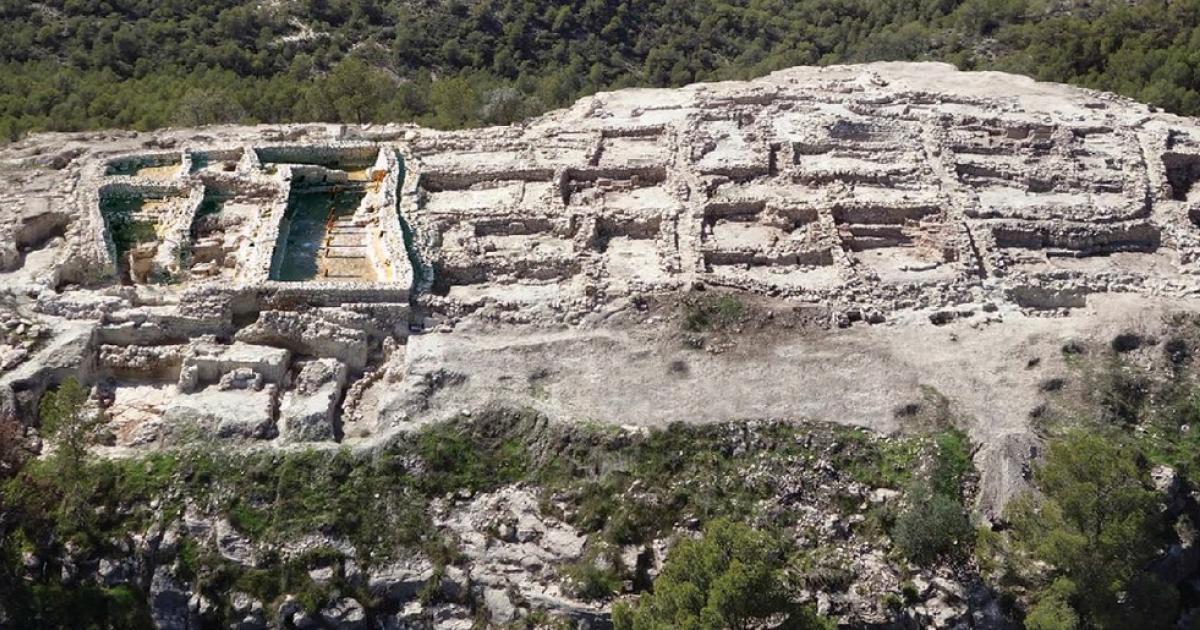

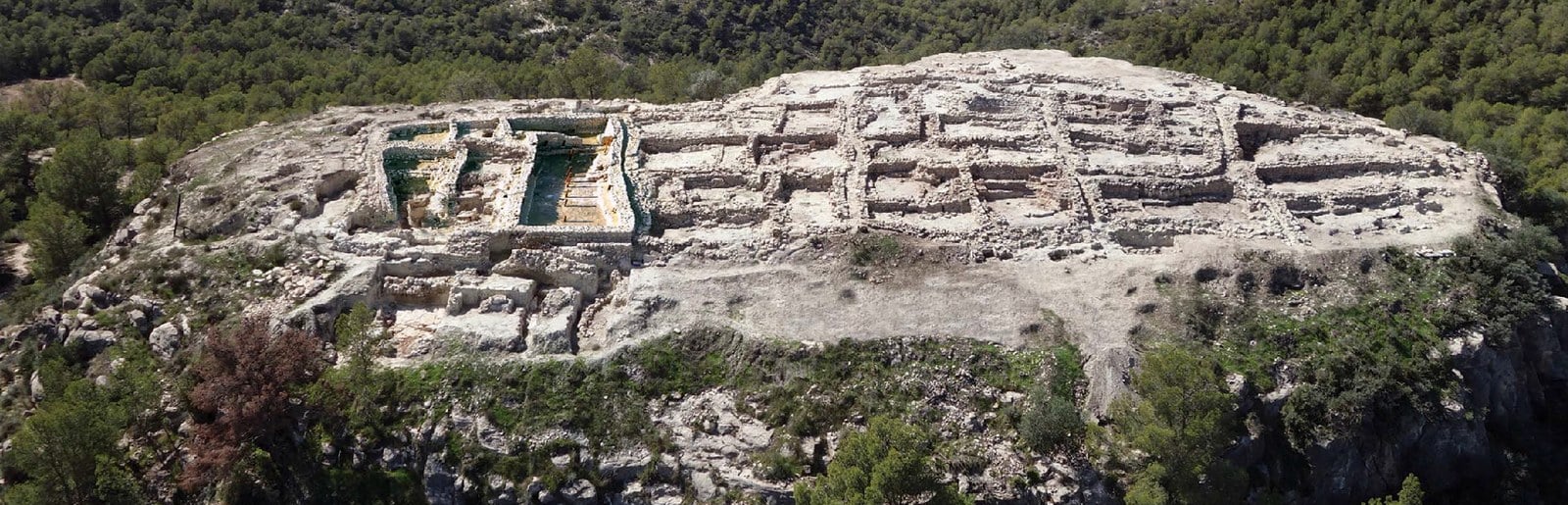
The excavated hilltop settlement of La Almoloya, in Pliego, Murcia, seen from the east. This photograph was published in 2022, before the newly reported towered wall came to light. (Image: Villalba-Mouco et al. 2022, Scientific Reports, Figure 1B, CC BY 4.0, via Scientific Reports, cropped from Figure 1 to show panel B only, resized from 2006 by 646 to 1600 by 515 pixels and converted from PNG to JPEG)
High on a steep hill in the Sierra Espuña, in the Spanish region of Murcia, the Bronze Age town of La Almoloya hardly seemed to need walls. Its cliffs and slopes did most of the work. Yet archaeologists from the Autonomous University of Barcelona (UAB) and the University of Murcia (UMU) have now uncovered a defensive system that the UAB, in a release of November 23, 2026, calls "monumental", with six rectangular towers found so far, set close together on the slope that leads up to the town.
La Almoloya is already well known to archaeologists. Its excavators have described one of its buildings as possibly one of the first Bronze Age palaces identified in Western Europe. Beneath it lay a rich double grave in which a woman wore a silver diadem. Now the same hill has given up a wall that its own discoverers did not expect. They say it forces them to rethink how much power was gathered there and what threat justified so much labor. So who, or what, were the people of La Almoloya guarding against?
A Wall Nobody Expected
According to the UAB release, the defensive system is up to six meters wide and consists of a succession of, so far, six rectangular towers in a stretch already more than 30 meters long. The UAB places the site's occupation between 2200 and 1650 BC, while a 2022 genetic study of its burials dates the town's last Argaric phase to between 1750 and 1550 cal BC.
"It is a formidable structure, the majesty of which has taken us by surprise," said Vicenç Lull, professor of Prehistory at the UAB and co-director of the research project, in the release. He added that the natural protection of the site had suggested that such substantial artificial defenses would not have been necessary.
The University of Murcia announced the find a few days earlier, on November 19, and its Spanish release gives somewhat smaller figures. It describes a second fortification system about four meters wide, with up to six rectangular towers, in an excavated stretch already over 20 meters long. Neither release explains the difference, and both describe a stretch that is still being excavated.
Found While Planning a Stairway
The wall turned up almost by accident, as Eva Celdrán Beltrán, a lecturer in Prehistory at the UMU and co-director of the excavations, explained in the university's release (translated by Ancient Origins):
"Last year, there was a project to place a stairway on the ascent, since it still keeps what we think was the original way up, short but very steep. When checking where the pillars could go, we came across this massive structure that more than fulfills its defensive mission."
The new wall was not the first barrier on that slope. According to the UAB release, an earlier campaign had found two smaller walls that blocked access to the settlement. The UMU release, which calls those earlier walls imposing, places them on the entrance slope at the same point and remarks on the great investment of effort that the new find reveals.
Miguel Valério, a Ramón y Cajal researcher at the UMU and the other co-director of the campaign, saw a familiar design with an unusual twist. As quoted in the UMU release (translated by Ancient Origins), he said: "It reminded us of La Bastida, although with notable differences. The space between towers in the Totana wall is up to three meters, while here the distances are much narrower, and between some towers there is barely one meter. It looks like a great platform, it is truly unusual."
The La Bastida Precedent
La Bastida, near Totana and also in Murcia, is the closest parallel that the team itself points to. In 2014, Lull, Rafael Micó, Cristina Rihuete-Herrada and Roberto Risch described its defenses in the journal Antiquity. According to the paper's published extract, recent excavations had revealed a stone-built fortification system dated to between 2200 and 2100 cal BC, made of parallel walls with projecting towers flanking a narrow entrance passage.
The authors wrote in that extract that "The defensive character of these structures appears beyond question and their design suggests they were a response to significant changes in warfare and weaponry in this period." They added that it raised the question of the role of physical violence in the rise of Argaric society.
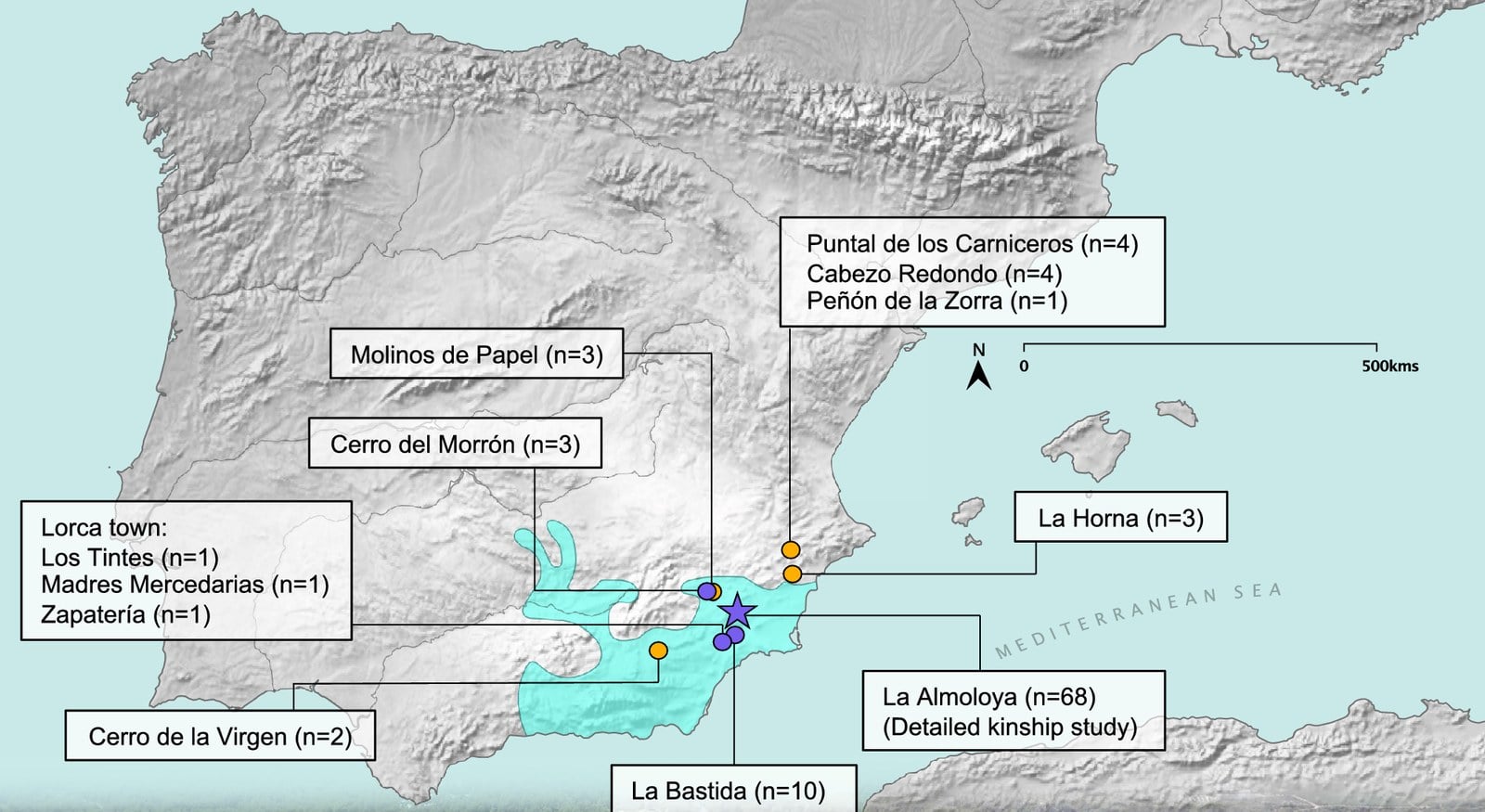
Map of the Iberian Peninsula showing the Argaric area in the southeast, with La Almoloya marked by a star and La Bastida labeled just to the south. The numbers in brackets refer to individuals sampled for the study. (Image: Villalba-Mouco et al. 2022, Scientific Reports, Figure 1A, CC BY 4.0, via Scientific Reports, cropped from Figure 1 to show panel A only, resized from 2006 by 1097 to 1600 by 875 pixels and converted from PNG to JPEG)
Argaric settlements, the UMU release explains, tended to sit on high ground, on plateaus or mountains with good natural defenses, and where a weak spot remained, their builders added fortifications. La Almoloya fits that pattern. However, the scale of what has now been found on its entrance slope is what surprised the team.
A Small Town With a Seat of Power
La Almoloya was never a large place. The UMU release puts it at about 0.3 hectares, less than half a soccer field, with room for 200 to 300 people in a planned layout. Among its buildings is what the release calls perhaps the first building for political power identified in Western Europe. It was a kind of assembly hall that could seat about 50 or 60 people. Ancient Origins reported on the Bronze Age palace and its huge trove of grave goods when they first came to light.
In that palace complex lay grave 38, the double burial of a man and a woman of the Argaric elite. A 2021 Antiquity paper led by Lull described the grave goods as including "politically and ideologically emblematic objects, among which a silver diadem stands out." According to the UMU release, this diadem is the only one of the five known Argaric examples still on the Iberian Peninsula. The others are in museums abroad, among them the British Museum and the Ashmolean Museum in Oxford. Ancient Origins has covered the female ruler sporting a rare diadem in detail.
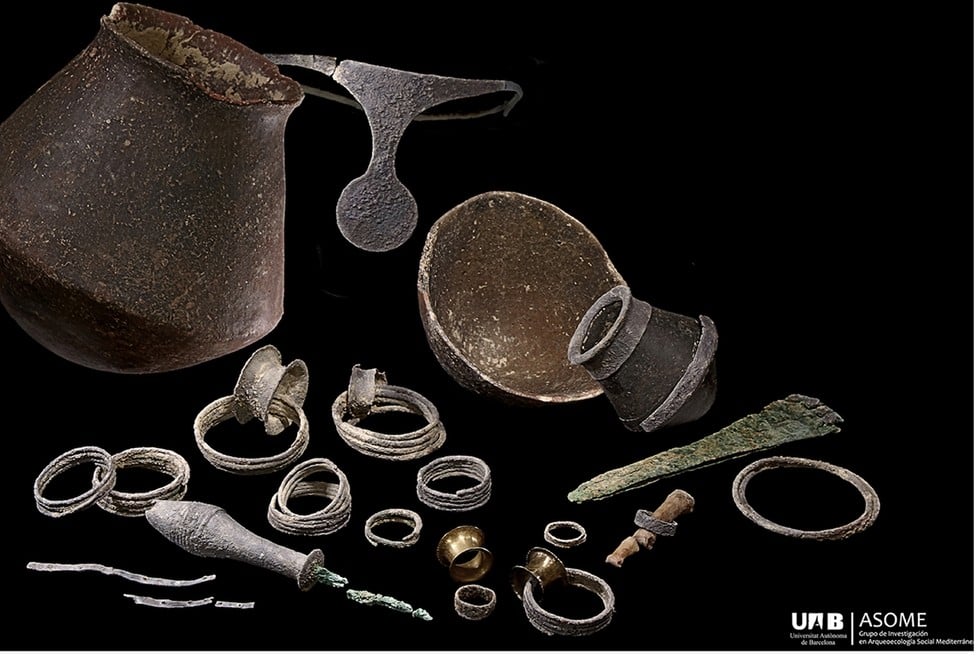
Grave goods from the elite double burial AY38, also called grave 38, at La Almoloya, with the silver diadem near the top. The logo of the UAB's ASOME research group, whose members found the new wall, appears in the published panel. (Image: Villalba-Mouco et al. 2022, Scientific Reports, Figure 2C, CC BY 4.0, via Scientific Reports, cropped from Figure 2 to show panel C only and converted from PNG to JPEG)
A genetic study published in Scientific Reports in 2022, led by Vanessa Villalba-Mouco, obtained genome-wide data from 68 individuals buried at La Almoloya. Its authors found that the couple in grave 38 had no clear family links to the other adults buried at the site, "thus raising the possibility that an 'external' ruling elite was involved in drastic architectural changes marking the beginning of phase 3." The same study reports that, later on, "a major social change took place, which entailed the collapse of the palace building in which AY38 was placed."
Who Were They Afraid Of?
That is the question the new wall raises, and the team is careful not to answer it too soon. Rafael Micó, professor of Prehistory at the UAB, said in the UAB release: "It leads us to rethink the magnitude of the power concentrated at La Almoloya and the threats that justified such an investment of labour in the defensive system."
The Argaric world was hardly a peaceful one. According to the UMU release, the society is regarded as marked by strong institutionalized violence and by deep political and economic inequality. Valério described it as "a world that gradually introduced an imbalance in access to wealth that had not been seen in the southeast of the peninsula until then" (translated by Ancient Origins). Ancient Origins has also reported on how skeletons revealed the deep-rooted inequality of El Argar society.
However, no date has yet been published for the wall within the long life of the town. According to the UMU release, the next stage of work will try to establish when both defensive systems were built, the one already known and the newly found wall. Until then, it cannot be tied to the rise of the palace, its collapse or any particular rival.
The End of El Argar
The wider mystery is how the Argaric world came to an end. The UMU release dates the culture to about 650 years, between 2200 and 1550 BC, across a territory reaching from Jaén to Alicante. Valério pointed to several possible causes (translated by Ancient Origins): "The significant inequalities make us think of a strong social dissatisfaction, also related to factors such as a deterioration of living conditions and, possibly, environmental changes."
After the end of El Argar, the UMU release adds, no other community ever settled on the hill again. For readers who want to explore the site, the La Almoloya entry in the Atlas of the Ancient World sets out its history. The team won the 2023 National Archaeology Award from the Palarq Foundation for its work at La Almoloya and La Bastida. Now it has a new puzzle on the slope where a stairway was meant to go.
By Aris Manus
Sources
Universitat Autònoma de Barcelona. 2026. "Monumental wall discovered at La Almoloya." UAB Newsroom, November 23, 2026. Available at: https://www.uab.cat/web/newsroom/news-detail/-1345830290613.html?detid=…
Universidad de Murcia. 2026. "El descubrimiento de una imponente muralla en La Almoloya reabre enigmas sobre la sociedad argárica." Sala de prensa, November 19, 2026. Available at: https://www.um.es/web/sala-prensa/-/el-descubrimiento-de-una-imponente-… (quotations translated by Ancient Origins)
Lull, V., Micó, R., Rihuete-Herrada, C. and Risch, R. 2014. "The La Bastida fortification: new light and new questions on Early Bronze Age societies in the western Mediterranean." Antiquity 88(340): 395 to 410. Available at: https://doi.org/10.1017/S0003598X00101073 (published extract only)
Lull, V., Rihuete-Herrada, C., Risch, R. et al. 2021. "Emblems and spaces of power during the Argaric Bronze Age at La Almoloya, Murcia." Antiquity 95(380): 329 to 348. Available at: https://doi.org/10.15184/aqy.2021.8 (published abstract only)
Villalba-Mouco, V., Oliart, C., Rihuete-Herrada, C. et al. 2022. "Kinship practices in the early state El Argar society from Bronze Age Iberia." Scientific Reports 12: 22415. Available at: https://doi.org/10.1038/s41598-022-25975-9

Enjoyed this? Get UNLEASHED for life, $249 once
Ancient Origins UNLEASHED is our Substack for the deeper, longer stories. Until Monday, November 30 at midnight UK time, you can join for life with one payment instead of a yearly subscription.
- The full paid UNLEASHED archive and every future paid post, for as long as the publication continues
- A Founders certificate
- A vote on upcoming topics
- Optional credit on our Founders page, only with your permission
- One welcome one-to-one discussion
Become an UNLEASHED Lifetime Founder, $249
Places are limited to 20 in total. Use the same email you use (or will use) on Substack. We switch on your paid access by hand after payment, so it is not instant. UNLEASHED only; Ancient Origins Premium is not included.
Want everything Ancient Origins makes? The Founders' Lifetime Pass is $349, paid once: Premium for life, all 29 ebooks, 177 webinar and interview recordings, 64 Magazine issues, AO Kids and the full Atlas.