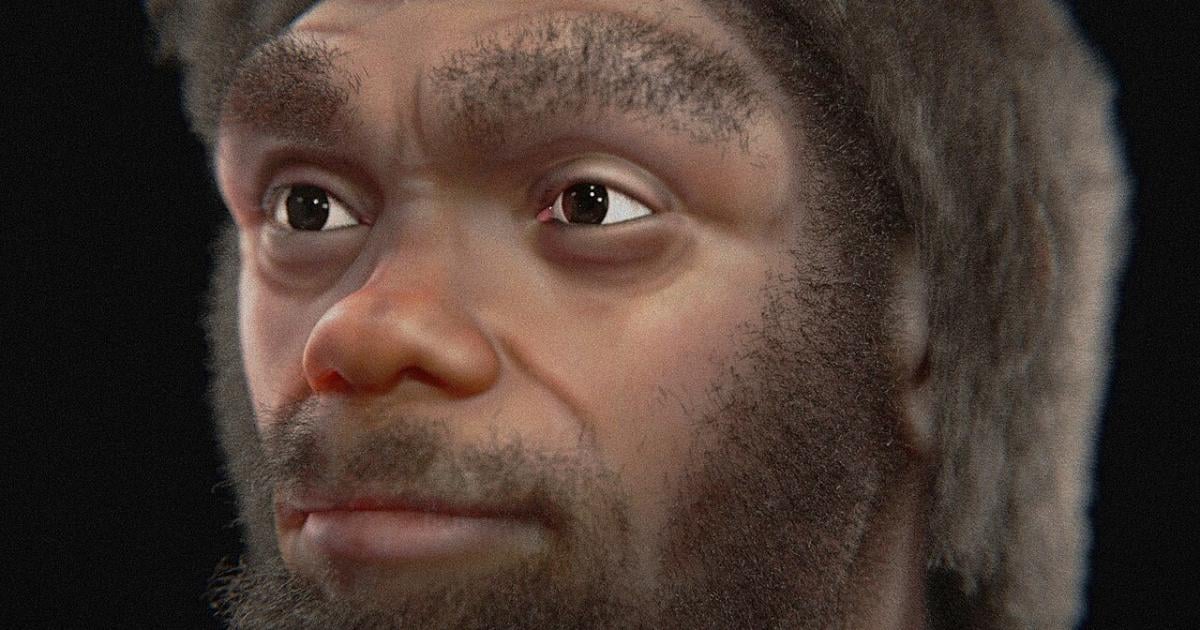

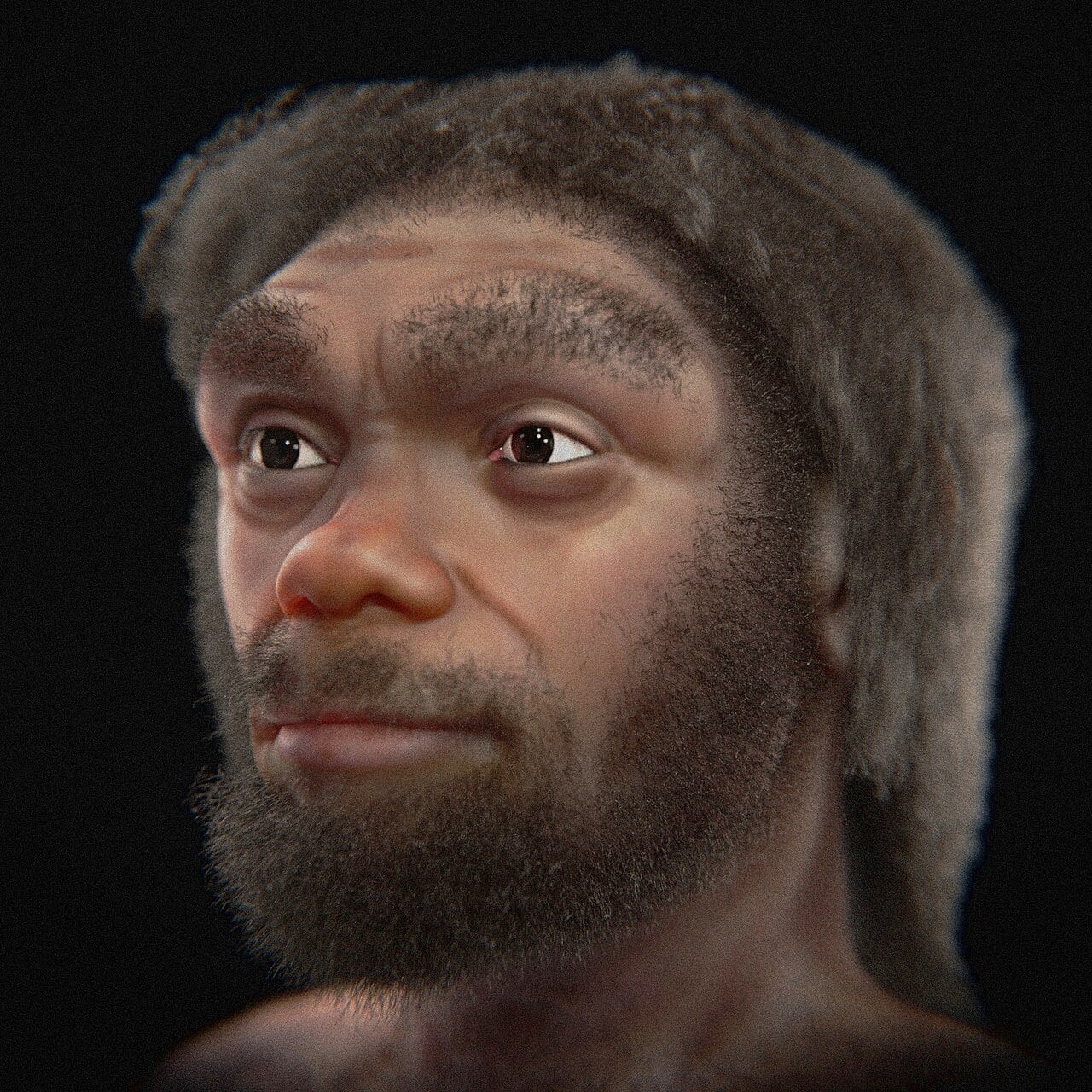
A modern forensic facial approximation of the Harbin skull from northeastern China, which Qiaomei Fu and colleagues linked to the Denisovans in 2025. It is an artist's reconstruction shown for context only and is not based on any of the Guangxi teeth. (Image: Cicero Moraes, Wikimedia Commons, CC BY 4.0, resized from 3,840 by 3,840 to 1,280 by 1,280 pixels, otherwise unaltered)
In the limestone hills of Guangxi, in subtropical southern China, two caves have yielded just four small teeth from ancient humans. A team that includes Song Xing and Huiyun Rao of the Institute of Vertebrate Paleontology and Paleoanthropology (IVPP) in Beijing, Guangmao Xie of the Guangxi Institute of Cultural Relics Protection and Archaeology, and Qiaomei Fu of the IVPP, who designed and supervised the research project, writes that those teeth are consistent with at least two different archaic lineages that may have lived in the region during the Middle and Late Pleistocene.
The study, published in Nature on November 25, 2026, combines the shape of the teeth with ancient proteins recovered from their enamel. According to the authors, one cave produced teeth that group with the Denisovans, an archaic human population first identified from DNA found in Denisova Cave in Siberia. The other produced teeth whose owner the authors could not assign to any known group. So who were the people of Chuanshandong, and could they really belong to a line of humans that nobody has yet described?
The authors summarize the result in their abstract: "Integrated morphological and palaeoproteomic analyses reveal substantial phenotypic and molecular diversity consistent with at least two distinct lineages." They do not name a new species, and they describe the second group only as "unresolved archaic Homo".
Two Caves in the Guangxi Karst
The teeth were found during surveys of cave deposits that the interdisciplinary team has carried out in Guangxi since 2016. Chuanshandong lies in the karst terrain of Long'an County near Nanning, and Longchuandong lies among the limestone hills of Luzhai County near Liuzhou.
Chuanshandong yielded a pair of lower premolars, and the authors write that the two teeth could have come from one individual, given their similar shape and degree of wear. Longchuandong yielded one upper second molar and one lower premolar.
Dating these teeth has turned out to be difficult. Uranium series dating of one Chuanshandong premolar gave an age of about 100,800 years, which the authors treat as a minimum age for the site. At Longchuandong, the same method gave ages ranging from about 104,500 to about 42,600 years for the two teeth. The animal fossils in both caves point to ages younger than about 300,000 years.
However, the sediments told a more complicated story. Luminescence dates for the Chuanshandong fossil layer fell between about 49,500 and 34,200 years ago, which is much younger than the teeth themselves. The authors read this as a sign of slow transport or delayed burial. In their words, "Therefore, the burial age of the fossils may substantially lag behind their true age."
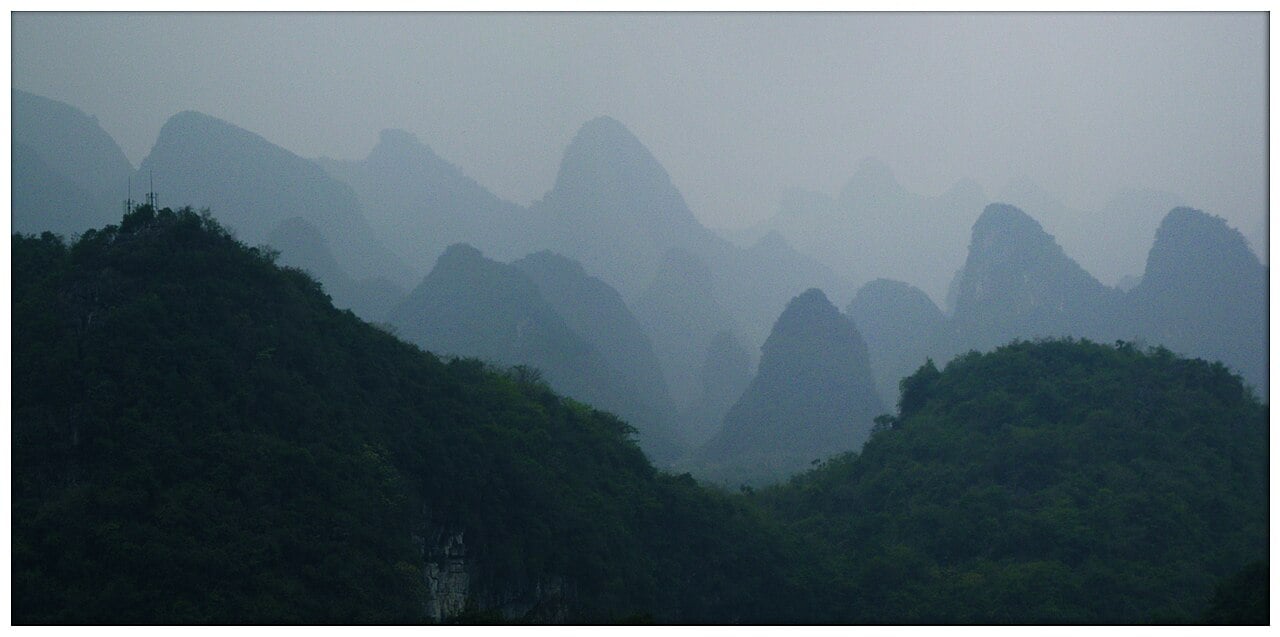
Karst hills near Zhongdu in Luzhai County, Guangxi, photographed in November 2010, shown with the thin white frame of the original photograph. Luzhai County is home to Longchuandong, one of the two caves in the study, but this view does not show the cave or the excavation. (Image: 涔水影人, Panoramio via Wikimedia Commons, CC BY 3.0, resized from 5,896 by 2,931 to 1,280 by 637 pixels, otherwise unaltered)
Water probably carried the teeth away from where they first came to rest. Because most of the Longchuandong fossils are isolated teeth, the authors conclude that they "were highly likely to have been sorted and transported into the deep cave by water." The caves also gave no clue to how these people lived, since "No stone artefacts or other cultural relics were associated with hominin fossils at these two sites."
Proteins Instead of DNA
Ancient DNA is the usual tool for sorting archaic humans into lineages. However, the authors note that DNA preservation is poor in the warm, humid conditions of southern China, especially for fossils of this age, so the team turned to proteins locked inside tooth enamel.
Enamel proteins carry small variations in their amino acid sequences that can differ between lineages, and they can be recovered from fossils where no DNA is left. Frido Welker and colleagues used the same approach in 2020 to recover enamel proteins from Homo antecessor in Spain and Homo erectus at Dmanisi in Georgia.
Proteins from Bianfu Cave in southwest China have already been used to identify Denisovan bones there. Rao, Xing and colleagues reported in Nature in September 2026 that the cave had produced the most abundant Denisovan remains known outside Denisova Cave in Siberia.
A Denisovan Signal at Longchuandong
The two Longchuandong teeth gave the clearer answer. The molar most closely resembled Denisova 4, a molar from Denisova Cave in the Altai Mountains, when all of the dental features in the study were considered together.
The proteins pointed the same way, since both teeth carried a variant in the enamel protein ameloblastin, known as AMBN 273V. In the protein tree they grouped with Denisova 3, the finger bone from Denisova Cave whose DNA was used to name the Denisovans in 2010, and that grouping had full statistical support.
The authors conclude that "the Longchuandong samples are likely to represent a Denisovan-affinity lineage in south China." With this find, they write, there is evidence of Denisovans in Siberia, northern China, the Tibetan Plateau, the Taiwan Strait, subtropical southern China and tropical Laos.
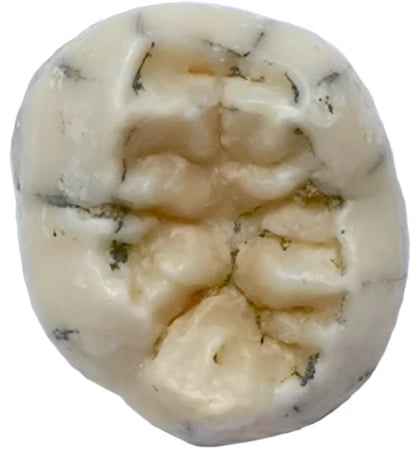
The chewing surface of TNH2-1, a molar from Tam Ngu Hao 2 (Cobra Cave) in northern Laos that Fabrice Demeter and colleagues identified as Denisovan in 2022. It is shown for comparison and is not one of the Guangxi teeth. (Image: Demeter et al. 2022, Nature Communications 13: 2557, Fig. 2a, Wikimedia Commons, CC BY 4.0, shown at its original size of 419 by 455 pixels, otherwise unaltered)
Several of those places are known from very few fossils. In 2019, Fahu Chen and colleagues described a jaw from Baishiya Karst Cave on the Tibetan Plateau, identified through ancient proteins, as direct evidence of Denisovans outside the Altai Mountains. Ancient Origins has since reported on Denisovan finds that show they survived on the Tibetan Plateau, as well as a Denisovan jawbone found off the coast of Taiwan and the Denisovan molar from Laos.
An Unresolved Lineage at Chuanshandong
However, the Chuanshandong premolars told a different story. Their enamel proteins carried a variant called AMBN 253G, which the authors note had previously been reported only in late Homo erectus fossils from Zhoukoudian, Hexian and Sunjiadong. They also carried an ancestral form of the amelogenin protein, AMELY 179M, which is shared with Homo antecessor and great apes.
These teeth also lacked the 273V variant that marked the Longchuandong teeth. In the protein tree, Chuanshandong formed a sister group to the common ancestors of Neanderthals, Denisovans and modern humans.
The authors put it this way: "The integrated evidence indicates that Chuanshandong may belong to a lineage distinct from the Denisovan in mainland southern China." Taken together, they say, the ancestral and erectus-like variants suggest "that the Chuanshandong hominin belongs to a primitive Homo lineage that may have survived into the Late Pleistocene in a geographical refugium."
The authors stop short of a firm conclusion, and they describe mixing among archaic humans in southern China, or gene flow from Homo erectus, as plausible explanations for the unusual traits of these teeth. They also add a direct caveat about their own tree: "However, such phylogenetic inference based on the limited proteomic data is preliminary."
That caveat matters because the protein data are limited. The AMBN 253G variant, for example, was supported by nine peptides from the Chuanshandong teeth, so the placement of this lineage may yet change as more ancient proteins are recovered from the region.
A Crowded Picture in East Asia
The new paper adds to a long debate about how to classify the archaic humans who lived in East Asia during this period. A separate study by Xing and colleagues, published in Nature in October 2026, argued that the Xujiayao fossils from northern China also belong to the Denisovan lineage, together with other East Asian skulls such as Harbin, Jinniushan and Dali.
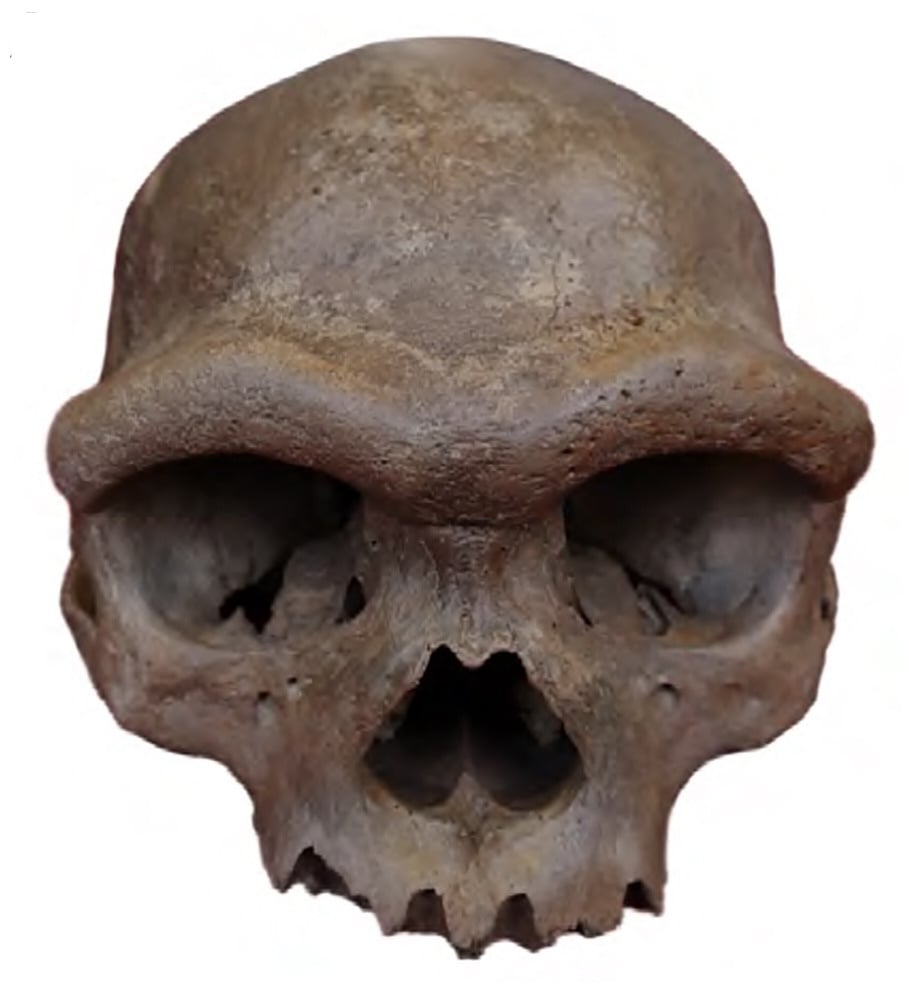
The Harbin skull, the holotype of Homo longi. In 2025, Fu and colleagues reported Denisovan mitochondrial DNA recovered from dental calculus on this skull. It is shown for context and is not from Guangxi. (Image: Fu et al. 2025, Cell, cropped and modified from Figure 1A by the Commons uploader, Wikimedia Commons, CC BY 4.0, shown at its Commons size of 909 by 987 pixels, otherwise unaltered)
Ancient Origins covered the Harbin skull and its Denisovan link when that work appeared. The Nature paper on Guangxi now places southern China in the same picture. In addition to the earlier suggestion of a Neanderthal-related human at Maba in neighboring Guangdong Province, the authors write that they have now identified both a Denisovan-affinity human and another unresolved archaic human in this part of China.
Many questions remain open, because four teeth from two caves cannot show how large these populations were, how long they lasted or whether they ever met. The dates are also hard to pin down because water may have carried the teeth. Further fossils and more protein data from the Guangxi caves may decide whether the Chuanshandong teeth belong to a distinct lineage, a late group of Homo erectus or a mixed population.
For now, the authors leave the question open in their abstract, where they write that these findings "indicate that diverse hominin populations may have inhabited subtropical China during the Middle and Late Pleistocene, including a Denisovan-affinity population and another unresolved archaic Homo".
By Aris Manus
Sources
Chen, F. et al. 2019. A late Middle Pleistocene Denisovan mandible from the Tibetan Plateau. Nature 569, 409 to 412. Available at: https://doi.org/10.1038/s41586-019-1139-x
Fu, Q. et al. 2025. Denisovan mitochondrial DNA from dental calculus of the >146,000-year-old Harbin cranium. Cell 188, 3919 to 3926. Available at: https://doi.org/10.1016/j.cell.2025.05.040
Krause, J. et al. 2010. The complete mitochondrial DNA genome of an unknown hominin from southern Siberia. Nature 464, 894 to 897. Available at: https://doi.org/10.1038/nature08976
Rao, H. et al. 2026. Ancient proteins identify various Denisovan remains from Southwest China. Nature 659, 705. Published online September 9, 2026. Available at: https://doi.org/10.1038/s41586-026-10976-9
Reich, D. et al. 2010. Genetic history of an archaic hominin group from Denisova Cave in Siberia. Nature 468, 1053 to 1060. Available at: https://doi.org/10.1038/nature09710
Welker, F. et al. 2020. The dental proteome of Homo antecessor. Nature 580, 235 to 238. Available at: https://doi.org/10.1038/s41586-020-2153-8
Xing, S. et al. 2026. The proteome of Middle Pleistocene Xujiayao and common Denisovan morphology. Nature 659, 1015. Published online October 21, 2026. Available at: https://doi.org/10.1038/s41586-026-11132-z
Xing, S., Rao, H., Xie, G. et al. 2026. Middle-Late Pleistocene Denisovans and unresolved Homo in southern China. Nature. Published online November 25, 2026. Available at: https://www.nature.com/articles/s41586-026-11341-6

Enjoyed this? Get UNLEASHED for life, $249 once
Ancient Origins UNLEASHED is our Substack for the deeper, longer stories. Until Monday, November 30 at midnight UK time, you can join for life with one payment instead of a yearly subscription.
- The full paid UNLEASHED archive and every future paid post, for as long as the publication continues
- A Founders certificate
- A vote on upcoming topics
- Optional credit on our Founders page, only with your permission
- One welcome one-to-one discussion
Become an UNLEASHED Lifetime Founder, $249
Places are limited to 20 in total. Use the same email you use (or will use) on Substack. We switch on your paid access by hand after payment, so it is not instant. UNLEASHED only; Ancient Origins Premium is not included.
Want everything Ancient Origins makes? The Founders' Lifetime Pass is $349, paid once: Premium for life, all 29 ebooks, 177 webinar and interview recordings, 64 Magazine issues, AO Kids and the full Atlas.