
A paper published online in Antiquity on October 14, 2026 sets out the full case for Łysa Góra, a fortified hill in northern Mazovia, Poland, where a rare Celtic bronze helmet was found crushed in a pit in 2024. Bartłomiej Kaczyński of the State Archaeological Museum in Warsaw and his coauthors write that the site was "a fortified base, production site, ritual centre and likely amber-trade hub." The helmet itself was reported in 2024, and the paper is careful to say that its boldest idea still needs testing. So who brought a Celtic warrior's helmet this far north?
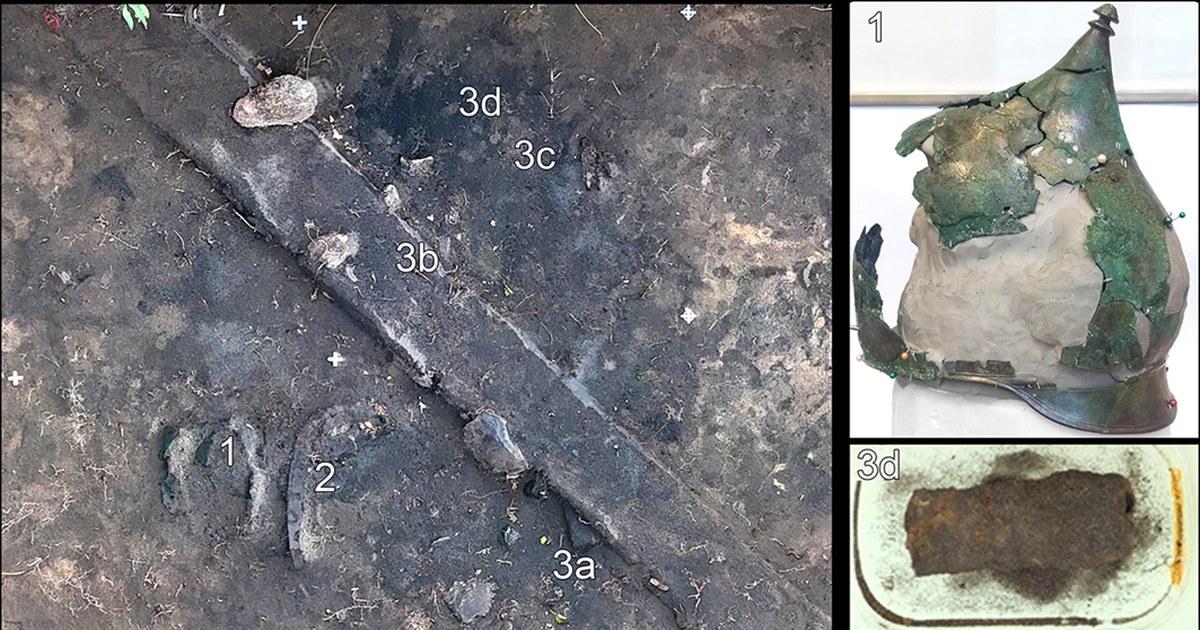
The pit lay on a sand dune between the Orzyc River and one of its oxbow lakes. It was filled with charred remains, and the crushed helmet lay in pieces next to an iron scythe and four iron adzes. According to Phys.org, this happened around 2,400 years ago.
A helmet from a small and select family
The helmet belongs to what archaeologists call the Berru type. In a preliminary report published in Wiadomości Archeologiczne in 2024, Kaczyński and Wojciech Borkowski describe the Berru type as "a small group of helmets characterised by great formal diversity, known only from areas of Celtic settlement of the early La Tène Period." That the Łysa Góra helmet is made of lead tin bronze is Established, according to the same report.
It is also a little odd within its own family. The same report notes a difference. "Unlike other specimens of this type, the bowl of the Bagienice helmet is topped with a solid knob." Bagienice is the village where Łysa Góra lies.
Live Science reported in 2024 that the helmet was made of thin bronze sheet, originally lined with leather or fabric, with "a conical top and a distinctive nape." Kaczyński told the outlet, "It was an item associated with the Celtic elites."
Dating the helmet is a more delicate business. The preliminary report places the helmet in phase LTB2 and calls it "among the youngest documented finds of the Berru type." That date is the authors' published reading, and it is Disputed for now, as a preliminary finding still to be tested. The Antiquity paper dates the La Tène brooches and ornaments at the site to around the mid fourth century BC.
Bald Hill on the edge of Iron Age Europe
Łysa Góra means "Bald Hill" in Polish, although the name no longer fits, since, as the University of Warsaw's Serwis Naukowy notes, the hill is "today densely forested." In the sixth to fourth centuries BC, according to the Antiquity paper, it was adapted and inhabited by members of the West Balt Barrow Culture. The authors describe these communities as "characterised by fortified sites, aquatic subsistence strategies and collective urn burials." The University of Warsaw adds a caution worth repeating. The name, it says, cannot be tied directly to a specific Baltic speaking people, and "there is currently no solid evidence for such an identification."
The site was surrounded by marshland, and the excavators found two kinds of timber and earth defenses, an embankment with a palisade and outer ditch and a second line built entirely of timber, though the paper notes it remains unclear whether both stood at the same time.
The site was first identified in 1957 and excavated on and off between 1971 and 1992, but the finds were never fully published. Work resumed in 2024 under the State Archaeological Museum in Warsaw and the Faculty of Archaeology at the University of Warsaw. "Nearly 350 metal artefacts were uncovered," the paper reports, including ornaments, weapons and evidence of bronze working. Among them are 31 mostly fragmentary Early La Tène brooches and ring ornaments. These are Established finds, and they show that objects from the Celtic south reached this hill, a point long hinted at by Poland's forgotten Celtic past farther south.
On the road for amber
As for why anyone would come to this hill at all, the answer the authors give is amber. The site lies close to the amber rich Kurpie region and along routes leading toward the Sambian Peninsula. The excavators found amber beads and an unfinished amber ring, which the paper says "suggests participation in long-distance amber exchange with regions south of the Carpathian Mountains." The trade in Baltic amber running from the north into Central Europe is Established. That Łysa Góra was a hub on that route is the authors' interpretation, with evidence behind it, and it is Disputed for now. The paper itself says only "likely."
Metalworking went on at the site as well, and the paper describes bronze ornaments cut into portions and pressed into bundles, "likely prepared for remelting," along with casting crucibles recorded in the 1970s.
Andrzej Maciałowicz of the University of Warsaw, a coauthor, explained the pull of the region. "In Kurpie there are natural amber deposits lying relatively close to the surface," he told the university's Serwis Naukowy. "We also know that the Celts valued Baltic amber," he said, adding that researchers had believed "their strong interest in it developed only about two centuries later."
Celtic elites in person, or a long chain of trade?
This is the heart of the debate, and it is Disputed. The authors lean toward one answer, but they set out the alternative fairly, and both deserve a hearing.
The authors build their case on what helmets meant to the people who wore them. In the paper's words, helmets in the Early La Tène world "symbolised high social status and affiliation with the warrior elite, a concept likely alien to local, presumably acephalous societies." So, the authors argue, the helmet "may suggest more than an exotic import, possibly reflecting the physical presence of southern groups, including members of their elite."
Maciałowicz made the same point to the University of Warsaw. "We have no evidence of such social stratification in northeastern Poland," he said, "nothing that would indicate the existence of a clearly distinguished elite within the local population."
On the other side of the argument, the paper itself concedes the point. "An alternative explanation based on down-the-line exchange cannot be entirely excluded," it says, because smaller La Tène objects, mostly ornaments, did reach distant parts of Central and Eastern Europe through indirect contacts. In that scenario the helmet passed from hand to hand and no Celt ever set foot on Bald Hill. The authors judge this less convincing, because of the helmet's prestige and the absence of comparable helmets outside the La Tène zone in the fourth century BC.
Kaczyński goes further in his public comments than the paper does, and he told Phys.org that the variety of La Tène finds "suggests that a group of Celts lived at the site for approximately two generations." The paper itself is more careful. It closes this section by saying the idea that La Tène people helped set up or run this stretch of the amber route "will require verification through further research." So the claim that Celts lived in northern Poland belongs to Kaczyński and his team, and it is Disputed. Earlier Ancient Origins coverage of a Celtic ritual lake site in Poland shows why the question keeps coming up.
Why crush a helmet?
The pit in which the helmet lay is the other puzzle at Łysa Góra. The Antiquity paper describes "Traces of ritual activity" within the fortifications, and the preliminary report calls feature 1 a possible "ritual hearth?" with a question mark of its own. The University of Warsaw reports that many of the objects, including the helmet, "show clear traces of exposure to very high temperatures," and that small bone fragments, most likely animal, lay among them. "At present, it is impossible to determine the exact nature of the ritual involved," the university writes, though the researchers are certain the objects "were not deposited randomly."
That a ritual took place is the excavators' reading, backed by the burning and the careful placing, so it is labeled Disputed here. Why the helmet was crushed is not explained in any of the sources, and it is not yet clear whether the damage was deliberate or came from the fire.
What comes next
The team plans to keep working at the site, and the paper says planned metallurgical and provenance studies, "including lead isotope analyses," aim to identify possible ore sources and compare the results with similar artifacts from Bohemia. A match with southern metal would narrow down where the bronze came from, although it would still leave open the question of who carried it north.
For now, the evidence is indicative rather than conclusive. A helmet of a kind Phys.org says turns up in lavish Celtic warrior graves from Champagne to Dürrnberg turned up in a burned pit in Mazovia, and the people who found it think its owner came with it. Whether that is right depends on the next few seasons of digging, and on what the metal itself has to say.
The pit at Łysa Góra as excavated, with the Berru type helmet (1), an iron scythe (2) and four adzes (3a to 3d). Image: B. Kaczyński, in Kaczyński et al. 2026, Antiquity (CC BY 4.0), cropped.
By Aris Manus
Sources
- Bartłomiej Kaczyński, Andrzej Maciałowicz, Wojciech Janusz Borkowski, Cezary Sobczak and Michał Aniszewski, Łysa Góra in north-eastern Poland: a key Early Iron Age site on the 'Amber Route', Antiquity, 2026, DOI 10.15184/aqy.2026.10436
- Bartłomiej Kaczyński and Wojciech Janusz Borkowski, Celtic bronze helmet from Łysa Góra in Bagienice (preliminary report), Wiadomości Archeologiczne LXXV, 2024
- The mysteries of a 2,500 year old Celtic helmet: a spectacular archaeological discovery in northern Mazovia, Serwis Naukowy, University of Warsaw, 2025
- Sandee Oster, Rare Iron Age Celtic helmet discovered in northeastern Poland far from its homeland, Phys.org, October 31, 2026
- Tom Metcalfe, 2,300-year-old Celtic helmet discovered in Poland, Live Science, September 12, 2024