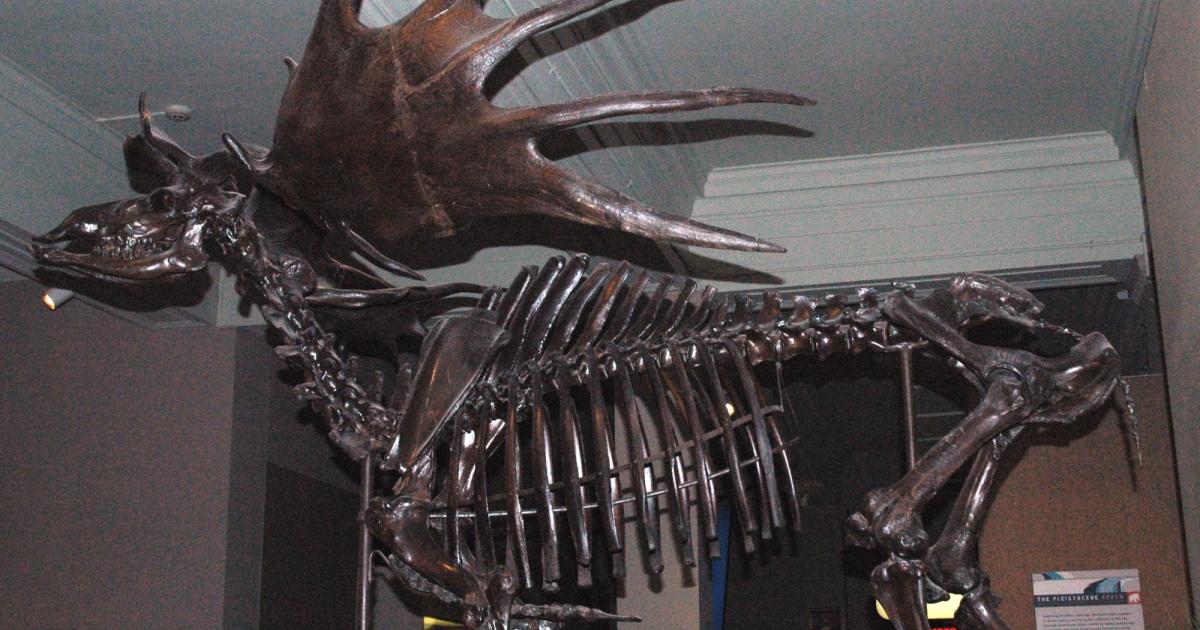

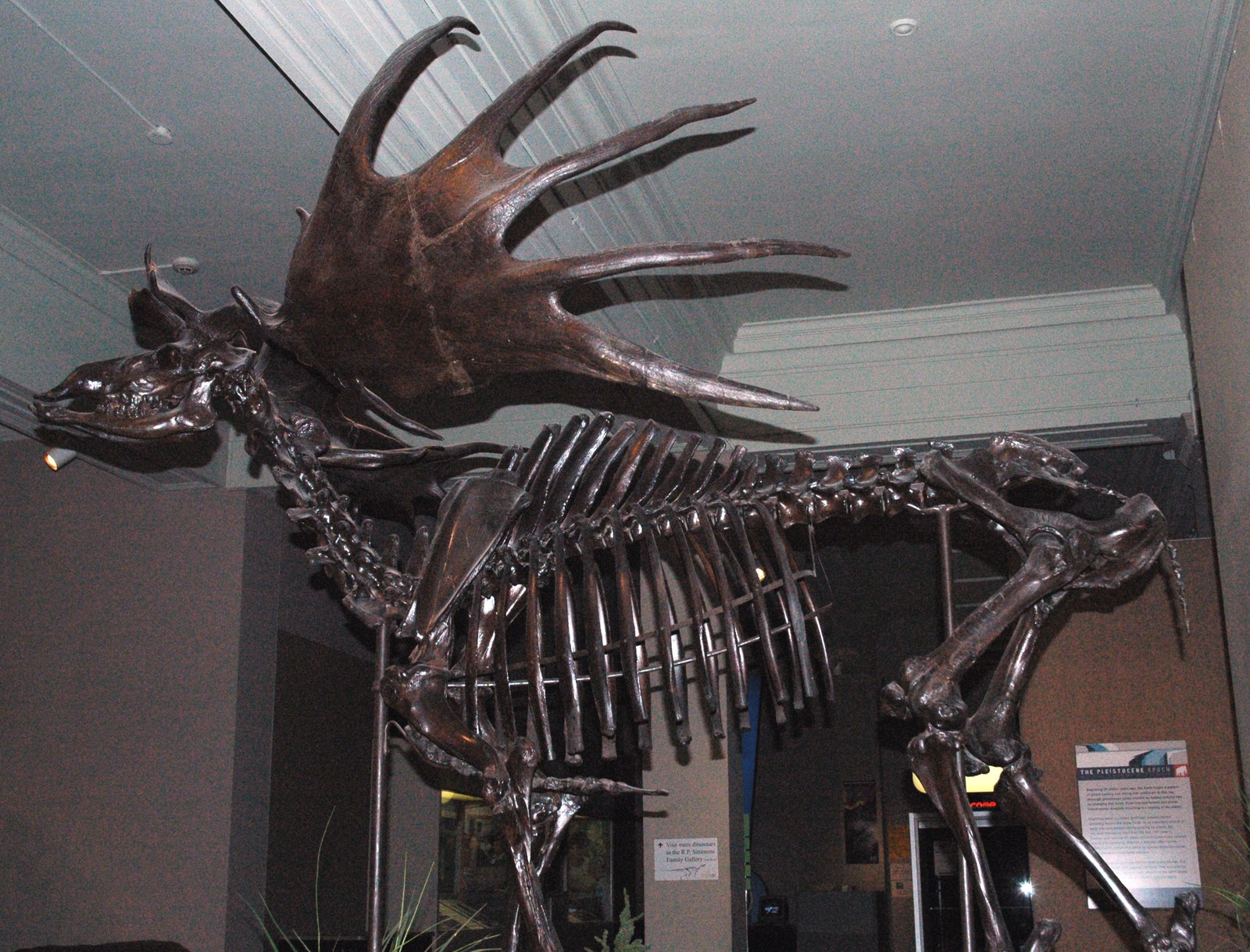
A mounted skeleton of a giant deer, Megaloceros giganteus, from a peat bog near Dublin, on display at the Carnegie Museum of Natural History in Pittsburgh. It is shown for context only and is not one of the Ballynamintra bones. (Image: James St. John, CC BY 2.0, via Wikimedia Commons, resized from 2575 by 1962 to 1600 by 1219 pixels, otherwise unaltered)
For more than a century, animal bones dug from a cave near Dungarvan, in County Waterford, have been kept at the National Museum of Ireland. Now a team of archaeologists and scientists says that two of those bones, both from the extinct giant deer, may show signs of human butchery about 13,500 years ago. If confirmed, that would push the human story of Ireland back by roughly a thousand years.
The study, led by Richard Jennings of Liverpool John Moores University, appears in the Proceedings of the Royal Irish Academy. Its title speaks of "Possible Upper Palaeolithic Human Butchery", and the authors make clear that the case is not closed. So were people really in Ireland that early?
A Cave Thought to Be Empty
Ballynamintra Cave was dug out between 1878 and 1882, according to The Irish Times, and the bones were later kept at the National Museum of Ireland. The newspaper notes that archaeologists and antiquarians targeted Ireland's limestone caves from the middle of the 19th century, and that these caves were thought to have been cleared out.
The new team put that idea to the test, and in the paper's abstract the authors report an excavation in the entrance chamber of the cave and the discovery of "late Pleistocene stratigraphy that had escaped the extensive late nineteenth-century excavations at the cave". The excavation also produced three giant deer specimens, which were radiocarbon dated to the Middle Allerød phase of the Late Glacial Interstadial, about 13,600 to 13,300 years ago.
The researchers also went back to the old museum collection. There, the abstract says, they "identified two giant deer bones that exhibit possible signs of human butchery." One of them was radiocarbon dated to between 13,500 and 13,300 years ago. The Irish Times, reporting on the study, gives the date of that bone as between 13,321 and 13,573 years ago.
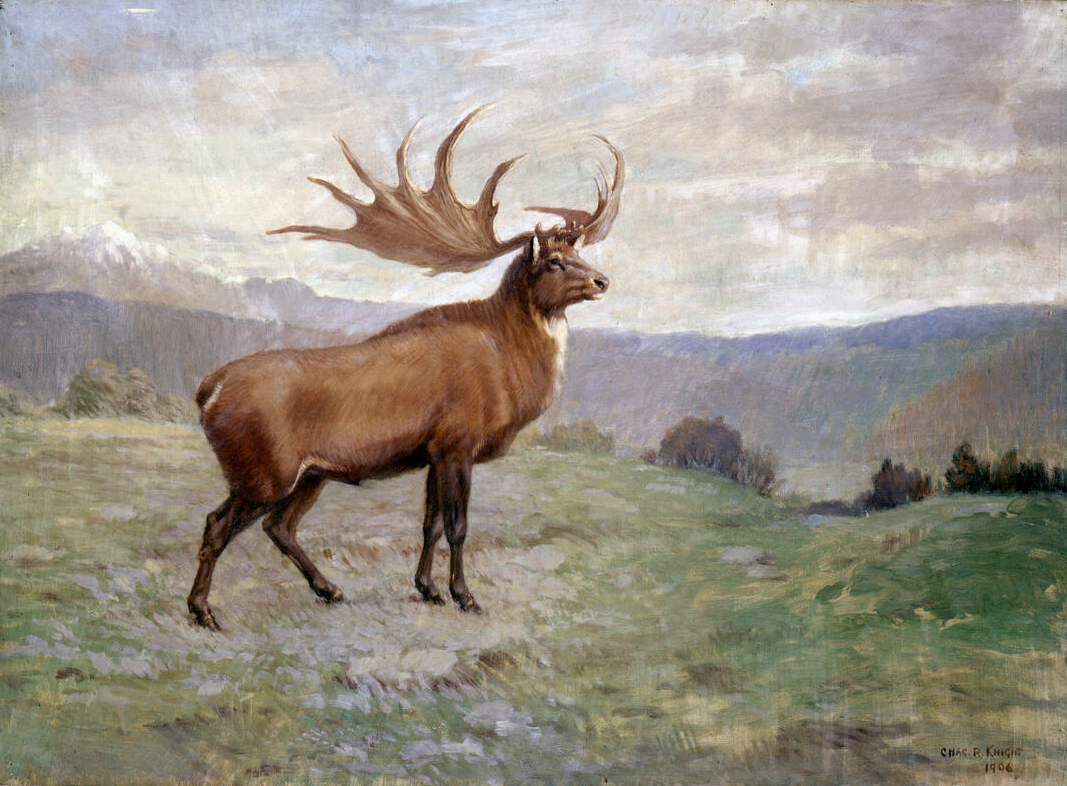
A giant deer stag on open ground, as imagined by the American artist Charles R. Knight in 1906. (Image: Charles R. Knight, public domain, the artist died in 1953, via Wikimedia Commons, source American Museum of Natural History, shown unaltered)
What the Marks May Mean
Only one of the two bones has been dated. The caution is central to the find, and The Irish Times reports that the researchers stressed that the marks cannot be proven to be human-made without additional artifacts.
There is a second clue in what is missing. The Irish Times reports that the main meat-bearing bones, such as upper legs, ribs and pelvises, are largely absent from the cave's giant deer assemblage. The authors suggest that early hunters may have butchered the animals somewhere else and left behind lower limbs, which wolves or bears then scavenged and dragged into the cave. The Irish Times adds that the undated bone carries wolf gnaw marks, suggesting that carnivores later scavenged the carcass.
Ruth Carden, one of the authors, said that the missing meat-bearing bones, together with possible chopping and marrow-splitting marks on giant deer legs, point to a kill site scavenged by wolves, according to The Irish Times. She added that more Ice Age deposits may still lie inside the cave.
Scavenging and butchery can be hard to tell apart, and archaeologists have faced the same problem elsewhere. Ancient Origins has reported, for example, on how 32,000-year-old mammoth bones in Germany reopened an Ice Age hunting question, where the line between hunting and scavenging is still debated.
The Bear Bone That Set the Record
Until now, according to The Irish Times, the earliest confirmed evidence of people in Ireland has been a single butchered brown bear bone. It was found in 1903 in Alice and Gwendoline Cave, near Ennis in County Clare, and it was only dated more than a century later.
In 2016, Marion Dowd and Ruth Carden published that bear knee bone in Quaternary Science Reviews. They described five linear cutmarks on its front surface and two independent radiocarbon dates that agreed, at roughly 12,800 to 12,600 years ago. In their view, the find pushed back the antiquity of human occupation in Ireland and challenged the traditional view that some plants and animals may have colonized the island naturally before people arrived.
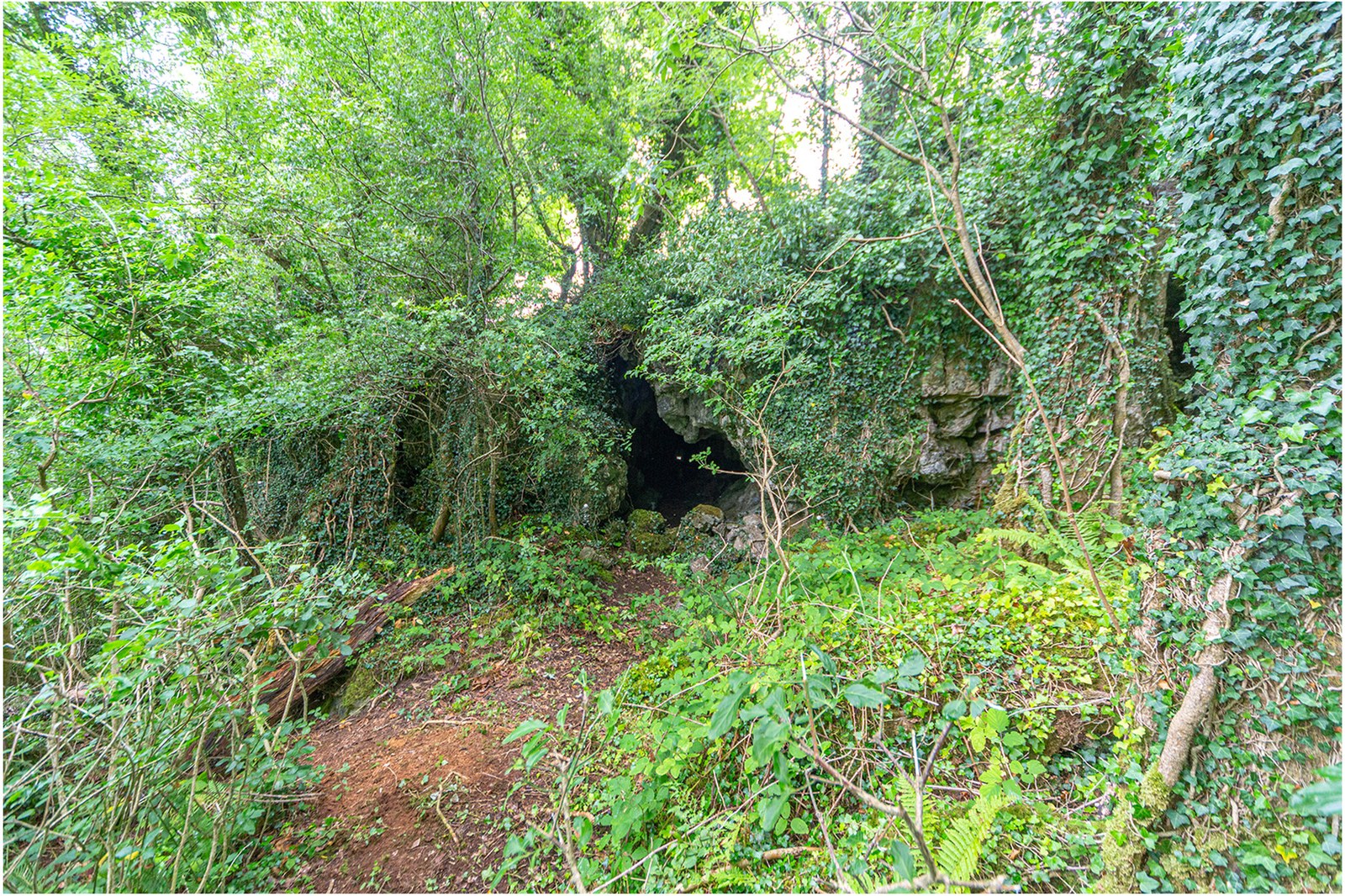
The entrance of Alice and Gwendoline Cave, near Ennis in County Clare, where a butchered brown bear bone was found in 1903. (Image: Thorsten Kahlert, CC BY 4.0, via Wikimedia Commons, from Dowd et al. 2024, Quaternary Science Reviews, resized from 1754 by 1169 to 1600 by 1066 pixels and converted from PNG to JPEG)
The Ballynamintra team sees a gap here, because people reached Britain much earlier. In the words of the new paper's abstract, "pioneering Late Upper Palaeolithic hunter-gatherer populations migrated into Britain from around 15,000 years ago as the ice sheets retreated and the climate ameliorated, but corresponding evidence in Ireland is absent for this period." Ancient Origins has covered research suggesting that Ice Age Britons returned 500 years earlier than thought.
However, the timing of the Ballynamintra date matters. The Irish Times notes that it falls in the Middle Allerød, the warm interval when hunter-gatherers were active across Britain and northwest Europe. Jennings set out what is at stake, according to The Irish Times. He said that confirming human activity at the cave 13,500 years ago would push back the arrival of people in Ireland significantly, and would change how early human dispersal across northwest Europe at the end of the last Ice Age is understood.
Ireland's Most Famous Extinct Animal
The giant deer is a fitting witness to such an early visit, since the National Museum of Ireland says the species was first described from Ireland, although it ranged across Europe and into Russia and Siberia, and the museum holds more than 800 records of it. According to London's Natural History Museum, the animal stood about two meters at the shoulder, and its antlers could reach about 3.5 meters across.
The same museum explains that giant deer preferred parkland, a mix of open woodland and grassland, and that they disappeared from Ireland, Britain and most of Europe about 12,000 years ago, as the climate turned cold again at the end of the Ice Age. A 13,500-year-old giant deer at Ballynamintra would therefore belong to the warmer centuries before that decline. Ancient Origins has written about enormous giant deer antlers pulled from Lough Neagh in Northern Ireland.
Waiting for a Stone Tool
The researchers say that only further artifacts can settle the question. According to The Irish Times, further excavations at Ballynamintra Cave are scheduled, where Ice Age deposits appear to continue into unexplored passages and could yield the stone tools or bone points needed for confirmation. The paper's abstract also points to the potential for recovering "more substantial butchered faunal remains and other forms of archaeological evidence".
Cóilín Ó Drisceoil, an archaeologist with the National Monuments Service and one of the authors, said that further artifacts will need to be found to confirm an earlier human presence, The Irish Times reports, and that this makes the cave a prime site for future research into Ireland's earliest human history. However, it is not the only lead. Ancient Origins has also reported claims that Irish cave art may push the human story back to 15,000 years, although firm dates for those markings are still needed.
For now, the two giant deer bones from Waterford remain a possibility, and they may mark the earliest known visit of people to Ireland, or they may turn out to be the work of wolves and time. The next season of digging may decide which.
By Aris Manus
Sources
Jennings, R.P., Fitzgibbon, B., Ó Drisceoil, C., Girdland-Flink, L., Carden, R.F., Lewis, H., Kenny, P., Meloro, C., Buckley, M., Quinney, P.R., Ditchfield, P., Simms, M.J., Dowling, S., Edwards, C.J. and White, T.S. 2026. "Ballynamintra Cave, Co. Waterford: A Window into Late Glacial Ireland and Possible Upper Palaeolithic Human Butchery at c. 13.5 ka cal BP." Proceedings of the Royal Irish Academy: Archaeology, Culture, History, Literature. Available at: https://doi.org/10.1353/ria.0.a1009058 (published abstract only)
McGreevy, R. 2026. "Butchered bones suggest Ireland was inhabited 1,000 years earlier than first believed." The Irish Times, November 26, 2026. Available at: https://www.irishtimes.com/ireland/2026/11/26/butchered-bones-suggest-i…
Dowd, M. and Carden, R.F. 2016. "First evidence of a Late Upper Palaeolithic human presence in Ireland." Quaternary Science Reviews 139: 158 to 163. Available at: https://doi.org/10.1016/j.quascirev.2016.02.029
Massignan, A. 2026. "Icons of the Dead Zoo: The Giant Irish Deer." National Museum of Ireland, April 8, 2026. Available at: https://www.museum.ie/en-IE/Collections-Research/Natural-History-Collec…
Natural History Museum. "The Irish elk: when and why did this giant deer go extinct and what did it look like?" Available at: https://www.nhm.ac.uk/discover/irish-elk-giant-deer.html

Enjoyed this? Get UNLEASHED for life, $249 once
Ancient Origins UNLEASHED is our Substack for the deeper, longer stories. Until Monday, November 30 at midnight UK time, you can join for life with one payment instead of a yearly subscription.
- The full paid UNLEASHED archive and every future paid post, for as long as the publication continues
- A Founders certificate
- A vote on upcoming topics
- Optional credit on our Founders page, only with your permission
- One welcome one-to-one discussion
Become an UNLEASHED Lifetime Founder, $249
Places are limited to 20 in total. Use the same email you use (or will use) on Substack. We switch on your paid access by hand after payment, so it is not instant. UNLEASHED only; Ancient Origins Premium is not included.
Want everything Ancient Origins makes? The Founders' Lifetime Pass is $349, paid once: Premium for life, all 29 ebooks, 177 webinar and interview recordings, 64 Magazine issues, AO Kids and the full Atlas.