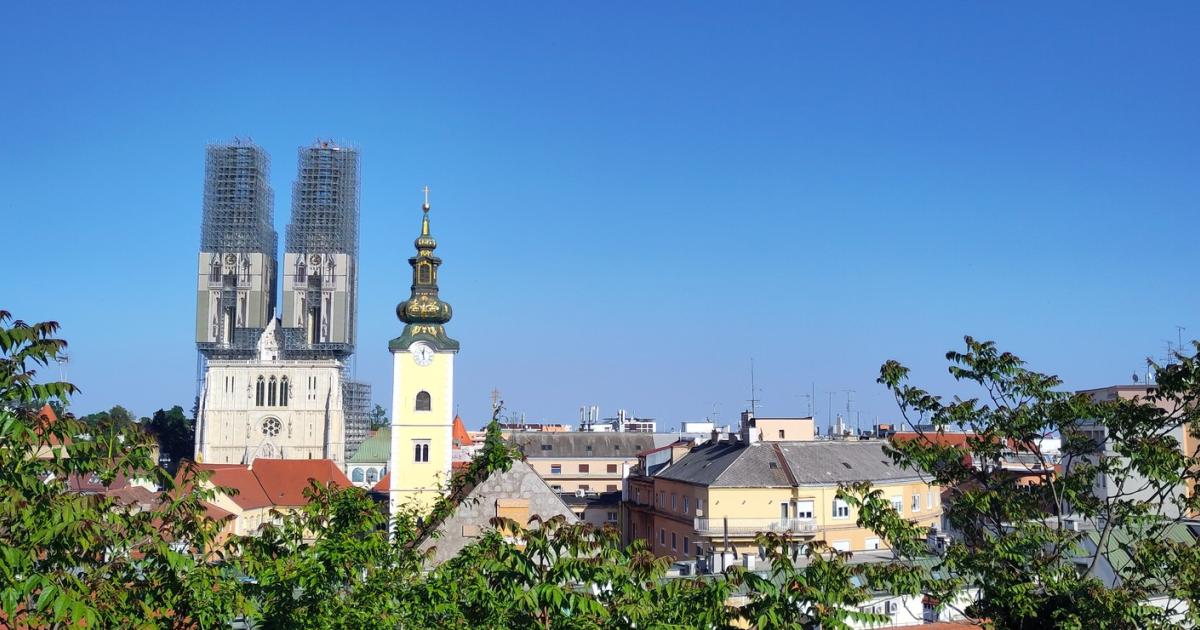

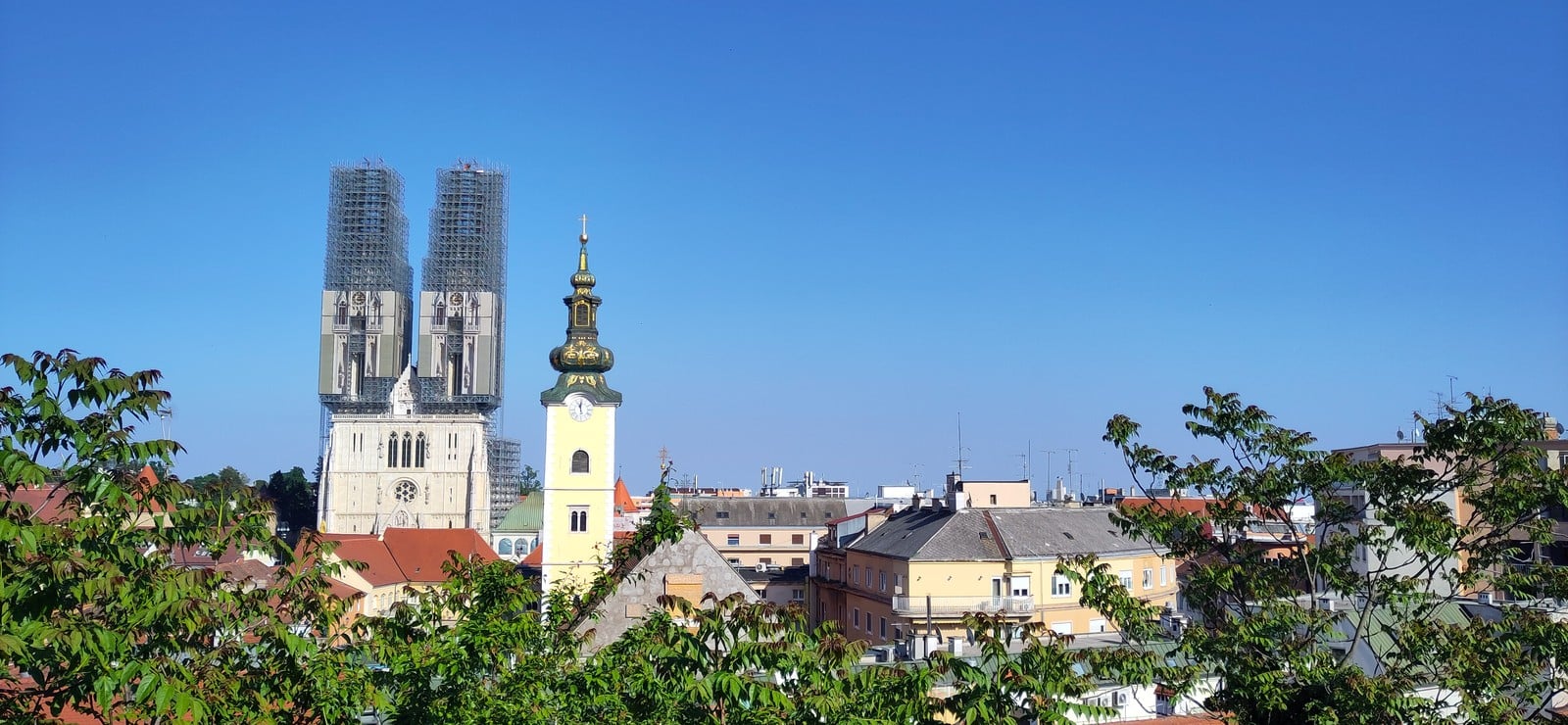
The towers of Zagreb Cathedral under scaffolding, seen from the Strossmayer Promenade in April 2024. The cathedral is being restored after the March 2020 earthquake, and Croatia Week reports that the dig which found the coffin accompanied that work. (Image: Alex Sirac, CC BY 4.0, via Wikimedia Commons, cropped at the top and bottom and resized from 4000 by 3000 to 1600 by 740 pixels)
Beneath the floor of a ruined chapel beside Zagreb Cathedral lay a sealed lead coffin, and on Friday, November 20, 2026, the Archdiocese of Zagreb announced that the skeletal remains inside are those of Ivan Zakmardi, a Croatian statesman who died in 1667. IKA, the Croatian Catholic news agency, reports that the excavation director, Dr. Ana Azinović Bebek of the Croatian Conservation Institute, can confirm the identification with 99 percent certainty.
Between the legs of the dead man lay an iron vessel. Azinović Bebek, as quoted by IKA, believes that it very probably held his heart, while Arkeonews puts her view more cautiously, as a vessel that may have contained his heart or another organ. So who was this man? Why did his body need special preparation before it could travel home? And what does his burial mean for Croatia?
A Chapel Forgotten After an Earthquake
According to Croatia Week, excavations along the cathedral's southern buttresses began in July 2026 as part of the research that accompanies its restoration after the earthquake of March 2020. The team uncovered the remains of the Chapel of St. John the Baptist, which Zakmardi had built for his own burial and which IKA places between the second and third southern buttresses.
The chapel was later rededicated to the Exaltation of the Holy Cross, and Azinović Bebek explained that it was badly damaged in the earthquake of 1880 and was not rebuilt during Bollé's restoration of the cathedral. The team opened it in September, on the feast of the Exaltation of the Holy Cross, September 14. As quoted by IKA, she described what they found (translated by Ancient Origins):
"In its floor we found, in a lead sarcophagus that was lined with fir wood, skeletal remains, which we then assumed to be those of Ivan Zakmardi."
Archival research, a publication by Ladislav Dobrica issued for an exhibition on Zakmardi at the Croatian State Archives, and scientific analyses then supported the identification, she explained.
What the Coffin Held
IKA reports that the burial goods point to a person of high rank. A wooden burial cross with bronze fittings, which were later gilded, lay with him, and its figure of Christ was gilded too. The coffin also held a rosary of jet beads, a devotional medal showing Ecce Homo and Mater Dolorosa, and leather shoes with silver buckles. Maša Vuković-Biruš, a senior conservator at the Croatian Conservation Institute, explained that each buckle is made of three different materials, and IKA reports that cleaning revealed hallmarks showing the quality of the silver and a workshop mark that may show where they were made.
According to IKA, the bones of the upper body are stained green, a sign of oxidized bronze, and the team assumes that the clothes he was buried in were woven through with, or made of, bronze threads. Preliminary results on the textile remains point to silk and wool, and because the lead coffin was sealed, the skeleton survived in excellent condition.
Dr. Vlasta Vyroubal, a senior research associate at the Anthropological Center of the Croatian Academy of Sciences and Arts, found that the man was older than 65. His spine had fused in blocks, a condition called diffuse idiopathic skeletal hyperostosis, which she said is linked in archaeological populations with people of better means. A CT scan at the Rebro clinical hospital showed a single lesion that broke through the vault of the skull. Vyroubal said it resembles a metastasis in appearance, but the scan interpretation is still pending, and Arkeonews notes that further examination is needed before any diagnosis. She found no sign of a violent death, and she noted that his slightly prominent lower jaw can also be seen in historical portraits of him.
Did the Iron Vessel Hold His Heart?
Zakmardi died on April 25, 1667, in Banská Bystrica, in what is now Slovakia. As quoted by IKA, Azinović Bebek explained why his body could not simply be carried home (translated by Ancient Origins):
"As he died on the road, according to the rules and regulations of the time, it was necessary to perform an autopsy so that the body could be returned to Croatia."
The team found traces of the procedure on the skeleton. According to Vyroubal, the clearest is a cut in the skull, and a cut in the breastbone confirms that the body was opened. Azinović Bebek said the iron vessel very probably held the heart, in line with the customs of the time, if not another internal organ as well. However, Arkeonews says the vessel's original contents have yet to be established.
Arkeonews notes that the custom of burying the heart apart from the body was established in the Middle Ages and persisted among European royalty and aristocratic families well into the modern era. It points to one of the most striking examples, the Jacobin convent in Rennes, in Brittany.
Echoes From Rennes
A team including the archaeologist Rozenn Colleter of France's National Institute of Preventive Archaeological Research (INRAP) studied the convent's burials and published the results in PLOS ONE in 2016. They report five lead urns, each holding a heart, as well as five lead coffins. The urns are heart-shaped, and three have suspension eyes. Four of them carry inscriptions dated between 1584 and 1655, from which the paper concludes that the practice had run for some 70 years.
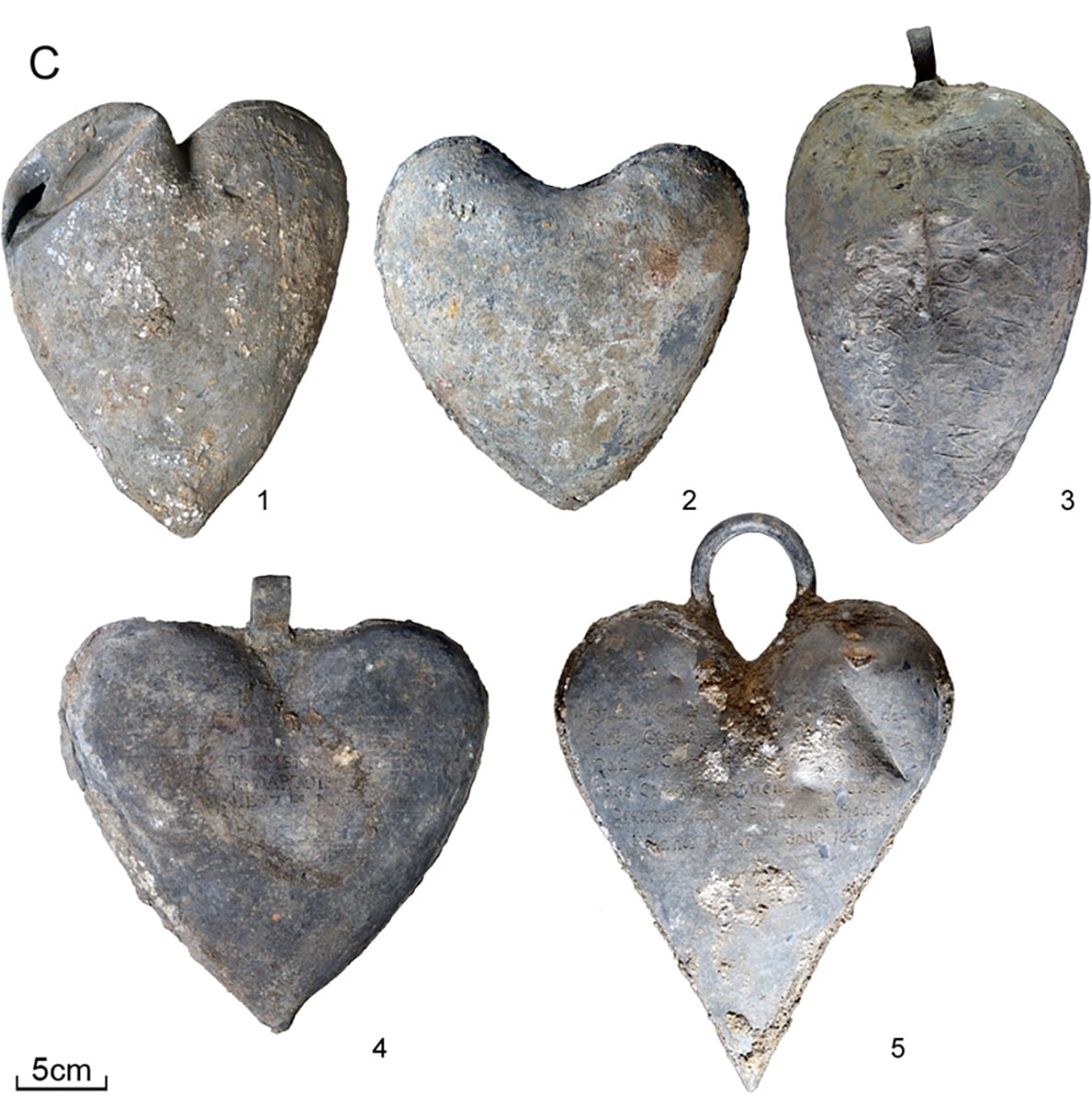
Lead heart urns from the Jacobin convent in Rennes, France, numbered 1 to 5 as in the paper. (Image: Colleter et al. 2016, PLOS ONE, Figure 2C, CC BY 4.0, via PLOS ONE, cropped from Figure 2 to show panel C only and converted from PNG to JPEG)
One urn belonged to Toussaint de Perrien, a knight who died in 1649. The paper gives its inscription in translation as "Here lies the heart of Toussainct de Perrien, Knight of Brefeillac &c". His body lay in a convent he had founded, but his heart rested on the coffin of his wife, Louise de Quengo, who died in 1656. Ancient Origins has covered the embalmed heart of a 17th-century knight buried in his wife's grave, the fully clothed noblewoman buried with her husband's heart and, more broadly, how 18th-century romantics gave their actual hearts.
The paper also counts 22 opened skulls among the 483 burials of the 16th to 18th centuries that it studied in depth. Rennes cannot explain what happened in Zagreb, but it does show that such procedures were part of a wider practice among people of rank in the same century.
The Man Who Locked Away a Kingdom's Charters
IKA's account, which it credits to the archdiocese's website, sets out Zakmardi's career. Born around 1600, he worked as a lawyer for the Diocese of Zagreb and held a number of public offices. In 1641, he was chosen for a commission charged with reviewing and listing the charters, laws and privileges of the Kingdom of Croatia. Two years later came the work for which he is best remembered.
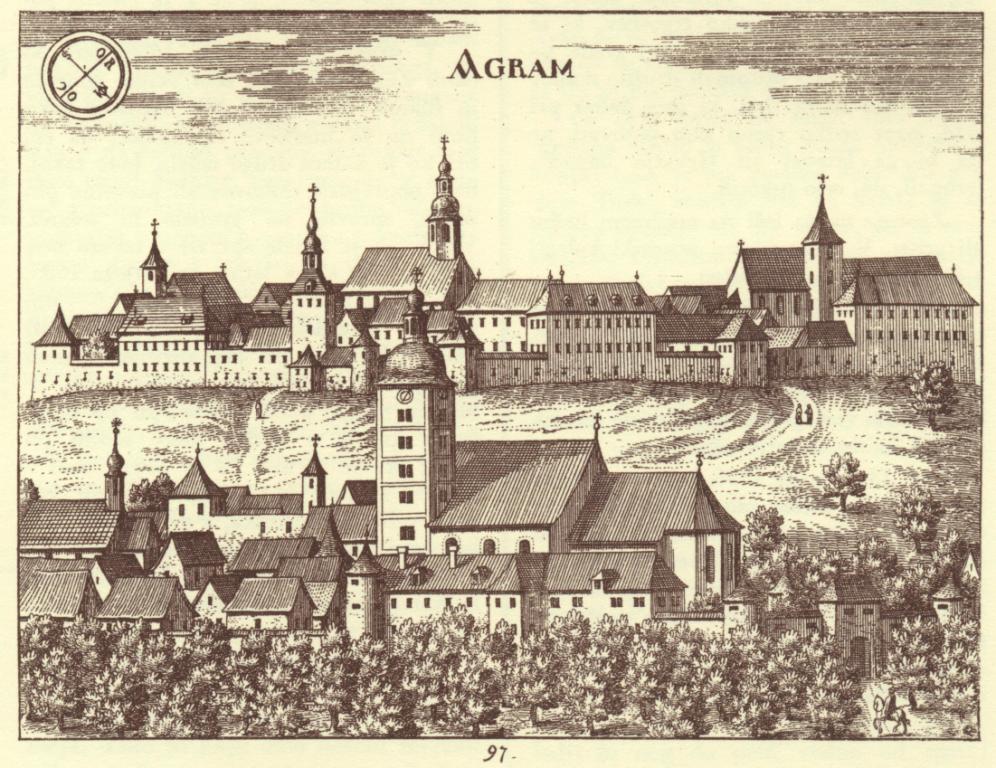
Zagreb, then called Agram, in a copper engraving by Johann Weikhard von Valvasor, which its Wikimedia Commons file page dates to 1689, about two decades after Zakmardi's burial. (Image: Johann Weikhard von Valvasor, public domain, via Wikimedia Commons, shown unaltered)
The Croatian State Archives, in the German version of its page on the chest, says that Zakmardi, whom it calls the royal treasurer, had an oak chest made by decision of the Diet to hold the privileges and charters of the kingdoms of Slavonia and Croatia, finished in 1643. Known in Latin as the Cista Privilegiorum Regni, it opened with three keys, and the Archives gives them to the ban, the protonotary and the vice-ban. However, IKA and Croatia Week report that the bishop, the ban and Zakmardi held them, and IKA says he kept his as royal protonotary, although its own outline of his career dates his election to that office to 1644, when the Diet at Varaždin chose him. The front of the chest bears the coats of arms of Croatia and Slavonia. Once kept in the sacristy of Zagreb Cathedral, it is now in the Croatian State Archives, which says it is widely seen as the start of the institution itself.
Zakmardi was also known for his charity. According to IKA, Azinović Bebek said that he set up two foundations that paid for the schooling of children of lower social status, and that they ran for almost 150 years after his death. By his own wish, he was buried in the Chapel of St. John the Baptist.
What Comes Next
According to IKA, the team now awaits the CT interpretation and the radiocarbon results, while conservators work on the leather shoes. A facial reconstruction is planned from the skull scans, and stable isotope analysis will show what he ate. When all the analyses are complete, his reburial will be arranged, and no date has been reported.
Today, the chest he had made to guard the charters of Croatia and Slavonia is still kept in the Croatian State Archives. Whether the iron vessel buried with him held his heart is a question that the coming analyses may finally answer.
By Aris Manus
Sources
Zagrebačka nadbiskupija (Archdiocese of Zagreb). 2026. Press office announcement of November 20, 2026, as reported by IKA, Croatia Week and Arkeonews.
IKA (Informativna katolička agencija). 2026. "VIDEO Uz zagrebačku katedralu pronađeni ostaci hrvatskog velikana Ivana Zakmardija." November 20, 2026. Available at: https://ika.hkm.hr/novosti/video-uz-zagrebacku-katedralu-pronadeni-osta… (quotations translated by Ancient Origins)
Croatia Week. 2026. "Remains of Croatian historical figure found near Zagreb Cathedral." November 21, 2026. Available at: https://www.croatiaweek.com/ivan-zakmardi-remains-zagreb-cathedral/
Buyukyildirim, O. 2026. "Sealed Lead Coffin and Possible Heart Urn Unearthed at Zagreb Cathedral." Arkeonews, November 21, 2026. Available at: https://arkeonews.net/sealed-lead-coffin-and-possible-heart-urn-unearth…
Hrvatski državni arhiv (Croatian State Archives). n.d. "Škrinja povlastica" (German-language section, "Privilegientruhe"). Available at: https://www.arhiv.hr/O-nama/Povijest/Skrinja-povlastica
Colleter, R., Dedouit, F., Duchesne, S., Mokrane, F.-Z., Gendrot, V., Gérard, P., Dabernat, H., Crubézy, E., and Telmon, N. 2016. "Procedures and Frequencies of Embalming and Heart Extractions in Modern Period in Brittany. Contribution to the Evolution of Ritual Funerary in Europe." PLoS ONE 11(12): e0167988. Available at: https://doi.org/10.1371/journal.pone.0167988

Enjoyed this? Get UNLEASHED for life, $249 once
Ancient Origins UNLEASHED is our Substack for the deeper, longer stories. Until Monday, November 30 at midnight UK time, you can join for life with one payment instead of a yearly subscription.
- The full paid UNLEASHED archive and every future paid post, for as long as the publication continues
- A Founders certificate
- A vote on upcoming topics
- Optional credit on our Founders page, only with your permission
- One welcome one-to-one discussion
Become an UNLEASHED Lifetime Founder, $249
Places are limited to 20 in total. Use the same email you use (or will use) on Substack. We switch on your paid access by hand after payment, so it is not instant. UNLEASHED only; Ancient Origins Premium is not included.
Want everything Ancient Origins makes? The Founders' Lifetime Pass is $349, paid once: Premium for life, all 29 ebooks, 177 webinar and interview recordings, 64 Magazine issues, AO Kids and the full Atlas.