
Aristeas of Proconnesus was one of the strangest figures in early Greek literature, a poet from an island in the Sea of Marmara who is remembered less for his verses than for the way he kept disappearing. The Greek historian Herodotus recorded a story he had heard at Proconnesus and nearby Cyzicus. It begins with a death in a shop and ends with a statue in a marketplace in southern Italy.
The miracles in that story are impossible to test, and Herodotus himself only reported what he was told. However, the tale also carries a poem about the far northern edge of the known world, and a modern scholarly argument about whether early Greeks borrowed the idea of a wandering soul from the peoples of the steppe. So was Aristeas a poet, a legend, or a little of both?
A Body That Was Not There
According to Herodotus (Histories 4.14, in the 1920 translation by A. D. Godley), Aristeas, who was as well born as anyone in his town, "went into a fuller's shop at Proconnesus and there died." The owner locked up and went to tell the dead man's relatives, and the report of his death soon spread about the city.
Before they arrived, a man from Cyzicus who had come from the town of Artace insisted that he had just met Aristeas on the road to Cyzicus and spoken with him. Herodotus says the man argued vehemently while the family gathered what was needed for a funeral. Then the shop was finally unlocked, and Herodotus records the result in a single line:
"when the place was opened, there was no Aristeas there, dead or alive."
But it didn't end there, because Herodotus continues: "But in the seventh year after that, Aristeas appeared at Proconnesus and made that poem which the Greeks now call the Arimaspea, after which he vanished once again." He adds plainly that this is the tale told in the two towns, and he does not claim to have seen any of it.
A Statue Beside Apollo in Metapontum
The story then jumps across the Greek world to Metapontum, a Greek city in southern Italy. Herodotus (4.15) says that something happened there "two hundred and forty years after the second disappearance of Aristeas, as reckoning made at Proconnesus and Metapontum shows me." The figure is worth checking, because the older Rawlinson translation, now on Wikisource, prints "three hundred and forty years." The Greek text on the Perseus Digital Library reads two hundred and forty, which is the number Godley gives.
According to the people of Metapontum, Aristeas appeared in their country and told them to build an altar to Apollo and set up a statue bearing his own name beside it. He said Apollo had visited them alone among the Italian Greeks, and that he had come with the god in the shape of a bird, which both Godley and Rawlinson translate as a crow. The Greek word in the text is korax, and Pliny the Elder, telling a related story, calls it a raven.
The townspeople asked the oracle at Delphi what the vision meant, and "the Pythian priestess told them to obey the vision, saying that their fortune would be better." Herodotus closes with something he presents as current fact: "And now there stands beside the image of Apollo a statue bearing the name of Aristeas," surrounded by bay trees in the marketplace.
The Poem of the Far North
The Arimaspea itself has not survived as a complete poem. Herodotus (4.13) gives its outline in a single sentence, saying that Aristeas, "possessed by Phoebus, visited the Issedones," and he summarizes the lands the poet described beyond them:
"beyond these (he said) live the one-eyed Arimaspians, beyond whom are the griffins that guard gold, and beyond these again the Hyperboreans, whose territory reaches to the sea."
That last people became a lasting legend in their own right, as the story of Hyperborea, the land beyond the north wind, shows. However, Herodotus was careful here as well, and he notes that "Aristeas' story does not agree with the Scythian account about this country," and in 4.16 he adds that even Aristeas never claimed to have gone beyond the Issedones. Instead, "he spoke by hearsay of what lay north, saying that the Issedones had told him." For readers who wonder how far Herodotus can be trusted, his habit of separating what he saw from what he heard is a recurring theme in debates over whether he was the father of history or of lies.
When did the poet live, and how old is the poem? The answer is disputed, since the Suda, a Byzantine encyclopedia, places him in the fiftieth Olympiad and in the time of Croesus and Cyrus. The editors of the Suda On Line note that the Olympiad date, 580 to 577 BC, is too early for those kings. Jan N. Bremmer of the University of Groningen, in a 2016 survey, reports that studies of the poem's language by Bolton and later Ivantchik point to about 500 BC, and he concludes that "the poet must have lived in the second half of the sixth century BC." J. D. P. Bolton's 1962 book, Aristeas of Proconnesus, was not consulted directly for this article.
A Soul That Could Leave the Body
Later writers turned Aristeas into a man whose spirit traveled without him, and the Suda entry, in a translation by Jennifer Benedict, states: "They say that whenever he wanted, his soul would leave and return again." Pliny the Elder, in his Natural History (in the Bostock and Riley translation), reports that in Proconnesus "the soul of Aristeas was seen to fly out of his mouth, under the form of a raven," before dismissing it as "a most fabulous story."
In the 20th century these tales became evidence in a scholarly debate. Bremmer reports that the Oxford classicist Eric Robertson Dodds, in The Greeks and the Irrational (1951), turned to the idea of shamanistic influence to explain the rise of the Greek notion of the immortal soul, and that this book "popularized the notion of the shaman well into the twenty-first century." Bremmer is a skeptic of that reading, and notes that the little known about Scythia and Thrace says nothing of shamanistic beliefs. He argues that a Greek trained as a Scythian shaman is hard to imagine and that the stories Herodotus collected look like later embellishments. He links the Metapontum episode to the Pythagoreans who were based there, noting that the raven was Apollo's bird. His conclusion:
"In the end there is no early shamanistic detail left of Aristeas' legends that is credibly derived from the Scythians."
However, this remains a debate rather than a settled question. Bremmer opens his survey by observing that the idea of shamanism has had a powerful attraction for important and influential classical scholars, and his own verdict is one side of that long argument.
Griffins, Gold and a Dinosaur
The gold-guarding griffins of the Arimaspea have prompted a more modern theory. Witton and Hing, discussed below, say the idea was first proposed in the 1990s. The theory holds that Greek griffin legends may have been shaped by reports of Protoceratops fossils in Central Asia, carried west along trade routes from the gold mines. Their reference list includes works by Adrienne Mayor, among them The First Fossil Hunters (2000), which is cited here through that paper rather than read directly.
The paper by Mark Witton and Richard Hing, published in Interdisciplinary Science Reviews in 2024, found the link "uncompelling." According to their abstract, Protoceratops fossils occur hundreds of kilometers from the nearest gold deposits, and suggested likenesses between the dinosaur and the griffin are "selectively identified." They suggest that "the allure of ancient cultures sharing our modern fascination with dinosaurs" has kept the idea alive. The exchange was also covered in a report on how dinosaur fossils may not have inspired the griffin after all.
What the Evidence Can Tell Us
Some parts of the story stand on firm ground. It is established that Herodotus recorded the vanishing, the return, the poem and the statue at Metapontum, and that the Arimaspea existed and survives only through later quotation and summary. The poet's date, any real journey toward the steppe, the shaman reading and the griffin fossil theory are all disputed. Every miraculous element, from the empty shop to the bird that followed Apollo, is unverified. A literal body that vanished and reappeared centuries later belongs firmly in fringe territory.
What lasted was a peculiar, durable tale about a poet who claimed to have heard of one-eyed men and gold-guarding griffins, and a city that honored him with a statue. Who Aristeas really was, and what he saw with his own eyes, still remains a mystery.
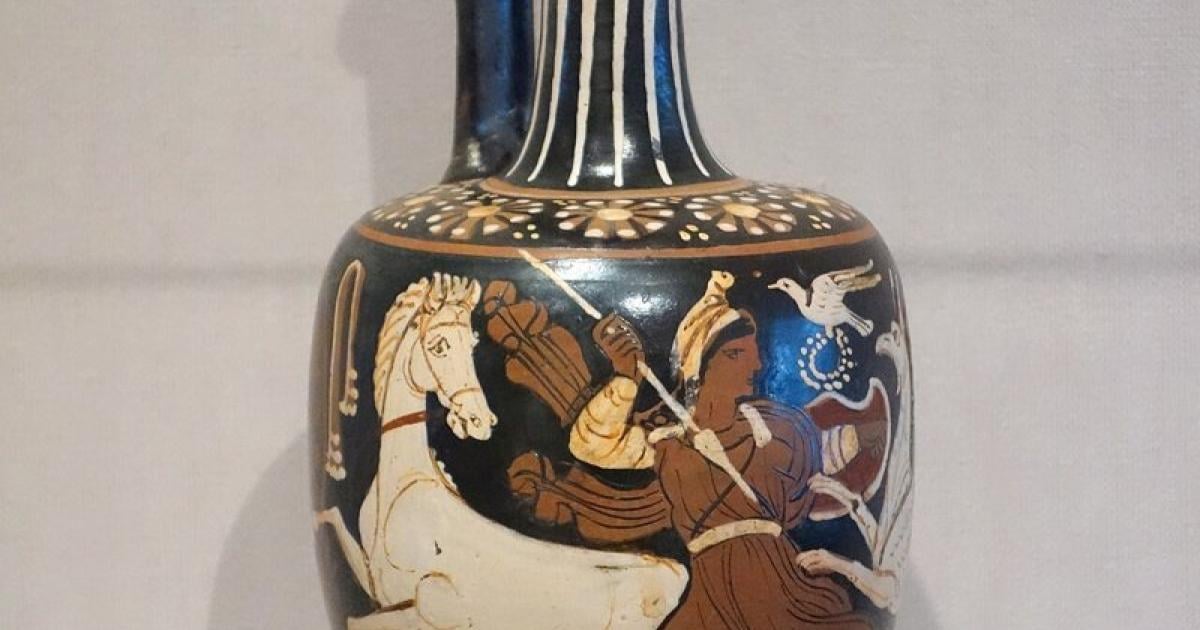
Illustration only: an Arimaspian fighting a griffin, on a red-figure oinochoe attributed to the Baltimore Painter, Apulia, around 325 BC, at the California Palace of the Legion of Honor. The scene illustrates the kind of legend Aristeas helped spread and is not connected to the poet himself. (Photo by Daderot, released under the CC0 1.0 Universal Public Domain Dedication, via Wikimedia Commons)
By Aris Manus
Sources
- Herodotus, Histories, Book 4, chapters 13 to 16, translated by A. D. Godley, Cambridge, MA: Harvard University Press, 1920 (Perseus Digital Library)
- Herodotus, Histories, Book 4, chapter 15, Greek text, 1920 edition (Perseus Digital Library)
- Herodotus, The History of Herodotus, Book 4, translated by George Rawlinson (Wikisource)/Book_4)
- Suda, alpha 3900, Aristeas, translated by Jennifer Benedict (Suda On Line)
- Pliny the Elder, The Natural History, Book 7, translated by John Bostock and H. T. Riley, London: Taylor and Francis, 1855 (Perseus Digital Library)
- Jan N. Bremmer, Shamanism in Classical Scholarship: Where are We Now?, in Horizons of Shamanism, Stockholm University Press, 2016, pp. 52 to 78. Dodds 1951, Bolton 1962 and Ivantchik are reported through this survey
- Mark P. Witton and Richard A. Hing, Did the horned dinosaur Protoceratops inspire the griffin?, Interdisciplinary Science Reviews 49 (3 and 4), 2024, pp. 363 to 388 (abstract and bibliography). Mayor's work is cited through this paper

Enjoyed this? Get UNLEASHED for life, $249 once
Ancient Origins UNLEASHED is our Substack for the deeper, longer stories. Until Monday, November 30 at midnight UK time, you can join for life with one payment instead of a yearly subscription.
- The full paid UNLEASHED archive and every future paid post, for as long as the publication continues
- A Founders certificate
- A vote on upcoming topics
- Optional credit on our Founders page, only with your permission
- One welcome one-to-one discussion
Become an UNLEASHED Lifetime Founder, $249
Places are limited to 20 in total. Use the same email you use (or will use) on Substack. We switch on your paid access by hand after payment, so it is not instant. UNLEASHED only; Ancient Origins Premium is not included.
Want everything Ancient Origins makes? The Founders' Lifetime Pass is $349, paid once: Premium for life, all 29 ebooks, 177 webinar and interview recordings, 64 Magazine issues, AO Kids and the full Atlas.