
Fact Check verdict: Unverified. No ancient text read for this check places the statue astride the harbor, and the pose first appears in local talk reported by a pilgrim in the 1390s.
Most people picture the Colossus of Rhodes as a bronze sun god standing over a harbor entrance with ships passing beneath him. National Geographic's history magazine shows the pose in paintings and frescoes, and a photo caption in its article on the statue reads "It is easy to envision the great Colossus standing astride the harbor entrance with one foot on each side." The same article says historians now regard that pose as highly unlikely. So where did the famous picture come from, and does any ancient writer back it up?
What Strabo and Pliny say
Strabo lists the Colossus first among the best votive offerings of Rhodes. In the Loeb translation on LacusCurtius he quotes a verse giving its height as "seven times ten cubits in height, the work of Chares the Lindian," and reports that it "now lies on the ground, having been thrown down by an earthquake and broken at the knees." He adds that "In accordance with a certain oracle, the people did not raise it again." He praises the city's harbors in the same passage, yet never sets the statue over one.
Pliny the Elder, in the Bostock and Riley translation of his Natural History (34.18), gives the same height of seventy cubits and says the statue was thrown down by an earthquake fifty six years after it was erected. He describes a ruin: "Few men can clasp the thumb in their arms, and its fingers are larger than most statues." Where limbs had broken, he writes, "vast caverns are seen yawning in the interior," with "large masses of rock, by the weight of which the artist steadied it while erecting it." The work took twelve years and was paid for from "engines of warfare which had been abandoned by King Demetrius."
How the statue was made
Herbert Maryon, in the opening paragraph of his 1956 article in the Journal of Hellenic Studies, dates the work from 292 to 280 BC. He says the fallen statue lay on the ground for "nearly 900 years" until the Arab conquest of Rhodes in AD 653. National Geographic gives 654 for that conquest.
The main ancient source on method is Philo of Byzantium. In the Blackwood translation he says the artist first fixed the feet on a pedestal of pure marble, and that as parts were finished the artist "poured a huge quantity of earth about the base hiding that part already completed." National Geographic notes that Philo wrote more than a century after the statue was built and that many modern art historians dispute his method.
Haynes, in a 1957 note, summarizes Maryon's view that the statue was formed of hammered bronze plates. A 2017 chapter by Ursula Vedder asks whether the Colossus was cast in courses or in large sections, but the Getty page returned a server error, so her answer is not reported here. Philo mentions one marble base and no harbor.
Where the straddle came from
The earliest hint of a straddle found for this check is late and secondhand. National Geographic quotes an Italian pilgrim, Nicolas de Martoni, who visited Rhodes between 1394 and 1395 and recorded what local people said: "it is said that it had one foot on the wharf, where the Church of Saint Nicholas stands, and the other on the end of the other wharf, where the windmills are."
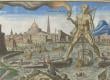
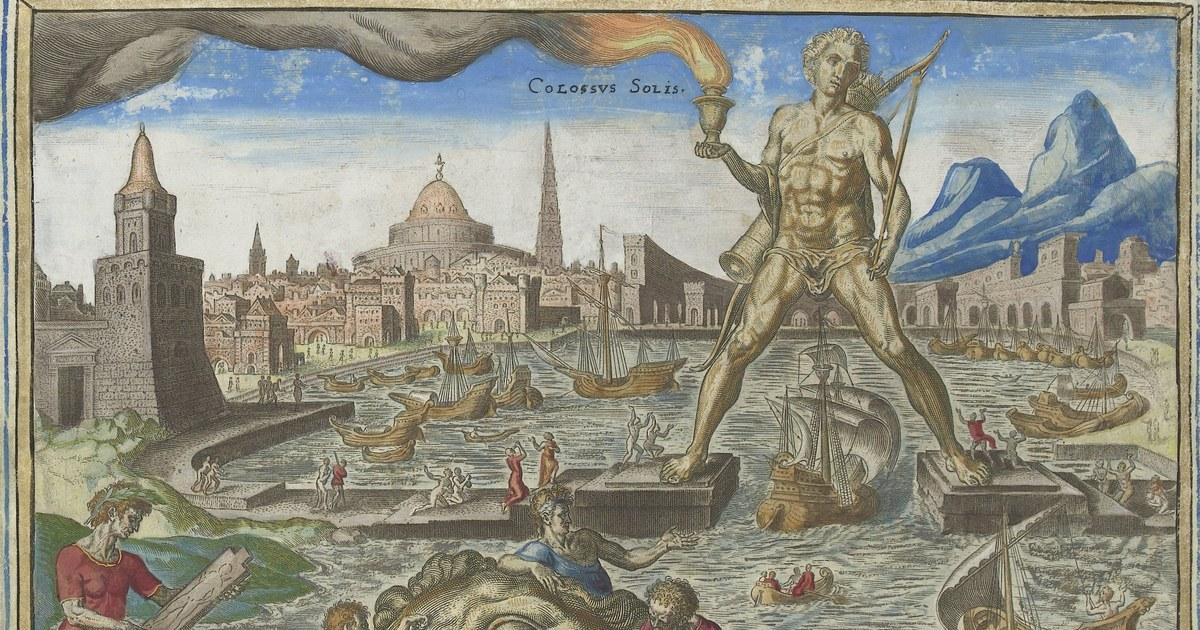
By the 1500s the pose had reached print. The Rijksmuseum's catalog entry for the 1572 engraving by Philips Galle, after a drawing by Maarten van Heemskerck, describes a bronze Helios standing with his legs wide apart over the harbor while ships sail between them.
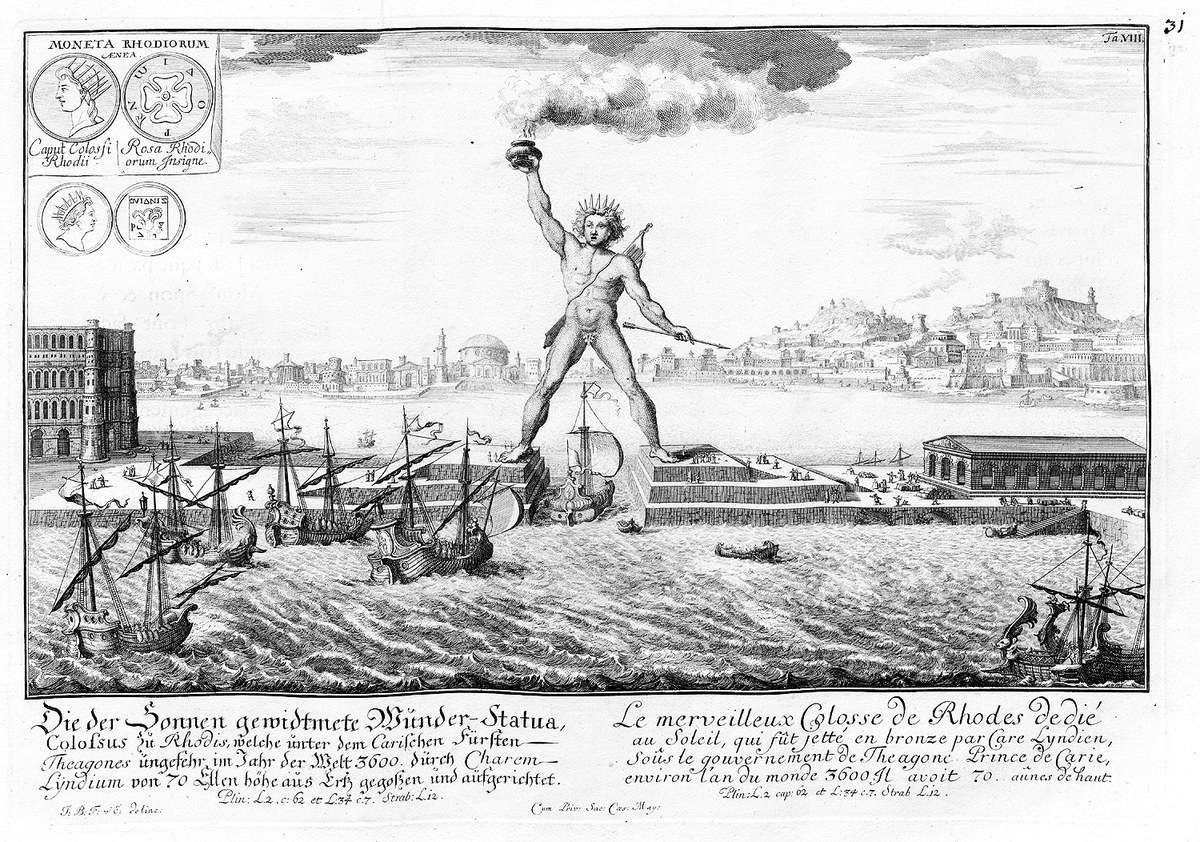
Plate of the Colossus in Johann Bernhard Fischer von Erlach's Entwurff einer historischen Architectur, 1721. Johann Bernhard Fischer von Erlach, via Wikimedia Commons, public domain, resized.
Johann Bernhard Fischer von Erlach drew the same scene for his 1721 survey of historic architecture, and its printed caption names Pliny and Strabo as authorities. Of course, neither of them describes a straddle. National Geographic also points to Cassius in Shakespeare's Julius Caesar, written in 1599: "Why, man, he doth bestride the narrow world Like a Colossus."
Why the pose does not hold up
National Geographic puts the physical objection plainly: "It would have been physically impossible for a statue standing at least 100 feet high to be supported by legs 650 feet apart." What's more, it adds that a wide stance could not have withstood the region's strong winds and that the break at the knees points to legs held together. The 650 foot figure is the magazine's own, and its basis was not checked here. Neither Strabo nor Pliny connects the statue with a harbor mouth or a blocked sea lane, and Strabo says the ruin lay on the ground.
Where it may have stood
National Geographic says it is now considered unlikely that the statue stood beside the sea or in the port area at all, "partly due to the lack of a site big enough to accommodate it," and that "no remains of a temple or an open-air sanctuary to the god have been found on the island."
The magazine reports that some archaeologists suggest a sanctuary of unknown identity near the stadium on the Rhodes acropolis was dedicated to Helios. Martoni's informants pointed to the wharf of the Church of Saint Nicholas, and National Geographic places today's Fort of St. Nicholas near the Mandraki harbor.
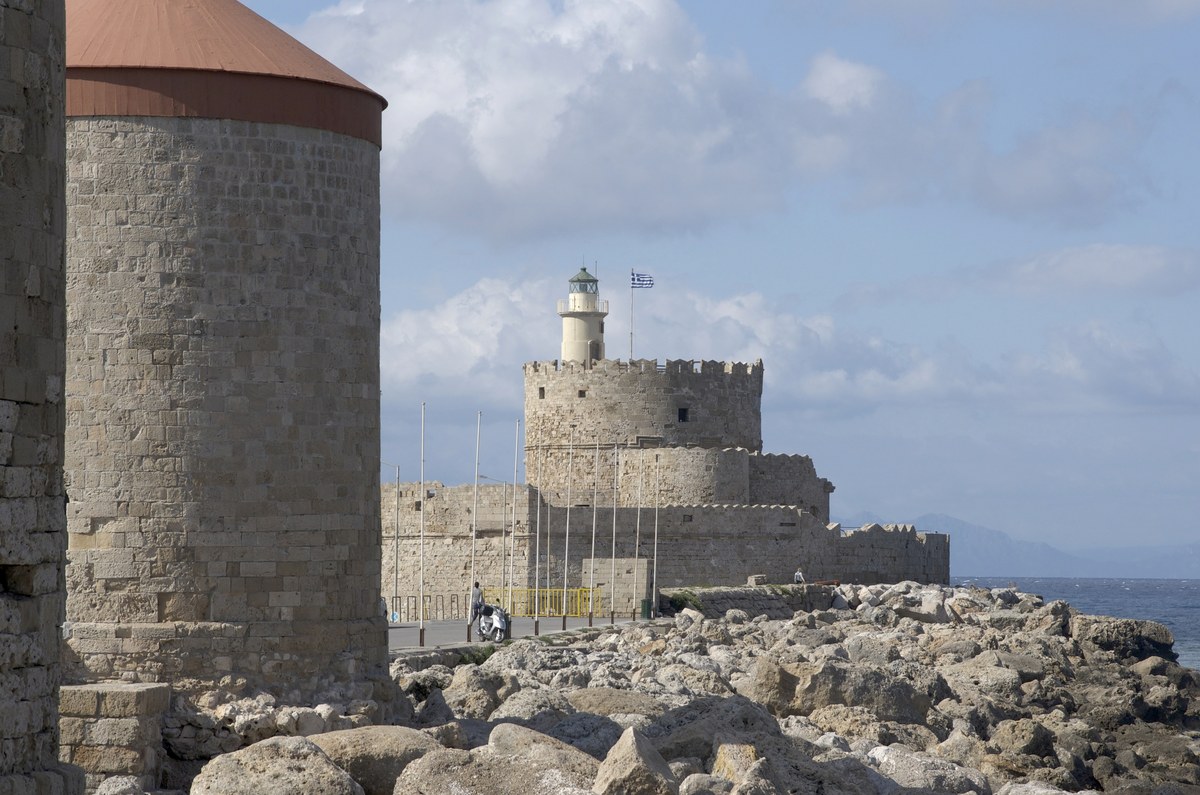
The Fort of St. Nicholas and a harbor windmill at Rhodes, photographed on April 18, 2011 by Jebulon. Via Wikimedia Commons, CC0, resized.
Where this leaves it
With these factors taken into account, the straddle rests on local talk reported in the 1390s and on prints made later still. However, this is not proof that the Colossus stood nowhere near the water, as neither Strabo nor Pliny says where in the city it stood. Until its base or a sanctuary of Helios is found, the site and the casting method remain open questions.
Ancient Origins has covered other Hellenistic engineering in Water for a Coin: Did Heron of Alexandria Design the Earliest Vending Machine? and 30 Surviving Gears Show the Antikythera Mechanism Was an Ancient Analog Computer. Another fact check asks Did the Romans Really Move Baalbek's Great Stones?, and the list of wonders is in Can You Name the Seven Wonders of the Ancient World?
How we checked this
Read in full were Strabo 14.2.5, Pliny 34.18, the National Geographic article, a published translation of Philo and the Rijksmuseum records. Maryon's 1956 article and Haynes's 1957 note were read only as the extracts on their Cambridge Core pages, so nothing here reports their full arguments. Vedder's chapter was not read because the Getty page returned a server error and was not retried, and its title comes from Crossref. The dedication verse and Lemprière were not opened and are left out. Earlier Ancient Origins coverage was not a source, and the labels are explained on the evidence standards page.
The Colossus of Rhodes as imagined in a print of 1572 by Philips Galle after Maarten van Heemskerck. Rijksmuseum, Amsterdam, via Wikimedia Commons, CC0 (https://creativecommons.org/publicdomain/zero/1.0/), cropped from a photograph of the album page and cropped again for the featured slot
By Aris Manus
Claim by claim
- Unverified: The Colossus of Rhodes stood with one foot on each side of the harbor mouth while ships sailed between its legs. Reason: No ancient text read places it astride the harbor, Strabo says the fallen statue lay on the ground, and the pose first appears in a report of local talk from the 1390s.
- Established: Chares the Lindian made a Helios statue about seventy cubits tall, paid for with siege gear Demetrius abandoned. Reason: Strabo and Pliny.
- Established: An earthquake threw the statue down at the knees and the remains lay on the ground. Reason: Strabo, with Pliny on the earthquake and the fallen ruin and Maryon's opening paragraph.
- Established: The straddling pose appears in a pilgrim's report of local talk from the 1390s and in prints from 1572 and 1721, and in no ancient text read. Reason: National Geographic on Martoni, and the two prints.
- Disputed: Where the statue stood. Reason: National Geographic describes the harbor site as unlikely and reports a proposed sanctuary on the acropolis.
- Disputed: How the statue was cast. Reason: Philo describes the statue rising section by section behind mounds of earth, National Geographic says many art historians dispute it, and Haynes summarizes Maryon's hammered plate view.
Sources
Strabo. Geography, Book 14, Chapter 2. Loeb Classical Library edition, 1928, on LacusCurtius.
Pliny the Elder. Natural History, Book 34, Chapter 18. Translated by John Bostock and H. T. Riley, Perseus Digital Library.
Maryon, Herbert (1956). The Colossus of Rhodes. Journal of Hellenic Studies 76, pp. 68 to 86. Opening extract only.
Haynes, D. E. L. (1957). Philo of Byzantium and the Colossus of Rhodes. Journal of Hellenic Studies 77(2), pp. 311 to 312. Opening extract only.
Philo of Byzantium. On the Seven Wonders of the World. Free translation by Jean Blackwood, reproduced by Roger Pearse.
Vedder, Ursula (2017). Was the Colossus of Rhodes Cast in Courses or in Large Sections? In Artistry in Bronze, J. Paul Getty Trust, pp. 21 to 27. Title from Crossref, chapter not read for this check.
Mariño Sánchez-Elvira, Rosa María (2018). The Colossus of Rhodes, the bronze wonder of the ancient world. National Geographic History Magazine, December 12, 2018.
Rijksmuseum. Print RP-P-2005-214-26-2, Colossus of Rhodes. Catalog record on Wikimedia Commons.

Enjoyed this? Get UNLEASHED for life, $249 once
Ancient Origins UNLEASHED is our Substack for the deeper, longer stories. Until Monday, November 30 at midnight UK time, you can join for life with one payment instead of a yearly subscription.
- The full paid UNLEASHED archive and every future paid post, for as long as the publication continues
- A Founders certificate
- A vote on upcoming topics
- Optional credit on our Founders page, only with your permission
- One welcome one-to-one discussion
Become an UNLEASHED Lifetime Founder, $249
Places are limited to 20 in total. Use the same email you use (or will use) on Substack. We switch on your paid access by hand after payment, so it is not instant. UNLEASHED only; Ancient Origins Premium is not included.
Want everything Ancient Origins makes? The Founders' Lifetime Pass is $349, paid once: Premium for life, all 29 ebooks, 177 webinar and interview recordings, 64 Magazine issues, AO Kids and the full Atlas.