
Fact Check verdict:
The Antikythera mechanism was an ancient analog computer, a hand-cranked bronze calculator that predicted eclipses: Established
Its gearing showed the positions of all five planets known in antiquity: Unverified
The mechanism made precise astronomical predictions in practice: Disputed
The calendar ring was laid out for a lunar year of about 354 days rather than the 365-day Egyptian year: Established
The mechanism was built around 205 BC: Unverified
Aliens or time travelers supplied the technology: Fringe
The verdict
Divers pulled lumps of corroded bronze from an ancient shipwreck off the Greek island of Antikythera in 1901. More than a century of study has shown that they hold a train of finely cut gears. Was the Antikythera mechanism really an ancient computer? Verdict: Established.
According to the 2006 study in Nature led by Tony Freeth, the device was "a unique Greek geared device" that predicted eclipses from Babylonian cycles, and the journal's editors wrote that it "can justifiably be claimed as the world's oldest known analogue computer". That holds for a hand-cranked calculator, while its precision, its planetary display and its date are still argued over.
- Established: The Antikythera mechanism was an ancient analog computer, a hand-cranked bronze calculator that predicted eclipses. Reason: X-ray scans of the surviving fragments, which include 30 gearwheels, reconstruct its gear trains, and its eclipse dial carries predictions built on Babylonian cycles, according to Freeth and colleagues in 2006 and 2021.
- Unverified: Its gearing showed the positions of all five planets known in antiquity. Reason: inscriptions list planetary cycles, which makes a planetary display likely, yet the gears for the Sun and planets do not survive and the 2021 reconstruction had to design theoretical ones.
- Disputed: The mechanism made precise astronomical predictions in practice. Reason: Mike Edmunds judged in 2011 that its gear errors made it more of a teaching display, and a 2025 simulation found those errors would jam it, though its authors suspect corrosion inflates them.
- Established: The calendar ring was laid out for a lunar year of about 354 days rather than the 365-day Egyptian year. Reason: a statistical analysis by Graham Woan and Joseph Bayley of the University of Glasgow found 365 holes implausible and 354 or 355 the likeliest count, without fixing one whole number.
- Unverified: The mechanism was built around 205 BC. Reason: 205 BC is a proposed start date for the dials, other researchers favor 178 BC, and a start date for the dials is a different thing from the year the machine was finished.
- Fringe: Aliens or time travelers supplied the technology. Reason: no evidence supports it, the inscriptions are Greek, and Cicero describes a comparable bronze device built by Archimedes.
What the evidence says
The fragments, recovered by divers in 1901, are held at the National Archaeological Museum in Athens. A 2021 paper in Scientific Reports by Freeth and colleagues describes the device as "split into 82 fragments" and notes that "only a third of the original survives, including 30 corroded bronze gearwheels".
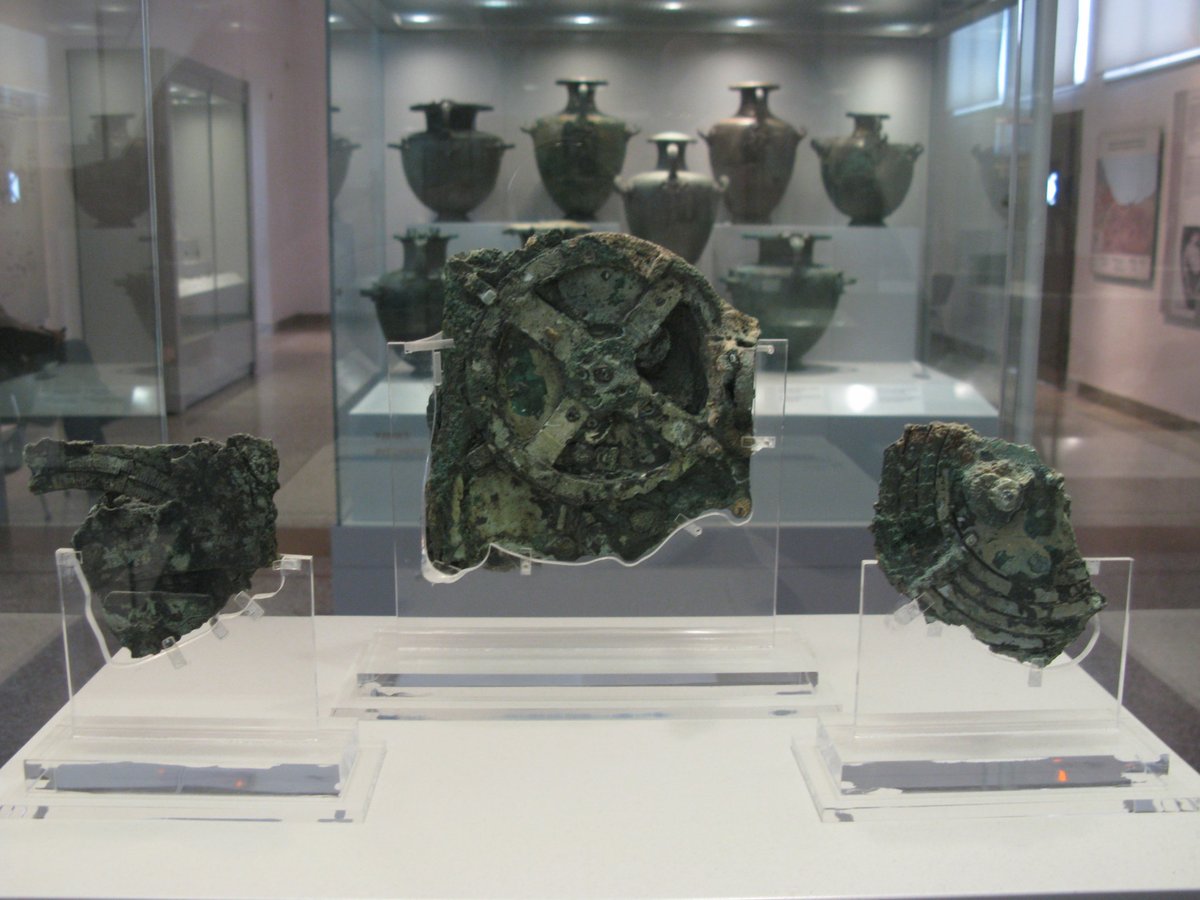
Three fragments of the Antikythera mechanism on display at the National Archaeological Museum in Athens. (Tilemahos Efthimiadis/CC BY 2.0)
The breakthrough came in 2006, when the Freeth team combined surface imaging with high resolution X-ray tomography and doubled the number of deciphered inscriptions. Their Nature paper reports that "The mechanism predicted lunar and solar eclipses on the basis of Babylonian arithmetic-progression cycles". Its gearing also models the irregular speed of the Moon, which the authors called "an unexpected degree of technical sophistication for the period".
Derek de Solla Price had already subtitled his 1974 monograph "a calendar computer from ca. 80 BC", and the 2021 paper calls the device "a mechanical computer of bronze gears that used ground-breaking technology to make astronomical predictions". A University of Glasgow press release from June 27, 2024 said it "functioned as a kind of hand-operated mechanical computer".
Whether it showed the planets is a harder question. The 2021 paper reads planetary cycles in the inscriptions, including the numbers 462 for Venus and 442 for Saturn, yet it concedes that "the evidence is missing for the Sun and planets". Its planetary gear trains fit the inscriptions, but as reconstructions they are indicative rather than conclusive, and the wheels that would settle it have never been recovered.
The calendar ring has produced the newest result. In 2020, Chris Budiselic and colleagues published X-ray measurements of holes beneath the broken ring and estimated a count between 347 and 367. Woan and Bayley reanalyzed those positions with Bayesian methods in the Horological Journal in July 2024, finding that "A ring of 360 holes is strongly disfavoured".
The Glasgow release said the ring was "vastly more likely to have had 354 holes, corresponding to the lunar calendar, than 365 holes, which would have followed the Egyptian calendar". The paper concludes that the count "is consistent with 354 days, but not with 365".
The date is less settled. The 2006 paper says it was "constructed around the end of the second century bc". Christian Carman and James Evans argued in 2014 that the eclipse dial "offers practically the only possibility for a close astronomical dating of the mechanism", with a best fit on May 12, 205 BC.
Paul Iversen reached the same year from the calendar in Hesperia in 2017, while Aristeidis Voulgaris and two colleagues argued in the journal Almagest for a start in December 178 BC. Neither date fixes construction, and a 2025 study notes that the wreck has been "dated to the decades around 60 BCE" and that there is no consensus on whether the device was built shortly before the ship sank or much earlier.
The alternative view
The viral version holds that the machine was too advanced for its time. Brian Dunning of Skeptoid notes that "Some have said the Antikythera Mechanism is therefore proof of time travel, alien visitation, or Atlantis". The grain of truth is that the 2006 paper calls it "technically more complex than any known device for at least a millennium afterwards".
At least one ancient writer describes a device of this kind. Cicero's dialogue On the Republic, in the 1928 translation by Clinton W. Keyes, describes a bronze sphere made by Archimedes. On that sphere "the moon was always as many revolutions behind the sun on the bronze contrivance as would agree with the number of days it was behind" in the sky. The 2021 paper links the passage to a scale on the mechanism.
The device is also Greek in its details. Iversen argues that the games on one dial include "the Halieia of Rhodes, suggesting that the Antikythera Mechanism was built on Rhodes". London's Science Museum holds a Byzantine sundial with a geared calendar, made between AD 400 and 600, which it calls "the second oldest known of its kind".
The serious skeptical case is about engineering rather than origins. In a preprint posted on April 1, 2025, Esteban Szigety and Gustavo Arenas fed Edmunds' model of its gear errors into a simulation. They found that such a mechanism "would generally stop after the solar pointer completed one-third (120°) of its full rotation".
They concluded that "either the mechanism never functioned or its actual errors were smaller than those reported by Edmunds", and they lean toward the second, since "The effects of 2,000 years underwater likely caused corrosion that may have deformed the gears". Edmunds, as they summarize him, saw it as "more of an educational display than a tool for making practical and precise astronomical predictions".
Where this leaves it
The Antikythera mechanism was a Greek geared calculator that modeled the Moon, the calendar and eclipses, and calling it an analog computer is fair. The open questions are narrower than the viral posts suggest, namely how well its worn teeth meshed, how its planetary display was geared and in which decade it was made.
The verdict is Established for the computer claim in the analog sense and for the lunar calendar ring, Unverified for a full planetary display and a 205 BC build date, Disputed on precision and Fringe for aliens, because Greek texts and inscriptions explain the machine without outside help.
How we checked this
Read in full for this check: the 2021 Scientific Reports paper, the arXiv versions of the Woan and Bayley paper and the Szigety and Arenas preprint, the Glasgow press release, the Cicero passage, the Science Museum entry and the Skeptoid transcript. The 2006 Nature paper and the Carman and Evans, Iversen and Voulgaris papers were read as abstracts only.
Price's 1974 monograph, Edmunds' 2011 study and the 2020 Budiselic paper were not read directly and are cited as reported above. No interviews were conducted, and earlier Ancient Origins coverage was not used as a source. Every quote was checked against a saved copy on October 24, 2026.
How we label claims: see How we check evidence.
More in this series: Göbekli Tepe, the Sphinx and Atlantis: what the evidence says.
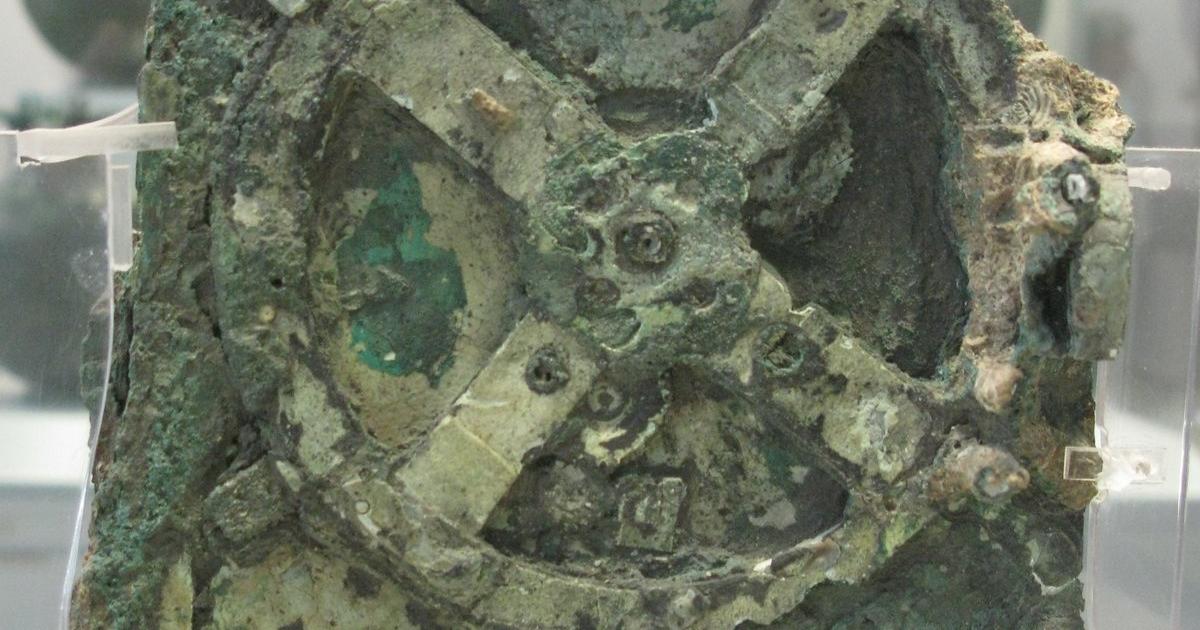
The main surviving fragment of the Antikythera mechanism, with its large four-spoked gearwheel, at the National Archaeological Museum in Athens. Tilemahos Efthimiadis, via Wikimedia Commons. CC BY 2.0
By Aris Manus
Sources
- Freeth, Tony, et al. (2021). A Model of the Cosmos in the ancient Greek Antikythera Mechanism. Scientific Reports 11: 5821. Read in full.
- Freeth, Tony, et al. (2006). Decoding the ancient Greek astronomical calculator known as the Antikythera Mechanism. Nature 444: 587 to 591. Abstract and editors' summary only.
- Woan, Graham, and Joseph Bayley (2024). An improved calendar ring hole-count for the Antikythera mechanism. Horological Journal, July 2024, arXiv version. Read in full.
- University of Glasgow (2024). Press release on the calendar ring study, June 27, 2024. Read in full.
- Szigety, Esteban Guillermo, and Gustavo Francisco Arenas (2025). The Impact of Triangular-Toothed Gears on the Functionality of the Antikythera Mechanism. arXiv preprint. Read in full.
- Carman, Christian C., and James Evans (2014). On the epoch of the Antikythera mechanism and its eclipse predictor. Archive for History of Exact Sciences 68. Abstract only.
- Iversen, Paul A. (2017). The Calendar on the Antikythera Mechanism and the Corinthian Family of Calendars. Hesperia 86. Abstract only.
- Voulgaris, Aristeidis, Christophoros Mouratidis and Andreas Vossinakis (2023). The Initial Calibration Date of the Antikythera Mechanism after the Saros spiral mechanical Apokatastasis. Almagest 14. Abstract only.
- Cicero. On the Republic, Book 1, sections 21 and 22, translated by Clinton W. Keyes (1928). Read in full (passage).
- Science Museum Group. Byzantine sundial-calendar, object 1983-1393. Read in full.
- Dunning, Brian (2009). The Antikythera Mechanism. Skeptoid, episode 184. Read in full.