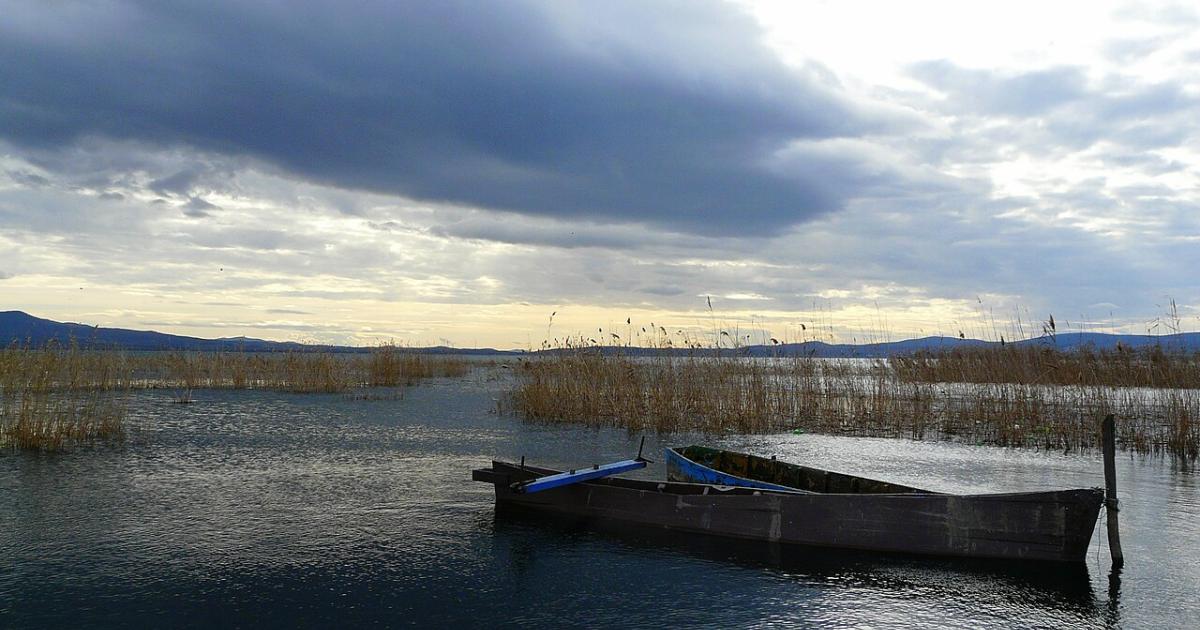

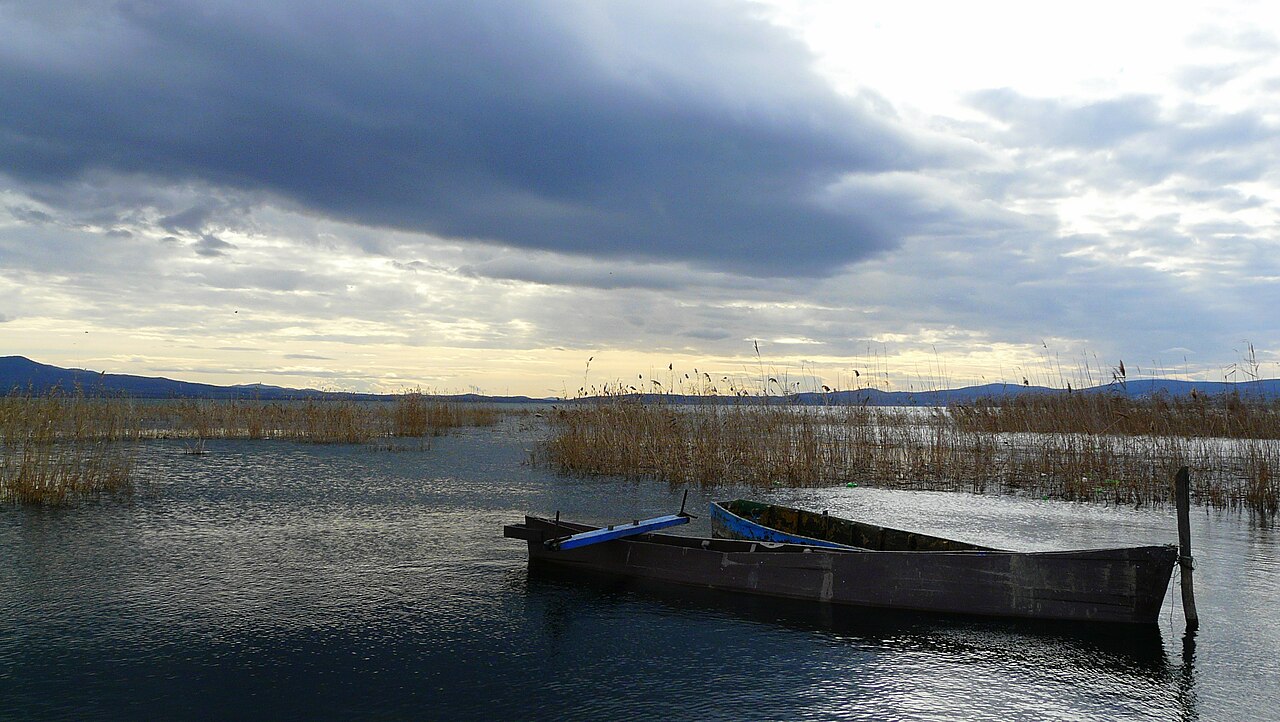
A wooden boat among the reeds on Lake Dojran, photographed in January 2010. The Bronze Age settlement of Mrdaja lies on the lake's southern shore. (Image: Ksenija Putilin, ImogenX on Flickr, via Wikimedia Commons, CC BY 2.0, resized from 3,264 by 1,840 to 1,280 by 722 pixels, otherwise unaltered)
About 3,500 years ago, a community lived on wooden platforms above the edge of Lake Dojran, walking from house to house across wooden bridges. In one of those houses, a skilled metalworker cast bronze axes, and the walls of that house may once have been painted red. This year archaeologists found a long bronze sword of a type associated with the Aegean world lying near that house, along with battle axes and a spearhead.
The site is called Mrdaja, and it lies near the town of Star Dojran (also written Stari Dojran) close to the border with Greece. The 2026 results were reported in North Macedonia by the broadcaster Sitel on November 7, 2026, and reached English readers through Arkeonews on November 24. The dig is led by archaeologist Zoran Rujak of the National Institute for the Protection of Cultural Monuments and Museum in Strumica.
So who lived in this lakeside village, and what happened around the metalworker's door?
A Village Built Over the Water
Mrdaja was found by accident, and much of it was damaged in the process. Rujak and his colleague Emil Slamkov explain in a 2021 paper in Macedoniae acta archaeologica that the site came to light in 2012 during building work to extend a beach used by the military, and that a "large part of the settlement was devastated by the heavy mechanization." Excavation ran from 2012 until 2014, when the lake rose and covered the site again.
In an October 2025 interview with the Serbian archaeology site Sve o arheologiji, Rujak said the water level had risen by more than two meters (about 6.6 feet), halting work for a decade. Digging resumed in 2024 and 2025 after the lake retreated. In 2025 the team worked on about 100 square meters with motor pumps running constantly to clear groundwater from the trenches, he told the site.
The houses stood on platforms raised on wooden piles above the lake. Rujak told Sve o arheologiji that single houses were probably built first, and that the platforms were later joined by small bridges as the village grew. According to Arkeonews, the 2026 season covered about 350 square meters (roughly 3,770 square feet) in under two months and exposed the remains of at least three houses linked by wooden bridges.
Pile dwellings of this kind are known from many European lakes, from the reconstructed pile dwellings at the Pfahlbaumuseum on Lake Constance to the Bronze Age lakeside settlement at Morges on Lake Geneva. Mrdaja brings the same way of life to a lake in the southern Balkans.
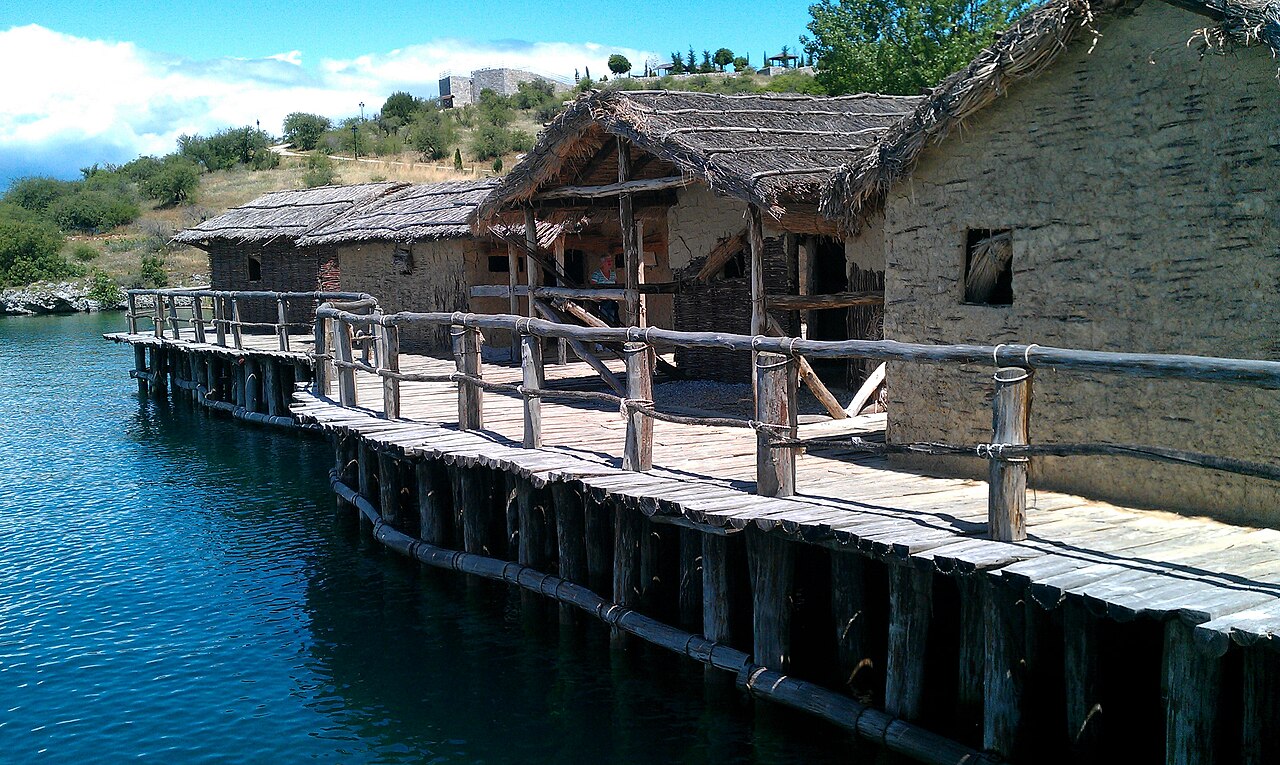
Reconstructed pile dwellings at the Bay of Bones museum on Lake Ohrid, photographed in June 2013. This is a modern reconstruction at a different lake, shown to illustrate how houses on platforms may have looked. It is not Mrdaja. (Image: A. Kerim Şengel, Wikimedia Commons, CC BY 3.0, resized from 3,264 by 1,952 to 1,280 by 765 pixels, otherwise unaltered)
The Metalworker's House
One of the houses at Mrdaja stands out from the others because of what was found inside it and around it. Arkeonews reports that archaeologists identified it as the metalworker's house because of the nature and density of the finds, which included bronze tools, objects linked to metal production and molds for casting double-edged bronze axes. These molds suggest that the villagers did more than buy finished metal goods, and that they carried out complex casting themselves. Rujak believes the person who lived there may have held a privileged position thanks to these skills.
The house was also decorated in a way that would have set it apart from its neighbors on the platforms. Surviving pieces of wall plaster show embossed circles surrounded by interlocking rings, with a frieze of spiral motifs above them. Traces of cinnabar, a red mineral, were found as well. Researchers think it was likely brought from the Alšar deposit and may have been used to paint the facade. However, that reading is still an interpretation. If it is confirmed, Arkeonews notes, the house would have been a showy and symbolic building as well as a workshop.
A Sword, Two Axes and a Spearhead
The weapons were found scattered around the house. Chief among them is a long, thin bronze sword of Mycenaean type, designed for thrusting. Arkeonews lists a socketed battle axe with two outer ribs around the socket, similar to examples from the Carpathian region, as well as a Kilindir-type double-edged bronze axe and a leaf-shaped bronze spearhead.
Sitel described the sword as the most important find of this year's excavations at Mrdaja and as the oldest sword found in the country (translated by Ancient Origins). That ranking is Sitel's report, and Ancient Origins has not checked it against a published catalog.
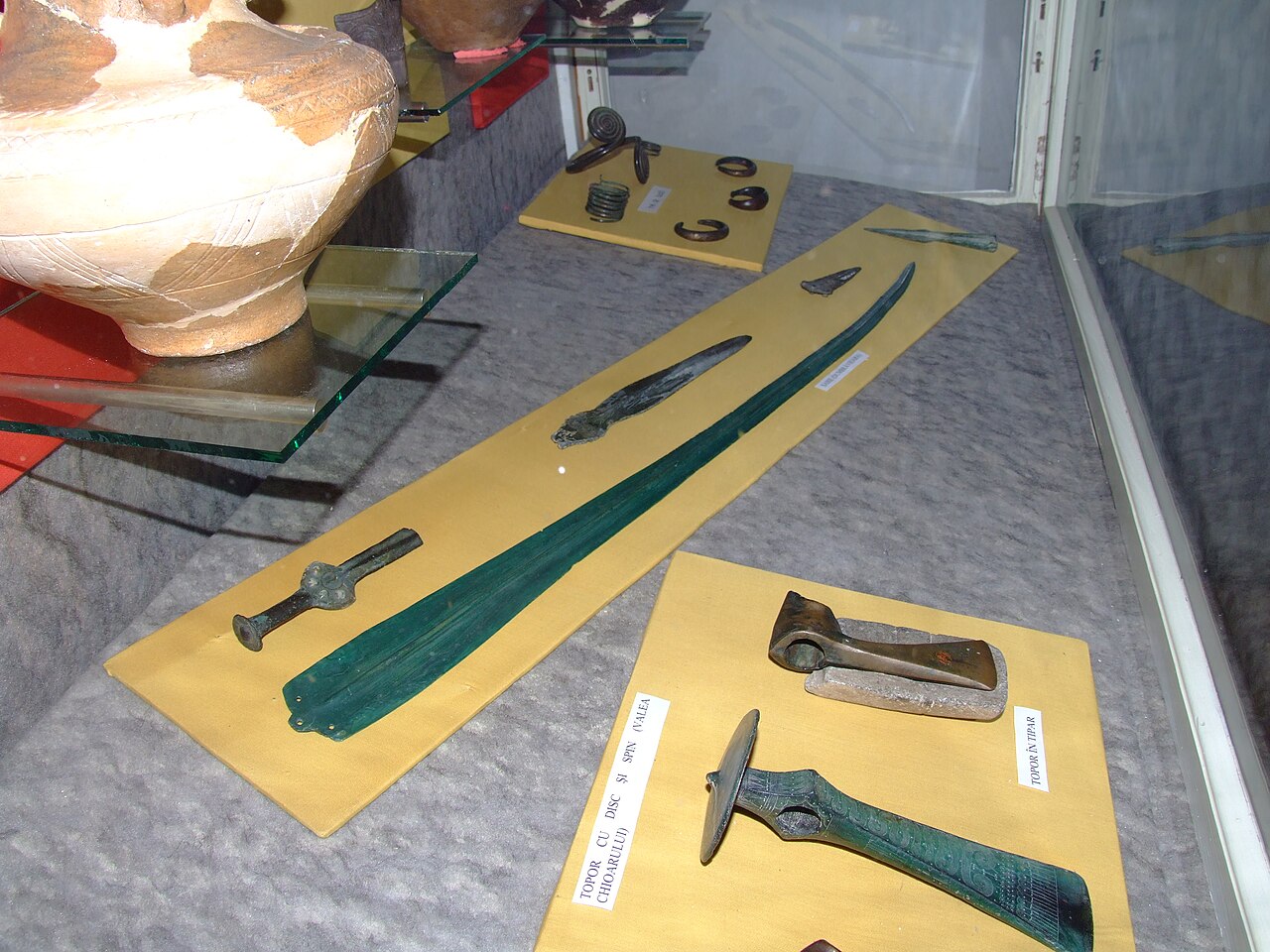
A Mycenaean bronze sword found at Dumbrăvioara in Romania, with Wietenberg culture battle axes from Valea Chioarului at bottom right, on display at the National Museum of Transylvanian History. These objects are not from Mrdaja. They show that swords of Aegean type also reached the Carpathian region. (Image: CristianChirita, Wikimedia Commons, CC BY 2.5, resized from 3,488 by 2,616 to 1,280 by 960 pixels, otherwise unaltered)
The term "Mycenaean-type" describes the shape of the blade and nothing more, since none of the reports says where the sword was made or who carried it. Arkeonews links the mix of weapon types to Mrdaja's ties with wider networks of trade, cultural exchange and technology that reached from the Aegean to the Carpathians. Ancient Origins has also reported a Mycenaean-like dagger-sword from Tavşanlı Höyük in Anatolia, far from the Aegean.
Archaeologist Barry Molloy, writing about Late Bronze Age weapons in southeast Europe, notes that research has turned toward "the movement of artefacts and ideas, but also of people, throughout and across perceived cultural boundaries." One possibility is that the Mrdaja sword arrived through trade or as a gift. Another is that it came with a traveler, or that a local smith copied a foreign model. None of the reports chooses between them.
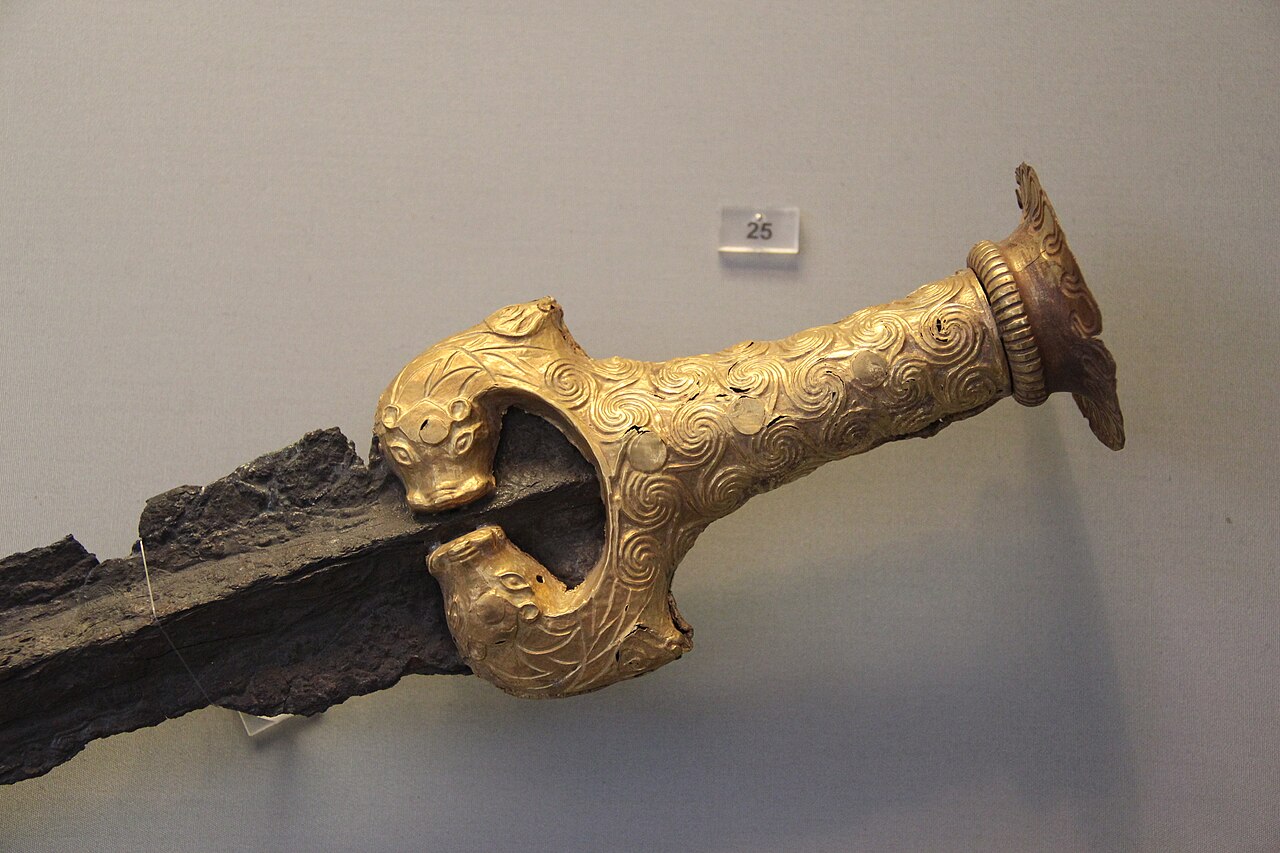
A Mycenaean bronze sword with a gold hilt in the Greek Prehistory Gallery of the National Archaeological Museum in Athens. The photographer's title says it came from Grave Circle B at Mycenae, which Ancient Origins has not checked against the museum's records. It is a far richer weapon than the plain blade from Mrdaja and is shown only for comparison. (Image: Gary Todd, Flickr, via Wikimedia Commons, CC0, resized from 5,184 by 3,456 to 1,280 by 853 pixels, otherwise unaltered)
An Attack, or Something Else?
According to Arkeonews, Rujak thinks the positions and types of the weapons point to a violent event that may have happened in the middle of the second millennium BC. However, the same report says that "archaeologists have not yet confirmed whether the finds are indeed the result of a conflict." Who might have attacked, and who defended the village, is not known.
The village also yielded signs of belief and daily work. Sun motifs appear often on the pottery, and ritual objects known as "consecration horns" were found. Other finds include an amulet made from a sea snail shell, spiral bronze wire rings, ceramic net sinkers likely used for fishing and small lead weights. In 2025, Sve o arheologiji reported small obsidian blades from the site, and Rujak told the site that the team had also found many net weights and animal bones, among them deer antlers.
How Long Did the Village Last?
The dates for Mrdaja are still shifting as each new season adds evidence. In the 2025 interview, Rujak placed the settlement roughly between 1500 and 1180 BC, based on its pottery and on comparisons with nearby sites. Sitel reported in November 2026 that the sixth and latest season pushes the start back by several centuries, from the Late Bronze Age into the Middle Bronze Age, in the first half of the second millennium BC. Arkeonews says life at Mrdaja is believed to have continued through nearly the entire second millennium BC. Bone and timber samples have been taken for tree-ring and radiocarbon dating, and Rujak told Sve o arheologiji that institutes in Switzerland will carry out the analyses.
The end of the village is a separate question. According to Arkeonews, Rujak suggests that life there may have come to a violent end around the 12th century BC, and that this could be linked to wider instability in the region during the Late Bronze Age. That was the time of the Late Bronze Age collapse, when, as Molloy writes, the fall of the palace centers in the Aegean transformed the societies around them. In 2025 he told Sve o arheologiji that the excavators saw clear traces of fire, and that Tumba Kilindir, a settlement about 9 kilometers (about 5.6 miles) to the south, suffered the same fate. In their 2021 paper, Rujak and Slamkov wrote that Mrdaja most likely "had the same destiny as the many other settlements which faced destruction and fire, after what it ceased to exist."
Arkeonews stresses that the possible earlier conflict "should not be viewed as the same event as the settlement's final abandonment." The weapons around the metalworker's house may belong to one crisis, and the fire that ended the village to another, centuries later.
The team now plans an open-air museum over the water at Star Dojran to show the lake houses and their finds to visitors. Until the radiocarbon and tree-ring results come in, the story of the smith's painted house and the sword beside it remains a set of careful hypotheses.
By Aris Manus
Sources
Altuntaş, L. 2026. 3,500-Year-Old Mycenaean-Type Sword and Battle Axes Found at Bronze Age Lake Settlement. Arkeonews, November 24, 2026. Available at: https://arkeonews.net/3500-year-old-mycenaean-type-sword-and-battle-axe…
Gjeorgiev, Z. 2026. Во Дојран откриен најстариот меч во Македонија, стар околу 3.500 години. Sitel, November 7, 2026. In Macedonian. Available at: https://sitel.com.mk/vo-dojran-otkrien-najstariot-mech-vo-makedonija-st…
Miljević-Đajić, M. 2025. Sojeničko naselje Mrdaja, Dojran: Život praistorijske zajednice na vodi. Sve o arheologiji, October 23, 2025. Interview with Zoran Rujak, in Serbian. Available at: https://sveoarheologiji.com/sojenicko-naselje-mrdaja-dojran-praistorijs…
Molloy, B. 2018. Bronze Weaponry and Cultural Mobility in Late Bronze Age Southeast Europe. In Horn, C. and Kristiansen, K. (eds), Warfare in Bronze Age Society, pp. 81 to 100. Cambridge: Cambridge University Press. Available at: https://doi.org/10.1017/9781316884522.007
Rujak, Z. and Slamkov, E. 2021. The Lake Pile-Dwelling Settlement Mrdaja at Dojran (The Bronze Age and the Transition between the Bronze and Iron Age). Macedoniae acta archaeologica 23, pp. 141 to 173. In Macedonian with an English summary. Available at: https://doi.org/10.55973/maa2123141r

Enjoyed this? Get UNLEASHED for life, $249 once
Ancient Origins UNLEASHED is our Substack for the deeper, longer stories. Until Monday, November 30 at midnight UK time, you can join for life with one payment instead of a yearly subscription.
- The full paid UNLEASHED archive and every future paid post, for as long as the publication continues
- A Founders certificate
- A vote on upcoming topics
- Optional credit on our Founders page, only with your permission
- One welcome one-to-one discussion
Become an UNLEASHED Lifetime Founder, $249
Places are limited to 20 in total. Use the same email you use (or will use) on Substack. We switch on your paid access by hand after payment, so it is not instant. UNLEASHED only; Ancient Origins Premium is not included.
Want everything Ancient Origins makes? The Founders' Lifetime Pass is $349, paid once: Premium for life, all 29 ebooks, 177 webinar and interview recordings, 64 Magazine issues, AO Kids and the full Atlas.