



Ramesses II is often called one the greatest pharaohs of ancient Egypt. He reigned for over 60 years and accomplished much during his lifetime. His achievements were not matched by the pharaohs who preceded or succeeded him. Even after death, Ramesses II continued to be unique. More than 3,000 years after he died, his mummy was flown to Paris and welcomed like a visiting head of state. A popular story claims that the Egyptian government even issued the dead king a passport for the trip, but curators and Egyptologists say that part of the tale is a myth.
Who Was Ramesses II?
Ramesses II (Ramses II) was a pharaoh of the Nineteenth Dynasty, the second dynasty of ancient Egypt’s New Kingdom. He was born around 1302 BC, and succeeded his father, Seti I, in his late teens or early 20s. Ramesses II reigned for a total of 66 years, making him one of the longest reigning pharaohs in the history of ancient Egypt. He outlived many of the children he fathered. Incidentally, this record was surpassed only by Pepi II, a pharaoh of the Old Kingdom who is recorded to have reigned for 94 years.
Apart from his long reign, Ramesses II is notable also for various achievements during his lifetime. For instance, he campaigned successfully against the enemies of Egypt, including the Hittites in Anatolia and the Nubians to the south of Egypt. Additionally, Ramesses II constructed many remarkable monuments that have survived till this day. Amongst the best-known of these are Abu Simbel and the Ramesseum.
- Leaving an Impression: Footprints Left by Children Found in Ancient Capital of Ramesses II
- Revealing the Ramesseum Medical Papyri and Other Remarkable Finds from the Temple of Ramesses II
- Cartouche purchased for £12 may be precious seal of Ramesses II

A Closeup of a Ramesses II Colossus in Luxor Temple. (Public Domain)
Moving the Mummy
Like many of the New Kingdom pharaohs, Ramesses II was buried in the Valley of the Kings, on the west bank of the Nile, across from Thebes. Initially, the pharaoh was buried in the tomb now designated as KV7. Sometime later, however, the mummy of the pharaoh was transferred by Egyptian priests to the mummy cache of Deir el-Bahri, where it remained until its discovery in 1881.
The mummy of Ramesses II was placed in the Egyptian Museum in Cairo in 1885. By the mid-1970s, it was clear that the pharaoh’s mummy was deteriorating at an alarming rate. In 1975, the French doctor Maurice Bucaille examined it at the Cairo Museum and found it in poor condition, and French President Valéry Giscard d’Estaing persuaded the Egyptian authorities to send it to France for treatment. Giscard d’Estaing later recalled that he won over the Egyptian leader Anwar Sadat by promising that the late pharaoh would be treated as a sovereign. Arranging such a journey required a great deal of official paperwork, and that is where a famous legend was born.
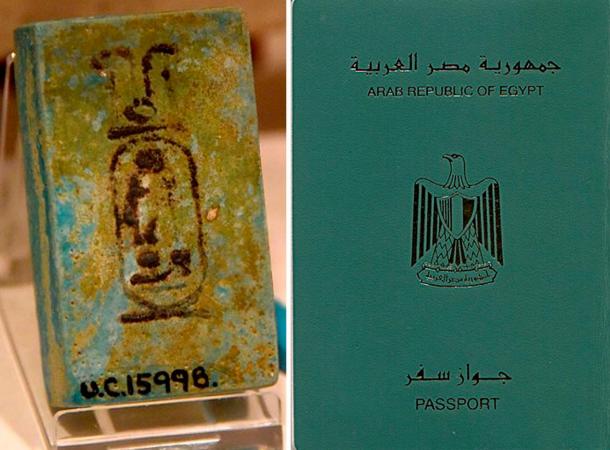
Left: Blue faience piece showing the cartouche of pharaoh Ramesses II. Inscribed in ink. 19th Dynasty. From Kurna (Qurna, Qurnah), Egypt. The Petrie Museum of Egyptian Archaeology, London. (Osama Shukir Muhammed Amin FRCP(Glasg)/ CC BY SA 4.0) Right: Egyptian Passport Cover. (Public Domain)
The Pharaoh’s Passport: A Popular Myth
For years, articles and social media posts have claimed that Ramesses II was issued an Egyptian passport, complete with a photo of his face and his occupation listed as ‘King (deceased).’ It is a charming story, but there is no evidence that such a document ever existed. Élisabeth David, a documentation specialist in the Louvre’s Department of Egyptian Antiquities, told AFP Fact Check in 2020 that the passport claim has no basis. She suggested that the confusion may come from a 1985 scientific report on the mummy, in which the Egyptologist Christiane Desroches-Noblecourt wrote of obtaining a “passport” (in quotation marks) to bring the mummy out of Egypt, a word meant to convey how complex the arrangements were. Egyptologist Toby Wilkinson, author of Ramesses the Great: Egypt’s King of Kings, agrees: he has said there is no evidence that a passport was issued and that the press almost certainly concocted the story. The passport image that is widely shared online is a modern illustration, not a real document.
What did happen was remarkable enough. The mummy of Ramesses II left Egypt in September 1976, and when it arrived in France, it was received at Le Bourget Airport near Paris with the full military honors befitting a king, including an honor guard of the French Republican Guard.
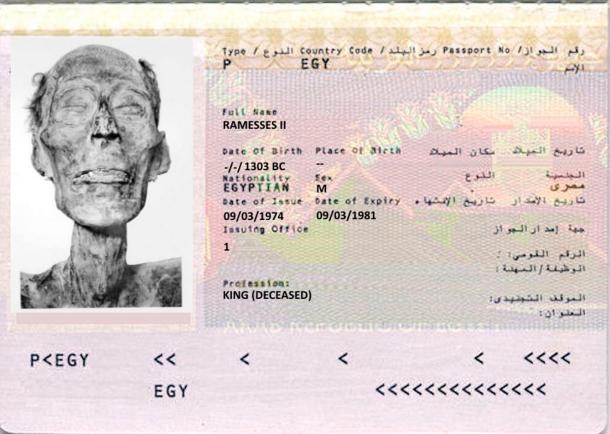
A modern mock-up of the imagined ‘mummy passport.’ No such passport was issued. Ramesses II (Public Domain) on an example of an Egyptian Passport Bio Page. (Public Domain)
The mummy was then taken to a laboratory at the Musée de l’Homme (Museum of Mankind) in Paris, where a team of French and Egyptian researchers examined it for several months. The researchers discovered that the deterioration of the mummy was caused by a fungal infection, and it was given the appropriate treatment to avoid total decay. As part of that treatment, the mummy was irradiated with gamma rays to eliminate the fungi and insects that were damaging it.
- The Life and Death of Ramesses II
- Living God in a Wooden Box: In Whose Coffin was Ramesses II Buried?
- The Women Who Created a Legendary Pharaoh: The Hidden Advisers of Ramesses II

A picture in color of Ramesses II's mummy in profile. (Wolfman12405/CC BY SA 4.0)
After the treatment, further examinations were carried out on the mummy. It was found that the pharaoh was about 1.7 meters (5 feet 7 inches) tall, had fair skin and red hair. In addition, some of the maladies the pharaoh suffered from were identified. For instance, it was reported that he was suffering from arthritis, as well as a tooth abscess. Moreover, it seems that Ramesses II also had ankylosing spondylitis, a long-term inflammation of the joints of the spine, which would have made him walk with a hunched back during his later years.
After the analyses of the mummy were completed, it was flown back to Egypt in May 1977 and returned to the Cairo Museum.
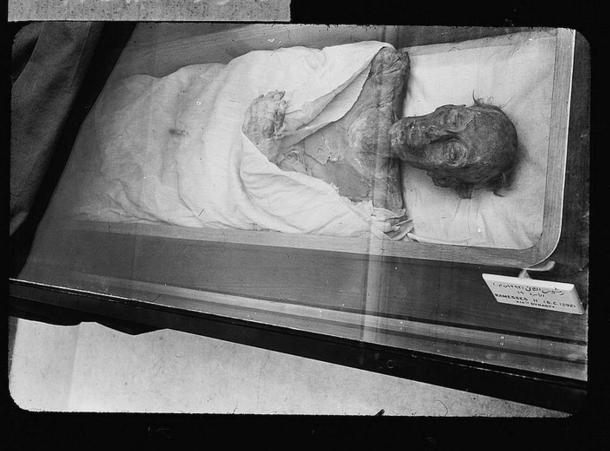
Mummy, Ramses II. (Public Domain)
Editor’s note (October 2026): This article has been updated. An earlier version repeated the popular story that Ramesses II’s mummy was issued a passport. Curators and Egyptologists say no such passport was issued. The mummy was, however, flown to Paris in 1976 and received with the honors due a head of state.
Top image: A modern mock-up of the imagined ‘mummy passport.’ No such passport was issued.
By Ḏḥwty
References
AFP Fact Check, 2020. This image was digitally created for representative purposes. Available at: https://factcheck.afp.com/image-was-digitally-created-representative-purposes
Pain, S., 2004. Ramesses rides again. New Scientist. Available at: https://www.newscientist.com/article/1875050-ramesses-rides-again/
Wikipedia, 2026. Ramesses II. Available at: https://en.wikipedia.org/wiki/Ramesses_II
Wikipedia (Portuguese), 2026. Ramsés II. Available at: https://pt.wikipedia.org/wiki/Rams%C3%A9s_II
Wilkinson, T., 2023. Did Ramesses II really have a passport? HistoryExtra. Available at: https://www.historyextra.com/period/ancient-egypt/ramesses-passport-myth/
Note: some of the older sources below repeat the passport story, which is now considered a myth.
Colton, 2018. Ramses II: The Mummy Who Had to Get a Passport. Available at: https://www.ripleys.com/weird-news/ramses-ii-the-mummy-who-had-a-passport/
Gardiner, K., 2018. Mummy mugshots and other strange passport facts. Available at: https://www.nationalgeographic.com/travel/features/weird-passports-history/
New World Encyclopedia, 2015. Ramesses II. Available at: http://www.newworldencyclopedia.org/entry/Ramesses_II
The New York Times, 1976. The Mummy of Ramses II is Flown To Paris for Treatment of Decay. Available at: https://www.nytimes.com/1976/09/27/archives/the-mummy-of-ramses-ii-is-flown-to-paris-for-treatment-of-decay.html
Wanweru, N., 2018. All about the powerful Ancient Egyptian king who got a passport 3000 years after his death. Available at: https://face2faceafrica.com/article/all-about-the-powerful-ancient-egyptian-king-who-got-a-passport-3000-years-after-his-death















Comments
Nothing more than an old-time
Permalink
Nothing more than an old-time traveling carnival. Pay two bits to see shrunken heads and freaks. As for the truth, it just gets in the way, and maybe upset somebody.
Burnt Hair cologne?
Permalink
In reply to Ramesses Two Times by Tesla's Apprentice (not verified)
Burnt Hair cologne?
Ramesses Two Times
Permalink
Hey Ramesses One One, you look like sh*t; what's your "secret"?