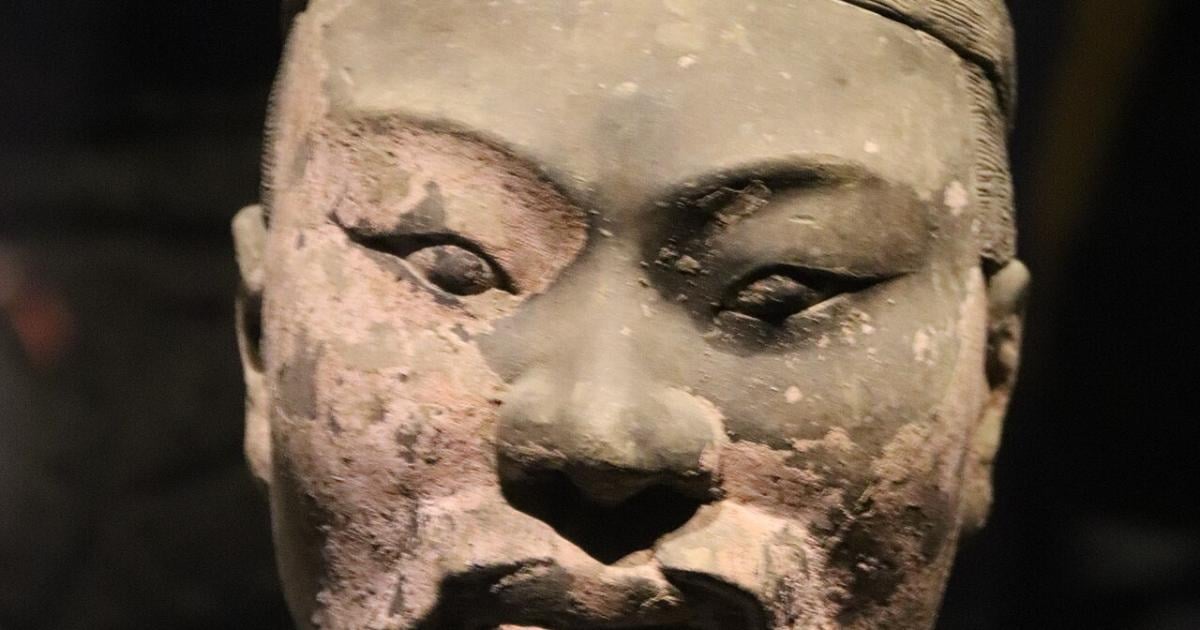

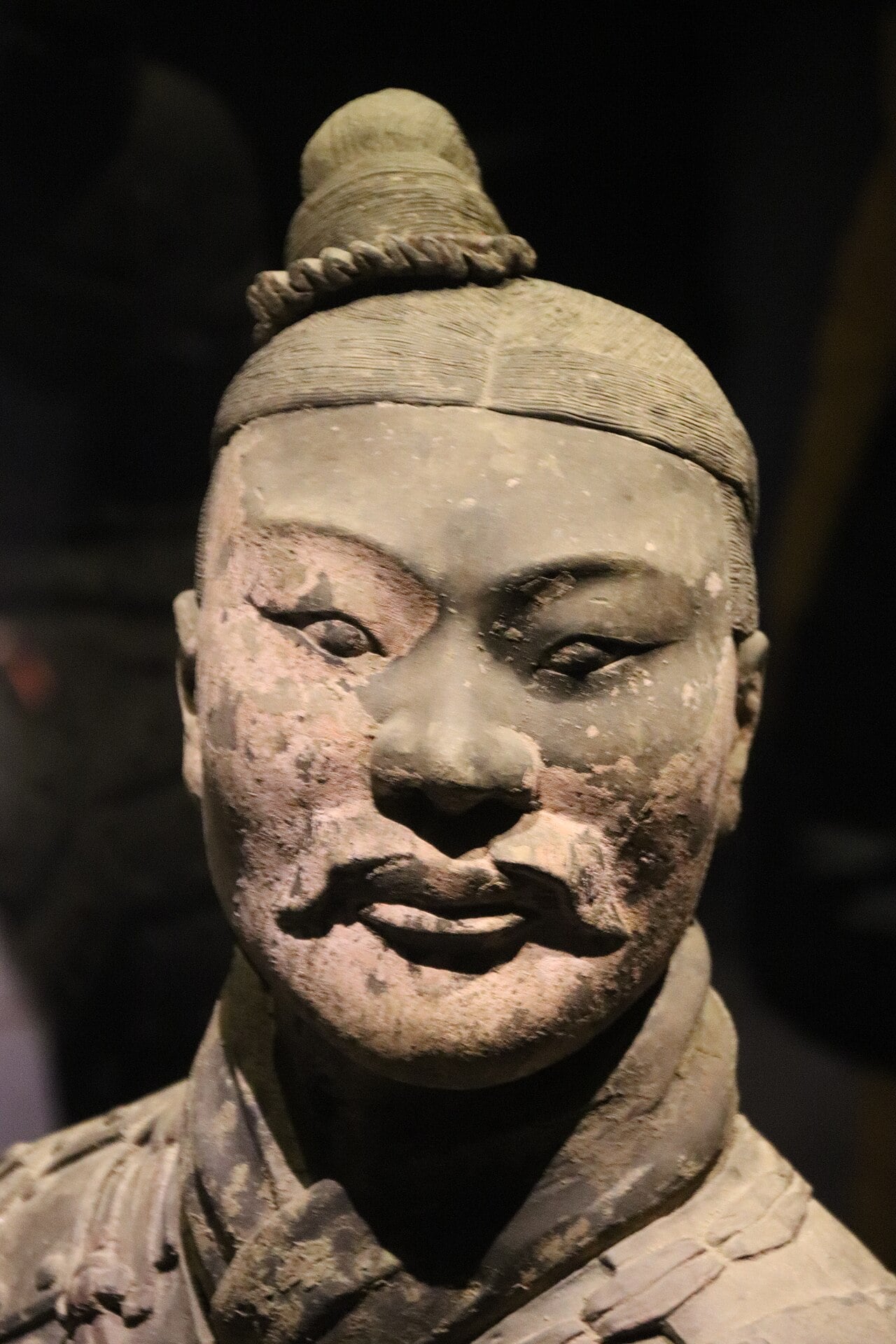
A Qin terracotta kneeling archer, photographed in March 2019 at a special exhibit of Qin and Han terracotta figures at the Terracotta Warriors site museum in Lintong. Only the collar and the edge of its clay scale armor show in this view. It is shown for context and is not the iron armor from Tomb M1. (Image: Gary Todd, Wikimedia Commons, CC0, resized from 4,000 by 6,000 to 1,280 by 1,920 pixels, otherwise unaltered)
Near Xi'an in Shaanxi Province, the burial complex of Qin Shihuang, the First Emperor of a unified China, is best known for its army of clay soldiers. Inside one of the large tombs west of the emperor's own mound, archaeologists have now found something rarer, the remains of what was probably a real suit of armor made from iron scales.
The find is described in a study published in Antiquity on November 26, 2026, by Michael Charlton of the Institute of Archaeology at University College London, Wenbin Shao of the Emperor Qin Shihuang's Mausoleum Site Museum and colleagues from both institutions. The authors write that "the M1 corselet is likely to be the earliest known Chinese example of a complete iron scale-armour corselet."
The complex itself is vast, and according to the authors it covers about 56 square kilometers (about 22 square miles) and includes more than 500 accessory pits or tombs, built between 248 and 208 BCE. The Terracotta Army was discovered in 1974, and UNESCO inscribed the mausoleum on the World Heritage List in 1987.
So who was buried in Tomb M1? How was the armor made? And what can it reveal about the way Qin soldiers were equipped?
A Rich Tomb West of the Emperor's Mound
Tomb M1 was excavated between 2013 and 2023. It is the third of nine large tombs that stretch west beyond the outer enclosure of the emperor's tomb, and its main chamber covers 1,900 square meters and lies 15.6 meters below ground.
The chamber held an outer coffin, an inner coffin, a large four-wheeled wooden carriage and a wide range of prestige objects. Three smaller pits beside the tomb contained horse and chariot burials. The authors sum it up plainly: "Overall, this is the wealthiest and best-preserved Qin tomb yet excavated."
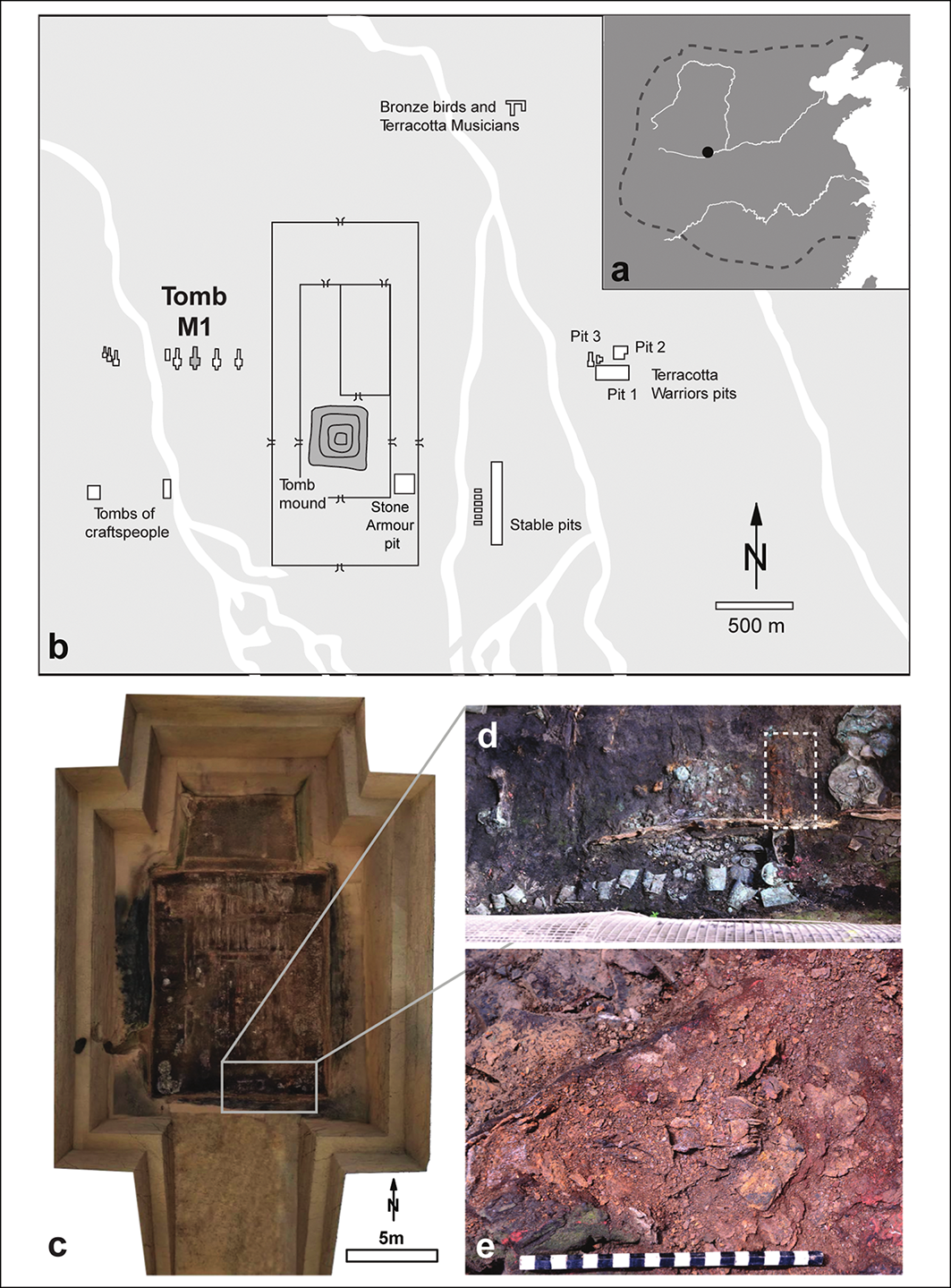
Location of the iron scale armor, showing the mausoleum within the approximate extent of the Qin empire around 221 BCE, the position of Tomb M1 in the complex, a top view of the tomb, the armor in the ground and a sediment block holding scales in place. (Image: figure by Wenxiao Jiang, Xiuzhen Li and Andrew Bevan, Figure 1 in Charlton et al. 2026, Antiquity, CC BY 4.0, shown at its published size of 1,063 by 1,439 pixels, otherwise unaltered)
Who was buried in Tomb M1 is still not known, although the authors note that the occupant held enough status to be placed inside the First Emperor's complex. They add that a costly item such as this armor fits suggestions that the tomb belonged to a high-ranking general or official or a member of the royal family, but that it "does not provide any further insights regarding which of these identifications is more likely."
A Heap of Fallen Scales
The scales lay on the southern side of the main chamber. The researchers think they fell from a shelf into a semi-organized heap on the floor when the chamber's ceiling collapsed, and the deposit measured only about 40 by 30 by 10 centimeters.
It held at least 200 larger scale fragments, along with tiny fragments and iron powder, and it was lifted in three blocks of sediment. The scales are heavily corroded, but the authors write that "several factors suggest that they derive from a single corselet."
They estimate that the corselet once held between 800 and 1,200 scales. That is far more than a helmet would need, since Chinese examples suggest 80 to 90 scales per helmet. The irregular or triangular scales typical of helmets are missing.
With an average of about 6 grams per scale, plus the lacing, the whole garment probably weighed around 10 kilograms (about 22 pounds). That is heavier than estimates of 4 to 5 kilograms for corselets of leather scales, and at the lighter end of the 10 to 25 kilograms recorded for other metal scale corselets.
Three Kinds of Scale
The team studied 81 loose scales in detail and used radiography to reveal the holes punched through them. The most common type is slightly convex and roughly rectangular, about 33 by 29 millimeters and 1.5 millimeters thick, weighing around 5 grams with 10 small holes along three sides.
A second, larger type weighs about 8 grams and has 11 holes. Several smaller, more elongated fragments suggest a third, fish-scale shape with five or more holes, so the corselet seems to have combined at least three scale designs.
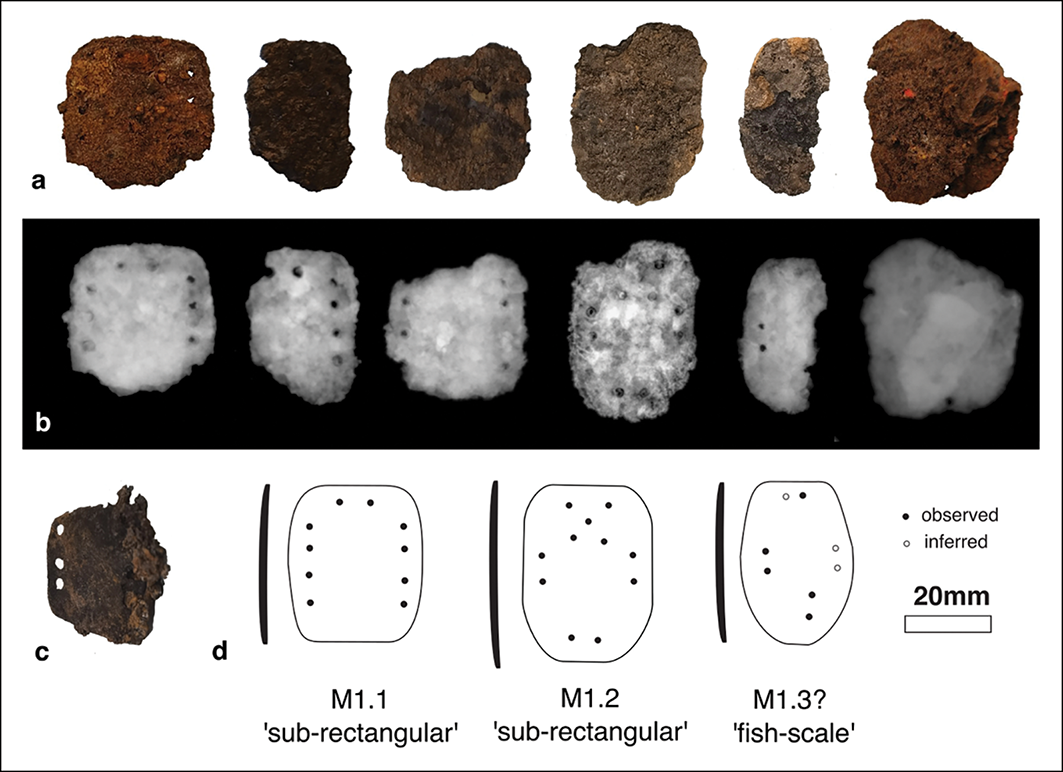
Iron armor scales from Tomb M1, some with holes and red pigment, shown above radiographs of the same scales, with a black surface layer flaking off one scale and drawings of the three reconstructed scale types. (Image: figure by Wenxiao Jiang, Weifeng Wang and Andrew Bevan, Figure 2 in Charlton et al. 2026, Antiquity, CC BY 4.0, shown at its published size of 1,063 by 772 pixels, otherwise unaltered)
Some scales still carry bright red color, and elemental mapping showed mercury and sulfur together, which the authors read as cinnabar, and a smooth black layer flaking from many pieces may be lacquer. Unlike a later iron corselet from a Han Dynasty tomb at Linzi, which was gilded in silver and gold, the M1 armor does not appear to have been gilded or inlaid.
Mild Steel From Cast Iron
Five scales were cut and examined under optical and scanning electron microscopes. The authors conclude that "The microstructure and internal composition of the scales indicate the use of a mild steel forged into thin sheets."
The carbon content was low, between 0.1 and 0.4 percent by weight, and the fine grains point to heavy forging. The authors think the metal most likely began as liquid cast iron that was then decarburized in a fining process. However, they leave open the possibility of iron smelted directly in the solid state, because the sample was small and some of the data were of limited quality.
The smiths did not work hard to keep the carbon even. As the authors put it, "The result was a scale with soft edges and cores of variable hardness."
Clay, Stone and Iron
The find gives new meaning to the armor already known from the mausoleum. Most of the clay scales on the terracotta warriors are brown and unpigmented, which suggests leather or rawhide, although smaller gray scales on some higher-ranking figures may have been meant to look like iron.
Accessory pit K9801, the second largest accessory pit in the mausoleum, tells a different story. In the roughly one percent of the pit excavated so far, excavators found 87 corselets and 43 helmets made of stone, with scales laced together by flattened copper wire. Ancient Origins has reported both on the stone armor found in the First Emperor's mausoleum and on what that stone armor reveals about the Qin. The new study notes that these stone scales resemble the M1 scales and concludes that "the stone scales emulate iron armour."
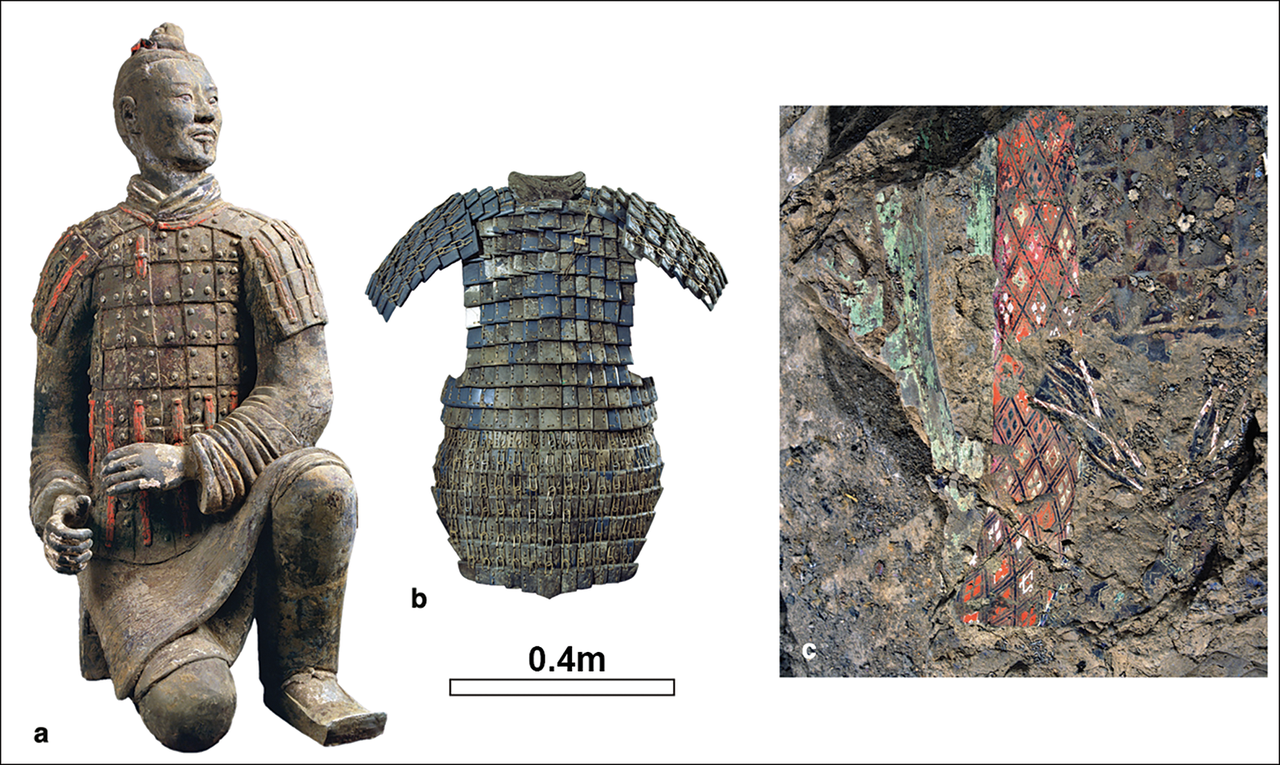
Imitations of scale armor in clay and stone from the mausoleum, showing a kneeling terracotta crossbowman from Pit 2, a corselet of gray limestone scales with copper laces from accessory pit K9801, and a painted border from a general's armor in Pit 2. The scale bar applies only to the stone corselet. (Image: figure by Michael Charlton and Weisha Du, Figure 6 in Charlton et al. 2026, Antiquity, CC BY 4.0, resized from 1,575 by 941 to 1,280 by 765 pixels, otherwise unaltered)
Written evidence from the Qin period hints at what such armor cost. Qin legal texts on bamboo slips from Shuihudi in Hubei Province set penalties that included making a set of armor, which the authors calculate as worth 168 to 224 days of labor for what was probably a simple leather corselet. An iron version, they suggest, "might easily require the dedicated attention of a small workshop for a year or more."
How Early Was Iron Armor?
Iron scale armor was already known in other parts of Eurasia by then. The authors note that between about 500 and 300 BCE it appears in wealthy burials and in art in Macedonian Greece, Thrace and Crimea. Scale armor also lasted for centuries afterward, and the authors describe it as a constant though more minor feature of Roman armor in western Europe, as seen in a restored Roman scale armor.
In China itself the record of early iron armor is thinner. "The earliest definitive iron scale armour is a helmet discovered in a tomb at Yanxiadu in north-eastern China," the authors write, made of 89 scales and dated broadly to between 475 and 220 BCE. Excavations of workshop areas at the same site have revealed another 222 helmet pieces and 270 other iron scales.
Iron swords were also found in Tomb M1. However, the rest of the mausoleum is dominated by bronze weapons, including the crossbow triggers that Xiuzhen Li, Andrew Bevan and colleagues showed in 2014 were made in batches and later used to equip groups of terracotta crossbowmen in Pit 1. A 2018 study by Bevan, Li and colleagues then found soot-based ink marks on two of those triggers, a further glimpse of the marking practices behind Qin weapon production.
That contrast leaves the authors with an open question about Qin warfare. Was the M1 armor an exceptional elite item, an early sign of new equipment, or a truer picture of how Qin soldiers were armed? The authors expect the debate over the materials chosen by the First Emperor and his armies to continue. For now, they write, "the iron armour from tomb M1 invites more detailed investigations of its origins and the organisation of the labour that produced it."
By Aris Manus
Sources
Bevan, A., Li, X., Zhao, Z., Huang, J. et al. 2018. Ink marks, bronze crossbows and their implications for the Qin Terracotta Army. Heritage Science 6, 75. Available at: https://doi.org/10.1186/s40494-018-0239-5
Charlton, M., Shao, W., Bevan, A., Li, G., Jiang, W., Du, W., Feng, K., Xia, Y., Yang, Y., Li, X. and Wang, W. 2026. Iron scale armour from the mausoleum of China's First Emperor and its wider context. Antiquity, First View, pp. 1 to 17. Published online November 26, 2026. Available at: https://doi.org/10.15184/aqy.2026.10478
Li, X. J., Bevan, A., Martinón-Torres, M., Rehren, T., Cao, W., Xia, Y. and Zhao, K. 2014. Crossbows and imperial craft organisation: the bronze triggers of China's Terracotta Army. Antiquity 88 (339), pp. 126 to 140. Available at: https://doi.org/10.1017/S0003598X00050262
UNESCO World Heritage Centre. Mausoleum of the First Qin Emperor. Available at: https://whc.unesco.org/en/list/441/

Enjoyed this? Get UNLEASHED for life, $249 once
Ancient Origins UNLEASHED is our Substack for the deeper, longer stories. Until Monday, November 30 at midnight UK time, you can join for life with one payment instead of a yearly subscription.
- The full paid UNLEASHED archive and every future paid post, for as long as the publication continues
- A Founders certificate
- A vote on upcoming topics
- Optional credit on our Founders page, only with your permission
- One welcome one-to-one discussion
Become an UNLEASHED Lifetime Founder, $249
Places are limited to 20 in total. Use the same email you use (or will use) on Substack. We switch on your paid access by hand after payment, so it is not instant. UNLEASHED only; Ancient Origins Premium is not included.
Want everything Ancient Origins makes? The Founders' Lifetime Pass is $349, paid once: Premium for life, all 29 ebooks, 177 webinar and interview recordings, 64 Magazine issues, AO Kids and the full Atlas.