
Fact Check verdict: Unverified. Medieval people drank water when it looked clean, towns piped it in, and ale was valued as food.
A short clip of the author Michael Pollan talking about caffeine recirculated on X in late October 2026, reviving a familiar idea about the past. Did people in the Middle Ages really drink ale all day because their water was unsafe to drink?
Pollan made the point in a 2021 interview on The Tim Ferriss Show. He said "It’s important to know just how drunk everybody was before caffeine came to Europe." He added that "alcohol was safer than the water then. When you ferment, you disinfect." The claim tested here is the general one about medieval drinkers, which is far older than any single interview.
According to the surviving sources, medieval people drank water when it looked clear and smelled clean, and towns spent money bringing it in. They also knew some water could make them ill. Ale was valued as food and drink in its own right. No saved medieval text gives disease in water as the reason people drank ale.
What the evidence says
The plainest witness is a schoolroom dialogue, Ælfric's Colloquy. In this text from tenth century Anglo-Saxon England, a teacher asks a pupil what he drinks. The Old English answer reads "ealu gif ic hæbbe oþþe wæter gif ic næbbe ealu". The food historian Jim Chevallier renders the answer as "Beer if I have it or water if I have no beer."
Chevallier, author of A History of the Food of Paris, reads that line as "a clear expression of both being comfortable with water and preferring beer." He notes that monks were punished with a diet of bread and water, which he argues "would have been frankly sadistic if in fact people of the time had believed water was likely to cause disease."
He also quotes the historian Paolo Squatriti, who studied water in early medieval Italy. Squatriti writes that "Once they had ascertained that it was pure (clear, without odor, and cold) people in postclassical Italy did, in the end, drink water."
For London the records are more detailed, because John Stow's Survey of London, first published in 1598, relays the 12th century writer William Fitzstephen on wells north of the city that were "sweet, wholesome, and clear" and "frequented by scholars and youths of the city in summer evenings." Stow then records that in the 21st year of Henry III, water from Tyburn was granted to the citizens "for the poor to drink, and the rich to dress their meat".
That water ran "by pipes of lead into their city," and Stow says the first lead cistern, the Great Conduit in West Cheap, "was begun to be built in the year 1285". His list of later conduits and of citizens who left money toward them runs through the 1400s and beyond.
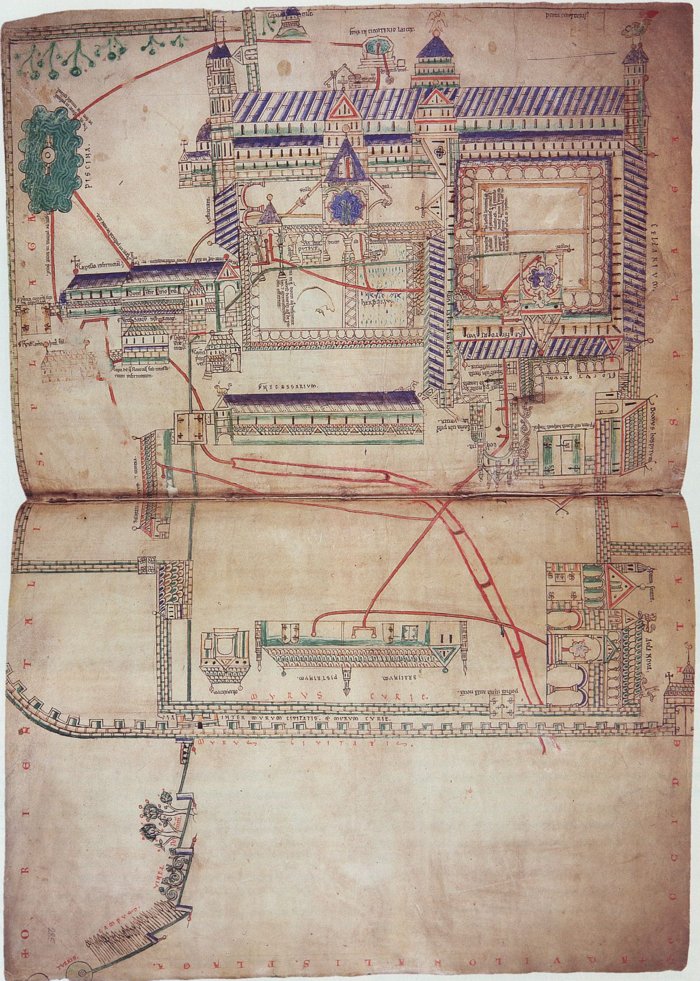
Plan of the waterworks of Christ Church Cathedral and priory, Canterbury, drawn about 1150 in the Eadwine Psalter. Public domain, via Wikimedia Commons.
Other towns built similar systems, and the medieval historian Katherine Harvey of Birkbeck, University of London, writes that in 13th century Ypres "a network of reservoirs, pipes and cisterns brought in water from outside the city," and that Montpellier built fountains with pipes and gutters. She concludes that "in spite of the risks, medieval people did drink water."
Some people drank water by choice, and Harvey notes that the bishops Wulfstan of Worcester and Hugh of Lincoln were admired "for choosing to drink pure water instead of the fine wines served at their table," and that the poet Petrarch recalled drinking water through his childhood and youth.
The alternative view
Of course, the claim does rest on something real, as Harvey also writes that "medieval people knew that drinking water could be dangerous," although "they knew nothing of the dangers posed by bacteria." People tested doubtful water, and a late 15th century Flemish guide advised boiling rainwater "because it undoes the putrefaction". The English physician John de Gaddesden even advised travelers to avoid unfamiliar water altogether.
What's more, medical writers ranked drinks against each other, and Harvey reports that the Italian court physician Michele Savonarola, writing in the 1450s, called water the "vilest of all beverages" in the sense of a low status drink. She adds that most people thought alcoholic drinks "not only quenched thirst but were also highly nutritious". In her account, beer and ale were part of the common diet.
The historian Richard W. Unger's book points further for towns in his history of the business and governance of brewing. The publisher's description of his book Beer in the Middle Ages and the Renaissance calls beer "the beverage of choice of urban populations that lacked access to secure sources of potable water" and "a safe drink for daily consumption that was less expensive than wine."
That description joins water supply and beer in towns, which suggests that historians do not all frame the question the same way. It does not say people refused water, and the same text calls beer "a nutritional necessity." Unger's full argument was not read for this check.
Where this leaves it
The evidence supports a narrower picture than the viral version, as medieval people drank water from wells, springs and conduits, avoided water that looked or smelled bad, and sometimes boiled it. They also drank a great deal of ale and beer, which they valued as nourishment. Unger's publisher adds that beer cost less than wine.
Pollan's further point that fermentation disinfects a drink is a modern scientific claim, and none of the saved medieval sources makes it. Perhaps the plainest point is Harvey's, that medieval people knew nothing of bacteria, which means they could not have chosen ale for that reason in those terms.
Chevallier adds a caution about the record itself. Because "water was not typically sold, transported, taxed, etc., there simply would have been no reason to record its use." Unger's publisher calls beer "a major source of tax revenue for the state." Water was not taxed in the same way, so how much water ordinary people drank day to day is not yet clear.
With these factors taken into account, the saved texts show people who drank both, and none of them shows people drinking ale because they believed clean looking water would make them sick. Until a medieval source says otherwise, the headline claim remains less a record of medieval habits than a modern explanation for them.
How we checked this
Ancient Origins read Ælfric's Colloquy in the Old English text on Wikisource and Stow's Survey of London in the Everyman edition of the 1603 text, introduced by Henry B. Wheatley, on Project Gutenberg. Fitzstephen and the Tyburn grant are cited through Stow. Squatriti and the English rendering of Ælfric are cited through Chevallier's essay.
Ancient Origins also read Katherine Harvey's 2025 essay for Wellcome Collection and the 2021 transcript of Pollan's interview with Tim Ferriss. Unger's 2004 book is known only from its publisher's description.
How we label claims: see How we check evidence. More Fact Checks: Göbekli Tepe, the Sphinx and Atlantis, the evidence hub.
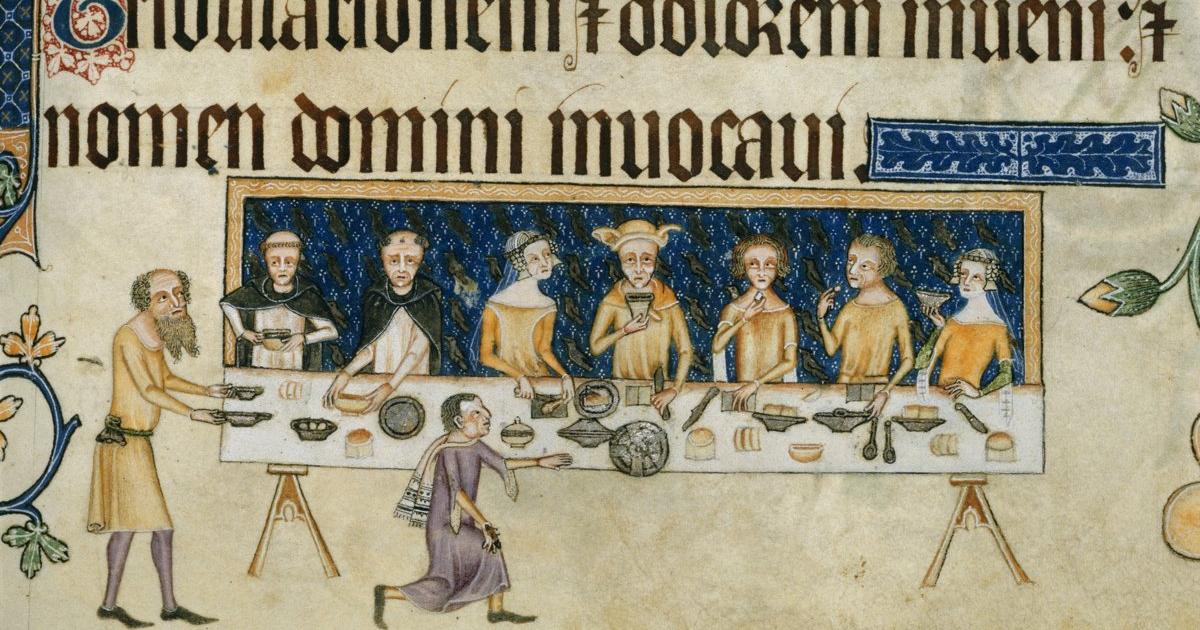
Sir Geoffrey Luttrell at table, with a kneeling cupbearer who has handed him his cup, in the Luttrell Psalter of about 1325 to 1335. British Library Add MS 42130, folio 208. CC0, via Wikimedia Commons.
By Aris Manus
Claim by claim
- Unverified: Medieval people drank ale because water was unsafe. Reason: people drank water when it looked clean, and no saved medieval source gives unsafe water as the reason for drinking ale.
- Established: Medieval people drank water. Reason: Ælfric's Colloquy, Fitzstephen's London wells and saints such as Wulfstan and Hugh of Lincoln all record it.
- Established: Medieval towns piped in water for drinking. Reason: London's Tyburn grant was made for the poor to drink, and Ypres and Montpellier built water systems.
- Established: Medieval people knew some water could make them ill. Reason: they tested doubtful water, boiled some of it and warned travelers about unfamiliar sources.
- Disputed: Beer was the main drink where safe water was scarce. Reason: Unger's publisher links urban beer drinking to a lack of secure potable water, while Chevallier and Harvey stress that water was drunk.
- Unverified: Medieval people chose ale because fermentation disinfects. Reason: this is a modern scientific explanation, and Harvey writes that medieval people knew nothing of bacteria.
Sources
- Ælfric. Colloquy. Old English text. Wikisource. https://en.wikisource.org/wiki/%C3%86lfric%27s_Colloquy
- Stow, John. A Survey of London (1603 text). Introduction by Henry B. Wheatley, edited by Ernest Rhys. Everyman edition. Project Gutenberg eBook 42959.
- Chevallier, Jim. The great Medieval water myth. Les Leftovers. https://leslefts.blogspot.com/2013/11/the-great-medieval-water-myth.html
- Harvey, Katherine (2025). The vilest of all beverages. Wellcome Collection, December 18, 2025. https://wellcomecollection.org/stories/the-vilest-of-all-beverages
- Unger, Richard W. (2004). Beer in the Middle Ages and the Renaissance. Philadelphia: University of Pennsylvania Press. Publisher's description only.
- Ferriss, Tim (2021). The Tim Ferriss Show Transcripts: Michael Pollan, This Is Your Mind on Plants (#520). June 30, 2021. https://tim.blog/2021/06/30/michael-pollan-this-is-your-mind-on-plants-…