
Fact Check verdict:
A curse from Tutankhamun's tomb killed members of the team that opened it: Fringe
Lord Carnarvon died in Cairo on April 5, 1923, of pneumonia after an infected insect bite: Established
People present at the key openings showed no significant difference in age at death or survival from other Westerners in Egypt at the time: Established
Howard Carter, who led the excavation, lived until 1939: Established
Mold spores inhaled in the tomb caused Carnarvon's death: Unverified
A tablet at the entrance warned that death would strike anyone who entered: Unverified
The verdict
Lord Carnarvon, who paid for the dig that found Tutankhamun's tomb in November 1922, died in Cairo on April 5, 1923. The press soon blamed a pharaoh's curse and kept adding deaths to the list for years afterward. Did a curse really kill the men who opened the tomb? Verdict: Fringe.
According to Jo Marchant, writing in Aeon, the novelist Marie Corelli had warned shortly before Carnarvon died that "the most dire punishment follows any rash intruder into a sealed tomb," and the papers ran with it. The deaths were real, yet the people who entered the tomb did not die unusually young, and Carnarvon's illness has an ordinary medical record behind it.
- Fringe: A curse from Tutankhamun's tomb killed members of the team that opened it. Reason: a supernatural cause cannot be tested, and a 2002 cohort study found no significant excess of early deaths among those exposed.
- Established: Lord Carnarvon died in Cairo on April 5, 1923, of pneumonia after an infected insect bite. Reason: his 1923 obituary in Nature and later medical reviews give the same cause.
- Established: People present at the key openings showed no significant difference in age at death or survival from other Westerners in Egypt at the time. Reason: Mark Nelson's 2002 cohort study in the BMJ found none, though it was small.
- Established: Howard Carter, who led the excavation, lived until 1939. Reason: he died in London on March 2, 1939, more than 16 years after the discovery.
- Unverified: Mold spores inhaled in the tomb caused Carnarvon's death. Reason: a 2003 letter in The Lancet called this a possibility, but no sample or diagnosis from 1923 supports it.
- Unverified: A tablet at the entrance warned that death would strike anyone who entered. Reason: the tablet appears only in press rumors of the time, as Marchant describes them, and no source here documents it.
What the evidence says
Carnarvon's death in Cairo is one of the best documented parts of the whole story. His obituary in Nature on April 14, 1923, said he died "from the effects of pneumonia, supervening on erysipelas and blood-poisoning, the result of a bite on the cheek by an insect, presumably a mosquito," aged 57.
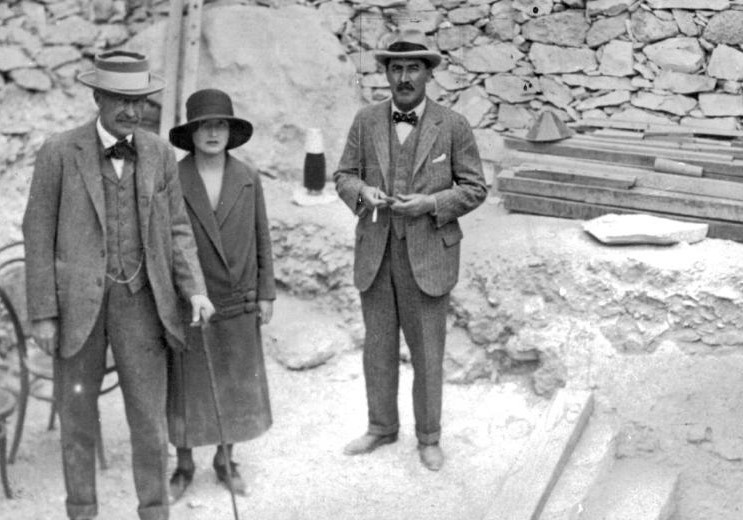
Howard Carter, Lord Carnarvon and his daughter Lady Evelyn Herbert at the steps leading down to the newly discovered tomb in November 1922. Photo: Harry Burton, Griffith Institute, University of Oxford, via Wikimedia Commons. Public domain
He was already frail when he reached Egypt. As Ann Cox noted in The Lancet in 2003, a car crash in 1903 had left him a semi-invalid who "was prone to frequent and severe lung infections". A later letter in the same journal puts the crash in 1901 instead. In that state, Cox wrote, his immune system was easily overwhelmed by erysipelas, a streptococcal infection of the skin.
The timeline does not suggest a sudden strike from the tomb, since Carter's diary, as Cox reports, has Carnarvon first entering it on November 26, 1922. She adds that "there is no mention in Carter's diary of Carnarvon being ill until March of 1923, 4 months after his initial entry".
The wider death toll is where the curse story was built, and in 1934 Herbert Winlock of the Metropolitan Museum of Art pushed back against the rumors in The New York Times. Mark Nelson, summarizing Winlock in a later BMJ paper, wrote that "only six of the original 24 people present when the tomb was opened had died." That 24 is Winlock's own tally, a different group from the 25 Nelson later classed as exposed. Marchant counts 40 people on Winlock's chart.
Nelson, of the department of epidemiology at Monash University in Australia, ran a formal check in the BMJ in 2002. He took 44 Westerners whom Carter recorded as being in Egypt at the time and treated the 25 present at four key openings, between February 17, 1923, and November 11, 1926, as exposed to the curse.
The exposed group died at a mean age of 70, against 75 for those who stayed away, and survived an average of 20.8 years after exposure, against 28.9 years. Nelson concluded that "There was no significant association between exposure to the mummy's curse and survival and thus no evidence to support the existence of a mummy's curse."
Nelson listed the study's limits, noting that dates of death were found for all 25 of those exposed but only 11 of the 19 others. The paper warns that "the study may have been underpowered to show a more subtle adverse effect," so a slight risk cannot be ruled out, though a deadly curse would be far harder to miss.
The man most exposed of all, Howard Carter, spent a decade clearing the tomb and died in London on March 2, 1939, according to Britannica. Marchant also notes that two colleagues later named as victims, Alfred Lucas and Douglas Derry, "survived for two and four decades respectively after Tutankhamun's mummy was unwrapped."
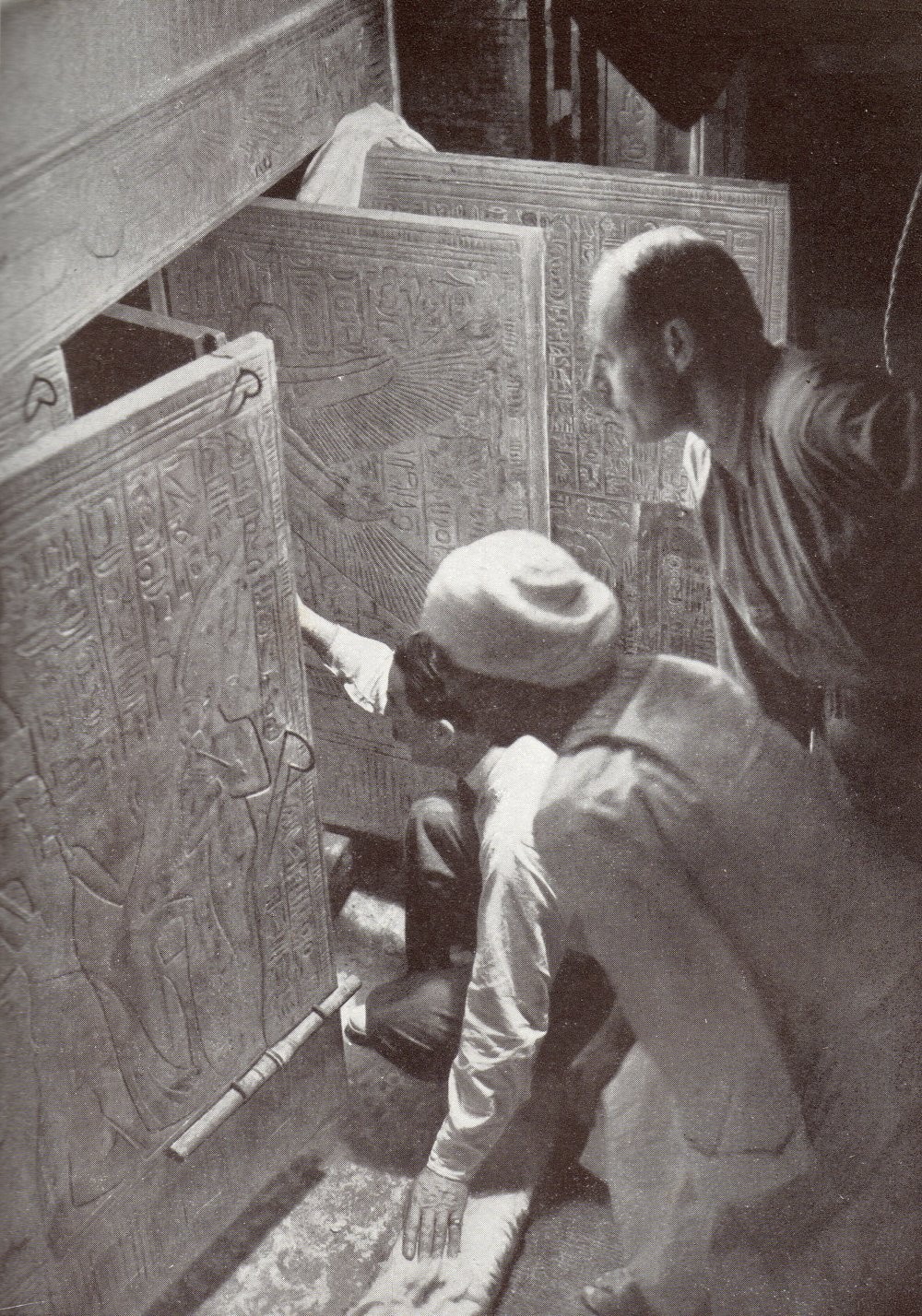
Howard Carter, an Egyptian workman and Arthur Callender at the doors of the gilded shrines in Tutankhamun's burial chamber in January 1924. Photo: Harry Burton, via Wikimedia Commons. Public domain
The alternative view
A supernatural cause cannot be tested against data, which is why the headline claim is rated Fringe, yet its defenders had an answer from the start. When critics asked why spirits had spared Carter, Arthur Conan Doyle replied, as Marchant quotes him, "One might as well say that because bulldogs do not bite everybody, therefore bulldogs do not exist!"
A more modern version swaps spirits for spores, set out by Sherif El-Tawil of Guy's, King's and St Thomas' School of Medicine in London in a 2003 letter to The Lancet. He argued that spores of the fungus aspergillus, which grows well on grain stored in the tomb, could have lain dormant in Carnarvon's lungs for months.
He cited The Times of London, which by his account reported on March 17, 1923, that Carnarvon suffered "pain as the inflammation affected the nasal passages and eyes". He read this as a sign of fungal sinus infection. He closed the letter with the words "That Lord Carnarvon died of invasive aspergillosis therefore remains a possibility."
Cox, writing a few months earlier, had found the mold idea weak because "of the 25 Westerners who first entered the tomb, Lord Carnarvon was the only one to become ill or die soon after its opening". Her letter ends on the line "That Carnarvon's death had anything to do with Tutankhamen's tomb is, therefore, unlikely."
Of course, even if the mold theory were right, it would describe a natural infection rather than a curse, and no sample from the tomb or from Carnarvon's body in 1923 links the two. El-Tawil argued that Carnarvon's weak chest could explain why others were spared, but with nothing physical to test, the idea is indicative rather than conclusive at best and stays Unverified.
The tomb inscription is the weakest part of the legend, resting on reports Marchant describes of "a clay tablet, allegedly found over the tomb's entrance", which Carter was said to have buried. She adds that "Only a few written warnings have been found in tombs", mostly from the Old Kingdom, more than a millennium before Tutankhamun.
Where this leaves it
Carnarvon did die within months of entering the tomb, and Marchant records how freely later deaths were pinned on the boy king. The evidence points to an infected bite in a man with weak lungs, and to a group of tomb visitors who mostly lived long lives, Carter among them.
Marchant traces the idea to fiction, writing that the modern legend "is a product of 19th-century England", decades before Carter opened the tomb. Until a test shows those exposed dying early, the curse of Tutankhamun remains less a medical mystery than a newspaper story from 1923.
How we checked this
Read in full for this check: Nelson's 2002 BMJ study, the letters by Cox and El-Tawil in The Lancet in 2003, Marchant's 2013 essay in Aeon, the 1923 Nature obituary of Carnarvon and the Britannica entry on Carter. Carter's diaries and The Times of 1923 are cited as quoted in the Lancet letters, Winlock's 1934 count as summarized by Nelson, and the words of Marie Corelli and Arthur Conan Doyle as quoted by Marchant.
No interviews were conducted, and earlier Ancient Origins coverage was not used as a source. No living relatives of anyone in the story are named. Every quote was checked against a saved copy on October 25, 2026.
How we label claims: see How we check evidence.
More in this series: Göbekli Tepe, the Sphinx and Atlantis: what the evidence says.
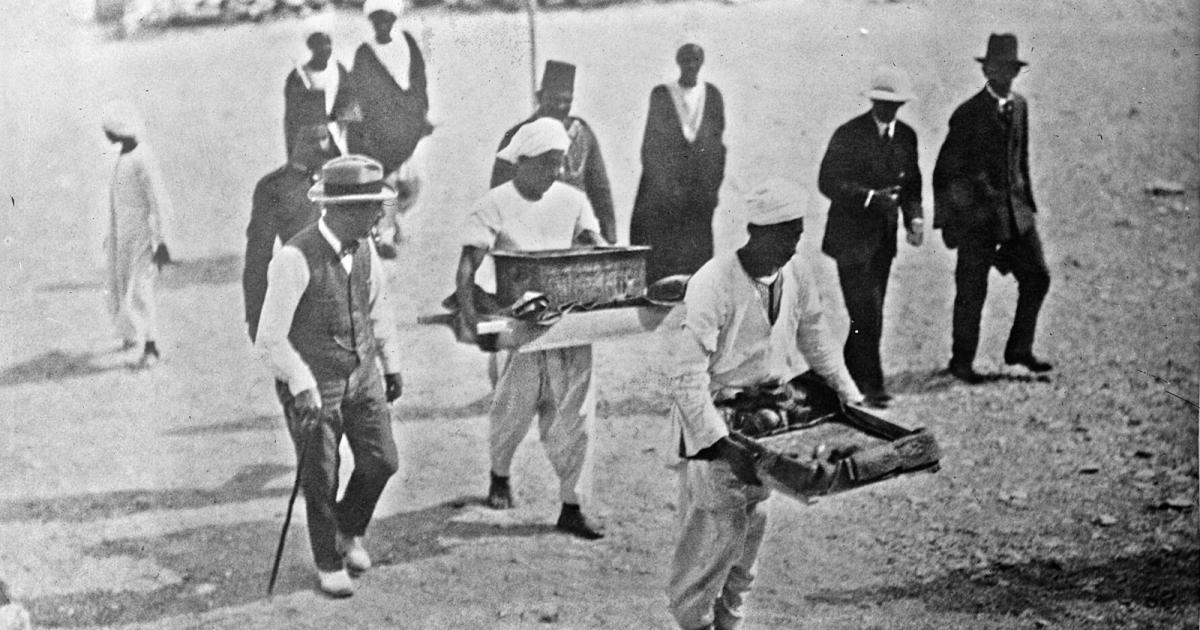
Howard Carter supervises Egyptian workers carrying finds from Tutankhamun's tomb in the Valley of the Kings, in a press photo from January 1923. Agence Rol, Bibliotheque nationale de France, via Wikimedia Commons. Public domain
By Aris Manus
Sources
- Nelson, Mark R. (2002). The mummy's curse: historical cohort study. BMJ 325: 1482 to 1484. Read in full (PubMed Central copy).
- Cox, Ann M. (2003). The death of Lord Carnarvon. The Lancet 361: 1994. Read in full.
- El-Tawil, Sherif (2003). Lord Carnarvon's death: the curse of aspergillosis? The Lancet 362: 836. Read in full.
- Marchant, Jo (2013). Why does the mummy's curse refuse to die? Aeon. Read in full.
- Lord Carnarvon (obituary). Nature 111: 504 to 505, April 14, 1923. Read in full.
- Howard Carter. Encyclopaedia Britannica. Read for dates of birth and death.