
Fact Check verdict:
Halloween is descended from the Celtic festival of Samhain: Disputed
Samhain was a major festival at the start of November in medieval Ireland: Established
Halloween takes its name and date from the eve of All Saints' Day, a Christian feast held on November 1 in the West by the ninth century: Established
Samhain was the Celtic New Year: Unverified
Samhain was a pagan festival of the dead: Unverified
The Church placed All Saints and All Souls on November 1 and 2 to replace a pagan festival: Unverified
The verdict
Every October the same origin story returns: Halloween began as Samhain, the Celtic New Year, a pagan night when the dead returned to walk among the living. Samhain was real, and it mattered in medieval Ireland. Is Halloween its direct descendant? Verdict: Disputed.
According to the historian Ronald Hutton, the idea of a pagan Celtic New Year and festival of the dead "was entirely the work of two very worthy and influential scholars writing over a hundred years ago".
- Disputed: Halloween is descended from the Celtic festival of Samhain. Reason: its name and date come from the Christian feast of All Saints, while Hutton argues that some customs of the start of winter, especially in Ireland, probably continue the older festival.
- Established: Samhain was a major festival at the start of November in medieval Ireland. Reason: tales written down by Christian authors present it as a time of assemblies, feasts and supernatural danger.
- Established: Halloween takes its name and date from the eve of All Saints' Day, a Christian feast held on November 1 in the West by the ninth century. Reason: a letter of 799 by Alcuin of York and the later imperial adoption of the date are documented.
- Unverified: Samhain was the Celtic New Year. Reason: Hutton finds the evidence indirect and inconclusive, resting on a medieval glossary entry and later folklore first assembled by John Rhys.
- Unverified: Samhain was a pagan festival of the dead. Reason: Irish, Welsh and Icelandic medieval literature shows no clear link between the start of winter and the human dead.
- Unverified: The Church placed All Saints and All Souls on November 1 and 2 to replace a pagan festival. Reason: no medieval record shows churchmen doing so, and the records point to Rome, Frankish lands and Cluny.
What the evidence says
Samhain, meaning summer's end, is well attested in medieval Irish literature. Hutton, a Bristol University historian, wrote in the journal Folklore that it was "a time for major assemblies and feasts" as farming, herding and fighting closed down for winter. Supernatural beings were thought especially active.
Those tales were written by Christian authors who, in Hutton's words, "set out to remember or recreate the pre-Christian society of their land". In a 2014 Guardian essay he added that northern European pagans left no record of their ceremonies, so the rites themselves are unknown.
The 1907 Catholic Encyclopedia entry on All Saints' Day, by the priest Francis Mershman, says, "The vigil of this feast is popularly called "Hallowe'en" or "Halloween"." The word shortens All Hallows' Eve, the night before the feast of all the saints, or hallows, on November 1.
Mershman traces the feast to early Christian commemorations of martyrs. He records that Pope Boniface IV consecrated the Pantheon in Rome to the Virgin Mary and all the martyrs on May 13, 609 or 610, that Pope Gregory III (731 to 741) consecrated a chapel in St. Peter's to all the saints and fixed its anniversary for November 1, and that Gregory IV (827 to 844) extended the November 1 celebration to the entire Church.
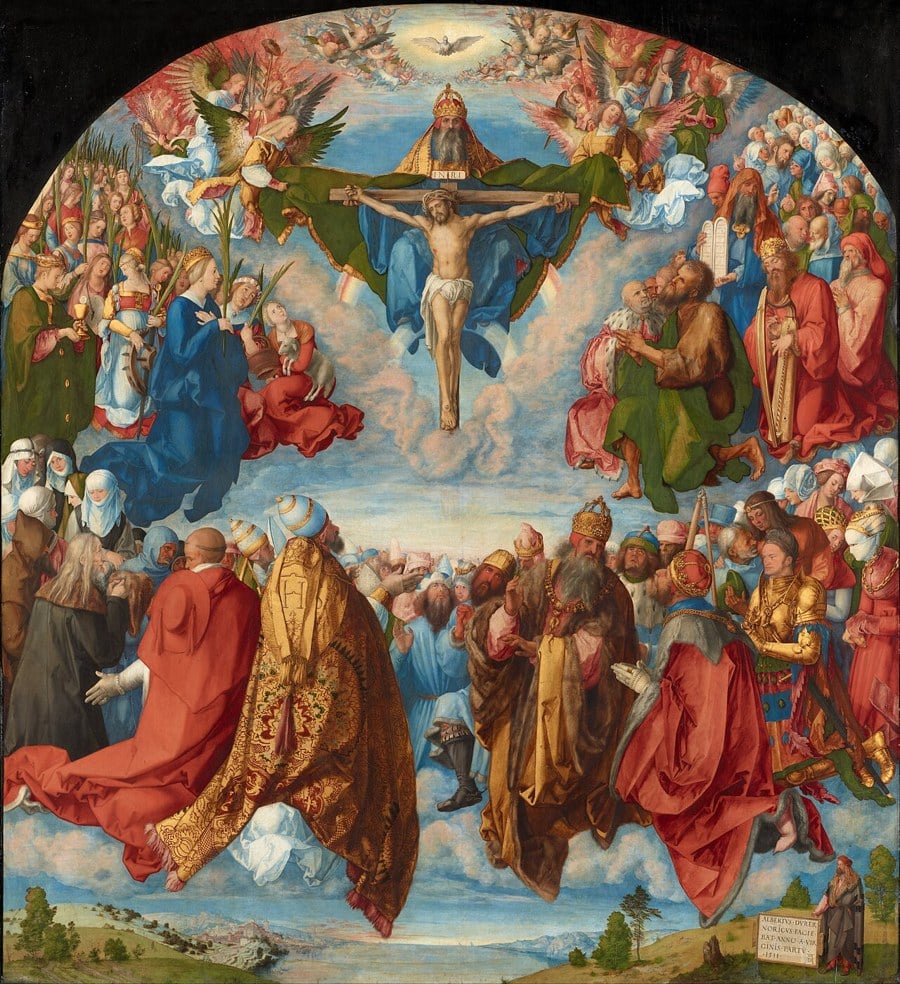
Albrecht Dürer's Adoration of the Trinity, known as the All Saints picture, painted in 1511 and now in the Kunsthistorisches Museum, Vienna. Saints and believers, including the donor Matthäus Landauer, gather around the Trinity. Albrecht Dürer, Adoration of the Trinity (Landauer Altar), 1511, Kunsthistorisches Museum Vienna, via Google Art Project and Wikimedia Commons. Public domain
Hutton reads the Gregory III evidence differently. The papal biography behind it, he writes, describes a chapel to Christ and the Virgin Mary holding relics of apostles, martyrs and confessors, and "does not mention an anniversary". He dates the first secure November observance to a letter of 799 from Alcuin of York, and cites a ninth century record that Gregory IV asked the emperor Louis the Pious to adopt the date across his empire, in 835 according to a chronicler writing around 1100.
All Souls' Day on November 2 has its own Christian logic. Hutton notes that "whereas pagans prayed to the dead, Christians, embracing a religion of salvation and damnation, prayed for them." By the third century, he writes, Christians believed such prayers could help the departed, and Augustine of Hippo held the same.
The single feast for all the faithful departed came from the Benedictine abbey of Cluny in France. Abbot Odilo ordered it held each year, probably between 1024 and 1033 by Hutton's dating, on a date likely chosen to sit beside All Saints. Mershman notes an earlier German ceremony of praying to the dead on October 1, which the Church "accepted and sanctified".
Hutton finds that the early local initiatives behind both feasts were mostly Germanic or Frankish, and that Irish church calendars of 800 to 825 record a feast of all saints at Rome in April but none in Ireland. In his words, "there is nothing Celtic in the geography".
The alternative view
As Hutton tells it, the philologist John Rhys gave wide publicity in lectures of 1888 to the idea that November 1 had been the Celtic New Year, citing a medieval Irish glossary and Halloween divination. In 1907 the classicist James Frazer argued, as Hutton quotes him, that All Souls "is nothing but an old pagan feast of the dead which the Christian, unable or unwilling to suppress, resolved from reasons of policy to connive at."
Frazer added, in Hutton's summary, that All Saints had probably been an earlier attempt by the Church to suppress Celtic rites for the dead. In the 1990s, Celtic specialists such as the archaeologist Barry Cunliffe repeated the link without evidence, and the 2003 New Catholic Encyclopedia, as Hutton notes, derived All Saints from "a Druid festival of the dead". Hutton notes that Frazer also hoped to discredit Christianity.
On Frazer's theory of the Church's motives, Hutton is direct: "There was never any objective evidence for it." He finds no medieval record of churchmen founding either feast to suppress or replace a pagan one. The fire ritual at Tlachtga, which Rhys and Frazer took as a New Year rite, appears first, he notes, in a seventeenth century history by Geoffrey Keating.
Hutton concludes that "the evidence for the New Year is all indirect, speculative, and inconclusive". On the second idea he is harsher, writing, "Evidence for the feast of the dead is pretty near non-existent." Customs linked to the dead at this season, he suggests, may more plausibly come from All Souls, which in many regions is still held then.
Hutton does not, however, cut Halloween off from Samhain. In his Guardian essay he called it "the modern name in English for the great north European festival" that marked the start of winter, known in Irish as Samhain. He argued that it survived in Ireland as both a Catholic feast and a seasonal festival.
The medieval sources support part of that continuity. A twelfth or thirteenth century Irish tale has Queen Medb consulting her magicians and poets at Samhain about the coming year, which Hutton takes as evidence that Samhain divination is medieval. Nineteenth century Welsh folklore treated the night as one when spirits roamed, and he calls it tempting, and probably correct, to trace that to the festival's ancient and medieval significance. The folklore evidence is indicative rather than conclusive, and he warns it is unwise to project modern customs confidently back onto the remote past.
Where this leaves it
Samhain was the great festival of the start of winter in medieval Ireland, and some of its atmosphere of divination and supernatural danger carried into Irish Halloween. The name, the date and the focus on the dead come through All Saints and All Souls.
Hutton allows that "Neither idea has been conclusively disproved, and probably never will be". Even so, Halloween remains less the heir of a pagan festival of the dead than the eve of a Christian feast that absorbed some older seasonal customs in Ireland.
How we checked this
Read in full for this check: Hutton's article "The Celtic New Year and Feast of the Dead" in Folklore, his 2014 Guardian essay, and the 1907 Catholic Encyclopedia entries on All Saints' Day and All Souls' Day by Francis Mershman. Rhys, Frazer, Cunliffe, the 2003 New Catholic Encyclopedia, the medieval Irish tales, Alcuin, the papal biography, the chroniclers, Keating and the Irish calendars are cited as Hutton quotes or summarizes them, not from the originals.
No interviews were conducted, earlier Ancient Origins coverage was not used as a source, and every quote was checked against a saved copy on October 25, 2026.
How we label claims: see How we check evidence.
More in this series: Göbekli Tepe, the Sphinx and Atlantis: what the evidence says.
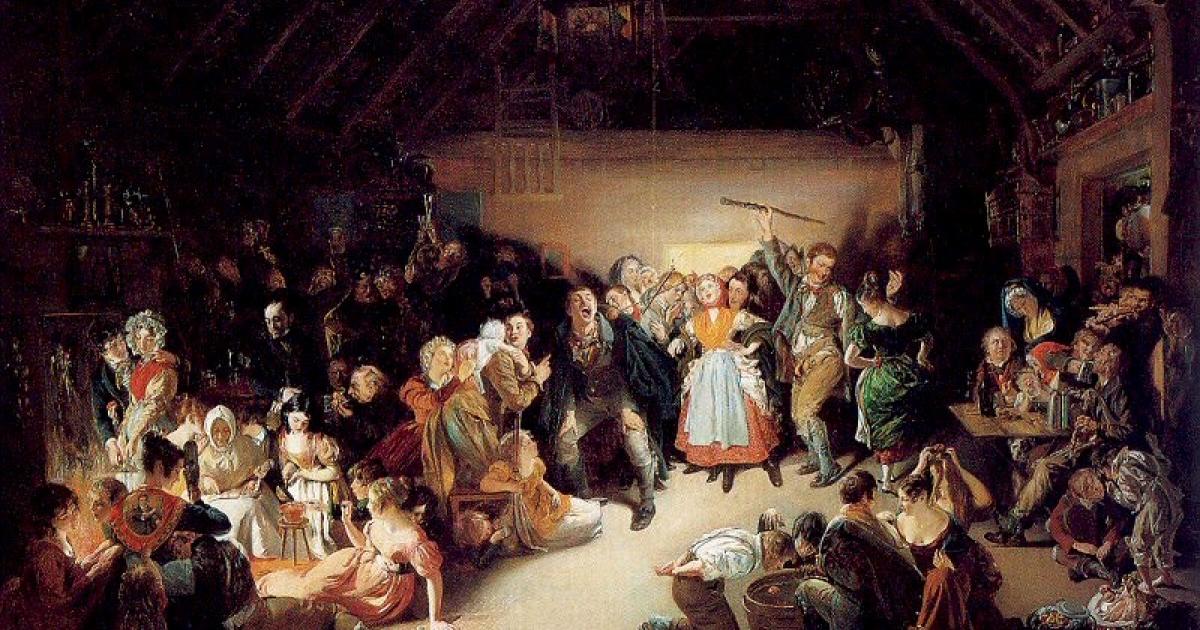
Snap-Apple Night, painted by Daniel Maclise in 1833 after a Halloween party he attended in Blarney, Ireland, in 1832. Its exhibition verse describes guests testing their fortunes, a Halloween custom Hutton traces in Ireland. Daniel Maclise, Snap-Apple Night (1833), via Wikimedia Commons. Public domain
By Aris Manus
Sources
- Hutton, Ronald (2024). The Celtic New Year and Feast of the Dead. Folklore 135(1): 69 to 86. Published online March 14, 2024. Read in full.
- Hutton, Ronald (2014). Halloween? It's more than trick or treat. The Guardian, October 28, 2014. Read in full.
- Mershman, Francis (1907). All Saints' Day. The Catholic Encyclopedia, vol. 1. New York: Robert Appleton Company. Read in full.
- Mershman, Francis (1907). All Souls' Day. The Catholic Encyclopedia, vol. 1. New York: Robert Appleton Company. Read in full.