
Fact Check verdict: Unverified. Leading medieval writers from Bede to Sacrobosco taught a round Earth, only a few early Christian authors dissented, and the Columbus flat earth scene traces to Irving's 1828 biography.
Many readers learned at school that Christopher Columbus sailed west in 1492 against a crowd of priests and sailors who feared he would drop off the edge of a flat world. Did most people in the Middle Ages really think the Earth was flat until Columbus proved otherwise on his first voyage?
According to the surviving texts, the leading scholars of medieval Europe taught that the Earth was a sphere, and a small number of early Christian writers who disagreed were not followed. What unlettered farmers and laborers believed is far less documented, so a claim about most people cannot be tested with any confidence.
What the evidence says
According to the historian Jeffrey Burton Russell, the idea of a round Earth was old long before the Middle Ages began. He writes that by the time of Eratosthenes in the third century BC, "the sphericity of the earth was accepted by all educated Greeks" and later Roman writers inherited that view along with Greek astronomy.
The clearest early medieval witness is the Northumbrian monk Bede, who wrote in the eighth century. In his book on reckoning time, chapter 32 states in Latin that "terrae rotunditas est" and adds that the Earth is round like a ball in every direction rather than round only like a shield. That wording rules out the flat disc that the claim assumes medieval readers pictured.
Bede used that shape to explain real observations. His Ecclesiastical History, in the 1907 translation by A. M. Sellar, notes that in Britain "the sun at night returns to the east in the northern regions without passing far beneath the earth" and compares the length of summer days there with Italy and Armenia, an argument that only works on a curved Earth.
A later witness is the Sphere of John of Sacrobosco, a short Latin handbook on the heavens and the Earth. In the 1949 translation by Lynn Thorndike, a section headed "THE EARTH A SPHERE" opens with the words "That the earth, too, is round is shown thus." before arguing from eclipses and from a ship that sails away from a signal on the shore.
Sacrobosco notes that a lunar eclipse seen at the first hour of night in the west is seen later in the east, and says of the time difference that "of this there is no other cause than the bulge of the earth." The same handbook adds that a sailor who loses sight of a signal on the shore from the foot of the mast can see it again from the top.
The idea also reached readers outside the universities. The travel book credited to Sir John Mandeville, which its 1900 editor says keeps a "fourteenth century flavour" in his edition, tells its audience that "men may well perceive, that the land and the sea be of round shape and form." It also imagines a ship that could sail all around the world.
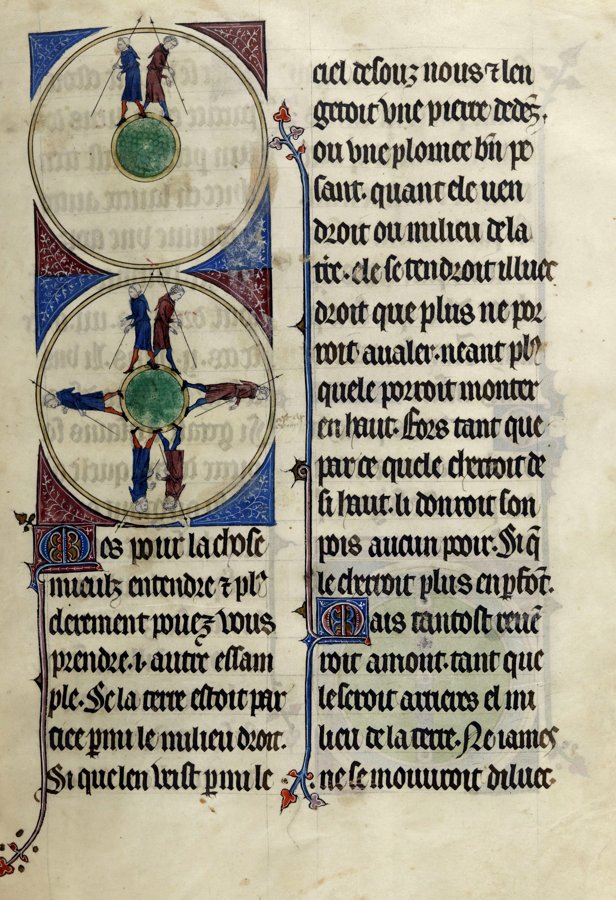
Two travelers walk around a round Earth and meet on the far side, in a 14th century copy of L'image du monde by Gossuin de Metz, a 13th century French work. Bibliothèque nationale de France, Fr. 574, folio 42. Public domain, via Wikimedia Commons.
The alternative view
A few early Christian authors did reject the round Earth. Lactantius, in book three of his Divine Institutes, summed up the philosophers by saying "they thought that the world is round like a ball" and then asked "What course of argument, therefore, led them to the idea of the antipodes?" because he found people walking upside down absurd.
Augustine of Hippo, in the City of God, accepted that scholars argued for a globe but rejected inhabited lands on its far side, writing that "as to the fable that there are Antipodes" the idea "is on no ground credible" in Marcus Dods's translation. His doubt concerned people living there, a question of Scripture and descent from Adam.
The sixth century writer Cosmas Indicopleustes went further. Andrew Dickson White summarizes his system as holding that "the earth is a parallelogram, flat, and surrounded by four seas" and modeled on the Tabernacle. Russell replies that Cosmas "had no followers whatever" and that his works were ignored or mocked by medieval readers.
The other question is what ordinary people thought. Russell concedes that "No doubt some people alive on August 3, 1492, believed that the earth was flat." Few peasants left any written record of their ideas about the shape of the world, so what the majority believed cannot be settled from the written record.
Where this leaves it
Washington Irving's Life and Voyages of Columbus, first published in 1828, staged a famous scene at Salamanca. In the abridged edition Irving says that "the very idea of antipodes, and of the globular form of the earth, was scouted on the authority of one of the ancient fathers of the church" when Columbus presented his plan to a council of churchmen.
Russell argues that the meeting was a royal commission, in effect a committee of lay and clerical advisers rather than a church council, and that Columbus's opponents, relying on Ptolemy, "argued that the circumference of the earth was too great and the distance too far" for his ships. He quotes one modern historian of Columbus who called Irving's version "pure moonshine" and a work of literary invention.
Later writers turned the Salamanca story into a wider claim about the medieval Church. John William Draper wrote in 1874 that the Church's "traditions and policy forbade it to admit any other than the flat figure of the earth, as revealed in the Scriptures." White, who helped Ezra Cornell found Cornell University, repeated the charge in his 1896 history.
Yet White also wrote that "In the eighth century a similar declaration was made in the north of Europe by another great Church authority, Bede." Russell traces the wider error to Irving, to the French scholar Antoine Letronne in the 1830s, and to Draper and White. Ancient Origins has also covered the wider history of flat Earth theories in an earlier feature.
The surviving medieval sources therefore point one way for the educated and say little about everyone else. The claim that most people thought the Earth was flat until Columbus remains less a finding drawn from medieval texts than a story first told by writers of the nineteenth century about them.
How we checked this
We read Bede's On the Reckoning of Time chapter 32 in Latin and his Ecclesiastical History 1.1 in the Sellar translation. We read Sacrobosco in the Thorndike translation, the Mandeville travel book, Lactantius's Divine Institutes 3.24 and Augustine's City of God 16.9. The Thorndike translation dates from 1949 and its copyright status has not been confirmed.
For the origins of the story we read Irving's own abridged Columbus of 1838, Draper's History of the Conflict Between Religion and Science, White's History of the Warfare of Science with Theology, and Russell's book Inventing the Flat Earth and his 1997 lecture. The 1828 first edition of Irving was not consulted, and Letronne is cited only through Russell.
How we label claims: see How we check evidence.
More in this series: Göbekli Tepe, the Sphinx and Atlantis: what the evidence says.
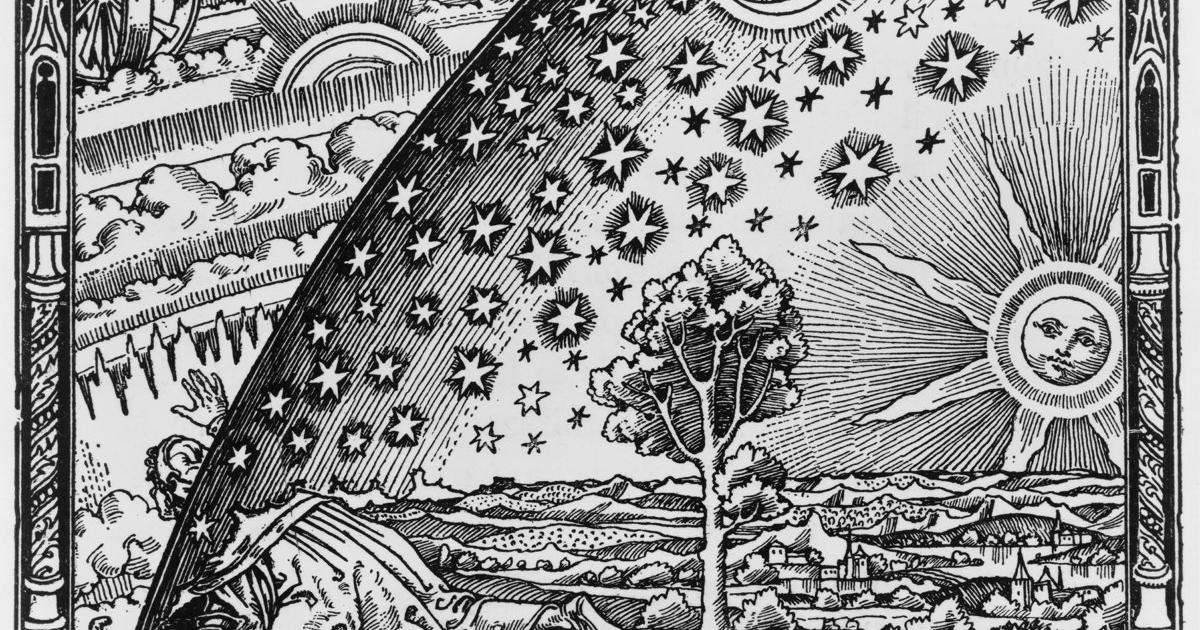
The so called Flammarion engraving, by an unknown artist, first printed in Camille Flammarion's L'Atmosphère in Paris in 1888. It is a 19th century image in a medieval style and does not come from the Middle Ages. Public domain, via Wikimedia Commons.
By Aris Manus
Claim by claim
- Unverified: Most people in the Middle Ages thought the Earth was flat until Columbus. Reason: medieval scholars taught a round Earth, and the views of ordinary people are rarely recorded.
- Established: Leading medieval writers taught that the Earth is a sphere. Reason: Bede, Sacrobosco and the Mandeville travel book all describe a round Earth.
- Established: A few early Christian writers rejected a round Earth or people on its far side. Reason: Lactantius mocked the idea, Cosmas described a flat Earth, and Augustine doubted the antipodes.
- Unverified: Columbus's critics objected that the Earth was flat. Reason: the scene comes from Washington Irving's 1828 biography, and Jeffrey Burton Russell says the objections concerned distance.
- Established: Nineteenth century writers spread the story of a flat medieval Earth. Reason: Irving, John William Draper and Andrew Dickson White all told versions of it.
Sources
- Bede. De temporum ratione 32. Latin text. Bibliotheca Augustana.
- Bede. Ecclesiastical History of England 1.1. Translated by A. M. Sellar. London: George Bell and Sons, 1907. Project Gutenberg.
- John of Sacrobosco. The Sphere. Translated by Lynn Thorndike, 1949. Esoteric Archives.
- The Travels of Sir John Mandeville. London: Macmillan, 1900. Project Gutenberg.
- Lactantius. Divine Institutes 3.24. Translated by William Fletcher. Ante-Nicene Fathers Vol. 7. New Advent.
- Augustine. City of God 16.9. Translated by Marcus Dods. Nicene and Post-Nicene Fathers, First Series, Vol. 2. New Advent.
- Irving, Washington. The Life and Voyages of Christopher Columbus, abridged by the author. 1838 printing. Internet Archive.
- Draper, John William (1874). History of the Conflict Between Religion and Science. Project Gutenberg.
- White, Andrew Dickson (1896). A History of the Warfare of Science with Theology in Christendom. Project Gutenberg.
- Russell, Jeffrey Burton (1991). Inventing the Flat Earth: Columbus and Modern Historians. New York: Praeger. Internet Archive.
- Russell, Jeffrey Burton (1997). The Myth of the Flat Earth. Lecture to the American Scientific Affiliation, August 4, 1997.