
The verdict
A widely shared post on X this month makes a short historical claim: 300 years ago, women were burned for witchcraft. With Halloween days away, it is worth testing against the court records. Did European courts really burn women as witches as recently as the 1720s, and how typical was it?
According to the historians who have counted the trials, the answer is yes, with several caveats. Courts on the continent were still executing people for witchcraft in the 18th century, and at Würzburg in 1749 a woman's body was burned after she had been executed by the sword. By 1726, however, the great hunts were long over, England hanged its witches, and at least one in five of the accused was a man.
- Established: 300 years ago women were burned for witchcraft. Reason: executions for witchcraft continued until 1782, burning of the body after execution is documented at Würzburg in 1749, and no source consulted for this check shows anyone burned alive after 1726.
- Established: Most executions came long before 1726. Reason: Hutton places 80% of the deaths between 1560 and 1640.
- Established: England and New England hanged convicted witches, and Scotland usually strangled them before burning. Reason: Levack's history and the Survey of Scottish Witchcraft, which found 120 of 141 recorded sentences were for strangling and burning.
- Established: Men were a sizable minority of those accused. Reason: Levack estimates one-fifth to one-quarter across Europe, and men were the majority in Normandy, Russia, Estonia and Iceland.
- Established: Most trials after 1550 were held in secular courts. Reason: Levack writes that trials were more commonly held in secular courts after 1550, and that Spain and Italy, where Inquisition courts kept control, saw relatively few prosecutions.
- Disputed: The exact number executed. Reason: published estimates range from about 40,000 to about 60,000, and none supports the figure of 9 million sometimes repeated.
What the evidence says
The date in the claim is the first thing to check. The historian Ronald Hutton told a Gresham College audience in June 2024 that executions for witchcraft in Europe "started in 1428 and went on until 1782." He added, "Between forty and fifty thousand people died in total," with 80% of those deaths falling "between 1560 and 1640."
That puts 1726 near the end of the story, and Brian Levack's standard survey, The Witch-Hunt in Early Modern Europe, lists the last execution and last trial region by region. His table gives 1685 for England, 1692 for New England and 1706 for Scotland, while Westphalia and Augsburg executed people as late as 1728 and Bavaria as late as 1756.
Levack also names Würzburg in 1749 among the late German executions. A sermon printed that year, now held by Frankfurt University Library, records the event in its title. It was preached beside the pyre outside Würzburg where the corpse of Maria Renata was burned on June 21, 1749. The title calls her a sorceress executed by the sword, so she was dead before the fire.
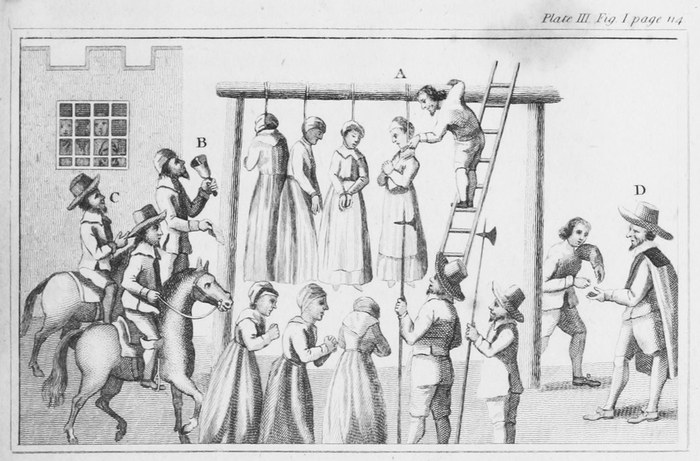
Women hanged as witches in England, a plate from a 1796 reprint of Ralph Gardiner's England's Grievance Discovered (1655). English courts hanged convicted witches rather than burning them. (Ralph Gardiner/Public domain)
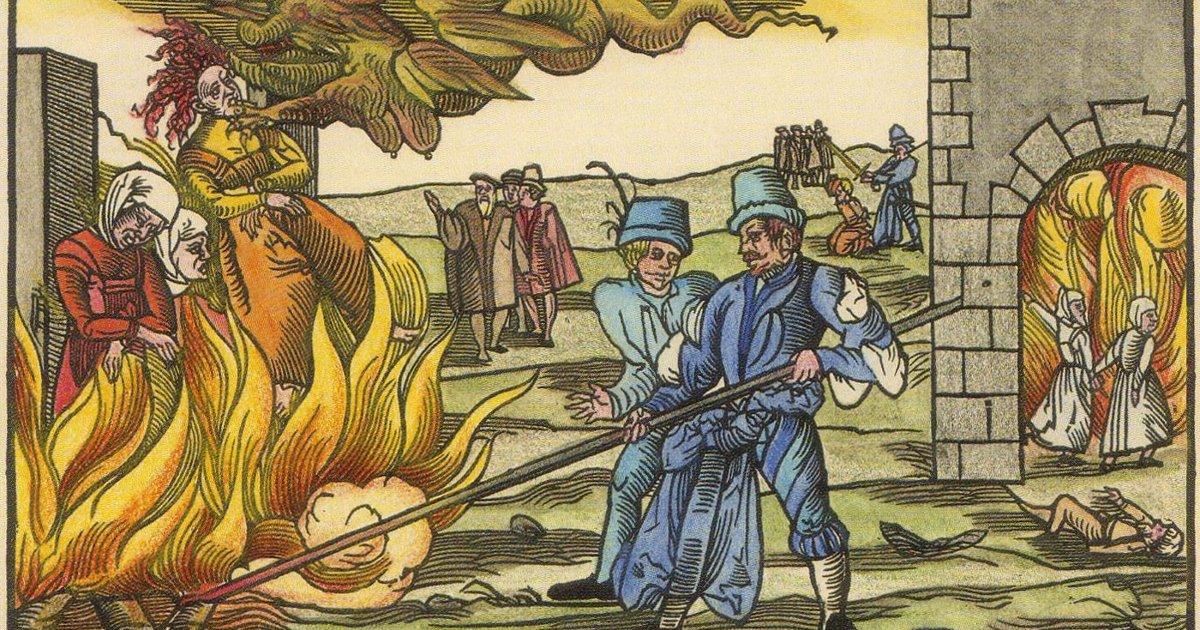
The method of execution is the second thing to check. According to Levack, witches across most of Europe were usually burned at the stake, the old punishment for relapsed heretics. In England and New England, however, condemned witches "were hanged like other felons." He also stresses that "Most witches were not burned alive" in France, Germany, Switzerland or Scotland, where the condemned were usually strangled first.
Scotland's surviving sentences show how this worked in practice. The Survey of Scottish Witchcraft, a University of Edinburgh database directed by Julian Goodare, found 141 recorded sentences naming a method, and 120 of them were for strangling and burning. Those convicted were "almost always strangled at the stake" before the body was burned, and only a very small number are known to have been burned alive.
The word women also holds up, within limits. The survey found that 84% of the 3,837 people accused in Scotland were women and 15% were men, close to the usual European split. Levack estimates that across Europe "between one-fifth and one-quarter of all witches were male," and men formed a solid majority in Normandy, Russia, Estonia and Iceland.
The courts matter too, since these deaths are often blamed on the Church alone. Levack writes that "especially after 1550, the trials were held in the secular courts," meaning the courts of kingdoms, principalities and towns. In Spain and Italy, where Inquisition courts kept control of witchcraft, prosecutions "remained relatively low by European standards," and Spanish church courts even softened secular sentences.
Clergy still played a part in the hunts. Levack adds that in the 16th and 17th centuries the clergy "often put pressure on secular authorities" to act and used the pulpit to sustain hunts, and in Salem the ministers encouraged the prosecutions. Hutton argued that "the push to hunt witches came from below," from ordinary people who feared bewitchment by neighbors they had come to distrust, and that large states with professional judges kept trials most tightly controlled.
The legal framework helps explain why the dates cluster where they do and why they stop when they do. The Holy Roman Empire's Carolina code of 1532, England's witchcraft statutes of 1542, 1563 and 1604, and the Scottish Act of 1563 all gave secular courts a clear right to hear witchcraft cases. A British statute of 1736 repealed the English and Scottish laws and created an offense of pretended witchcraft, punished by up to one year in prison.
The alternative view
The most common competing account runs the other way and inflates the numbers. The Scottish survey notes that a figure of 9 million witches executed in Europe is sometimes given, "when most scholars agree that it was about 60,000." Levack's estimate is lower still, since he judges that prosecutions "probably did not exceed 90,000" and that European courts "executed about 45,000 witches."
The totals themselves differ from historian to historian. Hutton's 40,000 to 50,000, Levack's 45,000 and the 60,000 that the Scottish survey attributes to most scholars are all estimates for Europe as a whole, and Levack calls counting executions an imprecise exercise because many trial records have not survived. Even Scotland is uncertain, since Levack puts its executions at about 1,500 and possibly as few as 1,000, while the survey cautions that its own estimate of a 67% execution rate involves a good deal of uncertainty.
A second competing view treats witch burning as a medieval Church project. The records place most executions after 1560, in an age of state courts and statutes. Hutton told his audience that Christianity's inherited beliefs about demons and magic "did not initially make it a witch-hunting religion," and that early Christians discouraged witch persecution. In his account, the large hunts followed a new belief, from 1420, that God let Satan empower human witches.
The last executions in Europe show how late the practice lingered. Levack calls Anna Göldi's execution in the Swiss canton of Glarus in 1782 and the execution of two women in Poznan in 1793 the traditional contenders for the last in Europe, and he describes the Polish case as probably illegal. Both fall roughly two generations after 1726, at the far end of a long decline.
Where this leaves it
The viral line is accurate as far as it goes for continental Europe around 1726. Courts in parts of Germany were still executing people for witchcraft in the 1720s, German and Swiss courts went on doing so for decades afterward, burning was still a sentence there, and a woman executed by the sword at Würzburg in 1749 was burned after death. What the short version leaves out is the scale, the timing and the method.
The court records offer a firmer guide than slogans. Trial registers, sentences and statutes are solid, while totals for Europe are estimates built on patchy archives and are best read as indicative rather than conclusive. The witches of 300 years ago remain less a single story of burning women than a long, uneven record of local courts, laws and fears.
How we checked this
Read in full for this check: Hutton's 2024 Gresham College lecture transcript, the Survey of Scottish Witchcraft's published FAQ and project pages, and the relevant chapters of the third edition of Levack's The Witch-Hunt in Early Modern Europe (2006). The Würzburg date and description come from Frankfurt University Library's catalog record of Georg Gaar's 1749 sermon, with the German title translated for this article.
No interviews were conducted, earlier Ancient Origins coverage was not used as a source, and every quote was checked against a saved copy on October 25, 2026. The viral post was used only for its claim about witch burning. Image licenses were checked on their Wikimedia Commons file pages.
How we label claims: see How we check evidence.
More in this series: Göbekli Tepe, the Sphinx and Atlantis: what the evidence says.
By Aris Manus
Sources
- Hutton, Ronald (2024). Witch-Hunting in European and World History. Gresham College lecture, June 5, 2024, transcript.
- Levack, Brian P. (2006). The Witch-Hunt in Early Modern Europe. 3rd edition. Harlow: Pearson Longman. ISBN 978 0 582 41901 8. Read in a digital copy, including Table 5, Last executions and last trials for witchcraft.
- Goodare, Julian, Lauren Martin, Joyce Miller and Louise Yeoman (2003). The Survey of Scottish Witchcraft: Frequently Asked Questions. University of Edinburgh.
- Goodare, Julian, Lauren Martin, Joyce Miller and Louise Yeoman (2003). The Survey of Scottish Witchcraft. University of Edinburgh.
- Gaar, Georg (1749). Christliche Anred Nächst dem Scheiter-Hauffen, Worauf der Leichnam Mariae Renatae, einer durchs Schwerdt Hingerichteten Zauberin. Frankfurt am Main: Rudolph. Catalog record and digital copy, Frankfurt University Library.