
Long before Heliopolis became the sun city of pharaonic Egypt, home to the statues of pharaohs found at its sun temple, it was a farming village on the edge of the Nile Delta. Its people grew crops, brewed beer and struck sharp flint blades, and a new study argues that some of those blades came from skilled specialists working inside the village itself.
The findings, published in the Journal of Anthropological Archaeology, come from a collection that waited a very long time for attention. Francesco Manclossi, Lorena Lombardi, Antonio Marsilio, Federica Ugliano and Giulio Lucarini studied the flint finds of Italian Egyptologist Ernesto Schiaparelli, who excavated at Heliopolis in 1905 and 1906. Three of the authors described the work for The Conversation on November 2, 2026, and Ugliano is a curator at the Museo Egizio in Turin.
A dig beneath the floodwater
Schiaparelli reached the early village by digging almost 9 meters (30 feet) down, according to the authors. Groundwater flooded his trenches, and workers had to recover artifacts straight from the water. He kept the flints, but his research focused mainly on monuments and inscriptions, the authors explain.
The flints then sat in 40 wooden boxes at the Museo Egizio, "almost forgotten, for over a century," the authors write, until they were recently moved for a time to the Museo del Duomo in Bracciano, Italy, for study. The area now lies beneath Matariya, a crowded district of northeast Cairo, and of the spot where Schiaparelli dug the authors write, "Those boxes are all that is left of it."
The team went through every box piece by piece. Faded labels and inventory numbers, checked against Schiaparelli's notes, allowed them to assign almost 3,000 objects securely to Heliopolis. A review of the paper by Anthropology.net gives the exact figure as 2,869 pieces, drawn from about 4,000 loose items that were mixed with other material.
More than the pretty pieces
Early excavators often kept the attractive objects and threw the rest away. This collection was different, the authors explain, because it also held cores, which are the blocks of flint from which blades were struck, as well as tiny flakes and knapping debris.
A newer excavation helped to anchor the old material. In 2019 an Egyptian and German team working 500 meters away, beside what appears to be an early brewery, reached a layer of the same age with the same kinds of tools. Rather than sort the tools into types, the researchers then reconstructed the chaîne opératoire, the chain of choices from picking up a pebble to throwing away a worn tool.
A workshop of village experts
The knappers picked good quality flint pebbles from nearby gravels and struck long, regular blades from them with soft stone hammers. The team identified four different ways of working the cores. The most telling clue, they write, was the balance between cores and blades, because Schiaparelli's area held many cores but relatively few blades.
According to Anthropology.net, the old collection holds 187 cores and 549 blades and bladelets, or fewer than three blades for each core. The cores show that far more blades were struck than were found, so most were taken elsewhere, the authors write. The paper's abstract describes "a specialised workshop, where skilled knappers produced blade and bladelet blanks in quantities exceeding domestic needs."
Newly excavated material from Area 251, the brewery area, tells the opposite story, with few cores worked by less skilled hands, and people there seem to have obtained most of their blades from the workshop. The authors link this pattern to a model they name in the abstract as "arbitrary craft specialisation", in which expertise was uneven and tied to its setting. So who controlled the work? According to the authors, a few people became skilled, but no one controlled access to raw materials or organized production on a large scale.
Farmers who were also experts
The specialists still seem to have worked the land, since flint sickle blades were sharpened and repaired in many different ways, which the authors read as a sign that each user maintained their own tools. A handful of very fine serrated sickle blades, probably finished with metal tools, hint at master knappers who also went to the fields at harvest time.
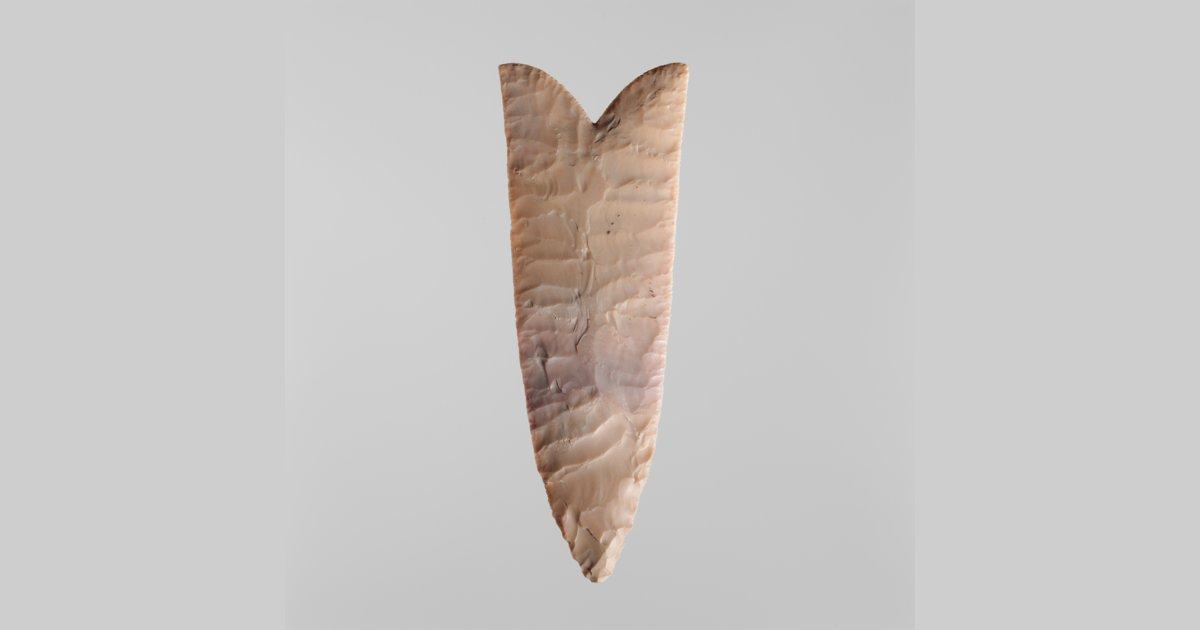
There are signs of a wider world too. Hammamiya knives, flint blades found across Egypt in the same period, turn up at Heliopolis along with traces of their making. The authors suggest that local experts may have copied a prestigious design or that traveling craftspeople passed through. Other finely made Predynastic flint knives are known from Egypt, among them the ivory-handled Gebel el-Arak knife.
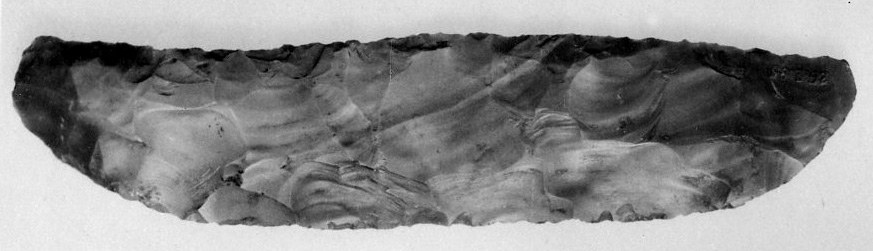
A bifacial flint knife from the Thebes area of Upper Egypt, dated to the Predynastic Period. It is not from Heliopolis and is shown only for comparison. Image: The Metropolitan Museum of Art, Rogers Fund, 1926, CC0.
Before the state arrived
Change came quickly afterward, because shortly before 3000 BC the traditional blades of the Delta region disappeared and gave way to more standardized ones, many of them from large workshops at desert flint mines. The authors note that the shift coincided with the rise of the Egyptian state and its growing demand for farm surplus.
It might look like a change imposed by the new rulers, but the authors argue that Heliopolis points the other way. Many farmers there already relied on someone else for an essential tool, so communities may have been ready when blades began arriving from distant workshops. "Early states, in other words, did not invent economic complexity from scratch," they write.
The study has limits, since Anthropology.net reports that the dating rests on pottery phases rather than radiocarbon dates, and it gives the depth of the old trenches as about 8 meters, slightly less than the authors' own figure. Other Predynastic sites have produced evidence of brewing too, including an early beer used in rituals.
The authors argue that museum storerooms are often the only archive left for sites now covered by towns and fields. For the early farmers of Heliopolis, 40 boxes of stone have turned out to hold a record of who made what, and for whom.
A Predynastic fishtail knife of flint from Egypt, dated to about 3650 to 3300 BC. It is not one of the Heliopolis flints and is shown only as an example of Egyptian flint working from roughly the same millennium. Image: The Metropolitan Museum of Art, Rogers Fund, 1916, CC0.
By Aris Manus
Sources
- Manclossi, F., Lombardi, L., Marsilio, A., Ugliano, F. and Lucarini, G. 2026. Crafting complexity: blade production and socio-economic transitions in Predynastic Heliopolis, Egypt (fourth millennium BCE). Journal of Anthropological Archaeology 84, 101819. https://doi.org/10.1016/j.jaa.2026.101819 (abstract consulted)
- Lucarini, G., Ugliano, F. and Lombardi, L. November 2, 2026. Forgotten flint tools in museum boxes reveal how Egypt's early farmers paved the way for the pharaohs. The Conversation. https://theconversation.com/forgotten-flint-tools-in-museum-boxes-revea…
- Anthropology.net. November 3, 2026. 2,869 Heliopolis flints point to pre-state craft experts. https://www.anthropology.net/p/2869-heliopolis-flints-point-to-pre