
Fact Check verdict: Disputed. Ancient writers say books burned in Caesar's war of 48 BC, but they disagree on how many, and the Museum kept working decades later.
Few stories from the ancient world have traveled as far as the tale that in 48 BC Julius Caesar, trapped in Alexandria during a war over the Egyptian throne, set fire to ships in the harbor and the flames consumed the great Library of Alexandria. Did Caesar really burn down the Library, and with it much of ancient learning?
According to the ancient sources, something in Alexandria full of books did burn during Caesar's war. Whether that was the Library itself, a portion of its rolls or books stored near the docks is debated, and the evidence that scholars kept working in Alexandria in the Roman period weighs against a single fatal blaze.
What the evidence says
According to Plutarch, Caesar reached Egypt after defeating Pompey, whom the Egyptian king's court had recently killed, and was drawn into the quarrel between Cleopatra and the king's party. The Egyptian commander Achillas besieged him in the part of the city he held, in the capital of the Ptolemaic kings, and the fiercest fighting broke out over the warships in the harbor.
Caesar's own Civil War, in the 1914 Loeb translation by A. G. Peskett, describes the decisive moment at the port. "He burnt all those ships and the rest that were in the docks, because he could not protect so wide an extent with his small force," Caesar writes, before landing his men on the island of Pharos and its famous lighthouse. He says nothing about books or a library.
The earliest surviving writer to mention burned books is the philosopher Seneca, about a century later. In Aubrey Stewart's 1900 translation of On Peace of Mind (De Tranquillitate Animi 9.5), he states: "Forty thousand books were burned at Alexandria." He raises it to scold Livy for praising a collection he calls "a piece of learned luxury." Seneca does not name Caesar or say the whole library burned.
Plutarch, writing around AD 100, goes further. In Bernadotte Perrin's 1919 Loeb translation of his Life of Caesar (chapter 49), Caesar "was forced to repel the danger by using fire, and this spread from the dockyards and destroyed the great library." Perrin's own footnote to that line adds a caution: "The destruction of the Library can have been only partial."
Cassius Dio, writing in the early third century, gives a fuller picture. In Earnest Cary's 1916 Loeb translation (42.38), "the docks and the storehouses of grain among other buildings were burned, and also the library, whose volumes, it is said, were of the greatest number and excellence." His "it is said" passes on a report more than two centuries old.
The Roman writer Aulus Gellius, in John Rolfe's 1927 Loeb translation of the Attic Nights (7.17), puts the total at "nearly seven hundred thousand volumes." He blames "the auxiliary soldiers" and says the fire was accidental. Ammianus Marcellinus, late in the fourth century, repeats the 700,000 figure in Rolfe's 1940 translation (22.16) and places the books in the Serapeum, a temple across the city.
Rolfe was skeptical of Ammianus on this point, and in a note he wrote that "Ammianus confuses two libraries," the main library and the one at the Serapeum, and that "The damage done by Caesar has been greatly exaggerated." The same note says Strabo "found the Museum intact" on his visit to Alexandria twenty-three years later.
Strabo's own words, in Horace Leonard Jones's 1932 Loeb translation of the Geography (17.1.8), describe a working institution. "The Museum is also a part of the royal palaces," he writes, with "the common mess-hall of the men of learning who share the Museum," and a priest "who formerly was appointed by the kings, but is now appointed by Caesar." He does not mention the Library, a silence Roger Bagnall sees as a failure to "speak clearly on the matter."
The alternative view
The case for Caesar as the culprit rests on the agreement of several ancient writers that books burned in 48 BC. Plutarch and Dio both use the word library, and Seneca's 40,000 books suggests a collection of real size went up in the war.
Bagnall, writing in the Proceedings of the American Philosophical Society in 2002, examined the evidence in his article "Alexandria: Library of Dreams." He calls the Library's end "a murder mystery with a number of suspects," and lists Caesar, whose "operations in 48 b.c. in the harbor of Alexandria are often blamed," alongside the emperors Caracalla, Aurelian and Diocletian. He reports that modern scholars have suspected Seneca's 40,000 to be an error for 400,000, a figure found in the late historian Orosius.
His main objection concerns the Museum, the scholarly community the Library served. "As the Museum was certainly still operative in the Roman period, belief in a Caesarian destruction of the Library requires the uneconomical assumption that the Library was destroyed in the fire but the Museum was not," he writes. He adds that the emperor Domitian later sent scribes to Alexandria to copy manuscripts.
Bagnall also points to the slow decay of the books themselves. Papyrus rolls could last a century or two, he writes, but Alexandria's humid climate was hard on them. "The likelihood is that by the reign of Tiberius relatively little of what had been collected under the first three Ptolemies was still usable," he concludes.
Bagnall reports signs of a consensus that the most likely date for major destruction of the Palace Library is 273, during Aurelian's recapture of Alexandria, while noting there is no direct ancient evidence for it. The Serapeum, home to a separate collection, was destroyed in 391, and Bagnall says the stories of a caliph ordering the books burned in 642 "originate centuries after the fact and are surely fiction." Each suspect has its supporters in the long debate over who destroyed the Library of Alexandria.
Where this leaves it
According to the sources consulted, Caesar's fire of 48 BC is real, and so are the reports of books burned in it. What those reports cannot carry is the idea that one blaze erased the Library and most of ancient knowledge in a single night. Caesar's own account mentions only ships, the earliest witness names no culprit, and the numbers grow with each retelling.
The burning of books in Caesar's war is indicative rather than conclusive evidence for the end of the Library. Bagnall argues the rarities owe their disappearance "as much to omission as to commission," and the single villain of the popular story remains less likely than a long decline that no one fire can explain.
How we checked this
Read for this check: Caesar's Civil War 3.111, Seneca's De Tranquillitate Animi 9.5, Plutarch's Life of Caesar 49, Cassius Dio 42.38, Aulus Gellius 7.17, Ammianus Marcellinus 22.16 and Strabo 17.1.8, all in the named public domain translations, and Bagnall's 2002 article in the open copy held by New York University. Myrto Hatzimichali's 2013 chapter "Ashes to ashes? The library of Alexandria after 48 BC" was identified but not read, Orosius is known here only through Bagnall, and Seneca's chapter number follows Bagnall because Stewart's text is unnumbered.
No interviews were conducted, earlier Ancient Origins coverage was not used as a source, and every quote was checked against a saved copy on October 27, 2026.
How we label claims: see How we check evidence.
More in this series: Göbekli Tepe, the Sphinx and Atlantis: what the evidence says.
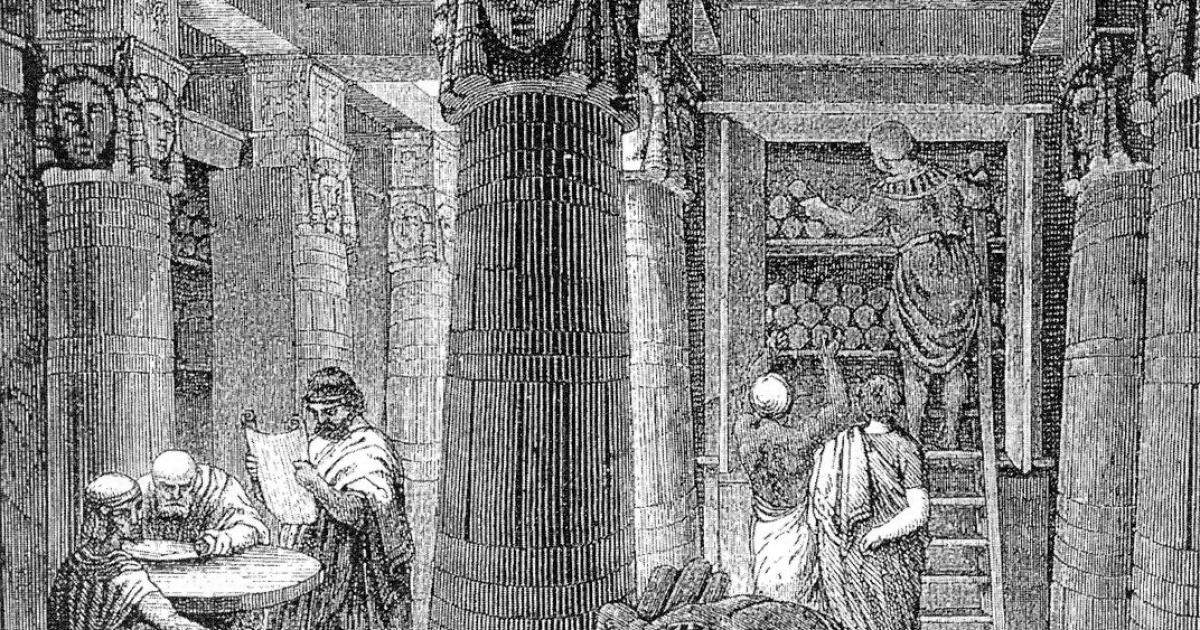
An artist's imagining of the Library of Alexandria, an engraving by O. Von Corven from the 19th century. It is a reconstruction drawn long after the library vanished and does not show the real building. Image: O. Von Corven, via Wikimedia Commons. Public domain.
By Aris Manus
Claim by claim
- Disputed: Julius Caesar burned down the Library of Alexandria. Reason: ancient writers report books burned in his war of 48 BC, but scholars disagree over what burned, and the Museum was still working decades later.
- Established: Caesar's side set fires in Alexandria in 48 BC. Reason: Caesar's own account says he burned the ships in the docks, and Bagnall dates the operations to 48 BC.
- Established: Ancient writers report books burned during Caesar's war. Reason: Seneca, Plutarch, Aulus Gellius, Cassius Dio and Ammianus all say so.
- Disputed: One fire destroyed the whole Library. Reason: Plutarch's translator calls the destruction "only partial," and Roger Bagnall argues the Library faded over a long period.
- Unverified: Some 700,000 scrolls burned in 48 BC. Reason: the ancient figures run from 40,000 to 700,000 and Bagnall doubts the high numbers.
- Established: The Museum, the Library's parent institution, outlived the fire. Reason: Strabo describes its scholars and their priest under Roman rule.
Sources
- Caesar, Julius. Civil Wars, Book 3, chapter 111. Translated by A. G. Peskett. Loeb Classical Library, 1914. LacusCurtius (public domain text).
- Seneca. Of Peace of Mind (De Tranquillitate Animi) 9.5, in Minor Dialogues Together with the Dialogue on Clemency. Translated by Aubrey Stewart. London: George Bell and Sons, 1900. Project Gutenberg. Chapter number as cited by Bagnall (2002), since the Stewart text is unnumbered.
- Plutarch. Life of Caesar 49. Translated by Bernadotte Perrin. Loeb Classical Library, Parallel Lives Vol. VII, 1919. LacusCurtius.
- Cassius Dio. Roman History 42.38. Translated by Earnest Cary. Loeb Classical Library, 1916. LacusCurtius.
- Aulus Gellius. Attic Nights 7.17. Translated by John C. Rolfe. Loeb Classical Library, 1927. LacusCurtius.
- Ammianus Marcellinus. Roman History 22.16. Translated by John C. Rolfe. Loeb Classical Library, 1940. LacusCurtius.
- Strabo. Geography 17.1.8. Translated by Horace Leonard Jones. Loeb Classical Library, Vol. VIII, 1932. LacusCurtius.
- Bagnall, Roger S. (2002). Alexandria: Library of Dreams. Proceedings of the American Philosophical Society 146 (4): 348 to 362. Open copy, NYU Faculty Digital Archive.