
Fact Check verdict: Unverified. None of the sources consulted describes the Giza builders as slaves.
Harvard Magazine wrote in 2003 that "Rooted firmly in the popular imagination is the idea that the pyramids were built by slaves serving a merciless pharaoh." Were the Giza pyramids really built by enslaved people?
According to the excavators who have worked at Giza since the late 1980s, the people who built the pyramids of Khufu, Khafre and Menkaure were Egyptians. They lived in a town built by the crown, ate rations supplied by the state and were buried in tombs beside the monuments. Their work was organized and compulsory in some measure, and how freely they gave it is still argued over.
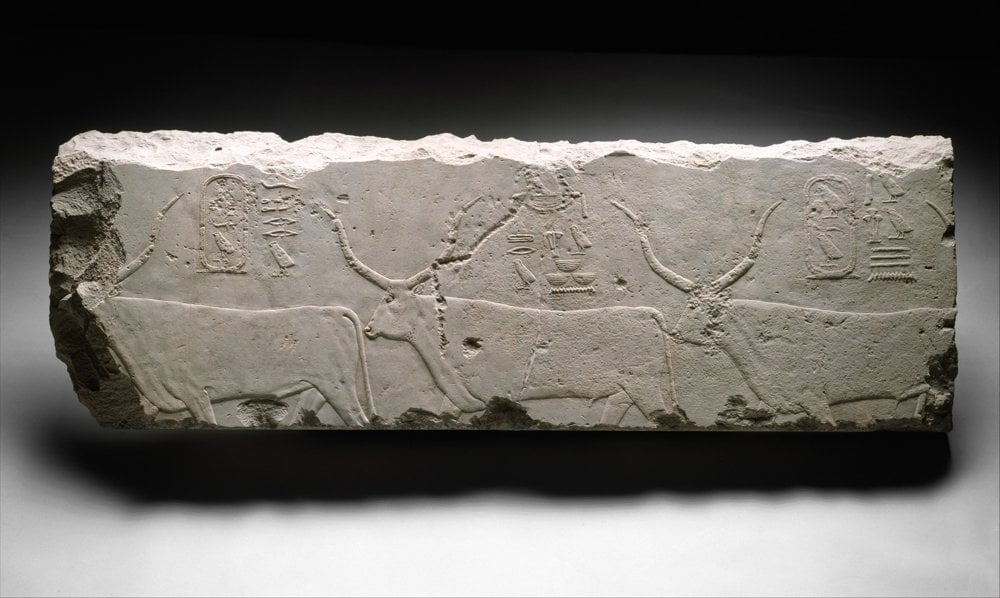
A relief fragment showing cattle belonging to King Khufu, carved around 2551 to 2528 BC. It comes from Khufu's reign, though not from the workers' town. Public domain (The Metropolitan Museum of Art, Open Access CC0)
What the evidence says
The oldest written account of the building of the Great Pyramid comes from the Greek historian Herodotus. In A. D. Godley's 1920 Loeb translation (Histories 2.124), his informants told him that Khufu, whom he calls Kheops, "brought the people to utter misery" and "compelled all the Egyptians to work for him." Herodotus says "They worked in gangs of a hundred thousand men, each gang for three months," and that the pyramid "was twenty years in the making."
Herodotus describes forced labor by the Egyptian population as a whole, and the passage uses no word for slaves. Zahi Hawass, who excavated the builders' cemetery at Giza, nevertheless calls the notion that pharaohs used slave labor "an idea as old as Herodotus."
Archaeology began to test that picture in December 1988. That month Mark Lehner's team started digging a site 400 meters south of the Sphinx, beside a stone wall known in Arabic as Heit el-Ghurab, the Wall of the Crow. According to the Ancient Egypt Research Associates (AERA), the 4th Dynasty settlement covered more than 7 hectares. It was "Purpose-built by the crown" as "the base of operations for constructing the great pyramid complexes of kings Menkaure, Khafre, and probably Khufu."
The excavators report streets lined with "craft workshops, industrial yards, bakeries, commissaries, kitchens, warehouses, small houses, and stately homes/offices for site administrators." Its long galleries may have served as barracks for the workers, according to Egypt's Ministry of Tourism and Antiquities. AERA describes "Massive royal silos" where grain was given out for bread and beer. The town sat on a flood plain that was struck by floods during construction.
According to Richard Redding and Brian Hunt of AERA, the team identified "over 175,000 bones and bone fragments" at the settlement, and the cattle and sheep eaten there were mostly young males. They conclude that "A central authority gathered predominately young, male sheep, goats, and cattle and brought them to the site to feed the occupants."
In April 1990, a tourist's horse stumbled over a mud brick wall south of the Wall of the Crow, and Hawass identified it as part of the builders' cemetery. He describes "an Upper Cemetery for high-status artisans and overseers, and a Lower Cemetery for the everyday workers." Its tombs carry titles such as "overseer of the side of the pyramid" and "director of the king's work." Most fractures in the skeletons had healed "with good realignment of the bone, indicating that the fractures had been set with a splint."
Hawass adds a caution. A seal of the 5th Dynasty king Djedkare Isesi found in the cemetery is, in his words, "a chronological indicator suggesting that much of this cemetery dates a few generations after the kings who built the Giza pyramids." Not every grave there belongs to a builder of Khufu's pyramid.
The builders also left their names on the stones. Lehner told NOVA in 1997 that red paint graffiti in the relieving chambers above the King's Chamber record gang names such as "the Friends of Khufu Gang." He reads another, from Menkaure's reign, as the Drunks or Drunkards of Menkaure, and describes gangs split into two crews and then into five phyles. Harvard Magazine reports that George Reisner found such graffiti early in the 20th century.
Written evidence from Khufu's own reign emerged in 2013 at Wadi al-Jarf on the Red Sea. There, Pierre Tallet's mission found what he calls "the oldest papyrus archive ever found in Egypt," dated to the end of Khufu's reign. It holds "accounts of commodities delivered to the workers" and the logbooks of an inspector named Merer. His team ferried limestone from the Tura quarries to Akhet-Khufu, the Great Pyramid, an event reported when the logbook was revealed.
The logbook entries are routine, and one reads "Inspector Merer spends the day with his phyle hauling stones in Tura South." Tallet estimates the team "might have counted some 40 members," based on a monthly bread ration collected for them at Heliopolis, and he describes them as "a group of royal labourers." The archive also shows the stone moving by water to the building site.
The alternative view
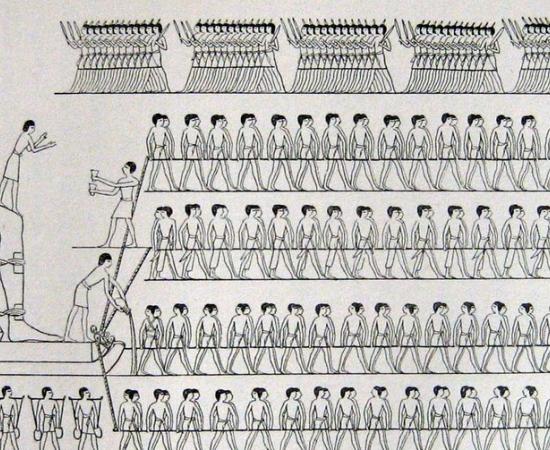
None of this makes the work voluntary in a modern sense. Hawass writes that the builders were "peasants conscripted on a rotating part-time basis, working under the supervision of skilled artisans and craftsmen." Lehner told NOVA that "it seems that everybody owed a labor tax."
Lehner left the question of motive open in the same interview. "We don't know if it was entirely coercive, or if, in fact, part of it was a natural community donation as in the Incan Empire," he said. Hawass leans further toward willing work, telling NOVA that the gang name "Friends of Khufu" shows building the pyramid "was not really something that the Egyptians would push."
Harvard Magazine reports Lehner as saying "There were slaves in Egypt," while adding that the well-fed pyramid workers "were not slaves at all, at least in the modern sense of the word." Workforce estimates differ too, with Lehner citing an engineering study of 4,000 to 5,000 men and Hawass arguing for 36,000 permanent and temporary workmen.
Where this leaves it
According to the sources consulted, the evidence from Giza and Wadi al-Jarf describes Egyptian crews with names, overseers, rations and tombs of their own. They worked for the king under some form of labor duty. No text or excavation cited here describes the builders as slaves, and the earliest account of forced work, by Herodotus, speaks of Egyptians compelled by their king.
The absence of any slave record is indicative rather than conclusive, since the cemetery has only been partly dug and the papyri cover one crew. Even so, the enslaved workforce of the popular image remains less likely than the conscripted and rotating Egyptian crews the excavators describe.
How we checked this
Read for this check: Herodotus 2.124 in Godley's public domain translation, AERA's project pages on Heit el-Ghurab and on the faunal remains, Hawass's account of the builders' cemetery in an archived copy of his website, Lehner's and Hawass's 1997 NOVA interviews, Harvard Magazine's 2003 report, Egypt's Ministry of Tourism and Antiquities page on the workers' town, and the English overview in Tallet's 2017 edition of the Merer papyri.
No interviews were conducted, earlier Ancient Origins coverage was not used as a source, and every quote was checked against a saved copy on October 28, 2026.
How we label claims: see How we check evidence.
More in this series: Did aliens build the pyramids? Fact check, and Göbekli Tepe, the Sphinx and Atlantis: what the evidence says.
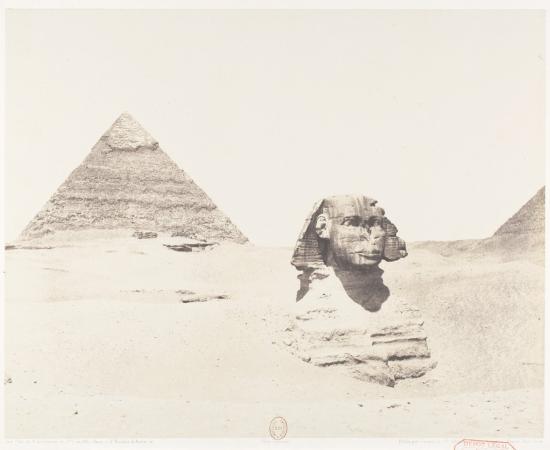
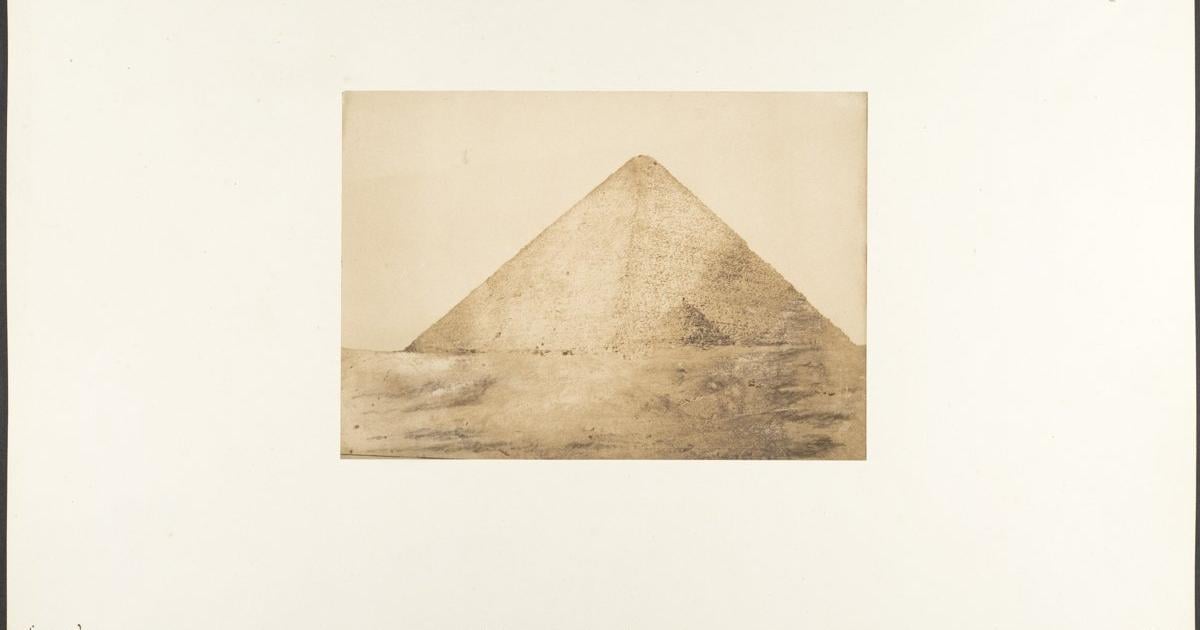
The Great Pyramid of Khufu seen from the southeast corner, photographed by Maxime Du Camp in December 1849. Public domain (The Metropolitan Museum of Art, Open Access CC0)
By Aris Manus
Claim by claim
- Unverified: The Giza pyramids were built by slaves. Reason: none of the sources consulted describes the builders as slaves, and the excavators describe a conscripted and rotating Egyptian workforce.
- Established: A crown-built town housed and fed the builders. Reason: the AERA excavations at Heit el-Ghurab found galleries, bakeries, silos and the bones of cattle and sheep supplied by a central authority.
- Established: Builders were buried in their own tombs beside the pyramids. Reason: Zahi Hawass excavated a cemetery with titles such as "overseer of the side of the pyramid," though much of it dates after the Giza kings.
- Established: Work gangs left their names on the monuments. Reason: red paint graffiti in the Great Pyramid name "the Friends of Khufu Gang," according to Mark Lehner.
- Disputed: How freely the builders worked. Reason: Hawass describes conscripts, while Lehner says a labor tax may have been mixed with willing community effort.
- Unverified: Gangs of 100,000 men worked in shifts. Reason: Herodotus reported the figure from what he was told, and modern estimates are far lower.
Sources
- Herodotus. Histories 2.124. Translated by A. D. Godley. Loeb Classical Library, 1920. Perseus Digital Library.
- Ancient Egypt Research Associates. Heit el-Ghurab project page. AERA, accessed October 28, 2026.
- Redding, Richard and Brian V. Hunt. Pyramids and Protein. AERA, accessed October 28, 2026.
- Hawass, Zahi. The Cemetery of the Pyramid Builders. drhawass.com, archived September 15, 2010.
- NOVA. Who Built the Pyramids? Interviews with Mark Lehner and Zahi Hawass. PBS, February 4, 1997.
- Shaw, Jonathan. Who Built the Pyramids? Harvard Magazine, July to August 2003.
- Ministry of Tourism and Antiquities, Egypt. Workers' Town and Cemetery. Discover Egypt's Monuments, accessed October 28, 2026.
- Tallet, Pierre. Les papyrus de la mer Rouge I: Le journal de Merer (Papyrus Jarf A et B). MIFAO 136. Cairo: IFAO, 2017. English overview, translated by Colin Clement.