
Kumis is a sour and lightly alcoholic drink that steppe herders make by churning mare's milk until it ferments, and it is still drunk in Mongolia, where it is known as airag. Popular food guides such as Atlas Obscura say the Botai people of Kazakhstan fermented it from mares' milk over 5,000 years ago. However, scientists working with ancient fats, genes and proteins have been quietly reopening that origin story. So how old is the drink, and who were the first people to milk a horse?
Fatty Traces in Botai Pottery
The case for Botai rests on a paper published in the journal Science in 2009 by Alan Outram of the University of Exeter and colleagues. The team said they had "three independent lines of evidence demonstrating domestication in the Eneolithic Botai Culture of Kazakhstan, dating to about 3500 B.C.E." Bone measurements and signs of bridling formed two strands of that argument.
The third strand came from the cooking pots. According to the paper, "Organic residue analysis, using delta13C and deltaD values of fatty acids, reveals processing of mare's milk and carcass products in ceramics, indicating a developed domestic economy encompassing secondary products." In other words, the chemistry of fats absorbed into Botai ceramics pointed to mare's milk being handled in those vessels.
That result is promising, but it says nothing directly about fermentation. A pot that once held mare's milk could have held it fresh, soured, or cooked, and the residue study does not separate those options. The link between Botai and kumis is therefore indicative rather than conclusive, even for readers who accept the milk identification.
Genes and Proteins Push Back
The Botai picture became more complicated in 2018. A team led by Charleen Gaunitz and Ludovic Orlando sequenced 42 ancient horse genomes, including 20 from Botai, for a study in Science. Their data indicated that "Przewalski's horses are the feral descendants of horses herded at Botai and not truly wild horses," and that later domestic horses carry only about 2.7 percent Botai-related ancestry.
Then in 2021, Shevan Wilkin, then of the Max Planck Institute for the Science of Human History, and colleagues reported in the journal Nature on milk proteins trapped in the dental calculus of 56 steppe individuals. Calculus, the calcified dental plaque on teeth, can preserve traces of the foods a person ate. The team also sampled two individuals from Botai itself.
The Botai results, however, came back negative for milk. The authors wrote that their study of calculus from Botai, "where early horse milking has been suggested by lipid analysis (albeit equivocally), did not yield milk proteins." They added a caution of their own: "Although two samples are insufficient for drawing broad conclusions, this finding does not support widespread milk consumption at the site."
Horse Milk in Bronze Age Teeth
The same study did find horse milk elsewhere. The authors identified Equus milk peptides from the protein BLGI in two Early Bronze Age individuals, both from the southwestern site of Krivyanskiy 9 and radiocarbon dated to between 3305 and 2633 BC. They describe these as, to their knowledge, "the earliest horse milk proteins yet identified on the steppe or anywhere else."
For the authors, this shifts attention west of Botai. They suggest the Pontic-Caspian region "may have been the initial epicentre for domestication of the DOM2 lineage during the late fourth or third millennium bc." The finding came with a qualifier, as the shift would hold only "if backed up by further sampling and analysis."
Further east, a 2020 study in Nature Ecology and Evolution, also led by Wilkin, examined dental calculus from Mongolia spanning 5,000 years. It reported "the earliest evidence for dairy consumption on the Eastern Eurasian Steppe by c. 3000 BC, and the later emergence of horse milking at c. 1200 BC, concurrent with the first evidence for horse riding."
The Mongolian horse milk peptides came from individuals linked to the Baitag and Slab Grave cultures in western Mongolia. By the Mongol period, the authors say, horse milk appears in 9 of 11 tested individuals, "a finding that matches historical accounts for widespread consumption of fermented mare's milk, known as airag (Mongolian) or koumiss/kymyz (Turkic languages)."
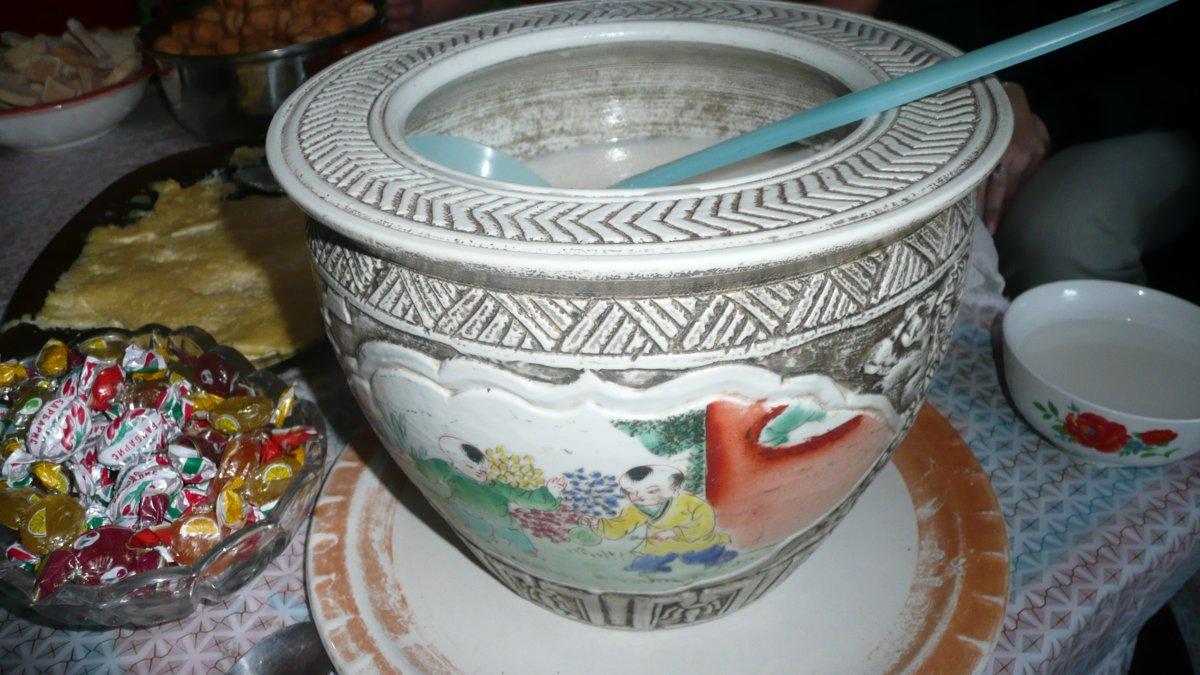
Airag, the Mongolian name for kumis, served in Mongolia in 2009. Photo by Brücke-Osteuropa. Public domain, via Wikimedia Commons.
What Did Herodotus and Rubruck See?
Written evidence enters the story in the fifth century BC. Herodotus, describing the Scythians north of the Black Sea, wrote in George Rawlinson's translation that they "thrust tubes made of bone, not unlike our musical pipes, up the vulva of the mare, and then to blow into the tubes with their mouths, some milking while the others blow."
He went on: "The milk thus obtained is poured into deep wooden casks, about which the blind slaves are placed, and then the milk is stirred round. That which rises to the top is drawn off, and considered the best part." The passage clearly describes mares being milked and the milk being stirred and separated, but it never mentions souring or alcohol.
The clearest early description of the brew itself comes from William of Rubruck, a Franciscan friar who traveled to the Mongol court in 1253 to 1255. In W. W. Rockhill's 1900 translation, he wrote, "This cosmos, which is mare's milk, is made in this wise," before describing foals tied to a rope so their mothers would stand quietly for milking.
According to Rubruck, the milk was poured "into a big skin or bottle," then churned with a stick, "and when they have beaten it sharply it begins to boil up like new wine and to sour or ferment." The finished drink, he said, "makes the inner man most joyful and also intoxicates weak heads."
Rubruck also recorded the sheer scale of supply at the Mongol camps he visited, reporting that the Mongol ruler Batu (Baatu in Rockhill's spelling) received "every day the milk of three thousand mares," and that at the court at Karakorum a silver tree made by "master William the Parisian" had pipes that poured wine, honey drink, rice mead and "caracosmos, or clarified mare's milk."
Weighing the Kumis Timeline
Chinese written records add a middle chapter to the story, and Wilkin and colleagues note that during the Xiongnu period (c. 200 BC to 100 AD), "lao ("horse alcohol") was the most consistently referenced dairy product." They also identify horse milk proteins at Tamiryn Ulaan Khoshuu, a site in the Xiongnu heartland.
The same team explains why mare's milk suits brewing. Horse milk "contains less curd protein (caseins) and much more lactose," and its high lactose content, they write, "makes it highly suitable for making alcoholic beverages with ethanol contents as high as 10-12%." The low casein content, they add, makes horse milk undesirable for dried curd products such as aaruul.
Put together, the evidence for people drinking horse milk on the steppe now reaches back to the Early Bronze Age at Krivyanskiy 9, though from just two individuals. The Botai claim rests on lipid residues that the 2021 team called equivocal and that their two calculus samples did not support. Of the sources here, Rubruck in the 13th century gives the first plain account of how the milk was fermented.
None of these studies shows when herders first fermented their mare's milk. For now, the origins of kumis remain less a settled date than a widening trail of clues.
How we label claims
Established: horse milk proteins were found in the dental calculus of two Early Bronze Age individuals at Krivyanskiy 9, and horse milking appears in Mongolia by about 1200 BC, according to the 2021 and 2020 Wilkin studies. Established: William of Rubruck described mare's milk being churned until it fermented. Disputed: horse milking at Botai around 3500 BC, supported by Outram's 2009 lipid analysis but not by the two Botai calculus samples in the 2021 study. Unverified: that the Botai people made fermented kumis, and that Herodotus was describing kumis rather than other processing of mare's milk.
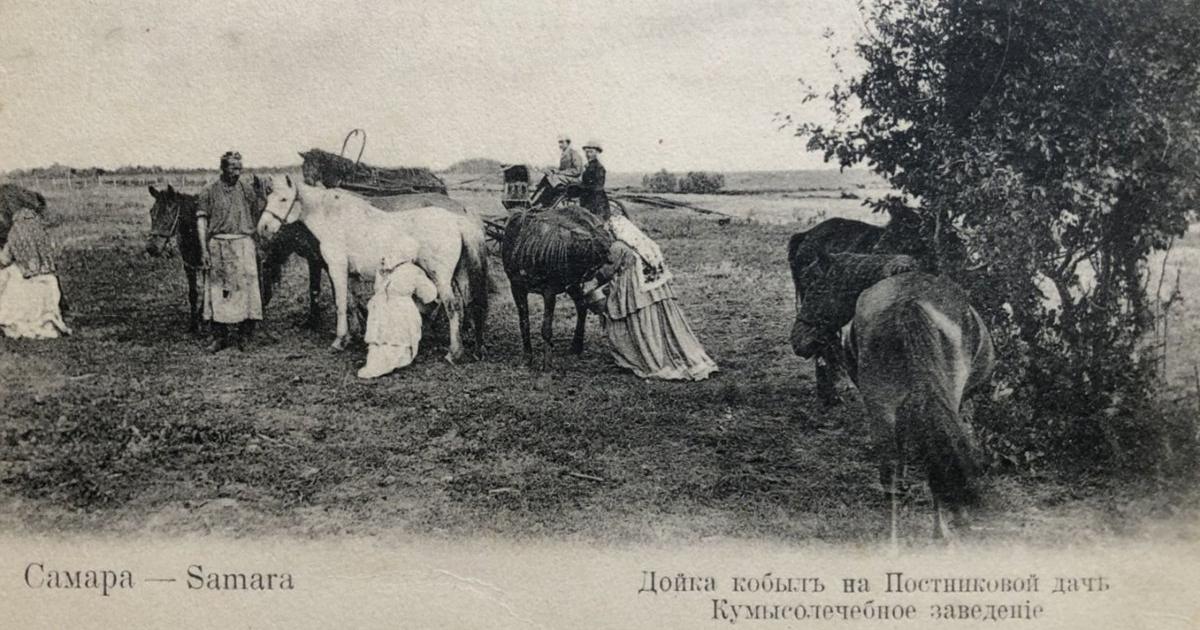
Mare milking at the Postnikov dacha, a kumis treatment institution in Samara, Russia, on a postcard published in the 1910s. Postcard by V. I. Asmolov and Co., Samara. Public domain, via Wikimedia Commons.
By Aris Manus
Sources
- Alan K. Outram et al., The Earliest Horse Harnessing and Milking, Science 323 (2009), 1332 to 1335
- Charleen Gaunitz et al., Ancient Genomes Revisit the Ancestry of Domestic and Przewalski's Horses, Science 360 (2018), 111 to 114
- Shevan Wilkin et al., Dairy Pastoralism Sustained Eastern Eurasian Steppe Populations for 5,000 Years, Nature Ecology and Evolution 4 (2020), 346 to 355
- Shevan Wilkin et al., Dairying Enabled Early Bronze Age Yamnaya Steppe Expansions, Nature 598 (2021), 629 to 633
- Herodotus, Histories, Book 4, translated by George Rawlinson, Internet Classics Archive
- William of Rubruck, The Journey of William of Rubruck to the Eastern Parts of the World, 1253 to 55, translated by W. W. Rockhill, London: Hakluyt Society, 1900