
Around two thousand years ago, someone in Roman Egypt painted the face of a person on a thin board of wood, and after that person died the board was bound into the linen wrappings over the face of the mummy. Hundreds of these faces survive, and they still look straight back at the viewer, yet the curator of a new exhibition in Rome says that some of the most basic questions about them, including when they were painted, are still open.
The exhibition is called "Il potere del ritratto. Egitto e Roma. I volti del Fayum," which AFP gives in English as "Egypt and Rome, the Faces of Fayum." It is held at the Museo dell'Ara Pacis in Rome, and the museum's own page gives the dates as November 5, 2026 to May 2, 2027. AFP, reporting on November 3, described the show as opening Wednesday, so the two sources differ by one day on when the doors open.
A show built on loans
According to the museum, the exhibition brings together more than 110 works, including painted panels, shrouds, funerary masks, marbles, plaster casts and ancient gold jewelry. Nearly 50 of the works are Fayum portraits. The museum says that for the first time Egypt has lent almost all of the panels held in its own collections, which had never left the country.
The Egyptian Museum in Cairo heads the list of lenders, under the Supreme Council of Antiquities. The museum page says the Louvre has sent 23 works, among them painted panels and linen shrouds, and that further loans come from the Getty Museum, the Metropolitan Museum of Art, the Landesmuseum Württemberg in Stuttgart and Eton College's Myers Collection, among others. The show also includes a portrait of a young person recently excavated by the University of Salento's Italian archaeological mission in Egypt, which the museum says is on public view for the first time. The curators are Claudio Parisi Presicce and Laura Petacco.
What a Fayum portrait is
The museum describes the portraits as boards of wood only a few millimeters thick, painted either in tempera or in encaustic, a technique that uses hot wax, and then placed over the face of the dead among the mummy bandages. It also states that a little under 1,000 of them survive around the world, and that Italian museums hold very few.
The name comes from the Fayum, which AFP describes as a fertile area on the edge of the desert. AFP adds that the dry climate there helped preserve the painted wood, textiles and papyrus that now travel to Rome. Parisi Presicce told a press conference that the panels were used "to depict, through extremely naturalistic painting, the faces of the individuals who were being buried."
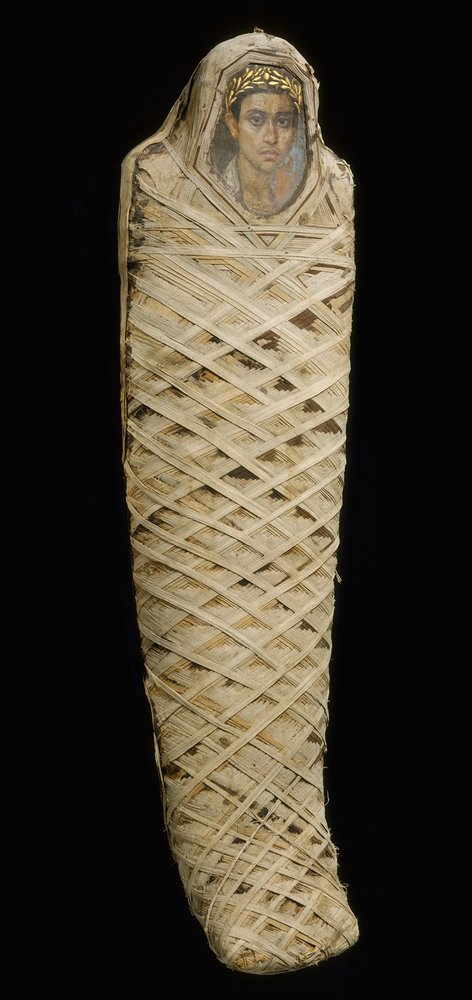
Mummy with an inserted panel portrait of a youth, from the Fayum region, dated by the Met to 80 to 100 CE. It shows how a painted panel sat in the wrappings over the face. It is not stated to be part of the Rome exhibition. Image: The Metropolitan Museum of Art, Rogers Fund, 1911, via Wikimedia Commons, CC0.
AFP places the portraits in a relatively brief period between the first and third centuries AD, after Egypt became a province of Rome, and notes that their painters worked in the tradition of Hellenistic painting. Researchers have also studied the painting techniques of the Fayum portraits with imaging methods that look beneath the visible surface of the paint.
Egyptian burial, Roman faces
The people in the portraits are men, women and children, and AFP observes that they often have Egyptian features but wear Roman dress. Some show graying hair and wrinkles, while the children have long eyelashes and round cheeks. Earlier work has looked at the stories that scholars read in the eyes of Fayum portraits, as well as at how closely the faces matched the people buried beneath them.
The mix of traditions is clearest in one of the Louvre's loans. AFP describes it as a near pristine linen shroud showing a man standing between the mummy he will become and Anubis, the jackal-headed god who led the dead into the afterlife. The same blend of Egyptian burial and Greco-Roman style appears in the gilded mummy of Lady Isaious.
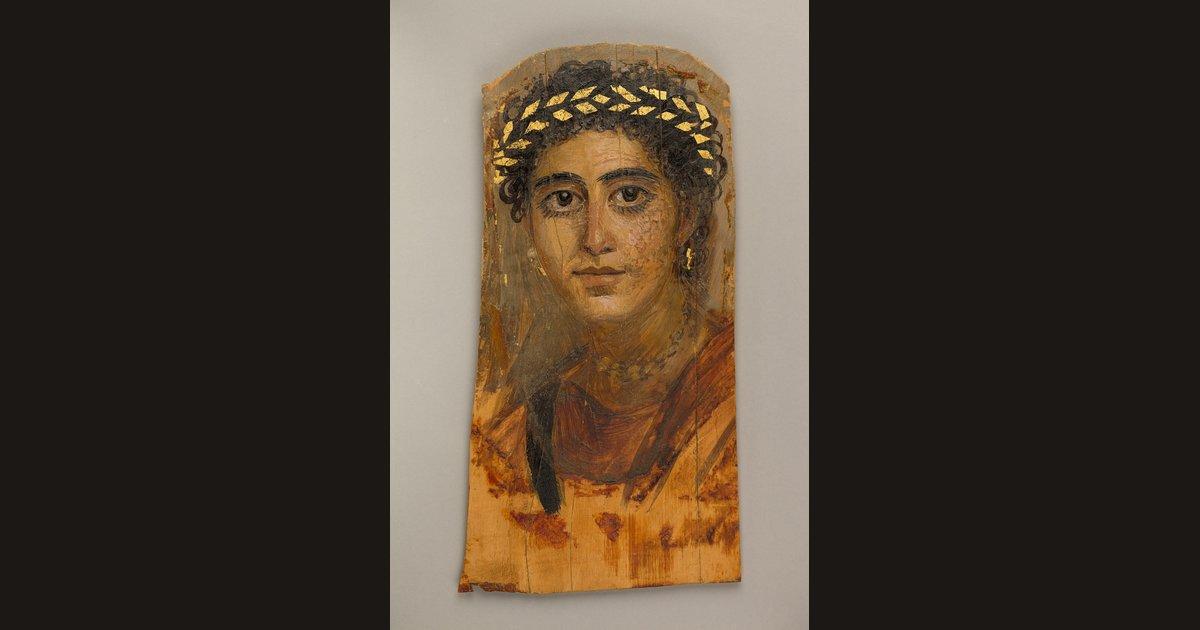
Several of the women's portraits display their wealth. AFP picks out a woman named Isidora, from the first century AD, whose portrait shows a three-tiered gold necklace set with precious stones, pearl earrings and an elaborately curled hairstyle.
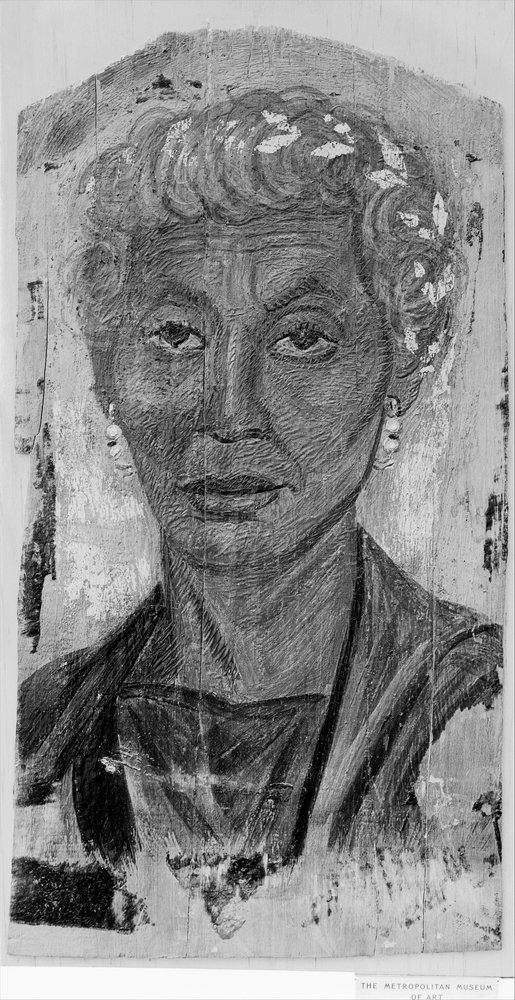
Portrait of an elderly lady with a gold wreath, encaustic on limewood, dated by the Met to 100 to 125 CE. It is not stated to be part of the Rome exhibition. Image: The Metropolitan Museum of Art, Rogers Fund, 1909, via Wikimedia Commons, CC0.
The Tondo of the Two Brothers
The work at the center of the loan is a round double portrait from the Egyptian Museum in Cairo, known as the Tondo of the Two Brothers. AFP dates it to the time of the emperor Hadrian and describes two curly-haired young men, possibly brothers, with soulful eyes, while ARTnews dates it to the second century. Parisi Presicce, who is Rome's top official for cultural heritage, called it an "absolute masterpiece, perhaps the most important pictorial work to have survived from antiquity."
Before it could travel, the panel needed repair. ARTnews reported in October that the Egyptian Museum spent three weeks restoring it in Cairo, together with Italian conservators from the Museo dell'Ara Pacis. Termites had eaten away part of the painting, and the team was able to recreate some of the features of one of the two figures.
The restorers also corrected the work of earlier hands. According to ARTnews, previous experts who had retouched the painting had set pieces showing one figure's mouth and chin in the wrong place, and these were put back. The museum in Rome says the restoration was carried out in Egypt by Italian restorers as part of the exhibition project.
The tondo has never left Egypt before, according to AFP, ARTnews and the museum. Sherif Fathy, Egypt's minister of tourism and antiquities, said that "The restoration of the Tondo of the Two Brothers is an important example of what can be achieved through international cooperation in the preservation and study of cultural heritage," ARTnews reported. AFP adds that organizers describe the show as a "milestone" collaboration between Italy and Egypt.
There is no freely licensed photograph of the Cairo tondo that can be shown here, so it is described in words only.
Questions that remain open
For all the attention the portraits receive, Parisi Presicce said that "countless questions" remain about them, and he set out several of them at the press conference. "Were they made earlier and kept until the moment of death? Were they painted at the time the deceased was buried? Were they panels that were hung in homes, in residences?" he asked.
One piece of physical evidence bears on the last of those questions, since AFP reports that a nail found at the top of one of the portraits makes the idea of hanging them at home plausible, in the curator's view. That would mean that at least some of the faces were seen by family members for years before they went into a tomb. Studies of individual mummies have also found mismatches, such as a portrait that looked older than the four-year-old boy it covered, which keeps the question of when they were painted alive.
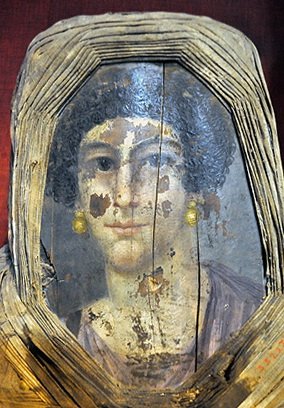
Portrait of a woman, possibly from Hawara, dated to AD 60 to 70, in the Egyptian Museum, Cairo (CG 33223). It is not necessarily one of the works in the Rome exhibition. Image: Egyptian Museum, Cairo, CG 33223. Public domain, via Wikimedia Commons.
The painter Amedeo Modigliani is quoted by AFP as having said of the Fayum portraits, "These people are not dead." Hisham El-Leithy, secretary-general of Egypt's Supreme Council of Antiquities, made a similar point at the Rome launch. "They are people like us, we look at them, they look back at you across 2,000 years," he said. "That is the power of the portrait."
Portrait of a young woman in red, encaustic on limewood with gold leaf, dated by the Met to 90 to 120 CE. It is shown here as an example of a Fayum portrait and is not stated to be part of the Rome exhibition. Image: The Metropolitan Museum of Art, Rogers Fund, 1909, via Wikimedia Commons, CC0.
By Aris Manus
Sources
- AFP. November 3, 2026. Egyptian mummy portraits show antiquity's piercing gaze in new Rome show. https://www.afp.com/en/egyptian-mummy-portraits-show-antiquitys-piercin…
- Museo dell'Ara Pacis. Il potere del ritratto. Egitto e Roma. I volti del Fayum (exhibition page, in Italian, read November 3, 2026). https://www.arapacis.it/en/node/1018884
- Greenberger, A. October 13, 2026. Ancient Fayum Mummy Portrait Gets Fresh Restoration, With Rare Plans to Leave Egypt for Italy. ARTnews. https://www.artnews.com/art-news/news/fayum-mummy-portrait-egypt-restor…
- The Metropolitan Museum of Art. Collection records 09.181.5, 09.181.6 and 11.139 (Roman Period panel portraits and mummy). https://www.metmuseum.org/art/collection/search/547697