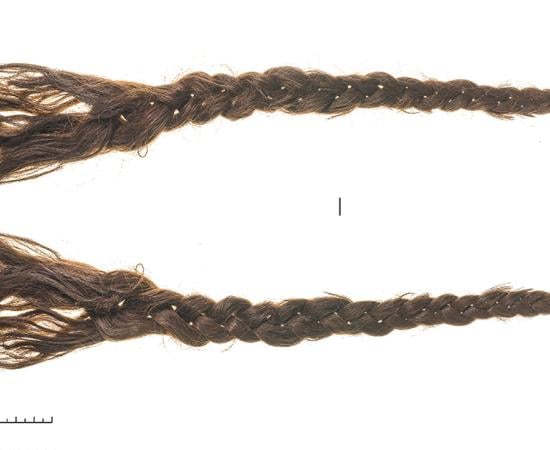

A strand of hair six centimeters long, taken from a girl of about eight who was buried on the Chuscha mountain in Argentina, has been read like a calendar. Each centimeter stands for roughly one month of growth, so the strand covers about the last six months of her life. The chemistry inside it changes in the final segment.
That timeline is one result of a newly published study in the journal Antiquity, led by Dagmara Socha of the University of Warsaw. Her team tested hair and nails from eight frozen mummies of children and young women sacrificed at mountain shrines in Peru and Argentina during the Inca state ritual known as capacocha. The paper appeared online on November 3, 2026, and is open access under a Creative Commons Attribution license.
A ritual for the mountain gods
The authors describe capacocha as one of the most sacred rituals performed in the Inca Empire. Children of both sexes and young women were offered to the most important deities, which in the provinces were often identified with mountain summits. The study says the ritual was often conducted in response to events such as drought, famine or political instability. Smithsonian Magazine notes that the friar Martín de Murúa wrote that the ceremonies were meant to ensure there would be "no famine nor lack of fruits of the earth, nor would there be drought, nor pestilence, nor rebellion."
The role of the children, in the paper's words, "was to act as messengers between the living community and the world of gods and ancestors." The authors add that the ritual also had a political side, because by regulating offerings to provincial deities the Inca state was able to assert control over local communities. Readers can find more background in an overview of the capacocha ritual and why the Inca practiced it.
Eight individuals from five volcanoes
According to the study, seven of the eight individuals were female. They came from Ampato, Sara Sara, Chuscha, Quehuar and Llullaillaco. Johan Reinhard, a co-author of the study, and Miguel Zarate found the girl of about 14 designated Ampato #1 in 1995, and she later became known as the Ampato Maiden. A second girl from the same mountain, Ampato #4, was about 10, and the paper says scans suggest hers was a secondary burial. The Sara Sara mummy was a girl of about 14 found in 1996, and the Quehuar mummy was a girl of about 10.
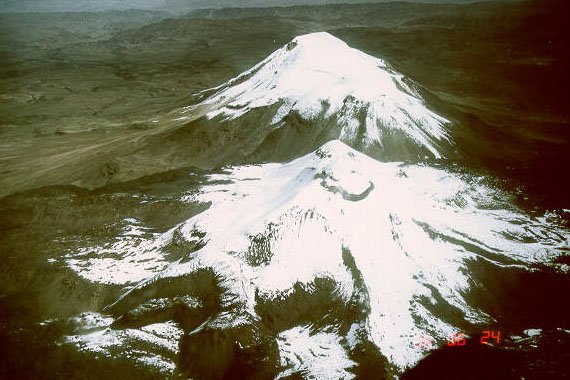
Sabancaya volcano in the foreground with Nevado Ampato rising behind it, seen from the air from the northeast. Two of the individuals in the study were found on Ampato. A context image of the mountain only. Photo: Norm Banks, U.S. Geological Survey, via Wikimedia Commons, public domain.
The Chuscha girl had a harder path to the laboratory. The authors write that she was discovered by grave robbers in the 1920s and sold to private collections before reaching the Museum of High Mountain Archaeology in Salta, Argentina. On Llullaillaco, Reinhard and Constanza Ceruti found three children in 1999 at an elevation of 6,715 meters (about 22,030 feet). They were a girl of about 14, a girl of about six and a boy of about seven. The paper calls the site currently the highest archaeological site in the world, and a recent study tied the Llullaillaco sacrifice to Inca imperial expansion.
How hair and nails keep a record
Most chemicals that enter the body become embedded in the keratin of hair and nails, so traces of plant compounds can survive for centuries in frozen remains. The team used liquid chromatography with tandem mass spectrometry to search for 10 compounds, including cocaine and its breakdown product benzoylecgonine, cocaethylene, harmine, mescaline and DMT. "Recent advances in toxicology now allow for the identification of low concentrations of such substances," Socha said in the Antiquity release.
Six individuals were tested through hair and two, Ampato #1 and Quehuar, only through their nails. Hair shows roughly when a substance was taken, but the study notes that nails take up chemicals from both the nail root and the blood vessels beneath, so no precise timeline can be drawn from them.
Coca, alcohol and a single vine compound
Cocaine and benzoylecgonine turned up in all six hair samples, which the authors read as evidence of coca leaf chewing. The two nail samples showed no cocaine, and the paper reports that contamination from environmental pollutants made the nail results difficult to interpret. The Chuscha and Sara Sara mummies had both tested negative for coca in earlier studies, a contrast the authors say shows the value of repeating older analyses with newer instruments.
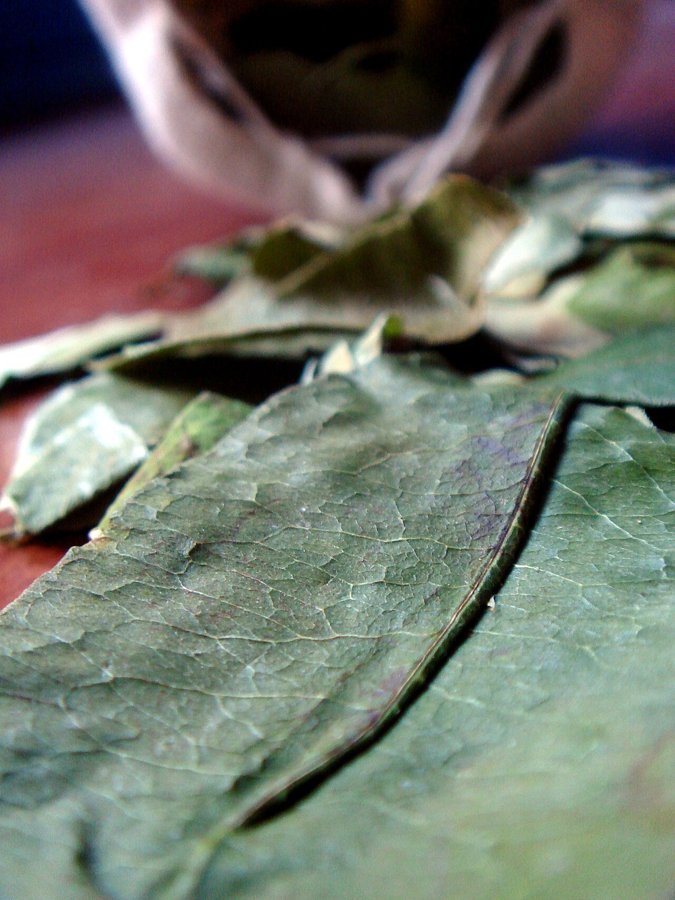
Dried coca leaves photographed in the Andes. The study links cocaine in the hair samples to coca chewing. A context image, not from the burials. Photo: 00dann, via Wikimedia Commons, CC BY 2.0.
Grave goods found with several of the children tell a similar story, since the paper notes that coca quids were found in the mouth of the older Llullaillaco girl, and that male figurines from Ampato, Llullaillaco and other peaks show bulging cheeks that suggest coca chewing. Spanish chroniclers recorded coca as a medicine for altitude sickness, an offering to the gods and something placed in the mouths of capacocha victims before their deaths.
Cocaethylene forms in the liver only when cocaine and alcohol are present together. Table 1 of the paper lists it in the hair of four individuals, the Chuscha girl and the three Llullaillaco children. The Antiquity release describes evidence of alcohol in four mummies, possibly from the maize beer chicha. Earlier research had found chicha residues in vessels buried with the Llullaillaco children, and readers can learn more about chicha de jora and its place in Inca tradition.
The hair of the Chuscha girl adds a sequence to this picture, because cocaine levels fluctuated across the six monthly segments and fell in the last one, and cocaethylene appeared only in the segment closest to the scalp. The authors suggest this probably reflects entry into the final stage of the ritual. They caution that the pattern could also be an artifact of preservation and of the body's breakdown of cocaine.
The result that has drawn wide press attention rests on a single sample. Harmine, at 0.6 picograms per milligram, was found in the nail of Ampato #1, the girl also called Juanita, whose story is told in an account of the Inca Ice Maiden. "Harmine is an alkaloid associated with Banisteriopsis species, one of the principal plants traditionally used in the ayahuasca beverage," Socha said in the release. "It may indicate that a harmine-containing beverage had a specific role in ceremonies connected with this particular sacred mountain."
No DMT, mescaline or other hallucinogenic compounds were detected in anyone. The authors write that Banisteriopsis and related plants grow only in the Amazon rainforest and were likely traded over long distances. They suggest the vine may have been taken for its medicinal value, and that its antidepressant properties could have been used to calm the children. This remains a hypothesis built on one nail from one person.
A ritual that may have varied
From these differences, Socha's team proposes that capacocha changed from place to place. "What we are seeing is that the capacocha was not a single standardized ritual, but rather, the Incas appear to have adapted it to different cults and local religious traditions," she said in the release.
The paper itself words this carefully, saying the observed differences "may derive from distinct prerogatives of mountain deities and local variation in the course of the rituals." It also reports that all individuals originally buried on Ampato and on Llullaillaco received the same substances, which points to the mountain rather than the individual child. However, comparisons across sites are complicated because some results come from hair and others from nails, and because burial conditions can reduce the traces that survive.
What the chemistry cannot say
The chemistry cannot say what the children felt or how they understood what was happening to them. "We cannot reconstruct the children's emotions or determine precisely how they experienced these events," Socha told New Scientist, as quoted by Smithsonian. "However, we should not assume that being selected for a prestigious religious ceremony necessarily meant that the experience was not frightening or traumatic."
The research builds on a 2022 analysis by the same group of two other children from Ampato, which also detected harmine, and which was covered in an earlier report on the Ampato findings. The authors now say further analysis of hair samples is needed for Ampato #1 and Quehuar. Those tests could show whether the faint signal in one girl's fingernail belongs to a wider pattern on her mountain or stands alone.
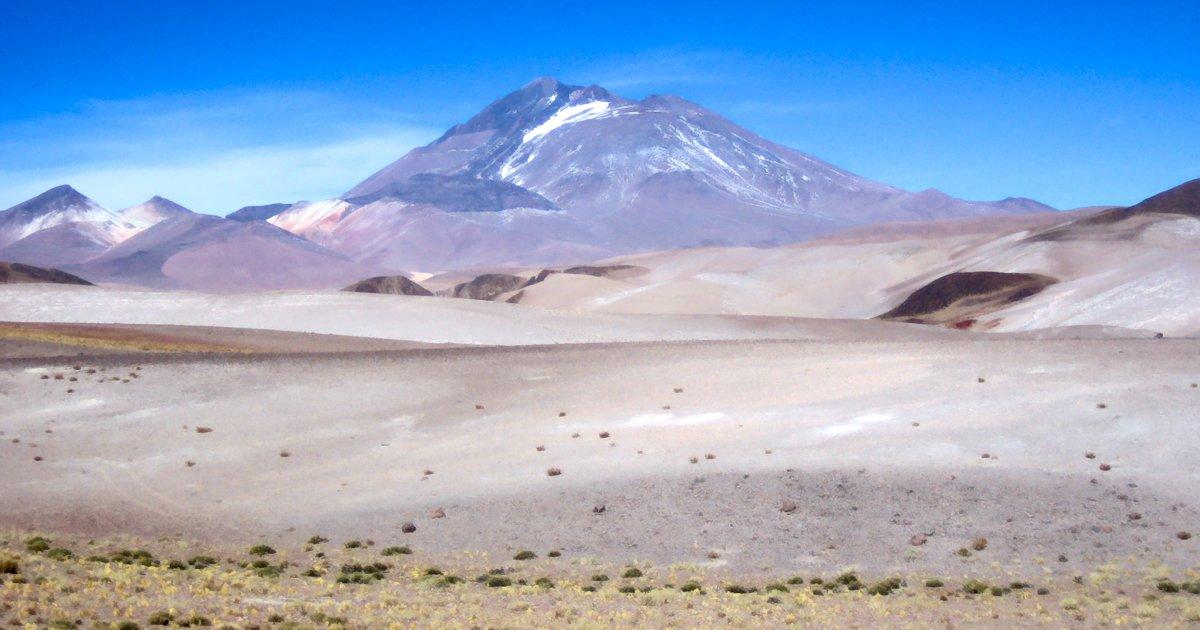
Llullaillaco volcano in Salta province, Argentina, where three of the children in the study were buried near the summit. A context image of the mountain, not of the burials. Photo: Lion Hirth, via Wikimedia Commons, public domain.
By Aris Manus
Sources
- Socha, D., Sykutera, M., Martinez Sulca, W., Recagno, G., Reinhard, J., Zigaran, F., Bernaski, M. and Grupp, F. 2026. Toxicological studies on the Inca frozen mummies from volcanoes in Peru and Argentina. Antiquity, First View. Open access, CC BY 4.0. https://doi.org/10.15184/aqy.2026.10439
- Antiquity Journal. November 3, 2026. Analysis of Inca mummies identifies the drugs used in their most important sacrificial ritual (news release). https://www.antiquity.ac.uk/news/2026/analysis-inca-mummies-identifies-…
- Sagar, S. November 4, 2026. Forensic Analysis of Frozen Inca Mummies Reveals That Sacrificed Children Were Plied With Coca Leaves, Corn Beer and Ayahuasca Compounds Before Death. Smithsonian Magazine. https://www.smithsonianmag.com/smart-news/forensic-analysis-of-frozen-i…
- Woodford, J. November 3, 2026. Inca child mummies were drugged before being sacrificed. New Scientist. https://www.newscientist.com/article/2596878-inca-child-mummies-were-dr… (not consulted directly, Socha's quote is relayed by Smithsonian)