
Some time in the second quarter of the fifth century AD, a man of about 50 was laid to rest in an oak boat on the marshy North Sea coast of northwestern Germany. His community covered the boat with wooden panels like a small roof, set a carved chair outside it and placed a footstool at his feet. Fifteen centuries later, the DNA in his heel bone and one of his teeth has added two surprises to that careful burial.
According to a study in the journal iScience, led by Daniel Anton Myburgh of the Institute of Clinical Molecular Biology at Kiel University, the man's genome clusters with people who lived along the Roman frontier on the Danube. His remains also held the DNA of Mycobacterium leprae, the bacterium that causes leprosy, from a branch that the Kiel team says had not been detected in Central or Northern Europe before. The paper was published online on October 15, 2026, and the university newly publicized the results on November 3.
A cemetery on a dwelling mound
Fallward lies in the triangle of land between the Elbe and Weser rivers, near the village of Wremen in the district of Cuxhaven. The settlement stood on an artificial dwelling mound, called a terp or wurt, built on an old beach ridge running parallel to the coast. In the study's words, such mounds "offered safe ground against storm surges, high tides, and flooding" at a time before dikes had been built.
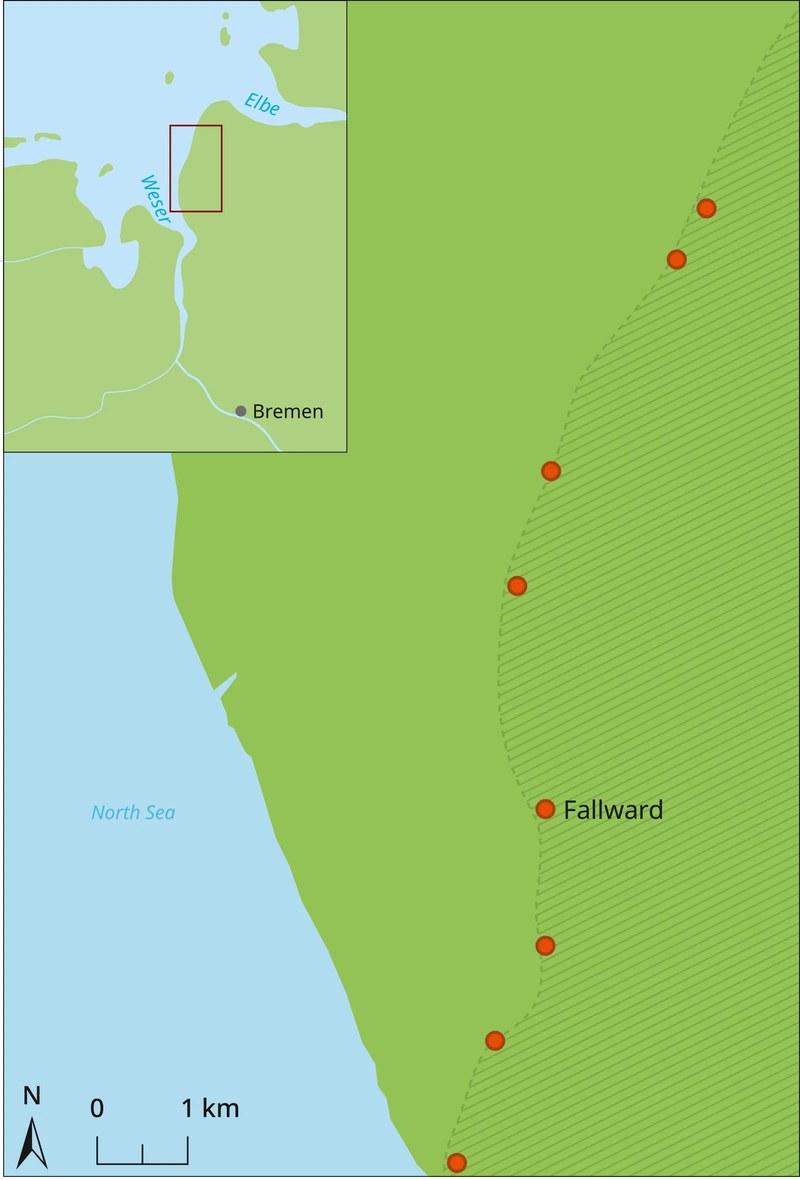
Fallward and seven other dwelling mound settlements along the ancient coastline between the Weser and the Elbe. The hatched area shows the marshland of the fourth and fifth centuries. Figure 1 of the study, resized. (Map: Myburgh et al., iScience 2026, CC BY 4.0)
Excavations in the 1990s uncovered a cemetery beside the settlement that was in use from the end of the third century to the late fifth century AD. The authors count around 200 cremation burials and 60 inhumation graves. Many grave pits were dug deep into the marsh clay, and in those constantly damp conditions wood, textiles, furs and plant materials survived in remarkable condition.
The settlement itself gradually declined over the fifth century and was likely fully abandoned by its end, the authors write. They link a similar drop in activity along the North Sea coast to migrations to Britain recorded in written sources of the period. Kiel University says the Fallward finds are now being fully analyzed for the first time in a project funded by the German Research Foundation at the Lower Saxony Institute for Historical Coastal Research (NIhK) in Wilhelmshaven, with a focus on objects that were lifted in blocks at the time and stored frozen.
The boat, the chair and the belt
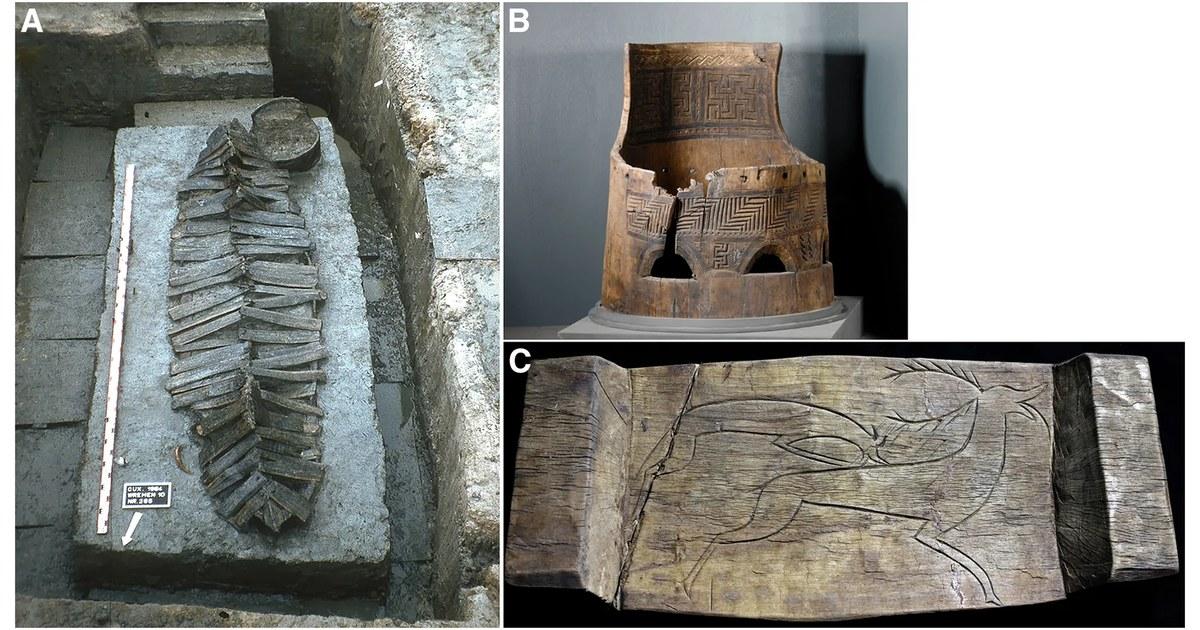
The man was buried in grave 265, which the researchers label G265. The study describes "a boat over four meters in length, which was covered with wooden panels forming a roof-like structure." His body lay on a reed mat, and fish bones and a small box shaped like a water bird were found inside the boat.
Outside the boat stood a block chair made from an alder trunk, decorated with notched carvings and presumably once painted. Arkeonews reports that it is known as the "Throne from the Marsh," and the paper notes that the chair is often interpreted as a throne and considered a symbol of authority or power. At his feet was a maple footstool with a hunting scene and a runic inscription on its underside. Neither the paper nor the Kiel release gives a reading of the runes, so their wording is not yet clear.
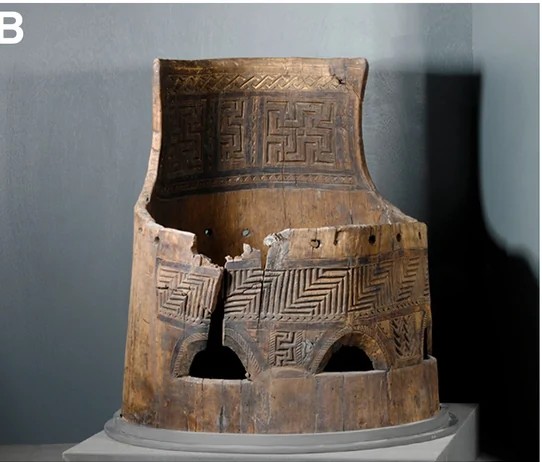
The alder block chair from grave 265, the object known as the Throne from the Marsh. Panel B of Figure 2, cropped from the original. (Photo: R. Kiepe, NIhK, via Myburgh et al., iScience 2026, CC BY 4.0)
The grave also held a game table, a bronze basin, a ceramic vessel and a Roman military belt, among other items. According to the authors, the objects show "clear signs of use and repair," which indicates that none of them were made for the funeral and that they likely belonged to the man or his close family circle. Wood analysis suggests only local timber was used, yet the decoration reflects late antique art and craftsmanship from the Roman world.
Burial in a boat has a long history around the North Sea, and much later examples include a Viking boat grave found under a market square in Trondheim, Norway. The Fallward grave is centuries older and belongs to a different time, and the study does not name the people who used the cemetery beyond describing a community on the North Sea coast.
What the DNA says about his origins
The Kiel team took 12 skeletal samples from 11 individuals, and only three produced enough data for population genetics. Two of them, from graves G14 and G250, aligned most closely with Iron Age and early medieval groups of northwestern Europe and showed more affinity to British Iron Age individuals than to German ones. The authors suggest their relatives might have taken part in the migration across the North Sea, though they present this as a possibility.
The man in the boat grave looked different. His genome clustered with Roman Iron Age and Migration Period individuals from the central and southern Danube frontier, in what is now Croatia, Slovenia, Hungary and Serbia. A spatial model of genetic similarity around AD 500 found its highest probability point more than 1,400 kilometers (about 870 miles) southeast of Fallward, near the old Roman frontier, while also showing elevated values in southern Scandinavia and the Pontic steppe.
However, the authors are careful about what that means. Other tests did not separate his ancestry clearly from that of the two other Fallward individuals, and the study says that because those analyses "lacked sufficient resolution to refine his exact genetic origin, this interpretation should be treated cautiously." Kiel University adds that "the man's exact origins remain unknown," even as it describes his roots in the Danube region.
A leprosy strain from an old branch
Screening for ancient pathogens turned up M. leprae DNA in both his tooth and his heel bone, in enough quantity to rebuild almost the whole bacterial genome. When the team placed it on a family tree of 44 ancient and 185 modern strains, it fell at the base of the group known as branch 4. The only older member of that branch so far comes from an Egyptian mummy dated between the fourth and second centuries BC. That mummy is simply the earliest known sample of the branch, and the study does not trace the man's infection to Egypt.
"He is the first individual from this group to have been identified in Europe," Myburgh said in the Kiel release. Earlier work has shown that leprosy bacteria are very old, as in a 4,000-year-old leprosy genome from Chile and research on the deep ancestry of the two leprosy bacteria.
However, his skeleton shows no bone changes typical of leprosy. "Leprosy is a chronic disease. It can take years for clear symptoms to appear," Almut Nebel of Kiel University said. "Either he was affected by an asymptomatic form of the disease, or the disease had so far only affected soft tissues." Whether he ever felt unwell is unknown, and the authors conclude that he "probably died from an unrelated secondary cause." Today, the World Health Organization notes, leprosy is curable with multidrug therapy.
A boatman, a soldier or a trader
The grave goods offer clues to his life. The boat, the reed mat, the fish bones and his well-developed upper arm muscles led the authors to suggest he may have worked often as a boatman or fisherman. The chair and the quality of the goods are read as signs of privileged status in the local community.
The Roman military belt in the grave raises a larger question about his past. "He could, for example, have been a mercenary in the Roman army who later settled between the Elbe and the Weser. Or he might have undertaken long journeys as a trader," said Ben Krause-Kyora, the study's senior researcher. The paper raises the hypothesis that he was a foederatus, one of the allied fighters who served Rome, but it also stresses that such a belt could have been acquired through trade, inheritance or as a spoil of war.
Whatever his story, the authors see in grave 265 evidence of possible long-distance connections between remote coastal communities and the wider Roman world in Late Antiquity. Their genetic results rest on only three individuals, which the study says should be treated as individual case studies. Analysis of the frozen block finds at the NIhK may yet add more detail to the lives of the people buried at Fallward.
Grave 265 at Fallward: (A) the boat burial covered by wooden panels, (B) the carved alder chair and (C) the footstool with a hunting scene on its underside. Figure 2 of the study, padded to fit. (Photos: R. Kiepe, NIhK, via Myburgh et al., iScience 2026, CC BY 4.0)
By Aris Manus
Sources
- Myburgh, D. A., da Silva, N. A., Romeyer-Dherbey, J. H., Grefen-Peters, S., Jöns, H., Peek, C., Nebel, A. and Krause-Kyora, B. 2026. Paleogenomics reveals leprosy at the late antique burial site of Fallward in northern Germany. iScience 29(11), 117877. Open access, CC BY 4.0. https://doi.org/10.1016/j.isci.2026.117877
- Kiel University. November 3, 2026. Human and Disease Mobility in Late Antiquity (press release). https://www.uni-kiel.de/en/research/details/news/195-fallward-lepra
- Altuntaş, L. November 4, 2026. 1,500-Year-Old Boat Grave in Germany Reveals a Wooden Throne and Roman Links. Arkeonews. https://arkeonews.net/1500-year-old-boat-grave-in-germany-reveals-a-woo…
- World Health Organization. Leprosy (fact sheet). https://www.who.int/news-room/fact-sheets/detail/leprosy