
Fact Check verdict: Fringe. Quarry sources, unfinished blocks and tool experiments all point to skilled Tiwanaku masons, and no machine or outside technology has been found.
Few ruins appear in ancient astronaut programs as often as Puma Punku, a terraced platform at the edge of the Tiwanaku site near Lake Titicaca. A clip from Season 9 of History's Ancient Aliens says the blocks are so precise that ancient astronaut theorists believe they "could not have been built without advanced alien technology." Were they?
According to the archaeological evidence, Puma Punku was built by the Tiwanaku culture from local and lakeside stone, and the blocks still carry the marks of work by hand. How the masons reached such sharp edges is still debated, but the evidence does not require machines or help from outside the Andes.
What the evidence says
Jean-Pierre Protzen and Stella Nair, in their 2013 book The Stones of Tiahuanaco, write that sandstone and andesite, rather than granite, were the main building materials at the site, and that "the sandstone used at Tiahuanaco almost certainly came from the Quimsachata range" to the south of the valley.
The andesite came from farther away, since the nearest andesite formations, the authors note, lie on Cerro Khapia in Peru and at Cerro Calvario near Copacabana, both across Lake Titicaca. They add that petrographic and geological analyses by Mille and Mogrovejo confirm the stones came from those formations, a study known here only through their summary.
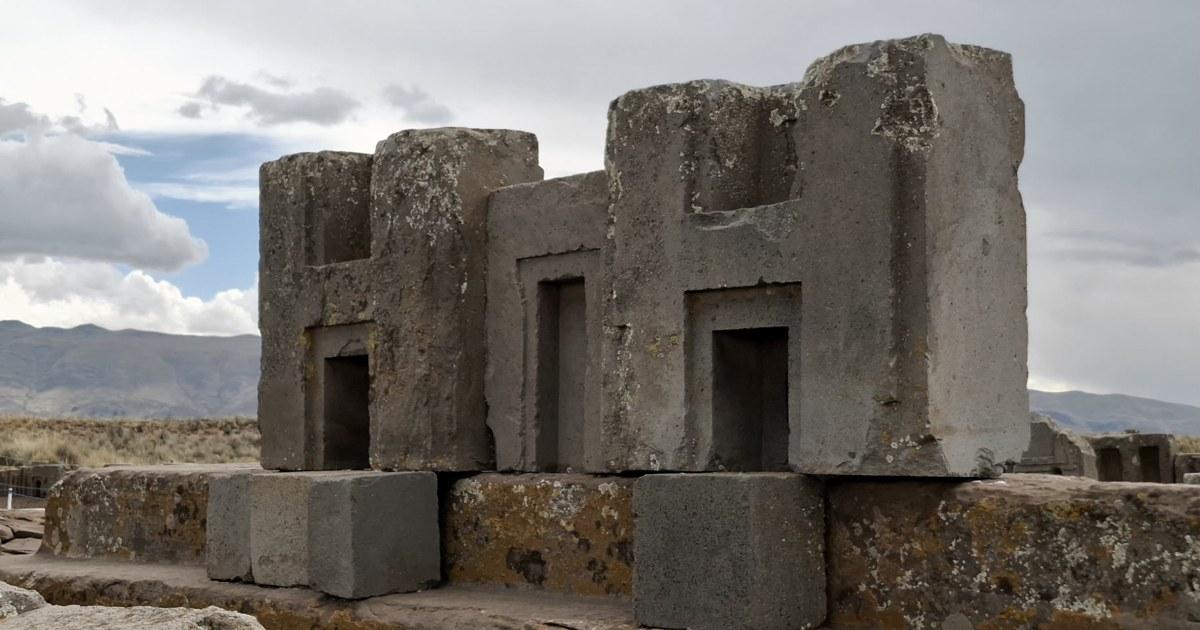
The famous H blocks are smaller than they look on screen, and Alexei Vranich, writing in Heritage Science in 2018, gives one typical H stone as "97 by 99 by 55 cm for an estimated weight of 600 kg." The largest pieces at Puma Punku are sandstone slabs, the biggest about 8 meters long and roughly 83 tons, by his figures.
Vranich dates the occupation of Tiwanaku to about AD 500 to 1000. An earlier claim about the site's age comes from the engineer Arthur Posnansky. Erik Marsh, in a 2019 history of Posnansky's work, writes that he proposed a sequence that "began over 12,000 years ago (the date varies and is as old as 17,000 years ago in some publications)" based in part on astronomical readings of the Kalasasaya temple. Marsh adds that "Posnansky's chronology was discarded shortly after his death with the site's first radiocarbon dates."
In a 2012 study in Radiocarbon, Marsh reviewed the earliest dates from Tiwanaku and concluded that the site was "founded centuries later, most likely around AD 110." Posnansky's 1945 volumes were not read for this check and are known here only through Marsh and Protzen and Nair.
How the blocks were cut
The precision is real, and Protzen and Nair describe some surfaces worked to "a precision measured in plus or minus 1 mm." Vranich describes the stonework as "characterized by planar surfaces, geometric form, precise edges, and internal right angles."
The tools remain the open question, and Protzen and Nair write that "Iron tools were unknown in the Andes before the arrival of the Spanish," and that the few copper or bronze chisels from Tiwanaku held in museums seem too small for building work. Hammer stones aside, they say the construction tools "remain essentially unknown and have yet to be discovered."
To test what stone tools could do, Nair carved a Tiwanaku motif herself. She pounded out the rough shape with hammer stones, then cut the corners with chisels made from broken nodules of flint, jasper and obsidian. With those blades, the authors report, "Nair was able to work within half a millimeter of the final line." They conclude that "rough, unworked flakes of hard stones make excellent stone carving tools."
The two researchers are careful about what that proves. They warn that "replicative experiments, at best, demonstrate that a postulated technology was not impossible," and cannot show which method the masons used. The experiment does show that the precision on the blocks lies within the reach of hand tools in skilled hands.
The repeated shapes also have a simple explanation. Protzen and Nair note that stones laid in a course were interchangeable, so "the stones could be prefabricated, mass-produced even" away from the building. For carved motifs, they suggest that "a reusable template would have greatly aided the work."
The alternative view
The strongest point for the machine idea is that the blocks look modern. Clean right angles, flat faces and repeated forms suggest mass production to a modern eye, and Protzen and Nair agree that no excavated tool has been tied to the building work.
Yet the stones show that the work was not finished. Vranich writes that studies "have confirmed the early observation that both the andesite architecture and sandstone slabs were unfinished," and that several H blocks "had aspects that were clearly in process of being reduced." Protzen and Nair say "many, if not most, of these stones show signs of work in progress."
Vranich also answers the claim that the design came from nowhere. Using 3D printed models of 140 andesite pieces and 17 sandstone slabs, his team found that the form of the gateways follows the design of earlier sites nearby, such as Chiripa on the lake shore.
Moving the stones was hard but possible with known methods. Protzen and Nair describe an experiment by Vranich and colleagues in which a stone of about 9 metric tons was loaded onto a reed boat at Copacabana and sailed about 90 kilometers across the lake. Marsh notes that von Däniken and Graham Hancock drew heavily on Posnansky's ideas.
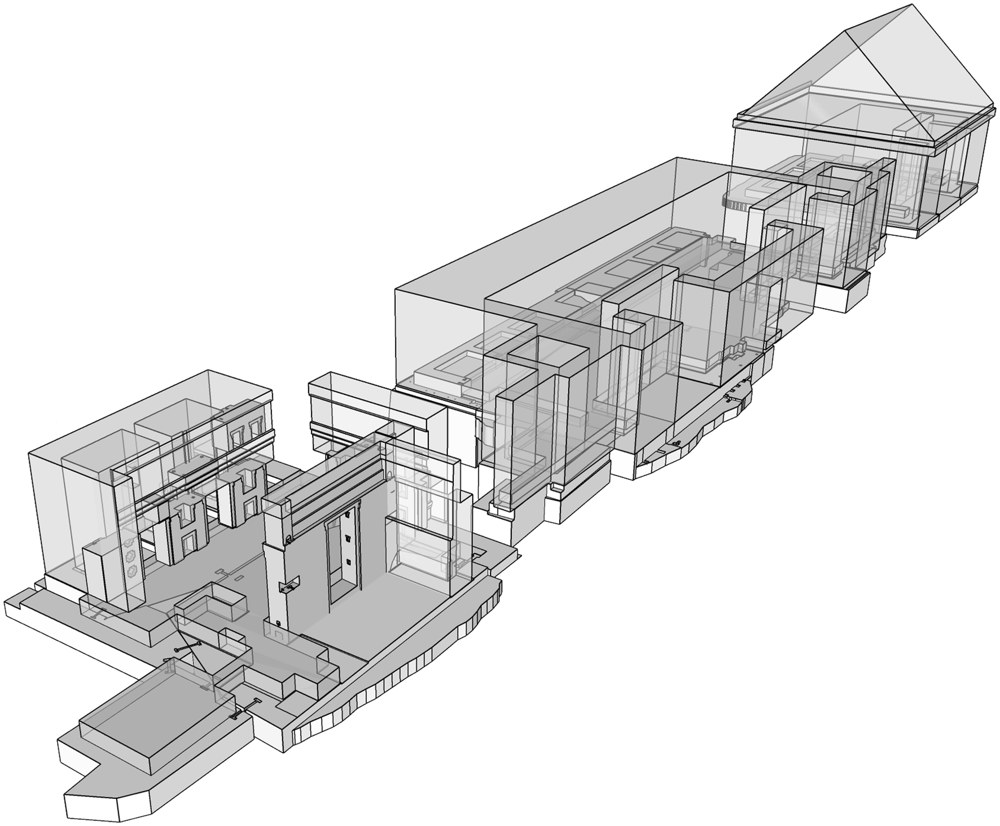
A virtual model of Puma Punku built from scans and 3D printed copies of the surviving blocks. Image: Alexei Vranich, via Wikimedia Commons. CC BY 4.0.
Where this leaves it
According to the sources consulted, Puma Punku's blocks were cut from andesite and sandstone quarried in the Titicaca basin and moved across land and water. Tiwanaku masons shaped them and left many of them unfinished. Exactly which tools gave the edges their final finish is still unknown.
That gap is a real question for archaeology, and it remains open. The idea that machines or ancient astronauts cut the stones remains less likely than skilled work by the people of Tiwanaku, whose temple at Puma Punku still draws visitors.
How we checked this
Read for this check: Vranich's 2018 Heritage Science article, Protzen and Nair's 2013 book The Stones of Tiahuanaco in its open copy, Marsh's 2019 history of Posnansky in the Bulletin of the History of Archaeology, the abstract of Marsh's 2012 Radiocarbon study, and the Ancient Aliens clip page on YouTube. Posnansky, Mille and Mogrovejo appear here only as other authors describe them, because their original works were not read.
No interviews were conducted, earlier Ancient Origins coverage was not a source, and every quote was checked against a saved copy on November 3, 2026.
How we label claims: see How we check evidence.
H-shaped andesite blocks at Puma Punku, part of the Tiwanaku site in Bolivia, photographed in 2025. Photo: Keyan Alejandro, via Wikimedia Commons. CC BY 4.0.
By Aris Manus
Claim by claim
- Fringe: Puma Punku's H blocks were cut with machines or advanced outside technology. Reason: no machine or tool of that kind has been found, and the blocks show hand work in progress.
- Established: The blocks are andesite and sandstone from the Titicaca basin. Reason: Protzen and Nair trace them to the Quimsachata range and to andesite formations across the lake.
- Established: Many blocks were left unfinished. Reason: Vranich and Protzen and Nair both describe stones still being shaped.
- Established: Stone tools can reach the precision seen on the blocks. Reason: Nair worked a motif to within half a millimeter of the line with flint, jasper and obsidian.
- Fringe: Puma Punku is many thousands of years old. Reason: Marsh reports Posnansky's dates were discarded once radiocarbon dates came in.
- Unverified: Which tools gave the blocks their final finish. Reason: Protzen and Nair say the construction tools have yet to be found.
Sources
Vranich, Alexei (2018). Reconstructing ancient architecture at Tiwanaku, Bolivia: the potential and promise of 3D printing. Heritage Science 6: 65. doi:10.1186/s40494-018-0231-0.
Protzen, Jean-Pierre and Stella Nair (2013). The Stones of Tiahuanaco: A Study of Architecture and Construction. Los Angeles: Cotsen Institute of Archaeology Press.
Marsh, Erik J. (2019). Arthur Posnansky, the Czar of Tiwanaku Archaeology. Bulletin of the History of Archaeology 29 (1). doi:10.5334/bha-605.
Marsh, Erik J. (2012). A Bayesian Re-Assessment of the Earliest Radiocarbon Dates from Tiwanaku, Bolivia. Radiocarbon 54 (2).
History. Ancient Aliens: The Impossible Stone Blocks of Puma Punku (Season 9). YouTube. youtube.com/watch?v=RJMZyl6zbKU.