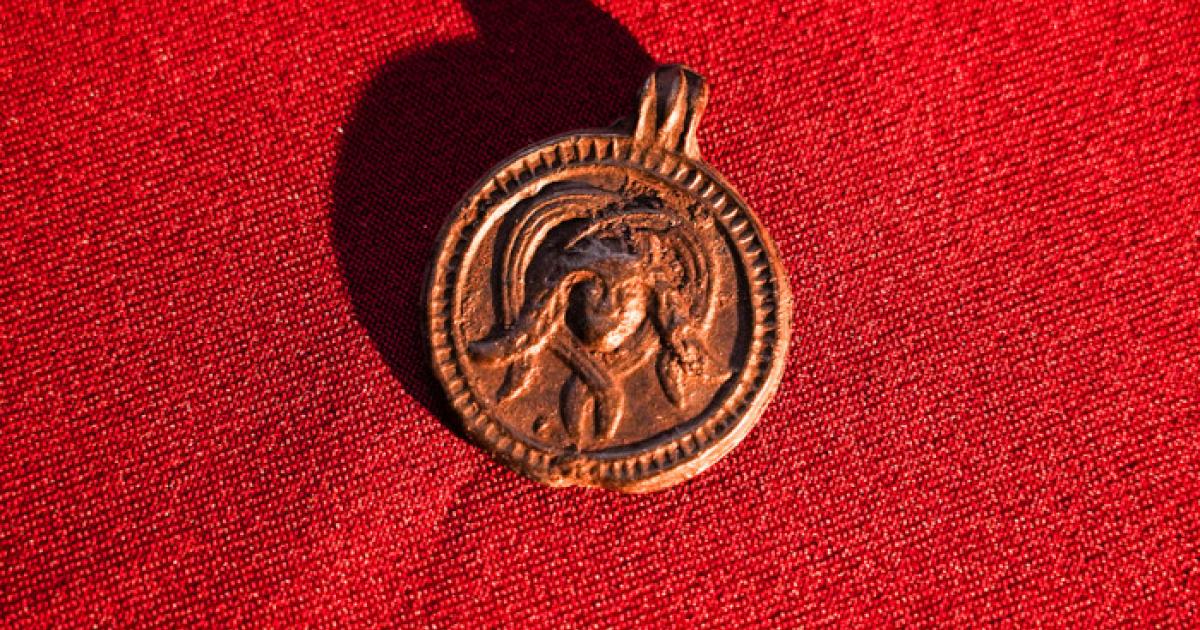

In the northwestern Russian town of Staraya Russa, archaeologists have discovered a serpentine pendant dated to the eleventh century that depicts a Christian warrior as well as a woman with snakes instead of hair. Novgorod State University describes the amulet as made of copper and it is considered to be among the earliest findings from medieval Novgorod. Its imagery shows how Christian belief, older protective traditions and Byzantine connections overlapped in early Rus.
A pendant of two worlds
The find came from the Pyatnitsky excavation, an urban settlement that developed in the eleventh century, according to the original NovSU announcement. The front shows a warrior with spear and shield, tentatively identified as Saint Theodore Stratelates; the reverse shows a woman with serpentine hair.
“The main characteristic of the serpentine pendant is its combination of images that are incompatible, from a strictly dogmatic standpoint,” Sergey Toropov, director of NovSU’s Centre for Archaeological Research, told Archaeology Magazine.
Archaeology Magazine notes that four later examples were already known from the area. It adds to other recent finds which are seen as protective objects, including a medieval wild boar tusk amulet and a Byzantine-era demon-repellent amulet.
- Medieval Wild Boar Tusk Amulet Found in Russia Unveils Elite Warrior Secrets
- Birch Bark Letters Found in Russia are an Ancient Time Capsule
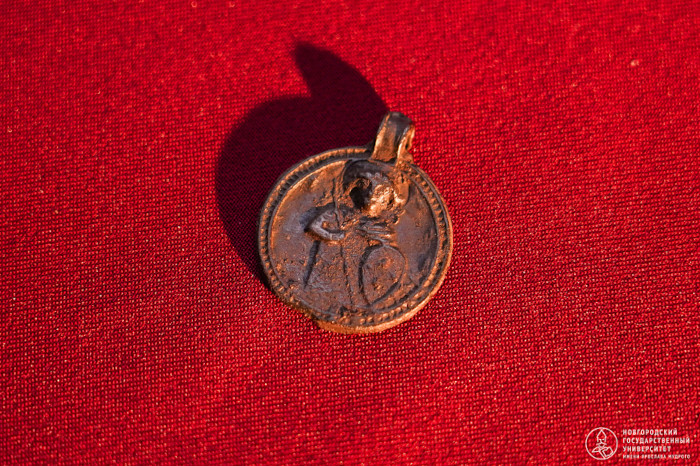
The two-sided pendant was found in an eleventh-century urban layer. Here the front of the piece shows a warrior with spear and shield. (Novgorod State University)
Protection from darkness
These type of medallions came to Rus from Byzantium and were probably used as charms or amulets, with Greek inscriptions used for healing purposes. Toropov connects the warrior with Saint Theodore Stratelates, a saint who is associated with slaying a huge serpentine monster, but rightly adds that this is not certainly a depiction of Medusa on the reverse side.
Ancient Origins’ account of Medusa’s protective powers offers a useful parallel: her head could ward off evil rather than simply represent a monster.
- Archaeologists Unearth Marble Head of Medusa at Roman Ruins in Turkey
- The Real Story of Medusa: Protective Powers from a Snake-Haired Gorgon
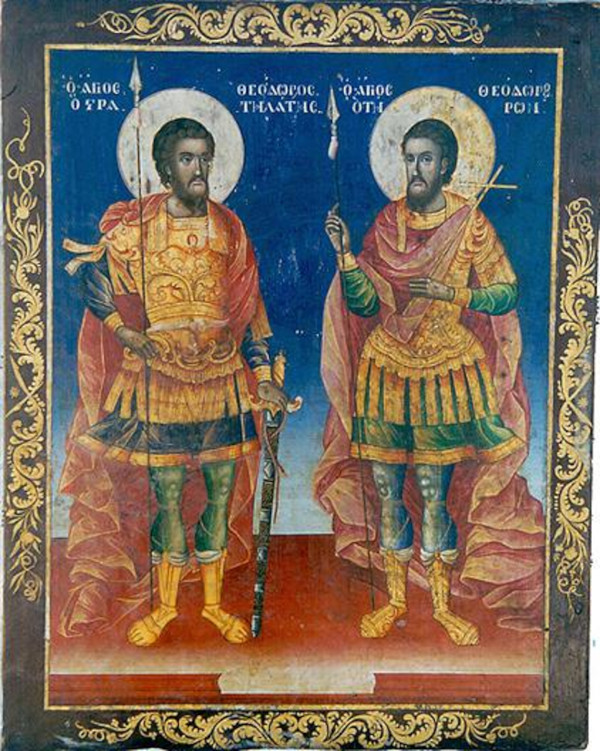
Saint Theodore Stratelates in a later icon; the pendant’s identification remains tentative. (Public domain)
What the amulet reveals
According to NovSU archaeologists, the item indicates the presence of a well-established Christian community in Russia where skilled craftsmen lived and had links to Byzantine culture. Toropov suggests that the owner of the item could belong to the middle class, as the poor could not afford such an item, while the upper class would have chosen gold or silver ornaments. The possibility of local manufacture makes the find especially valuable.
Like the birch-bark letters of medieval Novgorod and the warrior burials of medieval Rus, this small object preserves a vivid trace of a society in transition.
Top image: 11th-century serpentine pendant discovered at Staraya Russa, showing the face with a woman with snakes for hair. Source: Novgorod State University.
References
Archaeology Magazine. 2026. Medieval Serpentine Pendant Uncovered in Russia. Available at: https://archaeology.org/news/2026/09/18/medieval-serpentine-pendant-uncovered-in-russia/
Killgrove, K. 2026. 1,000-year-old ‘snake amulet’ featuring a Christian saint and ‘Medusa’ discovered in Russia. Available at: https://www.livescience.com/archaeology/1-000-year-old-snake-amulet-featuring-a-christian-saint-and-medusa-discovered-in-russia
Novgorod State University. 2026. Archaeologists Find a Pendant Depicting a Christian Saint and “Medusa”. Available at: https://www.novsu.ru/university/press/news/270312/