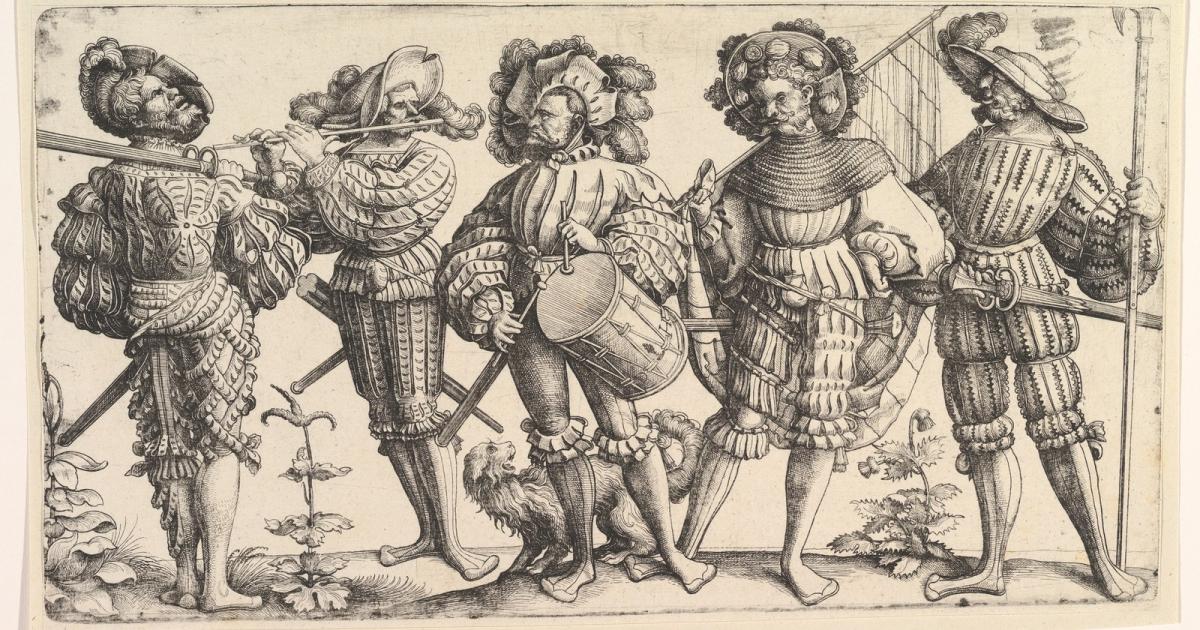

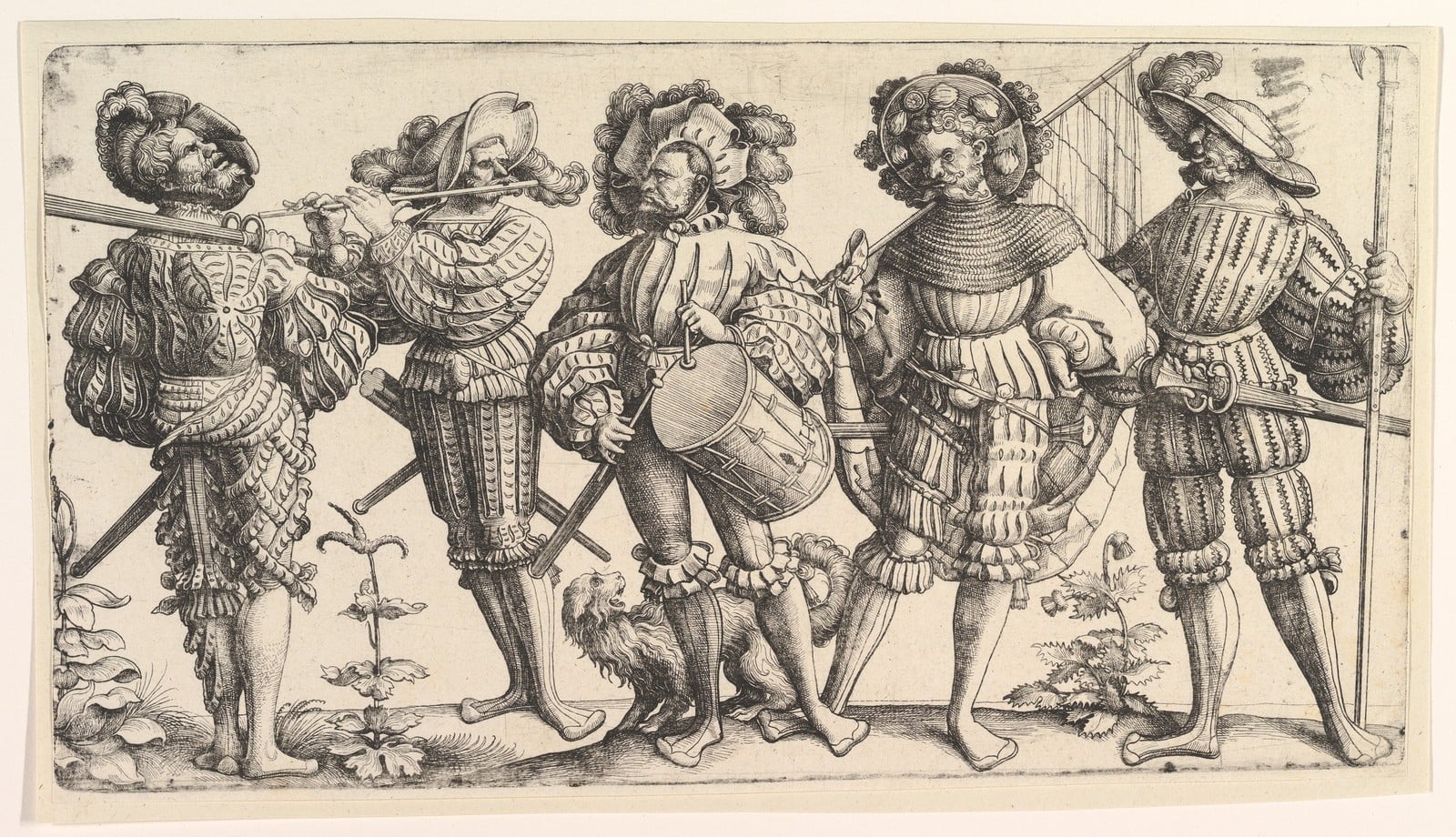
Five German soldiers of the Landsknecht type, with fife, drum, banner and pike, in an etching by Daniel Hopfer of Augsburg, which the Metropolitan Museum of Art dates to about 1520 to 1536. The fourth man appears to wear a cape of mail over his shoulders. Records cited by the Gribshunden team say German mercenaries of this kind were aboard the ship in 1495, a generation before this print was made. (Image: Daniel Hopfer, The Metropolitan Museum of Art, CC0 1.0, via The Met, resized from 3633 by 2089 to 1600 by 920 pixels)
In early October 2026, while documenting a wooden chest on the wreck of the Danish royal flagship Gribshunden, a team of maritime archaeologists came across several fragments of chain mail lying beside it. The University of Southampton announced the find on November 24, 2026, describing the copper alloy armor as exceptionally high in quality. The underwater archaeologist Florian Huber told the German press agency dpa that the rings had been riveted as well as bent shut.
The ship, also known as Griffin, belonged to King Hans of Denmark and Norway, and it sank in 1495 after an explosion and fire while the king was ashore. The project leader is careful to say that fine mail need not mean a high-ranking owner, and the owner has not been identified. So what was the mail doing beneath the forecastle, beside a chest of tools for making bullets?
A Find Made by Chance
According to the Southampton release, the team was working on the superstructure of the ship, including the forecastle, the raised fighting platform at the bow. The work joined researchers from the University of Southampton with colleagues from Södertörn University and Stockholm University in Sweden. Dr. Rodrigo Pacheco-Ruiz, a visiting fellow at Southampton's Centre for Maritime Archaeology and a co-investigator on the project, described where the armor lay:
"The remains of the armour were just below the forecastle, in a section that may have served as a storage area for military gear on the ship."
The project leader, Rolf Fabricius Warming, a doctoral researcher at Stockholm University, told Live Science that the mail was "rather surprisingly, completely exposed." He added, "It was only by chance that we came across it, and it shows just how much is still on the wreck site."
Huber told dpa that the riveting points to careful work (translated by Ancient Origins): "This points to an elaborate and careful manufacture of the protective clothing." According to dpa, the team says this is already the second mail shirt to come from the wreck.
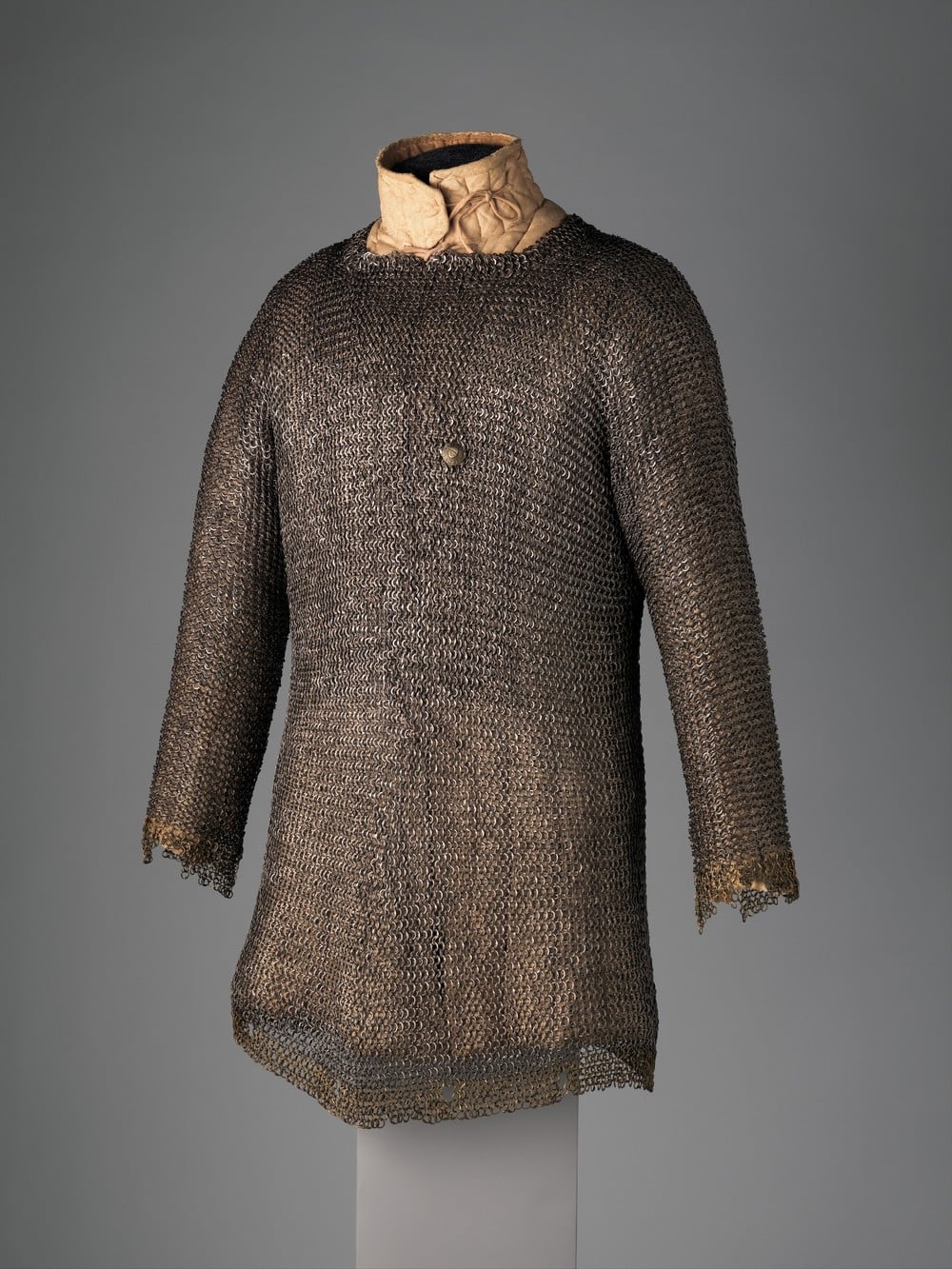
A German shirt of mail of the 15th century, attributed to Nuremberg, which the Met lists as made of steel, copper alloy, iron and brass. It is shown here as comparable mail from the same century and is not from the Gribshunden wreck. (Image: The Metropolitan Museum of Art, Bashford Dean Memorial Collection, Gift of Edward S. Harkness, 1929, CC0 1.0, via The Met, resized from 2920 by 3893 to 1000 by 1333 pixels)
Mercenaries at Sea
Pacheco-Ruiz links the space to the soldiers on board. "Historical sources indicate that German mercenaries, or Landsknechts, were aboard Griffin when it sank in 1495," he said in the release, adding that this part of the ship may have held their equipment, "although we've yet to establish a precise function for the space." Live Science reports that Hans had brought around 150 German mercenary soldiers with him.
Warming, speaking to Live Science, explained why a king would want such men beside him. "It was important to demonstrate military prowess, and the German and Swiss mercenaries were the finest you could get at that time," he said. The quality of the mail, however, does not settle who owned it. In the release, Warming cautioned that it "doesn't necessarily indicate an association with a high-status individual."
"This kind of armour could remain in use for extended periods, often undergoing repairs or being reused, so these fragments may represent older military equipment that was still active."
He told Live Science that the owner is still an open question. "It is probable that the mail armour belongs to the mercenaries, but it could also belong to someone else," he said. Warming added in the release that specialist analysis of how the mail was made, and of its composition, may reveal where it came from.
The Ammunition Chest
The mail came to light during the documentation of what the release calls an ammunition-tool chest, and dpa reports that it lay in the immediate vicinity of the chest. Ancient Origins reported in 2024 on a late medieval weapons chest from the wreck with a similar description, although the 2026 reports do not say whether it is the same one. Huber described the contents to dpa (translated by Ancient Origins):
"The chest contains, among other things, casting molds, lead plates and other tools for making lead balls for early handguns, a remarkable insight into the logistical organization of armament on board."
The release is more careful about the lead. It says that lead objects found during earlier fieldwork may relate to molds used to make ammunition, but that their precise function has yet to be established. This season, the team took samples of lead and other materials from the chest. Warming told Live Science, "We have taken different samples to try to determine the contents of the chest and perhaps find traces of gunpowder."
He also described a wider question the chest raises. "Did the mercenary forces bring their own ammunition and tool kit aboard, or was this supplied by the royal fleet?" he asked. Stored side by side, the mail and the tools for casting handgun shot suggest a fighting force in which old-style armor and early firearms served together, along with the ship's own guns, covered in an earlier report on the late medieval artillery recovered from Gribshunden.
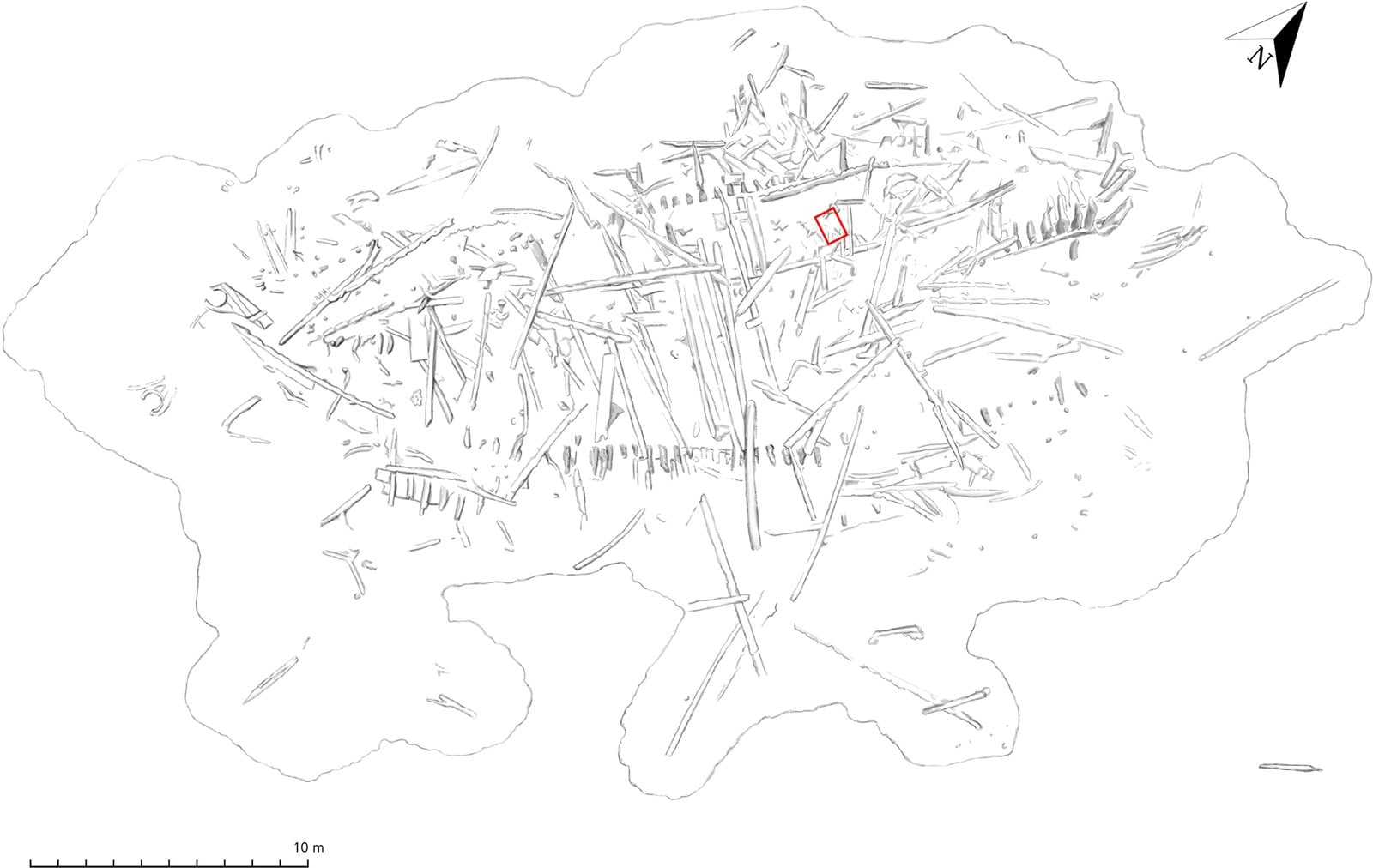
The Gribshunden wreck site as shown in the three dimensional model made during the 2019 to 2021 field seasons. The red rectangle marks the excavation trench in the sterncastle area where the plant remains described in the 2023 study, including spices, were collected. It is not the location of the new mail find, which lay beneath the forecastle at the bow. (Image: Media Tryck, Lund University, original copyright 2022, republished with permission from Frida Nilsson under a CC BY 4.0 license in Larsson and Foley 2023, PLOS ONE, Figure 2, via PLOS ONE, resized from 2100 by 1328 to 1600 by 1012 pixels and converted from PNG to JPEG)
A King's Floating Castle
The release points out that Gribshunden served royal diplomacy as well as war, noting that in 1493 it sailed to England on a diplomatic mission carrying representatives of the king. A 2023 study in PLOS ONE by Mikael Larsson and Brendan Foley of Lund University calls it a "floating castle" that served as the flagship and mobile seat of government for Hans.
According to Larsson and Foley, the ship's last voyage had a political purpose. Hans was sailing with a fleet to a summit in Kalmar, where he expected the Swedish Council to elect him king and so reunite the Nordic region under one crown. Store norske leksikon, the Norwegian national encyclopedia, records that Sweden was then governed by the regent Sten Sture the Elder, who opposed renewing the union and kept Hans from the Swedish throne until 1497.
Larsson and Foley write that Hans carried with him warships, shipboard artillery, a battalion of professional soldiers, and small arms including crossbows and gunpowder weapons. Ancient Origins has also reported on the spices found aboard the royal flagship, which point to the feasting side of that display.
At the end of June 1495, according to the same paper, the ship anchored off Stora Ekön, near Ronneby, and Hans went ashore. While he was away, a fire and explosion claimed the ship, which settled in about 11 meters (36 feet) of water. The dpa report puts the depth at 10 meters (33 feet).
Mail Named in the Chronicles
A 2019 article from Södertörn University notes that chronicles of the time describe how some of the king's most valuable clothes and possessions went down with the ship, and that chain mail was among them. Divers found the wreck in the 1970s, and the Södertörn page says that it took another 20 years for the ship to be identified.
None of the 2026 reports links the new fragments to the king's own wardrobe or to the mail named in the chronicles. However, the find adds a second set of mail to a site that has already given up a wooden tankard and other finds from the 1495 wreck.
What Comes Next
The release says the latest fieldwork combined robotic seabed mapping from an uncrewed surface vehicle, diver-led investigation and high-resolution photogrammetric recording. Speaking to dpa, Warming summed up the season (translated by Ancient Origins): "The new finds thus add to the ever more detailed picture of the military equipment of the royal warship shortly before it sank."
Until the samples are analyzed, the mail's origin and owner remain open. Whether it belonged to a hired soldier from the German lands or to someone else on board, it lay in what may have been a storage area beside the tools for making bullets when the ship went down, and that pairing offers a rare glimpse of how this floating castle was equipped for war.
By Aris Manus
Sources
University of Southampton. 2026. "Medieval armour discovered on centuries old Danish shipwreck." November 24, 2026. Available at: https://www.southampton.ac.uk/news/2026/11/medieval-armour-discovered-o…
dpa. 2026. "Unterwasser-Archäologie: Schiffswrack von 1495: Munitionskiste und Kettenhemd." Handelsblatt, October 27, 2026. Available at: https://www.handelsblatt.com/technik/forschung-innovation/unterwasser-a… (quotations translated by Ancient Origins)
Killgrove, K. 2026. "Medieval chain mail discovered during underwater excavation of 15th-century 'floating castle' that sank off Sweden." Live Science, November 24, 2026. Available at: https://www.livescience.com/archaeology/medieval-chain-mail-discovered-…
Larsson, M., and Foley, B. 2023. "The king's spice cabinet: Plant remains from Gribshunden, a 15th century royal shipwreck in the Baltic Sea." PLoS ONE 18(1): e0281010. Available at: https://doi.org/10.1371/journal.pone.0281010
Södertörn University. 2019. "Gribshunden: a unique piece of history on the bed of the Baltic Sea." October 21, 2019. Available at: https://www.sh.se/english/sodertorn-university/news/research/2019-10-21…
Haug, E., Mardal, M. A., and Petersen, L. I. R. 2024. "Hans (av Danmark, Norge og Sverige)." Store norske leksikon. Available at: https://snl.no/Hans_-_av_Danmark,_Norge_og_Sverige

Enjoyed this? Get UNLEASHED for life, $249 once
Ancient Origins UNLEASHED is our Substack for the deeper, longer stories. Until Monday, November 30 at midnight UK time, you can join for life with one payment instead of a yearly subscription.
- The full paid UNLEASHED archive and every future paid post, for as long as the publication continues
- A Founders certificate
- A vote on upcoming topics
- Optional credit on our Founders page, only with your permission
- One welcome one-to-one discussion
Become an UNLEASHED Lifetime Founder, $249
Places are limited to 20 in total. Use the same email you use (or will use) on Substack. We switch on your paid access by hand after payment, so it is not instant. UNLEASHED only; Ancient Origins Premium is not included.
Want everything Ancient Origins makes? The Founders' Lifetime Pass is $349, paid once: Premium for life, all 29 ebooks, 177 webinar and interview recordings, 64 Magazine issues, AO Kids and the full Atlas.