Archaeologists have unveiled extraordinary details about late medieval shipboard artillery from the wreck of Gribshunden, the royal Danish-Norwegian flagship that sank in 1495. This discovery provides unprecedented insights into the technological foundations that enabled European expansion and colonization across the world, offering a rare glimpse into the ship-gun combinations that would dominate global maritime power for centuries.
According to a from Lund University report, the Gribshunden represents a crucial archaeological bridge between medieval and early modern warfare, carrying artillery identical to that used by Spanish and Portuguese explorers during the Age of Exploration. Marine archaeologist Brendan Foley, who led the study alongside fellow Lund University archaeologist Martin Hansson and medieval artillery expert Kay Douglas Smith, emphasized the significance of these findings for understanding European maritime dominance.
- Europe's Oldest Artillery Cannon Found Off the Coast of Sweden
- Historic Danish Shipwreck Reveals 15th Century Secrets
Revolutionary Ship-Gun Technology at Sea
The Danish royal vessel, built near Rotterdam between 1483-84, carried more than 50 small-caliber guns designed for close-range anti-personnel warfare. These wrought-iron swivel guns, known as serpentines, fired lead projectiles with iron cores and represented cutting-edge naval technology of the late 15th century. The Lund University team successfully recreated these weapons using 3D models derived from the remarkably preserved wooden gun beds found on the wreck site.
"Diving on this late medieval royal shipwreck is of course exciting. However, the greatest satisfaction is when we can actually put the pieces of the puzzle together later on," explains Foley in the Lund University article, highlighting how the interdisciplinary approach combining maritime archaeology with artillery expertise has yielded remarkable insights.
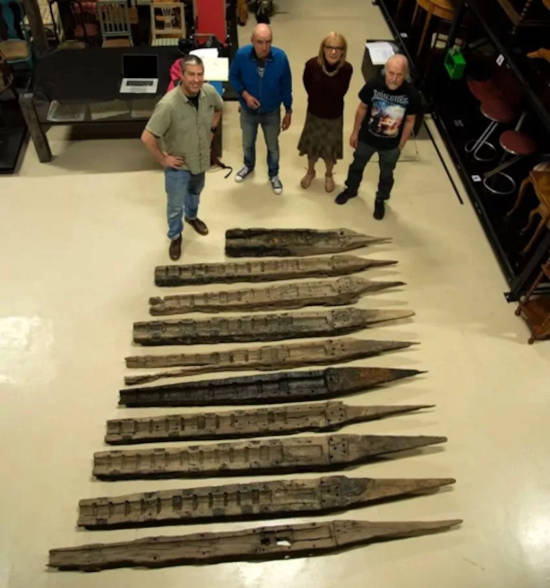
Oak beds of artillery pieces recovered from the wreck of Gribshunden, now curated at Blekinge Museum. (Blekinge Museum/via Lund University)
The preservation of these wooden gun beds in the low-salinity Baltic Sea environment has provided researchers with an extraordinary opportunity to study medieval naval artillery in unprecedented detail. While the iron guns themselves have largely disintegrated, their negative impressions in the oak beds allowed for accurate digital reconstruction of the complete weapons systems.
King Hans' Floating Castle and Political Power
Gribshunden served as more than a warship - it functioned as King Hans of Denmark and Norway's floating castle, enabling royal travel throughout his realm including frequent voyages to Sweden, Gotland, and especially Norway. The vessel represented approximately 8% of the Danish national budget in 1485, reflecting the enormous investment European rulers made in these revolutionary ship-gun combinations.
The ship's final voyage in June 1495 was intended to transport King Hans to a political summit in Kalmar, where he expected to unify the entire Nordic region under a new Kalmar Union. Historical documents describe how an explosion and fire claimed the vessel while anchored off Ronneby, with the king safely ashore. Among the 22 lead artillery shots recovered from the wreck, several show flattening consistent with the explosion that sank the ship.
- Medieval Weapons Chest Amongst Spoils in Sunken Warship
- Beast from the Deep: Rare wooden figurehead salvaged from historic Danish shipwreck
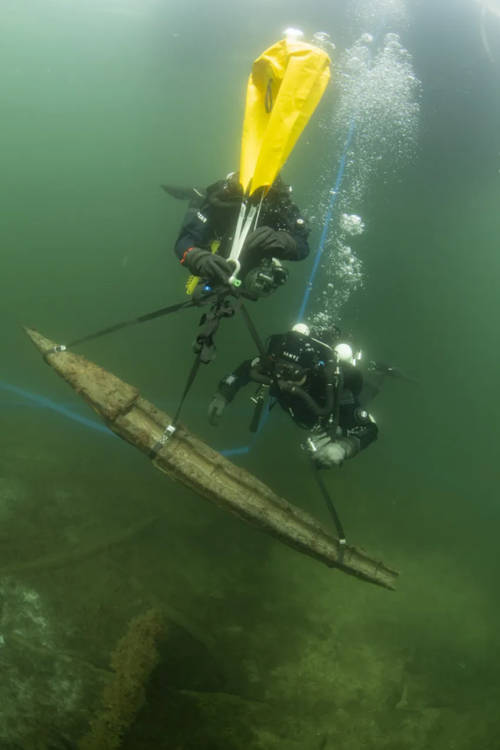
Phillip Short and Brendan Foley recover a gun bed from the wreck of Gribshunden in 2021
Source: Klas Malmberg/via Lund University)
European Expansion and the Carvel Revolution
The study reveals how carvel-built ships equipped with standardized artillery became the technological foundation for European global expansion after 1492. While Gribshunden itself never sailed across the Atlantic, it represents the same ship-gun technology that enabled Spanish and Portuguese explorers to establish maritime dominance from the Americas to the Indian Ocean.
The researchers emphasize that Denmark's failure to compete in Atlantic exploration stemmed not from technological limitations but from political priorities and papal restrictions. King Hans focused on consolidating Baltic control rather than oceanic expansion, while the 1493 papal bull granting Spain rights to the Americas created additional barriers for Catholic European nations before the Reformation.
The unique preservation conditions in the Baltic Sea have made Gribshunden the most complete example of a late medieval carvel warship yet discovered, providing invaluable comparative data to the handful of early 16th-century gun-carrying Iberian wrecks known from the Americas and Indian Ocean. This archaeological evidence fills a crucial gap in understanding how medieval craftsmen refined ship and artillery technologies into the mature systems that remained largely unchanged for over three centuries.
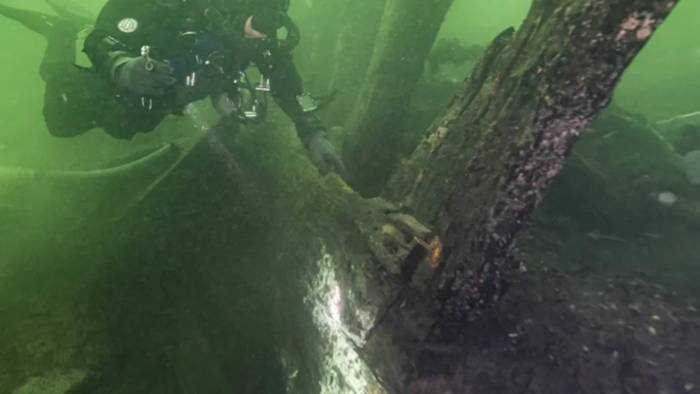
Archaeological diving operations at the Gribshunden wreck site. (Klas Malmberg via Lund University)
The discovery underscores how archaeological investigation of shipwrecks provides unique insights into the technological developments that shaped world history, revealing the maritime innovations that enabled European colonial expansion and fundamentally altered global power dynamics for centuries to come.
Top image: Uniquely preserved artillery from the Gribshunden shipwreck offers unprecedented insights into European colonial technology. Source: Lund University
By Gary Manners
References
Foley, B. et al. 2025. Late Medieval Shipboard Artillery on a Northern European Carvel: Gribshunden (1495). Available at: https://www.tandfonline.com/doi/full/10.1080/10572414.2025.2532166
Lund University. 2025. Uniquely preserved artillery offers clues of European colonisation. Available at: https://www.lunduniversity.lu.se/article/uniquely-preserved-artillery-offers-clues-european-colonisation