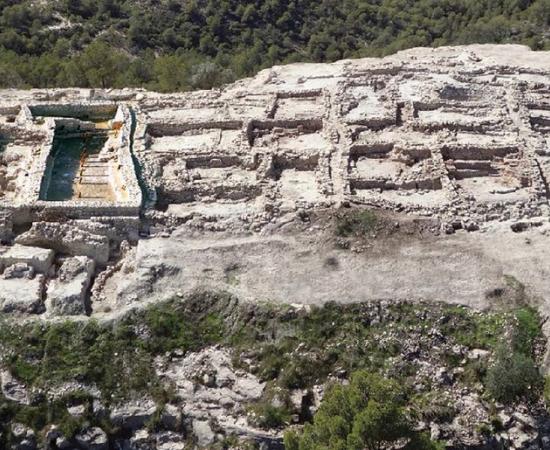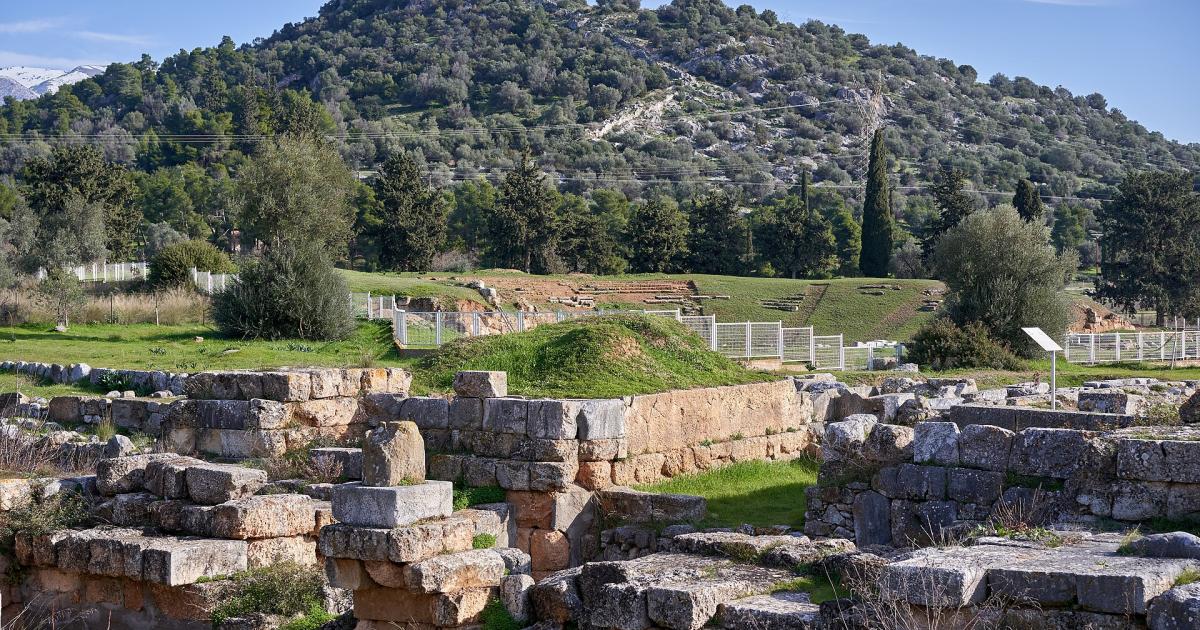

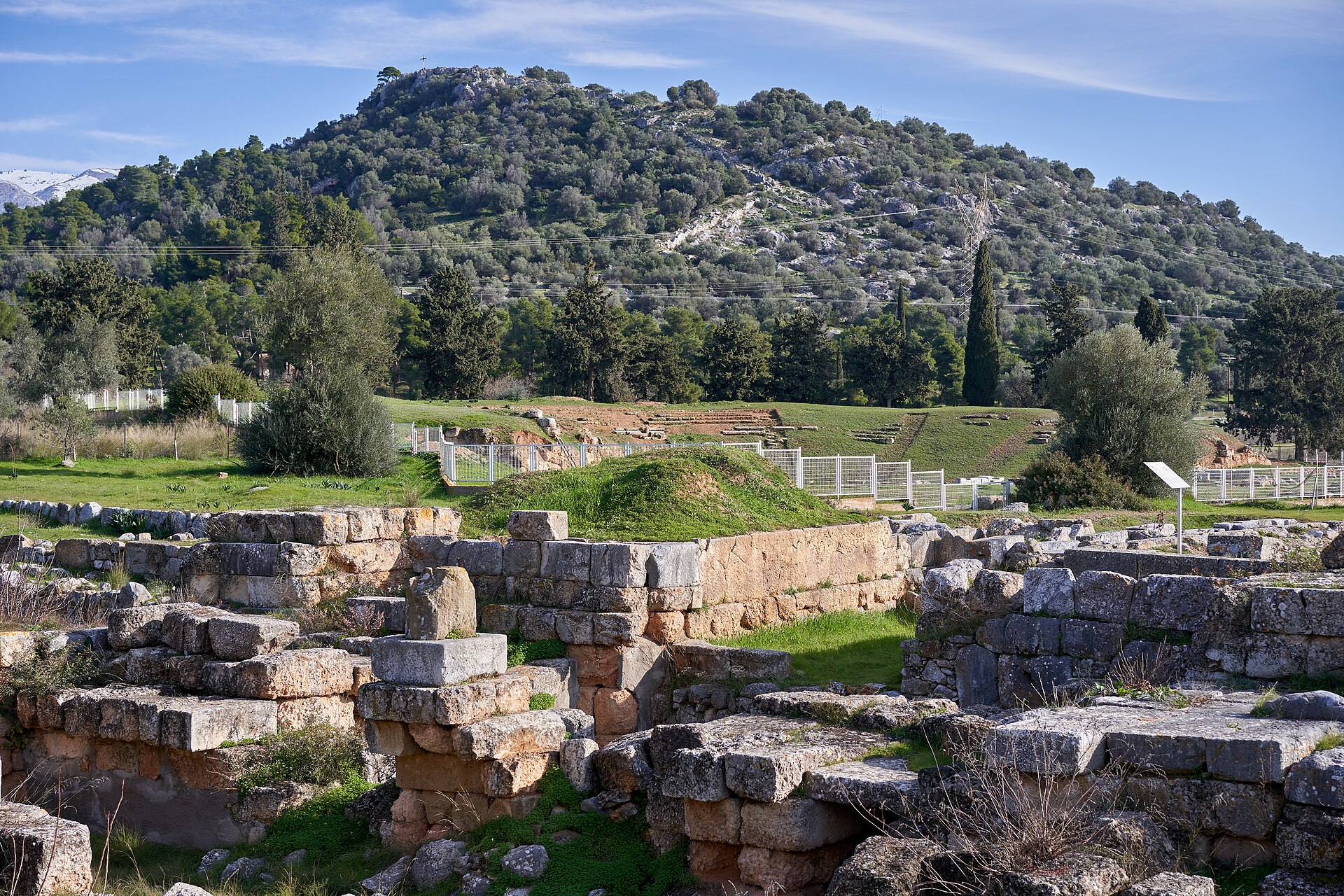
The ruins of ancient Eretria on Euboea, seen from the city's fortification wall, with the theater in the center and the citadel hill behind it. Live Science reports that the sanctuary on Elatias was used mainly by people from Eretria. The mountain itself is not shown. (Image: George E. Koronaios, Wikimedia Commons, CC0, resized from 6,000 by 4,000 to 1,920 by 1,280 pixels, otherwise unaltered)
High on a bare summit of Euboea, the large Greek island northeast of Athens, people climbed for generations to leave offerings in the cracks of the rock. There was no temple and no built altar, only a heap of limestone, a deep pocket of black earth and many broken pots and animal bones. The Swiss School of Archaeology in Greece (ESAG) excavated the spot for the first time in 2026, together with the Ephorate of Antiquities of Euboea, and the English abstract of its annual report says the work confirmed a peak sanctuary in use from the Geometric period to the Roman Imperial era.
So why would anyone haul offerings up a mountain this hard to climb, and for whom? The excavators are careful to say that the answers are still incomplete.
A Summit Above Eretria and Amarynthos
The site lies on Elatias, one of the peaks of the Euboean Mount Olympus. It is not the famous Olympus of northern Greece, which Live Science notes is the country's highest mountain and the home of the gods in the poems of Homer and Hesiod.
According to the Greek text of the ESAG report, translated here by Ancient Origins, the summit of Elatias stands at 1,138 meters (about 3,734 feet) and looks down over the plain between Eretria and Amarynthos. A survey in 2025 recorded a large concentration of pottery there. The location itself supported the idea of a sanctuary, the report adds, because the height and the harsh conditions make the summit unsuited to permanent settlement or to farming.
Excavation leader Chloé Chezeaux told Live Science by email that "mountaintop sanctuaries are not uncommon" in Greece. "The problem is that these sanctuaries often left very little archaeological evidence, sometimes with no visible structures at all, which makes them particularly difficult to identify," she said.
The climb is a hard one even now. The report describes a route of about 3 kilometers (1.9 miles) with a total climb of almost 650 meters (about 2,130 feet), roughly an hour of walking even without a load. A daily trip from Eretria was out of the question, so the team lived in tents on the summit for the whole excavation, which ran from June 5 to June 9, 2026. The 160 liters of water the dig needed had already been carried up in three separate climbs.
A Deposit in the Rock
The team began on the south slope, about 30 meters below the summit, where the survey had found most of the pottery. That area, Sector 3 in the report, produced plenty of material. However, Archaic, Classical and Hellenistic sherds lay mixed together without any coherent layer, and even the deepest pieces were worn, so the excavators concluded that erosion had carried them down from higher ground.
So the work moved up to the summit plateau and the flat ground around it, where the shape of the land favored the build-up of sediment. In Trench 6, opened just a few meters below the plateau, the team made what the report calls (in Ancient Origins' translation) one of the most important discoveries of the season. Under a large heap of limestone, natural cracks in the bedrock held a thick layer of black sediment, rich in organic matter and in archaeological remains.
The excavators followed this deposit to a depth of almost 2 meters (about 6.5 feet), and it yielded several hundred fragments of pottery and a large number of animal bones. No human-made structure was found, yet it was the richest trench of the season.
The bones come mostly from sheep and goats, with some from hares and birds. Several show traces of burning, and some were burnt so thoroughly that they turned fully calcined. "Several of them show signs of burning, sometimes at very high temperatures," Chezeaux told Live Science. "These finds naturally suggest practices involving animal sacrifice and ritual meals, which played an important role in ancient Greek religion."
The report also notes that certain parts of the skeleton turn up more often than others, which may point to a particular way of handling the animals. However, the team stresses that no clear evidence yet allows a secure reading of this pattern, and further study of the bones is planned.
Pottery Across Many Centuries
The pottery covers an unusually long span. The Greek text of the ESAG report places it between the Geometric and Hellenistic periods, and possibly into Roman Imperial times, a more cautious end point than the abstract gives. Among the pieces illustrated are a trefoil-mouthed jug of the eighth century BC and a mold-made relief bowl of the second or first century BC. The Geometric material is new, since it had not been recognized among the surface finds of 2025.
The two sources do not agree on when the visits began. Live Science reports the earliest pottery as dating from at least the ninth century BC, while the director's foreword to the ESAG report describes a site frequented from the eighth century BC, and the oldest piece the report illustrates is the eighth-century jug. Either way, Chezeaux described "an exceptional concentration of pottery" and told Live Science, "This means that people were coming to this summit over several centuries, perhaps even for more than a thousand years." The report adds that such a wide range makes the fill harder to read, since the remains seem to come from repeated activity on the summit that slowly piled up in the crevice.
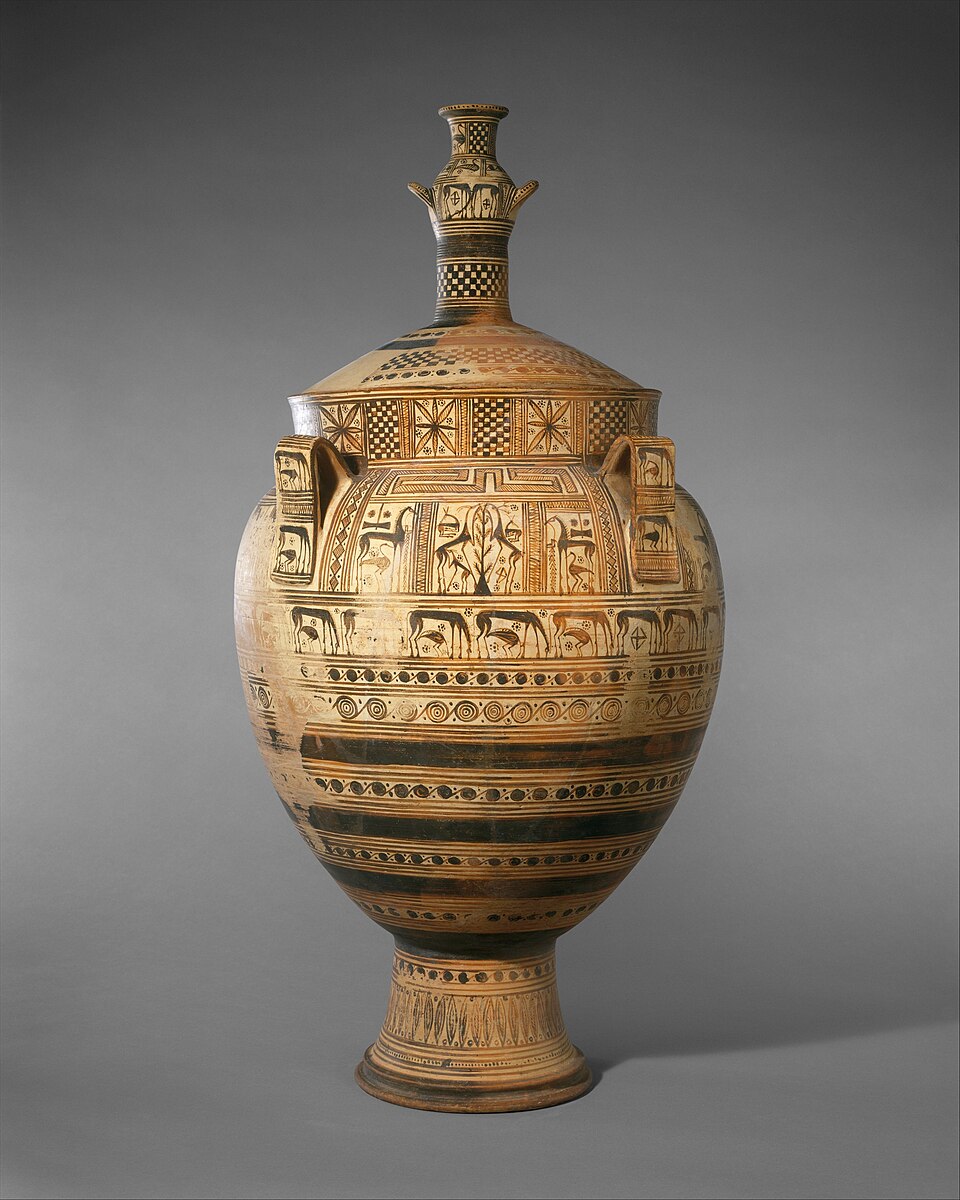
A Euboean krater of about 750 to 740 BC, attributed to the Cesnola Painter, in the Metropolitan Museum of Art. It does not come from Elatias and is shown as an example of Euboean pottery from the Geometric period. (Image: The Metropolitan Museum of Art, accession 74.51.965, via Wikimedia Commons, CC0, resized from 2,978 by 3,722 to 960 by 1,200 pixels, otherwise unaltered)
Artemis, Zeus or Someone Else?
The deity or deities honored on the summit remain unknown for now, according to the report. Zeus is traditionally associated with mountaintops, as Live Science notes. However, the report points to two scratched marks on pot fragments found this season. They are extremely fragmentary, and each keeps a single clear letter that could be read as alpha or delta. If that reading is confirmed, the names of Artemis or Zeus are among the possibilities to be weighed.
There is also a clue from the city below. According to the ESAG report, the epithet Olympia is recorded for Artemis in a Hellenistic dedication found at Eretria, and Live Science reports that the epithet suggests Artemis was worshipped at the summit. The ESAG team is more cautious, and its report states that the evidence is not yet enough to identify the deity.
Artemis was a major presence in this part of Euboea. In the plain below, ESAG located the sanctuary of Artemis Amarysia at Amarynthos, which the school describes as "one of the main places of cult in Euboea." It was identified in 2017 from roof tiles stamped with the goddess's name and inscriptions naming Artemis, Apollo and Leto. Her most famous temple, the Temple of Artemis at Ephesus, stood far away across the Aegean.
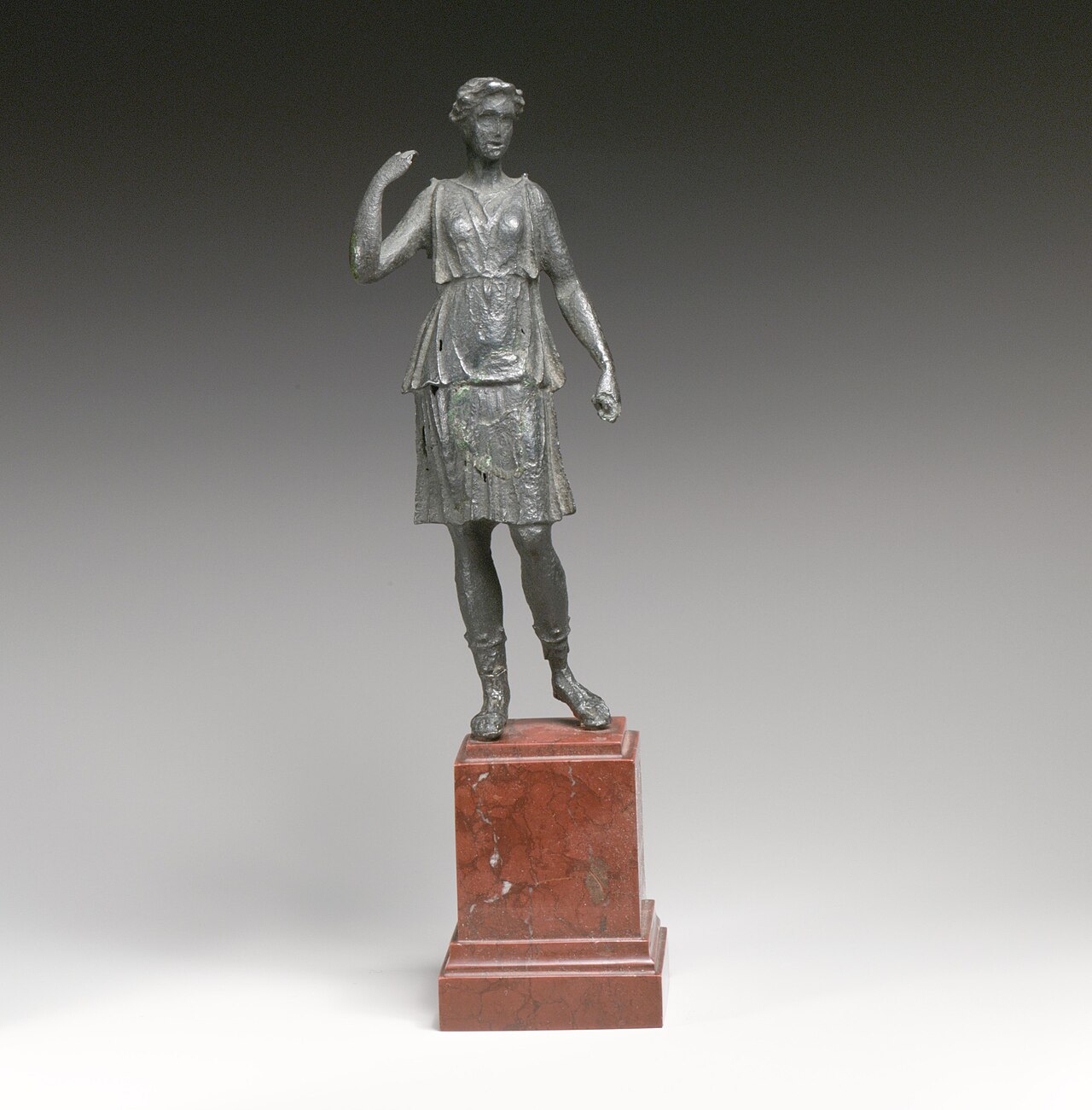
A Greek bronze statuette of Artemis dating from the third to the first century BC, in the Metropolitan Museum of Art. It is shown as an illustration of the goddess, has no link to the Euboean site and does not identify the deity of Elatias, which remains unknown. (Image: The Metropolitan Museum of Art, accession 1980.303.3, via Wikimedia Commons, CC0, resized from 1,928 by 1,960 to 1,280 by 1,301 pixels, otherwise unaltered)
Why Peak Sanctuaries Are So Hard to Find
The ESAG report sets Elatias within a wider pattern. Many Greek sanctuaries lay far from towns on mountains with broad views, visible from far away, and their importance came less from height than from position. The distance and the effort of the climb were part of the experience of reaching them. Zeus was worshipped in mountain sanctuaries, and so were Artemis, Athena, Pan and the Nymphs. Some kept temples and altars, while others are known mainly from potsherds, figurines, ash and burnt animal bones.
A well studied example is the sanctuary of Zeus on Mount Lykaion in Arcadia. Writing in the Penn Museum's Expedition magazine, David Gilman Romano and Mary E. Voyatzis described an ash altar on the southern peak where close to 98 percent of the bones came from sheep and goats.
The report compares the long life of Elatias with mountain sanctuaries in Attica and on Aegina, some of which stayed in use from the early Iron Age into the Imperial era. A cave on the south side of the Euboean Olympus has already been identified as a place of worship, and the excavators now want to explore whether a procession once linked the two sites.
What Drew People to the Summit?
The site adds to a rich picture of religious life around ancient Eretria. "In antiquity, Eretria had a very rich religious life, with sanctuaries both within the city and throughout its territory," Chezeaux told Live Science. "Mount Olympus dominates much of the surrounding region, and its prominent position probably played a role in the choice of this location."
She also stressed the commitment of those who made the climb. "People were willing to devote considerable time and energy to reaching these places, and in our case they seem to have done so over many generations," she said. ESAG says the results "offer new comparative material for the study of Greek peak sanctuaries," and studies now under way should clarify the dates of the site and what happened there. Until then, the name of the deity honored on Elatias remains an open question.
By Aris Manus
Sources
Chezeaux, C., Verdan, S., Allegro, T., Saggini, T., Simosi, A. G. and Fachard, S. 2026. Ανασκαφική έρευνα στον Ελατιά του ευβοϊκού Ολύμπου (Excavation on Elatias of the Euboean Olympus). In Swiss Archaeology in Greece: News from the Field 2026, pp. 8 to 10. Swiss School of Archaeology in Greece. Greek text with English abstract, paraphrased and translated by Ancient Origins. Available at: https://www.esag.swiss/wp-content/uploads/2026/11/%CE%95%CF%84%CE%AE%CF…
Metcalfe, T. 2026. 2,900-year-old sanctuary discovered on Greek mountaintop may have been a destination for Artemis worship. Live Science, November 24, 2026. Available at: https://www.livescience.com/archaeology/2-900-year-old-sanctuary-discov…
Romano, D. G. and Voyatzis, M. E. 2010. Excavating at the Birthplace of Zeus: The Mt. Lykaion Excavation and Survey Project. Expedition Magazine, Penn Museum. Available at: https://www.penn.museum/sites/expedition/excavating-at-the-birthplace-o…
Swiss School of Archaeology in Greece. 2017. The Artemision at Amarynthos. February 14, 2017. Available at: https://www.esag.swiss/artemision/
Swiss School of Archaeology in Greece. 2026. Swiss Archaeology in Greece: News from the Field 2026. Available at: https://www.esag.swiss/annual-report-2026/

Enjoyed this? Get UNLEASHED for life, $249 once
Ancient Origins UNLEASHED is our Substack for the deeper, longer stories. Until Monday, November 30 at midnight UK time, you can join for life with one payment instead of a yearly subscription.
- The full paid UNLEASHED archive and every future paid post, for as long as the publication continues
- A Founders certificate
- A vote on upcoming topics
- Optional credit on our Founders page, only with your permission
- One welcome one-to-one discussion
Become an UNLEASHED Lifetime Founder, $249
Places are limited to 20 in total. Use the same email you use (or will use) on Substack. We switch on your paid access by hand after payment, so it is not instant. UNLEASHED only; Ancient Origins Premium is not included.
Want everything Ancient Origins makes? The Founders' Lifetime Pass is $349, paid once: Premium for life, all 29 ebooks, 177 webinar and interview recordings, 64 Magazine issues, AO Kids and the full Atlas.