
A scribe in Roman Egypt needs the area of a field. He reaches for a reed pen, sketches a rough triangle on papyrus and writes numbers along its sides. A new study argues that scruffy sketch was not decoration, but the place where the mathematics actually happened. Thomas Kelly, a classicist at the University of Cambridge, has built the first full catalogue of these drawings and concluded they worked as scratch paper, memory aid and answer key all at once.

The original papyrus fragment from Vienna. The damaged ink lines belong to a diagram for finding the volume of a square-based pyramid. (Kelly, T. Historia Mathematica, 2026)
A Gap Filled After a Century of Scattered Sketches
Kelly examined ten Greek papyri carrying geometry problems, dating from the first to the fourth century AD. Between them they preserve triangles, circles, quadrilaterals and solid forms including pyramids, cylinders and cuboids. Some hold a single problem; one, a fourth-century teaching codex known as P. Math, holds 38. The drawings had never been gathered in one place, because the papyri sit in collections from Vienna to Chicago and earlier editors treated the sketches in very different ways. Kelly redrew each diagram and annotated every one, publishing the results in the journal Historia Mathematica.

Kelly’s redrawing of the papyrus diagram above. (Kelly, T., Historia Mathematica, 2026)
The problems read like recipes rather than proofs. One, from a papyrus associated with Soknopaiou Nesos in the Fayum, describes a semicircle with a leg of 5 schoinia and a diameter of 10: add the two figures, take half the total, multiply by 5, and the answer is 37 and a half arourai. Both units measure land, so the scribes were calculating fields, trenches and grain stores — the practical arithmetic of running a province, and the same kind of paperwork that has preserved so much of everyday life in ancient Egypt.
- Mathematics of the Pharaohs: The Rhind Papyrus and Ancient Egyptian Math
- Euclid and the Birth of Geometry

A Greek papyrus from Oxyrhynchus preserving part of Euclid's Elements, complete with a labelled geometric figure. The formal proof tradition and the rough working diagrams studied by Kelly belonged to the same world (Euclid/Public domain)
Diagrams That Did the Thinking
Kelly identifies three distinct jobs for the drawings. The first is a workspace. Scribes wrote intermediate results beside a figure — the squares of a triangle's sides, for instance — because those values would be needed later. In P. Math, some numbers beside a shape are not measurements at all, but derived values the scribe wanted to remember, effectively parking part of his memory on the page.
The second is a memory aid. Where a problem had many stages, such as dividing an irregular field into a rectangle and two triangles, the drawing kept every value next to the part it described, so the calculation did not dissolve into a tangle of figures.
- Archimedes: An Ancient Greek Genius Ahead of His Time
- The Oxyrhynchus Papyri: The Largest Cache of Early Christian Manuscripts Discovered to Date

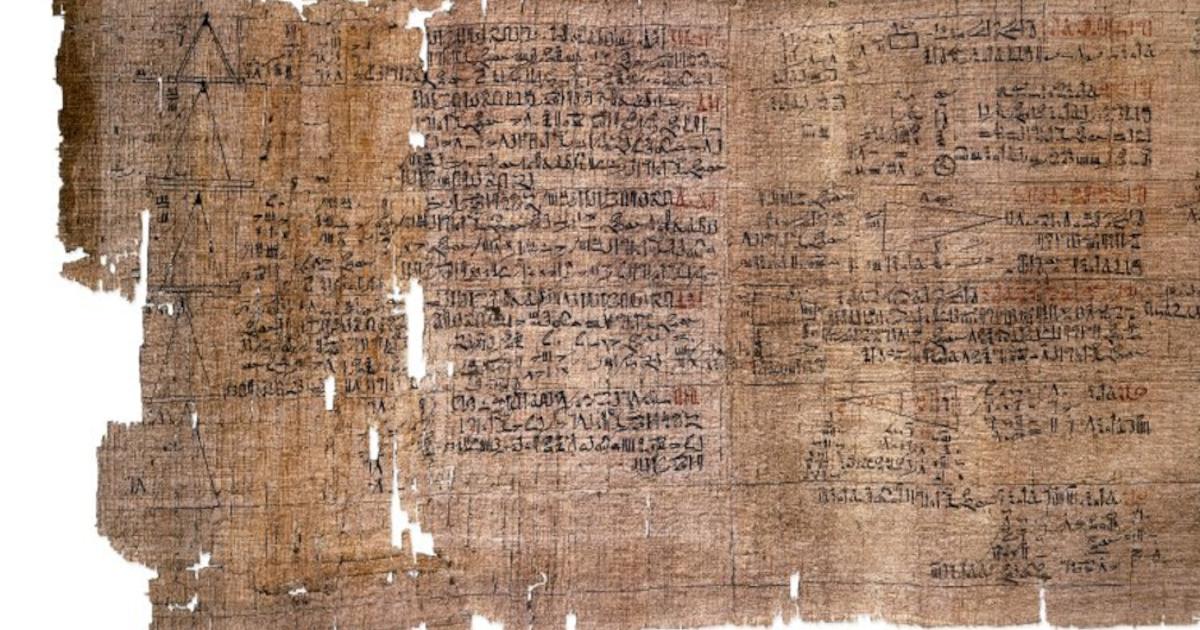
A redrawn triangle from the Rhind Mathematical Papyrus, showing the familiar stock shape: a long base, a short height and the right angle tucked at the lower left (Public domain)
The third is a check on the answer, and here the papyri part company with a modern exam paper. Today's diagrams usually hide the solution; the ancient ones label everything, answer included. A reader could watch the method work, then apply the same steps to fresh numbers. Kelly suggests the texts function almost like proofs.
Shapes That Looked Right Rather Than Were Right
The scribes were not careful draughtsmen. Reed pens held little ink, papyrus fibers pulled against a straight line, and some strokes show several attempts at the same edge. Nobody used compasses, so circles came out lopsided. What mattered was the familiar look of a shape. Right triangles almost always appear with the right angle at the bottom left and a base longer than the height; one example with a base of 7 and a height of 9 was still drawn nearly twice as wide as it was tall.
Stock shapes also took up less space on an expensive page. Circles were trickier to manage. In P. Math they tend to be stretched vertically, while in other texts they run wider than they are tall. The solids vary most of all, from attempts at linear perspective to schematic drawings that show both circular ends of a cylinder at once — a view the eye could never see, but one that made the dimensions easier to read.

A seated scribe with a papyrus scroll across his lap, Louvre Museum, Paris. Scribes were the professionals who wrote out and worked through the practical mathematical texts of the ancient world. (Louvre Museum, CC BY 3.0)
When a Tidy Redrawing Erases the Evidence
Kelly's catalogue also exposes how much can be lost in editing. When scholars published a Vienna papyrus in 1932, they printed a neat, flat figure for a pyramid problem. The papyrus itself holds a rough drawing set at an angle, with a sense of depth. The tidy version erased a real choice made by the scribe, and possibly information along with it.
The drawings are also a direct line to how mathematical knowledge was passed on — closer to the moment of use than the medieval copies through which the work of Euclid and Archimedes reached us. Egypt's dry sands preserved everything from these school exercises to a 16-meter-long funerary papyrus found in a Saqqara casket. Kelly hopes his catalogue will help future scholars avoid repeating the standardizing mistakes of the past.
Top image: The Rhind Mathematical Papyrus, the best-known surviving mathematical text from ancient Egypt, a tradition that practical problem-solving texts in Roman Egypt grew out of. Source: Public domain
By Gary Manners
References
García, A. 2026. The "Doodles" of Greek Mathematicians: Scribes' Notebooks Reveal How They Calculated in Roman Egypt. Available at: https://www.labrujulaverde.com/en/2026/10/the-doodles-of-greek-mathematicians-scribes-notebooks-reveal-how-they-calculated-in-roman-egypt/
Greek Reporter. 2026. 2000-Year-Old Greek Papyri Reveal a Surprising Way Ancient People Solved Math Problems. Available at: https://greekreporter.com/2026/10/08/greek-papyri-surprising-way-ancient-people-math-problems/
Kelly, T. 2026. Diagrams in ancient Greek practical mathematics. Historia Mathematica, vol. 75. Available at: https://www.sciencedirect.com/science/article/pii/S0315086026000339
Radley, D. 2026. Roman Egypt's Scribes Used Diagrams to Guide and Check Math Problems. Archaeology Magazine. Available at: https://archaeologymag.com/2026/10/roman-egypts-scribes-used-diagrams-to-check-math-problems/